




This has been one of the most incredible years for new camera releases that I've ever seen – and not just in terms of groundbreaking, bleeding-edge camera tech.
We've seen plenty of that, of course, with the most advanced medium format camera ever made (the Hasselblad X2D II 100C), the fastest Leica ever made (the Leica SL3-S) and the first Nikon x Red cinema camera (the Nikon ZR).
But we've also seen incredible innovation, with multiple manufacturers breaking from the norm – like a medium format compact camera (the Fujifilm GFX100RF), the "if Apple made a camera" camera (the Sigma BF) and the world's first 8K 360 drone (the Antigravity A1).
However, at the opposite end of the spectrum, it really has been the year that affordable compact cameras came back with a vengeance, whether it's an upcycled compact from 2016 (the Canon Powershot Elph 360 / Ixus 285 HS A), a $30 viral keychain camera (the Kodak Charmera) or the latest plastic fantastic digicams (like the Yashica City 100).
The team and I have been lucky enough to test every camera that's been released this year – so what have been our personal favorites?
Hasselblad X2D II 100C

James Artaius, Editor in Chief
I've spent most of this year waxing lyrical about this camera, so I'm running shy of superlatives! Thankfully, the specs speak for themselves: 100MP resolution, 15.3 stops of dynamic range, 10 stops of in-body image stabilization, LiDAR autofocus with subject detection algorithms, end-to-end HDR workflow… and the best color science in the industry.
The Hasselblad X2D II 100C isn't just a technical marvel, though; it possesses that intangible factor that compels you to pick it up and take pictures with it. It's inspiring. It makes you want to go out and create. In the videogames industry, there's a term for titles that make you want to pick up the control pad for "one more go": those games are called 'sticky'. The exact same thing applies here; this camera just makes you want to take "one more picture".
It's an absolute home run and I've had some of the most enjoyable, satisfying photoshoots of the year using it. But Hasselblad hasn't just made the best stills camera on the market, it's made a truly breakthrough product. Not only has the X2D II been one of the hottest-selling cameras in the US, it's also topped the sales charts in Japan – something that never happens.
This really has been a landmark year for the brand. The X2D II has been named as a camera of the year by everyone from Petapixel to DPReview, and respected creators like Jamie Windsor have switched systems from Fujifilm GFX to Hasselblad because the hype is real. If you've never had the pleasure of using one, I highly recommend going out of your way to try the X2D II 100C.
Polaroid Flip

Kim Bunermann, Staff Writer
The Polaroid Flip is a magical mix of nostalgic design and modern tech – and it had me hooked from the moment I realized how effortlessly it blends the two.
The most striking feature is hard to miss: the bold, flip-up flash. It's a clear visual callback to classic Polaroid 600-series cameras, but this isn't just for show; it's one of the brightest flashes Polaroid has added in years. And the sonar autofocus – a feature we haven't seen in decades – makes shooting effortless and reliable, while the app connectivity adds a layer of modern convenience.
What makes the Flip my favorite camera of 2025 is how it bridges eras. It's affordable ($219.99 / £199.99 / AU$416), respects Polaroid's history and solves many of the frustrations that often come with instant photography.
I can trust it to nail focus and exposure, then dive into the app for more creative control – all without losing the magic. Playful, forgiving and full of character. And the best part? It's about moments, not megapixels!
Fujifilm GFX100RF

Hillary K Grigonis, US Editor
Capable cameras that still fit within the moniker "compact camera" were a key trend for 2025. I think the Fujifilm GFX100RF absolutely deserves to be among the top cameras of 2025 for fitting a medium format sensor into such a compact fixed-lens camera.
Medium format cameras tend to be big and expensive, but the GFX100RF is actually priced a bit under the GFX 100S II – and you don't need to buy a separate lens. Yes, the fixed focal length is more limited than the interchangeable lens camera, but the design is simply brilliant.
I took the GFX100RF on a trip to Los Angeles this year, and the camera was such a joy to use. The 102MP files did make my hard drive cry but, if there's a camera I got to try out that I really didn't want to send back this year, it was the GFX100RF.
I also have to give an honorable mention to the Fujifilm X-E5, not because it does anything that the X-T5 couldn't do, but because it embodies the idea that photographers don't have to skimp on quality or give up the interchangeable lens to get something that's travel-ready.
Canon EOS R6 Mark III

Mike Harris, How-To Editor
What a year for high-end enthusiast-grade full-frame cameras! It was a tough decision choosing between the Canon EOS R6 Mark III and the Sony A7 V, but ultimately the Canon won out in my mind. It’s quite simply the best camera in its class and is another step closer toward the professional titans.
In this age of high-resolution cameras, the Mark III’s resolution bump from the Canon EOS R6 Mark II's 24MP to 33MP might just be the sweet spot for photo-first hybrid bodies.
Add to that blistering 40fps RAW shooting, up to 8.5 stops of image stabilization, internal 7K 60p and open gate 7K 30p, and you’ve got yourself an absolute monster that’s knocking on the door of the Canon EOS R5 Mark II.
And if you find yourself bemoaning the (official) lack of dual-base ISO and the absent cooling system, you can pick up the Canon EOS C50, which is essentially a video-first version of the R6 Mark III. It’s not often I find myself saying this, but Canon – where the heck do we go from here?
Nikon Z5 II
Adam Waring, Guides Editor
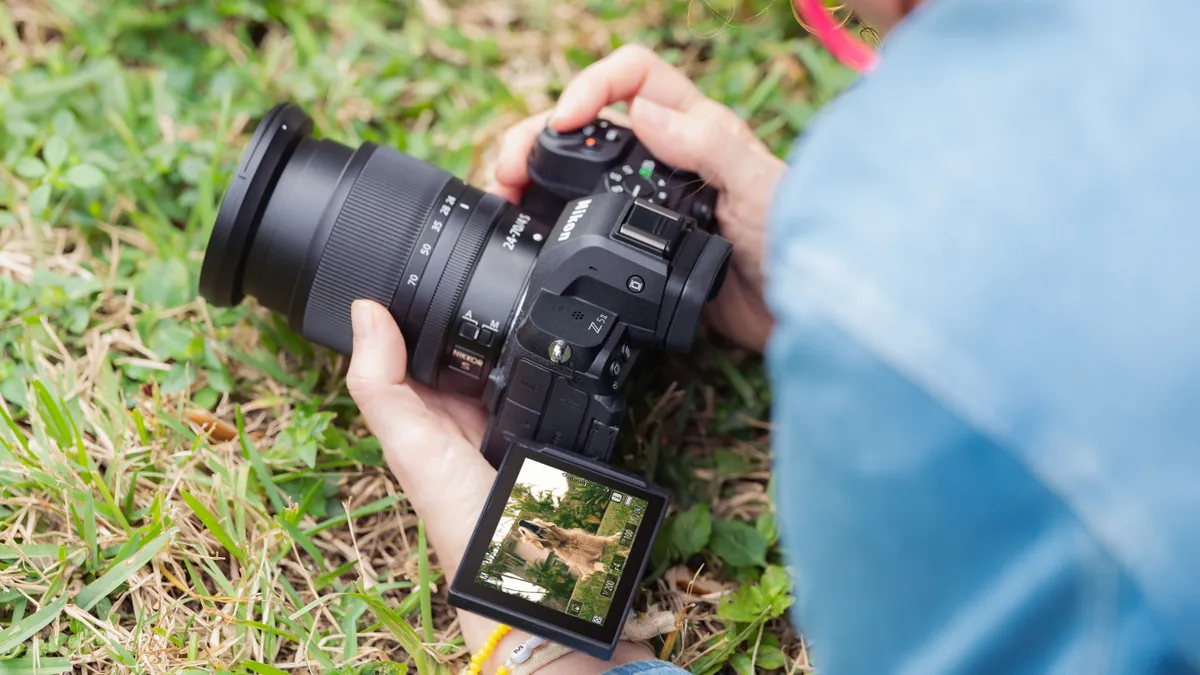
I’m a Nikon fanboy through and through, having previously been the editor of N-Photo magazine and knowing the Nikon ecosystem like the back of my old, grizzled hands, so for me the best camera of 2025 has to be a toss-up between the Nikon Z5 II and Nikon ZR.
The Z5 II is Nikon’s entry-level full-frame Z-series camera, replacing the aging Z5 that was launched in 2020. It’s not only fantastic value for a full-frame mirrorless camera, but it’s surprisingly highly specced, with a fast 11fps frame rate using its mechanical shutter (or a blistering 30fps JPEG / 15fps RAW with the electronic one), 4K 60p video, and all the autofocus and subject tracking finery that has trickled down from Nikon’s pro cameras higher up the range.
In fact, it’s so good that for the vast majority of photographers, it offers everything they could possibly want. Yes, the Z6 III is a little faster in the frame-rate stakes (14fps mechanical shutter, 20fps RAW electronic) and better for video (6K rather than 4K) thanks to its particularly stacked sensor. And yes, it has a 24.5Mp sensor, rather than the 45.7Mp of the Z8. But for everything else, it goes pretty much toe-to-toe with far more expensive cameras.
Then there’s the Nikon ZR. It’s essentially a Z6 III optimized for video, with the same partially stacked sensor capable of 6K video, no viewfinder but a much larger 4-inch rear monitor, and video-focused controls. Again. It offers fabulous value for money.
But for me, the Z5 II takes the crown as the best camera from the past year. It really does do everything that the vast majority of photographers could ever want, and at a price that most of us can afford.

Chris George, Content Director
For me, the camera of the year has to be a compact. Compact cameras came back with a vengeance in 2025, with mainstream manufacturers such as Canon and Fujifilm getting back into the point-and-shoot game with new models.
We also saw compacts at every single price point you could think of.
There were high-ticket big-sensor beasts that cost more than many mirrorless cameras such as the Fujifilm GFX100RF, the Leica Q3 Monochrom, and the Sony RX1R III.
And then there were the models that cost less than a meal out - such as the cute little Kodak Charmera, and the delightful Chuzao digital TLR camera.
But for me, a compact needs to be affordable, portable, and provide images that are decent quality. More controversially, I also think a compact camera must have a built-in zoom, and not a fixed focal length lens. So, for these reasons, my choice of camera of the year is the Canon PowerShot V1.
What appealed to me was that Canon hadn't simply re-introduced an old compact from its recent past. Instead, it had come up something completely new for a new type of user.
The V1 is unashamedly aimed at both photographers and videographers. Its 16-50mm wide zoom is optimized for vlogging – but you still get a respectable 1/1.4in 22 megapixel sensor for stills photos. And costing $849/£789, it is just the sort of model I'd happily carry in my pocket for times I don't want to carry my full full-frame system.
You might also like…
Take a look at the best mirrorless cameras on the market, see where the X2D II and GFX100RF rank among the best medium format cameras and see how the Flip compares to the best instant cameras.

