







Digital Camera World Verdict
The Sony A7 V delivers a big leap in autofocus intelligence, burst speed, video, and workflow flexibility over the prior generation. There are a couple of headline-grabbing improvements we haven’t yet seen debuted in other Sony cameras, but mostly, enough of all the good bits of Sony’s range are distilled into a more affordable jack-of-all-trades body. However, the competition in this segment of the market has become especially fierce since the A7 III burst onto the scene and changed the game, and despite the A7 V being the best yet in the series, it doesn’t best the competition in every department, with video being a key area where rivals are showing up Sony's omissions. But as a hybrid body for generalist photographers, the A7 V is another stellar entry into the A7 Series.
Reasons to buy
- +
Big AF upgrade with new AI processor and auto subject detection
- +
Blackout-free 30fps shooting
- +
Rolling shutter more tightly controlled
Reasons to avoid
- -
Video specs a little underwhelming versus the competition
- -
CFexpress Type A is still expensive and not as widely used as Type B cards
Why you can trust Digital Camera World Our expert reviewers spend hours testing and comparing products and services so you can choose the best for you. Find out how we test.
The A7 series has always been Sony’s dependable full-frame workhorse, the jack-of-all trades, and the camera most generalist photographers should probably buy, whether they shoot portraits, sports, landscapes, weddings, or video. The new A7 V doesn’t aim to change the purpose of this line; it’s still the everyman’s camera, but it represents the biggest generational shift this range has seen since the A7 III.
While the A7 V has many, many improvements that trickle down from other recent models, Sony has introduced a couple of firsts. There is the debut of a new partially stacked sensor, which improves readout times for faster burst speed and writing video. This is joined by a refreshed Bionz XR2 processor, which finally integrates the separate AI unit we have seen in most of Sony’s recent range into the processor itself, and enables an evolution in autofocus performance over the prior model.
It’s still very recognisably an A7-series body, but it's faster, more intelligent, and more refined than the A7 IV. However, since the A7 III came along and changed the mirrorless camera game forever, the competition has finally come to the party. The latest mid-range bodies from the big players, including the Canon EOS R6 Mark III, Nikon Z6 III, and Lumix S1 II, challenge Sony’s once-dominant position in this market segment. Does the A7 V do enough to stick its nose back out in front?

Specifications
Lens mount |
Sony E |
Resolution |
33MP |
Processor |
Bionz XR2 |
ISO |
100 – 51200 |
Autofocus |
759-point phase detect, 94% coverage, -4.0EV |
IBIS |
7.5 stops (centre), 6.5 stops (periphery) |
Continuous shooting |
30fps with AE/AF (E/S) for 185 JPEGS / 85 RAW |
Video |
4K60p 4:2:2 10-bit, 4K120p (Super35), |
Viewfinder |
0.5-inch, 3.68m-dot, 0.78x magnification, 60/120fps |
Screen |
3.2-in, 2095k-dot LCD |
Storage |
1x CFexpress Type A / SD UHS-II, 1x SD UHS II |
Battery |
NP-FZ100, rated for 630 shots (EVF), 750 shots (LCD) |
Dimensions |
130.3 x 96.4 x 82.4mm / 5 1/4 x 3 7/8 x 3 1/4 inches |
Weight |
695 g / 1 lb 8.6 oz (with battery and memory card) |
Price
Slipping further into professional territory, the A7 V is the most expensive main A7 series camera yet, launching for $2,899 / £2,799 / AU$4,699 for the body only, or $3,099 alongside a redesigned FE 28–70mm f/3.5–5.6 OSS lens (other territories TBC).
But compared to the competition, the Sony A7 V has its work cut out. It clocks in at around $100 more than the full price of the new Canon EOS R6 Mark III, or the Nikon Z6 III (which is actually heavily discounted at the time of writing), and is only slightly cheaper than the powerful Lumix S1 II.
All these cameras offer similar bang-for-your-buck to the A7 V, and in many cases, outperform it, especially when it comes to video. If you are already deep in the Sony ecosystem, then the A7 V is a no-brainer, but if you are looking to swap systems, or this is your first serious camera, there is a lot more to consider.
Design & Handling
If not for the camera name printed along the top plate, you might not spot the difference between the A7 V and the previous model. Sony hasn’t radically changed the design, which is completely fine. Sony cameras are some of the best-handling and looking cameras around, as the saying goes, if it ain’t broke, don’t fix it.

Tweaks include a slightly redesigned grip that is marginally deeper than the previous model, with more of a lip at the top. Though the camera is still very compact, I found the A7 V still feels comfortable and well-balanced in the hand, even with he huge array of Sony E-mount glass. However, I feel it could still use a little more support at the bottom for larger hands, as it leaves my little finger dangling.
The A7 V still has controls everywhere, including a button for almost every function you’d want during everyday shooting. Most can be remapped to taste, making the camera feel more personalised the longer you use it.

The EVF is identical to the one on the A7 IV. It’s a 0.5-inch, 3.68m-dot screen with a 0.78x magnification, and it is switchable between 60 and 120 fps, for power conservation or smoother subject tracking. It’s not class-leading, but it's a fine EVF that you won’t struggle to use. The LCD screen has received a more significant improvement, with a bump in size from 3 inches to 3.2 inches, and a long-overdue leap in resolution from a 1.03m-dot screen on the A7 IV to a 2.1m-dot screen on the A7 V.
Sony’s menus are well-designed and relatively easy to navigate through, although some newer users might find them slightly overwhelming due to the sheer number of options. Fortunately, Sony does have brief in-camera explanations for settings, should you be a little confused about what something does. But, I still had to Google a couple of times where a specific setting was, after my initial trawling through the menus had me pulling my hair out.
Thankfully, there is a simplified touch interface that is the fastest way to change key settings without diving through layers of menus, which is a huge timesaver.
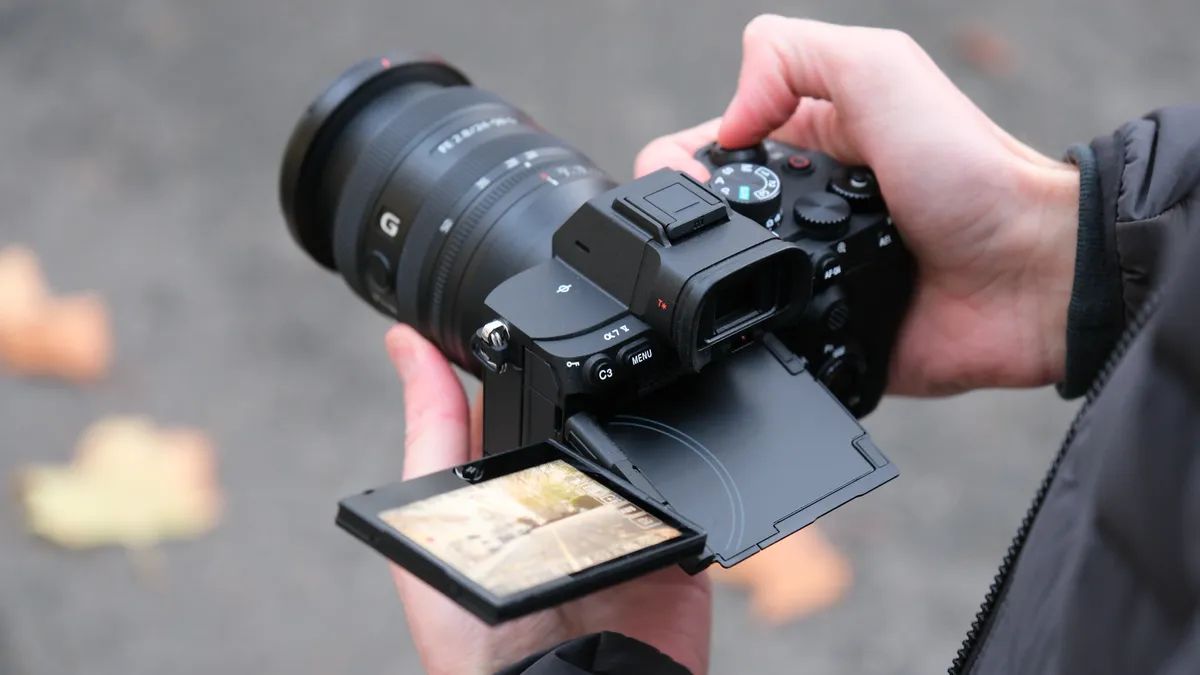
The A7 V has also inherited the 4-axis multi-angle screen we have seen on recent Sony models. It's a big upgrade over earlier A7 bodies, and with the added tilt, it makes low-angle photography easier and more subtle, as you no longer have to flip out and rotate the entire screen. It can also avoid the awkward cable congestion, with the additional axis providing enough space for the screen to clear any HDMI or USB-C cables connected to the camera during filming.
I am a little torn on the unmarked port doors. On one hand, it looks super clean and minimal, but the unmarked flaps can be confusing until you develop the muscle memory to know exactly what is underneath which. A few times, I opened the wrong flap in search of the USB-C ports. I don’t think subtle markings would ruin the overall aesthetic of the camera.
Underneath those ports, Sony has included a full-size HDMI for connecting to an external monitor, a headphone jack for monitoring sound, a mic jack with plug-in power, and a new addition that is slightly surprising – two USB-C ports – one for mains power and one for connecting accessories. Maybe Sony has feedback that says different, but for me, this feels a little bit unnecessary for this camera, as it doesn’t feel like a scenario that will trouble many users.
Finally, the two SD card slots from the previous model remain, with one doubling as CFexpress Type A. This is useful if you shoot a lot of high-bitrate video or long bursts, but Type A cards are still prohibitively expensive and not widely used outside of Sony cameras. Sony is, of course, going to support its own format, but CFexpress Type B is more affordable and would be more useful for any frequent system switchers.

Performance
Sony has decided to keep the resolution at a respectable 33MP, which does actually make it the highest resolution partially stacked sensor yet, albeit from a limited field. But I think 33MP remains a sweet spot between file size, detail, and overall usability, and if you really need more resolution, then the Sony A7R V has you covered.
When it comes to image quality, A7 V doesn’t bring any surprises here – it simply refines what Sony already did very well. This will be somewhat dependent on the lens you use, but combined with the excellent Sony FE 24-50mm f/2.8 G lens, my images were packed with plenty of detail, with a decent amount of scope for cropping, but I think you’d struggle to see any difference over the prior model.


Sony is promising 16 stops of dynamic range, which I will have to wait until I can edit my RAW files to see if that holds true, and there is a good amount of scope to push and pull shadows and highlights.
JPEGs/HEIFs are good, highs and lows are nicely balanced without looking overly processed. I shot in some of the harsh, low winter sun lighting conditions, but the JPEGs retained a surprising amount of detail in the highlights without brightening the shadows too aggressively. And shooting in 4:2:2 10-bit HEIF, I was especially impressed by the amount of detail I was able to salvage from underexposed images, and the scope to manipulate colors.
Noise performance has so far been strong throughout the 100-6,400 range, but noise becomes an unavoidable issue at higher ISOs. You can go up to 51,200, although I wouldn’t recommend these extreme values unless you really need that shot.

Sony is also claiming white balance will look more consistent thanks to AI-assisted AWB, and I have been impressed by the accuracy from the A7 V, and even in challenging light, it has avoided the slightly greenish cast Sony has been known for.
Colors are accurate and true to life, but don't have a signature look. Sony offers some control over JPEG images, with several different pre-programmed styles, including a few non-specific film emulations and black and white profiles, and you can also tweak your own. These are great for adding a quick bit of style to an otherwise mundane image, but these profiles don't have the flexibility of Fujifilm's recipes or Lumix's LUTs to really consider the A7 V JPEGs as being social-media-ready.

Autofocus on the A7 V is the biggest improvement Sony has made over the prior generation. The A7 V doesn’t see anything new here that hasn’t already debuted on other Sony models, but the new AI unit (now integrated into the main processor) brings the latest subject recognition across all subject types, not just human faces, but also to animals, birds, insects, and vehicles. There is also a whopping 759 PDAF points covering 94% of the sensor.
The A7 V also benefits from the latest auto subject recognition mode, which means you no longer have to pick the specific type of subject you’ll be shooting; the camera can recognize all subjects in one unified mode. Although you can still pick a specific subject type, should you wish to focus on a pet and not the owner, or a driver and not the car, for example.
In practice, I found autofocus lightning quick. It also just seems certain of what it’s doing; it's one of the most confident and accurate subject recognition focuses I have used. Tracking is just incredibly sticky and so easy to use; just tap on your subject on the touch screen, and the autofocus glues itself to them.


I am yet to really push this to the limits, but one of the big benefits of the partially stacked sensor is the A7 V’s blistering 30fps blackout-free shooting with autofocus and auto exposure, while the buffer can handle up to 185 JPEG or 85 RAW images when using CFexpress Type A cards. You also get pre-capture, which is programmable from 0.03-1 second before you press the shutter, and gives you a small safety net for moments that happen just before your reactions can catch up.
I have found battery life to be good. Official ratings of 630 shots with the EVF or 750 with the LCD do represent an improvement – and are much better than most mirrorless rivals. In practice, I wasn't quite getting those top numbers, but there was a noticeable improvement, and I would be confident shooting a full-day event like a wedding on just a couple of NP-FZ100 batteries.


When it comes to video, it's another big leap from the prior generation, adding 4K/120P, and the new partially stacked sensor improves readout speeds for less rolling shutter. But while video has improved, some limitations feel more noticeable given what other brands are offering.
Where rival brands are pushing 6, 7, or even 8K open-gate video, the video from the A7 V tops out at 4K. The 4K is oversampled from the 7K readout of the sensor, and video quality is absolutely excellent as I would expect from Sony. But missing out on open gate limits a creative tool that is becoming increasingly useful to video editors trying to edit for multiple platforms. While restricting the resolution limits in post-production cropping.
Using the full sensor, the A7 V can record in 4K up to 60p. 4K/120P, on the other hand, requires a more significant Super35 (roughly APS-C) crop. This is to be expected and does allow better control over rolling shutter speed, color dynamic range. The Canon EOS R6 Mark III is the only similar hybrid camera around this price point that offers full frame readout 4K/120p – but we are yet to see how that really performs.
The rolling shutter is very well controlled; testing on some high-speed trains, they remained firmly upright rather than skewed. This is not just a huge improvement on the last generation, but it embarrasses recent video cameras like the Sony FX2, and it's pretty lousy rolling shutter.


Unfortunately, Sony also continues to avoid RAW video. This is another Sony camera with no internal RAW, including industry standards like Apple ProRes, which again sets it behind similarly priced rivals – but you do get 4:2:2 10-bit footage in S-Log or S-Log2, which does give plenty of scope for changing colors and lighting in post production, but it makes it more challenging to use with footage shot using other systems.
For video stabilization, the A7 V has an improved 7.5 stops of in-body stabilisation in the centre and 6.5 stops on the peripheries. The A7 V is impressively stable for handheld video in subtle movements like pans, but IBIS alone won't counter heavier movements like walking.
However, the A7 V now benefits from improved digital stabilisation, with Active and Dynamic stabilization modes. These do add a slight crop to the footage, but I found they are really effective and make handheld footage look smoother than before. It isn't quite up to Lumix/OM level, but the A7 V remains one of the better stabilised full-frame cameras for general use.
Lab results
For our lab data comparison we're comparing the A7 V to its core full-frame mirrorless rivals from Canon, Nikon and Panasonic: the EOS R6 Mark III, Z6 III, and Lumix S5 IIX.
Resolution (line widths/picture height):

As we'd expect, the 33MP A7 V is able to resolve noticeably more fine detail than the ~24MP Nikon and Panasonic cameras. However, in our testing it couldn't quite match the detail levels from the EOS R6 III, despite the Canon camera having a marginally lower pixel count than the A7 V.
Dynamic range (EV):

Dynamic range is a measure of a camera's ability to record extreme brightness ranges and still retain detail in the brightest and darkest parts of the scene. It's measured in EV (exposure values, or 'stops').
At low ISOs the A7 V captures pretty much the same dynamic range as the Canon, Nikon and Panasonic cameras. But push past ISO 800 and the Sony is able to capture almost 1 stop more dynamic range than the EOS R6 III, performing broadly on par with the Nikon Z6 III.
Signal to noise ratio (decibels):

This test compares the amount of random noise generated by the camera at different ISO settings as a proportion of the actual image information (the 'signal'). Higher values are better and we expect to see the signal to ratio fall as the ISO is increased.
All four cameras are closely matched here, with the A7 V's noise levels being especially close to those from the EOS R6 III. However, at high sensitivities its the Nikon and Panasonic cameras that produce the cleanest images, likely due in part to their lower megapixel counts resulting in larger, more light-sensitive individual pixels.
Verdict
While the autofocus leap alone might have been enough to make this a compelling upgrade over the prior model, Sony has also improved the handling, stabilisation, burst speed, and with the new partially stacked sensor – video gets a big boost with 4K/120P and tighter rolling shutter.
It’s not flawless. Despite the video improvements, the video specs still feel a little held back compared to rivals, with no open gate, a max resolution of 4K, and limited codecs with no internal RAW. CFexpress Type A also remains a pricey investment to get the best out of the latest power features.
But the bottom line: the A7 V is faster and smarter than the A7 IV and a worthy upgrade. Although it is even further out of enthusiast and into professional territory, and for many photographers, this might be overkill, for serious enthusiasts, pros, and hybrid creators – this is the best Sony camera in some time.
Design ★★★★★ |
Secure and comfortable handling with an improved grip, controls galore, and the new 4-axis screen allows much more freedom and avoids cable clashes from the camera's ports. |
Photo Performance ★★★★★ |
Image quality is excellent, and Sony's autofocus is some of the best in the biz – now upgraded to automatically recognise and track even more subjects. |
Video Performance ★★★★☆ |
Lightning fast and sticky autofocus, rock solid active stabilization. Rolling shutter is vastly improved by the partially stacked sensor. But with no open gate, 4K60p still at a crop, and no RAW codecs, the A7 V is falling behind the increasingly tough competition. |
Value ★★★★☆ |
The most expensive A7 series camera yet does bring some worthwhile upgrades to justify the price increase, but there are lower priced bodies that compete with – and can outperform – the A7 V. |
Overall |
★★★★½ |

Alternatives


Also see our Sony A7 V vs A7 IV head-to-head comparison

