For each of the 12 days of Christmas, I’m revisiting a month’s worth of lenses that we covered on DCW. Today it's October 2025… check out the other 12 lenses of Christmas!
Time flies! This month marked the sixth birthday of the Nikon Z50, the company’s first DX (APS-C format) Z system camera. It took four years until the launch of the Nikon Z DX 24mm f/1.7, which at that point was Nikon’s one and only Z DX prime lens.
So yes, the range of Z DX primes effectively doubled with the advent of the Nikon Z DX MC 35mm f/1.7 ($449.95 / £399 / AU$699), which itself was a bit like two lenses in one.
Pictured above, and having roughly a 50mm ‘effective’ focal length in full-frame terms, it works perfectly as a standard prime for general shooting, while also delivering a 0.67x magnification ratio at its shortest focus distance – equivalent to a full 1.0x macro when you take the DX crop factor into account.
The other new Nikkor was maybe even more enticing. Going fully up-market, the Nikon Z DX 16-50mm f/2.8 VR ($899 / £799 / $1,299) launched as a high-grade, constant-aperture ‘trinity’ standard zoom. This lens has an effective zoom range of 24-75mm, complete with that all-important f/2.8 constant aperture design, aiming to deliver premium performance.

More top news for Nikon Z camera owners came in the shape of the Tamron 70-180mm f/2.8 Di III VC VXD G2, which was previously just for Sony E mount cameras but was now also available in Z mount.
This ‘alternative trinity’ telephoto lens is particularly compact and lightweight, making it great not only for Z FX (full-frame) cameras but also for Z DX cameras, on which it has an ‘effective’ zoom range of 105-270mm, still with that relatively fast and constant f/2.8 aperture.

Unlike the first edition of the Tamron (Sony only) as well as Nikon’s own 70-180mm zoom upon which it was based, the Tamron G2 adds optical image stabilization, redesigned optics, faster autofocus, custom controls and a lens function button, all for $1,149 / £999.
Tamron wasn’t done yet and also announced the brand new Tamron 25-200mm f/2.8-5.6 Di III VXD G2. Available only for Sony E-mount cameras, this supremely travel-friendly, all-in-one superzoom is full-frame compatible with a generous zoom range that stretches from wide-angle coverage to strong telephoto reach. It weighs just 575g / 20.3oz and launched at a budget-conscious $899 / £729.

New lenses for Nikon Z as well as Sony E mount cameras kept on coming from Viltrox. The pro-grade Viltrox AF 50mm f/1.4 Pro launched in both mount options, making a top-quality, not-so-standard prime available for the bargain price of $549 / £525.
The Viltrox AF 85mm f/2.0 Evo also surfaced as the first of a whole new series. A highly attractive lens for the budget-conscious, the Evo is designed to deliver impressive performance with high-end handling characteristics that included an aperture control ring and a customizable function button, at the wallet-friendly price of just $275 / £265.
There were also rumors that Viltrox was working on front-mounted wide-angle and telephoto conversion lenses…

Compact cameras with fixed lenses were all the rage in 2025 and the Fujifilm X100VI went viral, although it doesn’t have any optical zoom to speak of. That made Fujifilm’s new lens an enticing choice for photographers looking to build their own ‘compact’ camera system, as a travel companion with a small lens.
The Fujifilm XC 13-33mm f/3.5-6.3 OIS became the smallest and lightest zoom lens in Fujifilm's stable, and mounted on an X-T30 III body it results in a more lightweight kit than the X100VI. Even the price tag is pretty lightweight, at $399 / £329 / AU$649.

The Canon rumor mill went into overdrive with talk of the new the Canon EOS R6 Mark III and no less than four new Canon RF lenses, namely the RF 45mm f/1.2 STM, RF 20-50mm f/4 PZ, RF 24-70mm f/2.8L IS VCM and RF 300-600mm f/4-5.6L IS USM telephoto, all of which were said to be coming soon.
In other news, the company announced yet another milestone, with Canon having made 170 million RF and EF lenses, enough to stretch all the way around the world.

On the ‘artisan’ lens front, there was news of the 7Artisans AF 10mm f/2.8 ultra-wide-angle prime for APS-C format Fujifilm X, Sony E and Nikon Z cameras. It packs an expansive field of view, equivalent to a 15mm lens on a full-frame camera, into a small build, also launching with a small price tag of $199 in the USA.
There was also the comparatively feature-rich 7Artisans AF 35mm f/1.8, complete with aperture ring, AF/MF switch and customizable function button for full-frame Sony E, Nikon Z, and L-mount cameras, at the still very competitive price of $299 / £272 / AU$529.

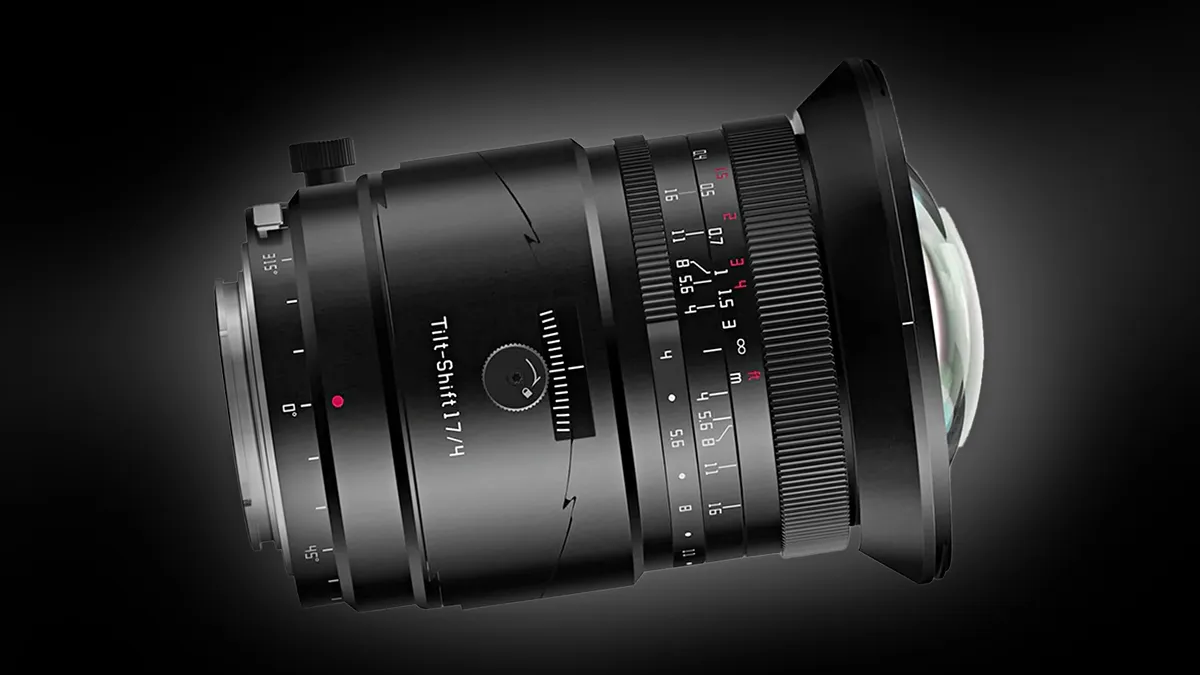
Not to be left out, the TTArtisan brand hit the news with the resurrection of an old Canon classic, in the shape of its new TTArtisan TS 17mm f/4 Asph tilt-shit lens. A complex bit of engineering, the lens went on sale at the surprisingly low price of $509 / £509, initially for Sony E and Fujifilm GF mount cameras, and with Nikon Z, Canon RF, and L-mount versions to follow.
In other bargain news, the Yongnuo 50mm F1.8S DA Lite for APS-C format Sony cameras came to the market at just $135 / £100 / AU$200.
Rounding off our Oktoberfest of lens news, there was Oppo and Hasselblad’s new Find X9 Series mobile phones that aimed to bring pro-grade optics to your pocket. There was even a new Hasselblad teleconverter as an optional extra, truly a teleconverter for a telephone!
And finally, the Blazar’s Beetle 1.33x anamorphic lens series brought ultra-compact cinematic widescreen in both landscape and portrait orientation, thanks to rotating barrels, priced at $599 /£459 each or $1,499 / £1,159 for the complete set of three. Keep those bargains coming!

October’s review schedule featured some instant classics, kicking off with the Sigma 20-200mm f/3.5-6.3 DG Contemporary, Sigma 135mm f/1.4 DG Art and Sigma 200mm f/2 DG OS Sports, the last of these facing direct competition from the Laowa 200mm f/2 AF FF.
There was also the Viltrox AF 50mm f/1.4 Pro and Viltrox AF 85mm f/2.0 Evo, plus the Laowa 180mm f/4.5 1.5X Ultra Macro APO.

You might also like...
Looking for more best-in-class glass? Take a look at the best Canon RF lenses, the best Nikon Z lenses, the best Sony lenses all for full-frame and APS-C bodies. For crop sensor cameras, check out the best Fujifilm lenses and the best Micro Four Thirds lenses. And for medium format, these are the best Fujifilm GF lenses and the best Hasselblad lenses.