





Sony has had a busy time in 2026, and the range of best Sony cameras is continually getting bigger and better. Whether you shoot sports, wildlife, travel, fashion, landscapes or whatever else, Sony will have a camera in its lineup that will do the job to an exemplary standard.
While this list does include the top-end professional Sony cameras like the sports-focused Sony A9 Mark III and the high-resolution Sony A7R VI, I've also made sure to include budget-friendly picks, both from Sony's APS-C range and older cameras from the full-frame A7 lineup.
Plus, there's also Sony's ZV roster of vlogging-focused cameras to consider – I love the super-compact and simplified designs of these cameras, and I've made sure to include a couple in the guide. Not every Sony camera is in here, but the ones that are, in my opinion, are the finest you can buy right now.

Gareth is the Reviews Editor at Digital Camera World. He has had hands-on time with all the cameras on this list, as well as years of experience as a photographer and videographer – perfect for picking the best Sony cameras.
The best Sony cameras
Why you can trust Digital Camera World Our expert reviewers spend hours testing and comparing products and services so you can choose the best for you. Find out how we test.
Best Sony camera overall


The Sony A7 V builds on the success of the A7 series with a meaningful generational leap in performance and versatility. At its core is a new partially stacked 33 MP full-frame sensor paired with Sony’s powerful BIONZ XR2 processor and integrated AI unit, which together deliver excellent image quality, faster read-out speeds, and a significant improvement in autofocus intelligence and subject recognition.
Autofocus is notably responsive and dependable across a wide range of subjects, thanks to expanded subject recognition and enhanced tracking algorithms, making this a strong choice for everyday shooters, wildlife, and action photographers alike. Performance is also boosted by blackout-free continuous shooting up to 30 fps with AF/AE and markedly reduced rolling shutter.
Video capabilities have also been upgraded, with oversampled 7K-to-4K video at 60p, plus high-frame-rate 4K 120p in a Super 35 crop, giving hybrid shooters considerable flexibility. In-body image stabilization is class-leading, rated up to 7.5 stops, and the redesigned articulating display improves usability for stills and video workflows alike.
That said, there are some compromises compared with Sony’s very top tier and the fiercest rivals: there’s no open-gate video mode, some advanced codecs like internal RAW are absent, and low-light autofocus sensitivity hasn’t changed dramatically relative to the A7 IV.
Overall, the A7 V represents Sony’s most capable “vanilla” full-frame camera to date – a true hybrid that marries fast performance, excellent stills, and strong video in one package – making it a compelling contender for the best all-purpose Sony camera in the current lineup.
Design ★★★★★ |
Secure, comfortable handling comes from the improved grip and plentiful physical controls, while the new 4-axis screen offers greater shooting flexibility and helps prevent cables clashing with the camera’s ports. |
Photo Performance ★★★★★ |
Image quality is excellent, and Sony’s autofocus remains among the best available, now enhanced with expanded subject recognition and tracking capabilities. |
Video Performance ★★★★☆ |
Autofocus performance is extremely fast and reliable, supported by highly effective active stabilization, while the partially stacked sensor significantly reduces rolling shutter. However, the lack of open-gate recording, a crop at 4K 60p, and the absence of RAW video codecs leave the A7 V trailing some of its increasingly capable competitors. |
Value ★★★★☆ |
As the most expensive model in the A7 series so far, it introduces several meaningful upgrades that help explain the higher price, but there are more affordable bodies that match — and in some areas exceed — the A7 V’s performance. |
Overall |
★★★★½ |
Read more: Sony A7 V review
Best Sony camera for resolution


The Sony A7R series have always been the resolution specialists of the A7 family – since the series' inception, if you wanted pixels, pixels and more pixels, this was where you'd go. However, since the A7R V or so they've expanded to be cameras that are good at pretty much everything else, too, with fast shooting speeds, sophisticated autofocus and a top-tier video spec.
So, the latest Sony A7R VI is the full-frame camera you can buy right now with the highest native resolution – a 66.8MP full-frame sensor. However, it also boasts a stacked sensor design that allows it to shoot blackout-free at 30fps with autofocus and auto exposure using the electronic shutter, in 14-bit RAW. It takes that already-excellent Sony autofocus and upgrades it with the latest subject recognition, including human pose estimation tech.
In case it's not already obvious, let me abundantly clear – this is a beast of a camera. I tested it myself, and it has taken everything I already loved about the A7R series and turbo-charged it. The level of detail from the 66.8MP sensor is a genuine first, providing unparalleled latitude for cropping into images. Autofocus, stabilization, first-class 8K video (though no open-gate, boo) – there's really nothing this camera cannot do.
And that's also its problem. Because, as you might expect, all that tech comes at a whopping price – you're looking at paying around $4,500 for an A7R VI, body-only, and if you're buying a high-resolution camera because you want to shoot great-looking landscapes, for instance, you're paying for a lot of features you don't need.
As such, I'll also throw in a recommendation for this camera's predecessor, the Sony A7R V. Its native resolution of 61MP isn't quite as high, but let's be real, that's still more than enough for basically any task you want to throw at it, and since the release of the successor camera, it has seen some quite tempting discounts.
Features ★★★★★ |
It might be the 'resolution specialist' but this camera has everything with 8K video, 30fps, and AI-powered autofocus |
Design ★★★★★ |
Usual great Sony body design, with a new deeper grip and illuminated buttons for night shooting. |
Performance ★★★★★ |
Stills, video, sports, it does it all. There's no open-gate video, but otherwise, this is a powerhouse. |
Value ★★★★☆ |
Very, very expensive, and for most people, more camera than is needed. |
Overall |
★★★★½ |
Read more: Sony A7R VI review
Best Sony camera for sports


To quote from our review, "I am nothing short of gobsmacked, blown away, bowled over, and wowed by the Sony A9 III". With the first-ever global shutter put in a consumer camera, it enables a top shutter speed of a mind-blowing 1/80,000 and up to 120 frames per second for RAW+JPEGS. Oh and the full 1/80,000-second global can also be used with flash!
The A9 III's blistering speed is matched by Sony's impressive AI autofocus performance, which can track more subjects than ever before as well as perform feats like human pose estimation, which knows what your subject is going to do before they do.
However, this camera is definitely only for those who need the very best in speeds, we are talking about the professional sports photographers of the world where every millisecond can mean missing the action or getting that back page shot.
If that is you, then what are you waiting for? But for everyone else, this camera is overkill to a huge degree, as most photographers will never need to tap into the speed this camera can accomplish. One of the major pitfalls of all that speed is backup, storage, and culling unwanted photos – it's a lot to manage!
However, if my most damning criticism is that the A9 III is too fast to keep up with, surely that's nothing but a mission accomplished for Sony! For professionals who need more than speed, however, the Sony A1 II edges ahead of the A9 III as an all-around hybrid model, as it throws in 8K video and 50MP stills, although features some slightly less sophisticated autofocus tracking.
Features ★★★★★ |
Global shutter with 120fps stills and 1/80,000 sec shutter speeds, although some will complain about the relatively small 24.1MP sensor |
Design ★★★★☆ |
A deep grip and custom function buttons will satisfy pros, although many will wish the vertical grip was built in |
Performance ★★★★★ |
Mind blowing speed makes this the best sports camera ever for the very top pros, although is overkill for anyone else |
Value ★★★★☆ |
Be prepared to pay for that global shutter, as this very pricey camera is considerably more than Canon or Nikon's best |
Overall |
★★★★½ |
Read more: Sony A9 III review
Best Sony camera for travel
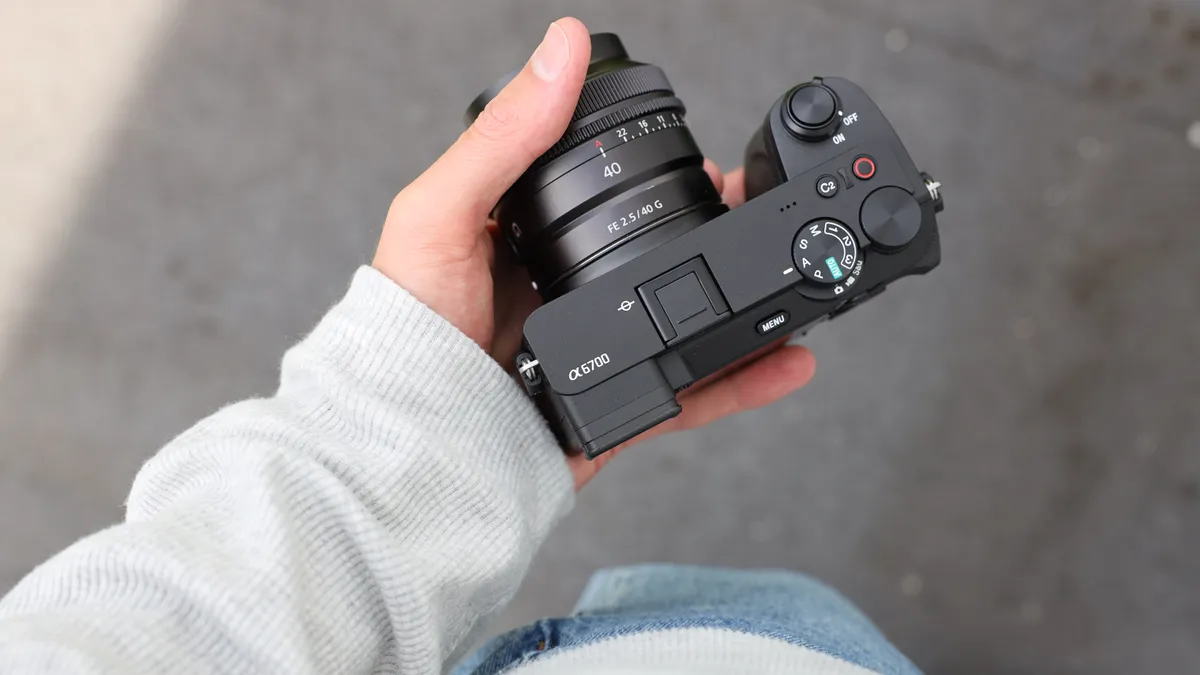


Sony's a6xxx range has long been one of the most popular lineups of cameras for hybrid shooters who love to travel, or keen social media and YouTube content creators. The concept for the camera is a simple and pocketable camera APS-C camera, that also hides some impressive specs. The Sony a6700 represents a logical progression from its predecessor the a6600, upgrading components like autofocus and IBIS to Sony's very latest.
The a6700 maintains the compact rangefinder-style APS-C camera design from prior models but incorporates some notable and welcome improvements in button layout, however, I still found the camera was still a little cramped and hard to hold with larger full-frame lenses. If you are happy to settle for Sony's smaller enthusiast lenses, then they are a much better balance for the a6700, although it can be a little confusing to tell the two format's lenses apart.
But for hybrid stills and video shooters seeking a compact camera, importantly – with a viewfinder, the a6700 stands out as my preferred choice among Sony's APS-C lineup, and a much better choice over Sony's confusingly similar ZV range of cameras.
The a6700 delivers an exceptional stills experience with an improved resolution, better tracking, and faster speeds. While its advancements in 4K video recording and integration of AI autofocus technology from Sony's more powerful and pricey cameras means the a6700 is a little more powerful than its compact size might allude to.
The a6700 does have a higher starting price compared to the previous generation, and it is relatively more expensive than some competitors, which have done a lot to close the gap in recent releases. However, the a6700 offers a lot for the money and emerges as one of the top choices for travel photographers and content creators who prioritize professional features within a compact form factor.
Features ★★★★★ |
The latest Sony AI-AF, IBIS, and oversampled video are squeezed into Sony's best compact and travelable APS-C camera |
Design ★★★★☆ |
While it plays well with small APS-C lenses, the small body is hard to use with bigger Sony optics |
Performance ★★★★★ |
Image and video quality is excellent, with autofocus and IS taking a big jump from prior models. and the smaller sensor crop benefits distance shooting |
Value ★★★★★ |
A lot of camera tech for fantastic value, although other brands have equally compelling options |
Overall |
★★★★½ |
Read more: Sony a6700 review
Best Sony camera on a budget


You might have spotted the next generation of the A7 III (A7 IV) at the top of this list, and while that camera is just about every aspect of the A7 III refined and tuned up with Sony's latest tech, Sony made the A7 III so good that it is refusing to go away. And planned or not, this has certainly worked in Sony's favor as it has perhaps unintentionally got the best value full-frame camera on its hands.
Headline features include a highly effective 696-point AF system, eye autofocus, and 4K video with a 5-axis image stabilization system that promises 5EV of compensation. There’s a 24.2MP back-illuminated image sensor, coupled with the latest generation of the image processor, and the two deliver excellent tonal range and make super-high ISO settings possible. All this might seem pedestrian today, but it was sit-up-and-take-notice stuff in 2019 when the camera was released.
Handling is good, though some may find the body a little small when paired with pro lenses, although this does apply across the Alpha range. There are so many lenses to choose from though, with Sony's own range being extensive, but its willingness to open its mount means there are incredible third-party options too.
It might not have the blinding speed of Sony’s top-flight A9 cameras or the ultra-high-resolution of the A7R V, but the Sony A7 III still manages to offer a compelling alternative to these pricier models delivering instead sheer value for money. For the top performance at a sensible price, I think it’s not only the best-priced Sony camera out there – but the best value full-frame camera full stop!
Read more: Sony A7 III review
Features ★★★★★ |
It might be an older model, but still has the mod-cons like eye detection, IBIS, and 4K video |
Design ★★★★★ |
Fantastic hybrid handling, small enough to travel yet big enough for pro work. Menus are a bit of a nightmare |
Performance ★★★★★ |
Newer Sony cameras do things much better, but the A7 III has great 4K vids, and 24MP is still respectable |
Value ★★★★★ |
A perfect way to get into full frame photography with a lot of killer features for incredible value |
Overall |
★★★★★ |
The best Sony camera for video


The ZV-E1 is an excellent vlogging camera, it is small, compact, and lightweight while packing in some incredible features like an image-stabilized full-frame sensor, and subject recognition and auto tracking straight out of the Sony A7R V. The camera is also simple and intuitive to use, so is perfect for anyone wanting professional looking footage without knowing a huge amount about cameras.
The video footage is excellent, sharp, clear, and with good color direct from the camera, so can be thrown up on social media right away. The latest autofocus tracking is just beyond good as well, especially for human subjects, it is incredibly fast and accurate, with its AI powers meaning you don’t have to worry about focus and can think about other aspects of filming. The real benefit of the ZV range is their built-in stereo microphones which offer audio that is far beyond the microphones in other hybrid cameras and rivals some of the best on-camera external microphones.
The ZV's downfall is its stills, although that isn't really the intended purpose of the ZV-E1 anyway. While still are the usual great quality expected from Sony, they are limited by the 12MP sensor. This is fine for uploading to social media for small screens, but the ability to crop into images or blow up to large sizes becomes limited.
The ZV-E1 is also tricky to use with larger Sony pro lenses, which with its full-frame sensor and skew towards serious content creators I would say these big G-Master lenses are the preferred lenses to use. The body is very compact, but this quickly becomes very front-heavy with any attached lens and is not easy to handhold, however the compact form pairs nicely with gimbals and rigs.
Features ★★★★☆ |
4K video, AI AF-tracking and built-in stereo audio make this a video powerhouse, but its 12MP stills take a hit |
Design ★★★★☆ |
The small body works great with gimbals and rigs, but it's not the easiest to use handheld with big lenses |
Performance ★★★★☆ |
Excellent video chops, the audio and AI-AF are both stand outs. Image quality is good, but very limited by the megapixel count |
Value ★★★★☆ |
More affordable than Sony's Alpha or FX range, but more rounded hybrid cameras can be had more the same price |
Overall |
★★★★☆ |
Read more: Sony ZV-E1 review
Best Sony camera for vlogging


The Sony ZV-E10 II is first-and-foremost a vlogging and content creation camera aimed at video. A big upgrade from the first version, it improves on every criticism of Sony's menus and video from the first model, now with next to no crop on footage and easy-to-use touch menus.
It packs a large and well-performing internal microphone (with clip-on muffler) and offers some very good 4K video. For serious video makers, you won't find any complex oversampling or multiple codec recording options here. This camera is for anyone who is taking their video a little more seriously than recording on a phone but isn't quite ready or willing to jump into a more professional level of videography.
The ZV-E10 II is not going to be a first-choice photography camera, as it lacks the EVF that photographers would expect, however, with the same sensor and processor as the Sony a6700, its specs are decent enough. If you are looking for something more hybrid, then cheaper cameras in the Sony A6xxx series (a6000 or a6400) are a better, although aging, option.
The ZV-E10 fits in an APS-C sensor, which means it is able to make use of Sony's extensive range of E-mount lenses. However, due to its very compact body, the camera does not balance well with larger Sony lenses, but Sony has a good range of quality smaller optics, as well as a huge number of third-party lens options. The body also features an articulating touchscreen which is vital for vlogging from low or awkward angles.
The ZV-E10 II has a very appealing price tag, it's a shame that there is no in-body image stabilization, but for a very specific audience looking for the perfect balance between affordability and features, this camera hits the nail on the head.
Features ★★★★★ |
An APS-C sensor pairs with Sony's huge range of lens choices, backed up with an in-built stereo mic and 4K video |
Design ★★★★☆ |
Small and compact design is great for vlogging, so long as your don't pair it with too big lenses |
Performance ★★★★★ |
Video performance is great, but lack of IBIS and older autofocus lets it down |
Value ★★★★★ |
Very reasonably priced, although good value, does reveal the cameras limitations |
Overall |
★★★★½ |
Read more: Sony ZV-E10 II review
Best full frame Sony camera for size


The Sony A7C II is an incremental upgrade over the original version, although it packs in some very welcome big improvements to autofocus and a bump in resolution to 33MP that keep it fresh. I am not sure if it is a worthwhile upgrade for anyone who owns the Mark I version of the A7C, but for newcomers, the camera still is one of the best options for photographers and video makers looking for the smallest and most compact camera, while still getting pro-level features.
Separating itself from its very similar ZV companions, the A7C II still keeps the rangefinder-style EVF, even if it isn't the strongest EVF I have used. For photos the camera is outstanding, it shares the same sensor and tech as the other most recent cameras in the Sony Alpha series, so has the latest in AI autofocus recognition and tracking for people, animals, and other subjects. The A7C II also benefits from much improved in-body image stabilization.
Sony continues to offer up all its cameras now as hybrid models, and the A7C II has some serious video specs. I seriously considered naming this as the best Sony video camera over the ZV-E1, but that camera's built-in mic and more video-centric body won. But that should show how serious a camera this is for hybrid creators who care just as much about video.
The only real disappointment with the camera is its fairly terrible ergonomics. Despite Sony at least attempting to make some improvements in this area, it is still a difficult camera to handhold with larger Sony lenses, which the inclusion of a full-frame sensor suggests it is designed for. I tested the camera with big Sony G-Master glass and it was very uncomfortable. You can of course use smaller lenses, but I feel that kind of defeats the purpose of this camera using a full-frame sensor, and you should look more closely at the Sony a6700.
Features ★★★★★ |
A bigger 33MP sensor, oversampled 4K video, IBIS and the latest AI autofocus makes this a compact powerhouse |
Design ★★★☆☆ |
Very compact, but the full-frame sensor is begging to be used with big lenses which is an ergonomically poor experience |
Performance ★★★★★ |
Excellent performance in photo and video, Sony's autofocus is the star of the show |
Value ★★★★★ |
Priced below the rest of the A7 range, this is Sony's latest tech at the best value |
Overall |
★★★★☆ |
Read more: Sony A7C II review
Best Sony compact camera


This tiny compact dates back to 2021, but it's long been a popular model of Sony's, and I think it's still the best Sony-branded travel compact you can buy. The Sony RX100 VII is a tiny camera, packing a high-quality 1-inch sensor and pairing it with a sharp, Zeiss-branded 24-200mm lens that provides you with a usefully broad zoom range for tackling various subjects.
The RX100 VII is a solid all-rounder – it pre-dates the boom in AI-powered subject-recognition autofocus, but its autofocus system is still very impressive, with fast tracking and reliable Eye AF that works with humans and animals alike. Its continuous shooting rates are formidable, with 20fps standard and up to 90fps (!) in Short Burst mode, and it also features image stabilization for stills and video.
In terms of image quality, the RX100 VII generally impresses, with our reviewer only being disappointed by some slight image softness at the outer edge of the zoom range. Color rendition is natural and neutral, and image detail holds up well even as you push up the ISO sensitivity, making the RX100 VII a capable option for low-light shooting.
Unfortunately, even in the eight years since the RX100 VII's release, we still haven't seen much of a price reduction – you're going to be paying four figures for the camera new. It's a fully featured travel camera that can turn its hand to just about anything and produce great images in a multitude of situations – but there are many compelling alternative ways to spend $1,000+ on camera kit.
Features ★★★★☆ |
Very good image quality from the 1-inch sensor, even at higher ISOs, and the lens performs well until you hit the maximum zoom. |
Design ★★★★☆ |
Incredibly compact and lightweight, with a lovely pop-up electronic viewfinder – though some may find it too small. |
Performance ★★★★½ |
Astonishing performance for a camera of its size – arguably too much (does anyone truly need this little compact to shoot at 90fps?) |
Value ★★★½☆ |
The price hasn't really dropped since launch, and you're paying quite a lot for a fixed-lens camera. |
Overall |
★★★★☆ |
Read more: Sony RX100 VII review
Best Sony bridge camera


Confession: I thought Sony had all but given up on bridge cameras, with the Sony RX10 IV that debuted in 2017 looking like it might be the last in the line. But happily, it wasn't so! Renewed interest in fixed-lens compact cameras saw the 2026 arrival of the Sony RX10 V, an SLR-styled superzoom pairing a 1-inch sensor with a 24-600mm f/2.4-4 lens with Zeiss-Vario optics, ensuring excellent image quality across an enormous zoom range.
Having tested it out myself, I can confirm that the RX10 V is a delightful camera to use. Being able to traverse enormous optical distances with the twist of a zoom ring makes you feel wonderfully versatile as a photographer – and these distances can even be extended digitally via Sony's surprisingly credible Clear Image Zoom.
Thanks to a new processor, the Sony RX10 V features comfortably the best autofocus of any bridge camera on the market – incredibly fast, with absolutely excellent subject recognition. This makes it a particularly strong choice for wildlife, which has long been a strength of bridge cameras thanks to their long zoom lenses.
Weaknesses? As is so often the case, it's price – more than $2,200 is quite a lot to pay for a camera with a single lens, however versatile that lens might be. It's a lot more than Sony was charging for the Sony RX10 IV before it was discontinued. As much as I enjoyed using the Sony RX10 V, I don't think I would actually pay that much to lock myself into a single lens.
Still, not everyone thinks the way I do – and for those who like bridge cameras, I can confidently say that the Sony RX10 V isn't just the best Sony bridge camera – it's the best bridge camera you can buy right now, period.
Features ★★★★☆ |
An impressive raft of bridge camera features, turbo-charged by a new processor that improves autofocus performance and speed. |
Design ★★★★½ |
The RX10 V is a chunky bridge camera, but the redesigned controls, new joystick, AF-ON button, improved screen and upgraded EVF make it much nicer to use than the previous model. |
Performance ★★★★☆ |
Image quality is excellent right the way through the 24-600mm zoom range, with strong stabilization and good (but not perfect) AI subject recognition. |
Value ★★★★☆ |
A lot to like, but at a $600 increase over the previous model, you have to be quite committed to bridge cameras. |
Overall |
★★★★½ |
Read more: Sony RX10 V review
Comparisons and Lab Data
Sony camera lab test data
See the Signal-to-Noise ratio, Dynamic range, and Resolution for the eight cameras in the guide. Note the results shown are for the earlier RX10 IV, not the RX10 V.
| Timestamp (ISO) | Sony A7V () | Sony A7R VI () | Sony a9 III () | Sony A6700 () | Sony Alpha a7 III () | Sony ZV-E1 () | Sony ZV-E10 II () | Sony A7C II () | Sony RX100 VII () | Sony RX10 IV () |
|---|---|---|---|---|---|---|---|---|---|---|
| 1 | 30 | 45 | 30 | 28 | 28 | 18 | 28 | 30 | 26 | 24 |
| 2 | 30 | 45 | 30 | 28 | N/A | 18 | 28 | 30 | 26 | 24 |
| 3 | 30 | 45 | 30 | 28 | N/A | 18 | 28 | 30 | 26 | 24 |
| 4 | 30 | 45 | 28 | 28 | N/A | 18 | 28 | 30 | 24 | 24 |
| 5 | 30 | 45 | 28 | 28 | N/A | 18 | 28 | 30 | 24 | 22 |
| 6 | 30 | 45 | 28 | 28 | N/A | 18 | 26 | 30 | 22 | 22 |
| 7 | 30 | 44 | 28 | 26 | N/A | 18 | 24 | 30 | 20 | 20 |
| 8 | 30 | 41 | 26 | 24 | N/A | 18 | 22 | 28 | 18 | 18 |
| 9 | 28 | 38 | 24 | 22 | 26 | 18 | 20 | 26 | N/A | N/A |
| Timestamp (ISO) | Sony A7V () | Sony A7R VI () | Sony a9 III () | Sony A6700 () | Sony ZV-E1 () | Sony ZV-E10 II () | Sony A7C II () | Sony RX10 IV () |
|---|---|---|---|---|---|---|---|---|
| 1 | 12.52 | 12.38 | 12.39 | 12.36 | 12.54 | 12.49 | 12.21 | 11.39 |
| 2 | 12.52 | 12.37 | 12.15 | 12.36 | 12.37 | 12.5 | 12.62 | 11.39 |
| 3 | 12.3 | 12.37 | 12.36 | 12.36 | 12.37 | 12.49 | 12.51 | 11.06 |
| 4 | 12.53 | 12.36 | 12.37 | 12.29 | 12.28 | 12.13 | 12.52 | 10.45 |
| 5 | 12.52 | 11.85 | 12.08 | 12.17 | 12.37 | 11.44 | 12.45 | 9.44 |
| 6 | 11.6 | 10.71 | 11.19 | 10.53 | 12.27 | 10.53 | 11.88 | 8.54 |
| 7 | 10.56 | 9.85 | 10.06 | 9.55 | 11.98 | 9.66 | 10.9 | 7.29 |
| 8 | 9.68 | 9 | 9.11 | 8.78 | 10.96 | 8.83 | 10.02 | 6.27 |
| 9 | 8.75 | 8.21 | 8.39 | 8.11 | 9.97 | 8.09 | 9.26 | N/A |
| Timestamp (ISO) | Sony A7V () | Sony A7R VI () | Sony a9 III () | Sony A6700 () | Sony Alpha a7 III () | Sony ZV-E1 () | Sony ZV-E10 II () | Sony A7C II () | Sony RX10 IV () |
|---|---|---|---|---|---|---|---|---|---|
| 1 | 42.74 | 40.54 | 45.61 | 39.72 | 46.96 | 44.1 | 41.83 | 41.44 | 41.01 |
| 2 | 40.22 | 37.8 | 43.66 | 37.28 | 45.03 | 40.23 | 39.18 | 39.27 | 37.48 |
| 3 | 37.9 | 34.89 | 40.07 | 34.61 | 43.3 | 38.33 | 36.1 | 36.44 | 34.13 |
| 4 | 34.74 | 31.86 | 37.03 | 32.59 | 39.89 | 36.77 | 33.1 | 34.04 | 30.35 |
| 5 | 32.04 | 29.56 | 34.39 | 29.47 | 35.43 | 34.73 | 29.92 | 32.35 | 27.12 |
| 6 | 29.6 | 26.36 | 30.87 | 26.19 | 31.67 | 32.24 | 26.81 | 29.31 | 22.82 |
| 7 | 26.56 | 23.29 | 27.39 | 23.11 | 28.18 | 29.84 | 23.78 | 25.95 | 20.89 |
| 8 | 23.45 | 20.1 | 24.22 | 19.9 | 24.72 | 26.8 | 20.49 | 23.14 | 17.42 |
| 9 | 20.58 | 18.58 | 22.64 | 18.23 | 21.28 | 24.46 | 18.95 | 20.46 | N/A |

| Header Cell - Column 0 | Sony A7 V |
Sony A7R V |
Sony A9 III |
Sony a6700 |
Sony A7 III |
Sony ZV-E1 |
Sony ZV-E10 II |
Sony A7C II |
Sony RX1R III |
|---|---|---|---|---|---|---|---|---|---|
Launch Price |
$2,499 (body) |
$3,899 (body) |
$5,999 (body) |
$1,399 (body) |
$1,799 (body) |
$2,199 (body) |
$999 (body) |
$2,199 (body) |
$5,098 |
Sensor |
Full-frame |
Full-frame |
Full-frame |
APS-C |
Full-frame |
Full-frame |
APS-C |
Full-frame |
Full-frame |
Megapixels |
33MP |
61MP |
24.6MP |
26.1MP |
24.2MP |
12.1MP |
26MP |
33MP |
61MP |
Lens Mount |
Sony E-mount |
Sony E-mount |
Sony E-mount |
Sony E-mount |
Sony E-mount |
Sony E-mount |
Sony E-mount |
Sony E-mount |
Fixed 35mm f/2 |
IBIS |
Yes |
Yes |
Yes |
Yes |
Yes |
Yes |
No |
Yes |
No |
Screen |
3in vari-angle, 1.04m dots |
3.1-in vari-angle, 2.1m dots |
3.2-in vari-angle, 2.1m dots |
3-in vari-angle, 1.03m dots |
3-in vari-angle, 921k dots |
3-in vari-angle, 1.03m dots |
3-in vari-angle, 1.03m dots |
3-in vari-angle, 1.03m dots |
3-in fixed, 2.36m dots |
Viewfinder |
EVF, 3.69m dots |
EVF, 9.44m dots |
EVF, 9.44m dots |
EVF, 2.36m dots |
EVF, 2.36m dots |
EVF, 2.36m dots |
None |
OLED EVF, 2.36m dots, 0.7x |
None |
Max Burst Speed |
33fps |
10fps |
120fps |
11fps |
10fps |
5fps |
11fps |
10fps |
24fps |
Max Video Resolution |
4K30p, 4K60p (crop) |
8K24p |
4K120p |
4K120p |
4K30p |
4K30p |
4k60p |
4k60p |
4k30p |
How to choose the best Sony camera

First, you need to ask yourself what you are going to use your camera for.
If you are mostly interested in photography, then Sony's Alpha series is the way to go; these cameras are more specialized for higher-quality images in different situations. The Sony A7R V is a megapixel monster for massive images, the Sony A9 II is for serious sports shooters, and the Sony a6700 packs the best of Sony's tech into a travelable body. Sony's Alpha series is also compatible with the best Sony lenses to up your photography game even further.
If you want to shoot video to use on social media or to live stream on the internet, then Sony makes an excellent range of compact content creation cameras, my favorite here being the small Sony ZV-E10 II with the freedom of interchangeable lenses. If your video projects are more advanced, then you might need more options in terms of sensor size or video codecs. In that case, the ZV-E1 offers excellent video specs with built-in pro audio, or the A7R V can record 8K video footage for ultimate resolution.
If you want to produce very high-end video, then we have a separate guide for that. Check out our choices of the best camera for filmmaking for some top-end Sony video options.
What is the best Sony vlogging camera?
This depends on your budget. The cheapest entry-level vlogging camera from Sony is the ZV-1F, which is small and compact and shoots good 4K. If you want something a little more advanced, then the Sony ZV-1 II or Sony ZV-E10 II is the best in Sony's range. With its interchangeable lenses, it gives you more freedom to create.
Are Sony cameras better than Nikon and Canon?
Not necessarily – how good a camera is depends on how you use it. Sony cameras excel in various aspects including excellent subject recognition and tracking, solid image stabilization, as well as Sony's long pedigree in producing professional-level video. Switching to a Sony camera from another brand will not improve your photography without you also working on your technique. Whatever camera system you use, you can be sure with practice you can create equally exceptional images.
How we test Sony cameras
We test Sony cameras both in real-world shooting scenarios and in carefully controlled lab conditions. We test Sony cameras with their intended purpose in mind – for example, we test powerful sports cameras like the Sony A9 III with high-speed subjects, while we test Sony's ZV vlogging range with a focus on video quality over any stills prowess.
☑️ Over two thousand products tested and reviewed
📷 7 years of experience testing camera gear and accessories
👥 Team of knowledgeable and passionate reviewers who love photography
✖️ Reviews and guides are unbiased – and never influenced by brands
Our real-world testing assesses how Sony cameras perform in everyday shooting situations. This is based on our reviewer's own experiences using the camera, how the camera feels and works, any issues they encountered, and their subjective opinion on the camera performance separate from the lab results.
Our lab tests measure resolution, dynamic range, and signal-to-noise ratio. Resolution is measured using ISO resolution charts, dynamic range is measured using DxO Analyzer test equipment and DxO Analyzer is also used for noise analysis across the camera's ISO range.
The real-world experience and lab results are combined to inform exactly what we select for inclusion in our buying guides.
Find out more about how we test and review at Digital Camera World
Top deals on the best Sony cameras

