
The next Summer Olympics is still years away, with the Games taking place in Los Angeles in 2028. But camera manufacturers will most likely be busy trying to capitalize on this time to release their flagship sports cameras to show off what their state-of-the-art tech is capable of at the world’s largest sporting event.
So, with plenty of time between now and then, I thought we could have a bit of fun doing some crystal ball gazing and pondering what sort of new technology the likes of Canon and Sony could be cooking up with for their next-generation professional cameras that would replace the likes of the Canon EOS R1 and Sony A9 III.
Nikon users may not have to wait so long, as the camera rumors have insisted that the Nikon Z9 II will arrive in time for the 2026 Winter Olympics… but that might just be for the pros and ambassadors who are testing it on the sidelines prior to launch, as was the case with the Nikon Z9 at the Tokyo Olympics!
New sensor tech
The 2024 Summer Games saw many flagship models going after faster burst rates, AI features and the ability to pre-capture images. However, some of the blisteringly fast speeds are actually too quick for working professionals who know all too well that spraying and praying just leads to memory cards filling fast.
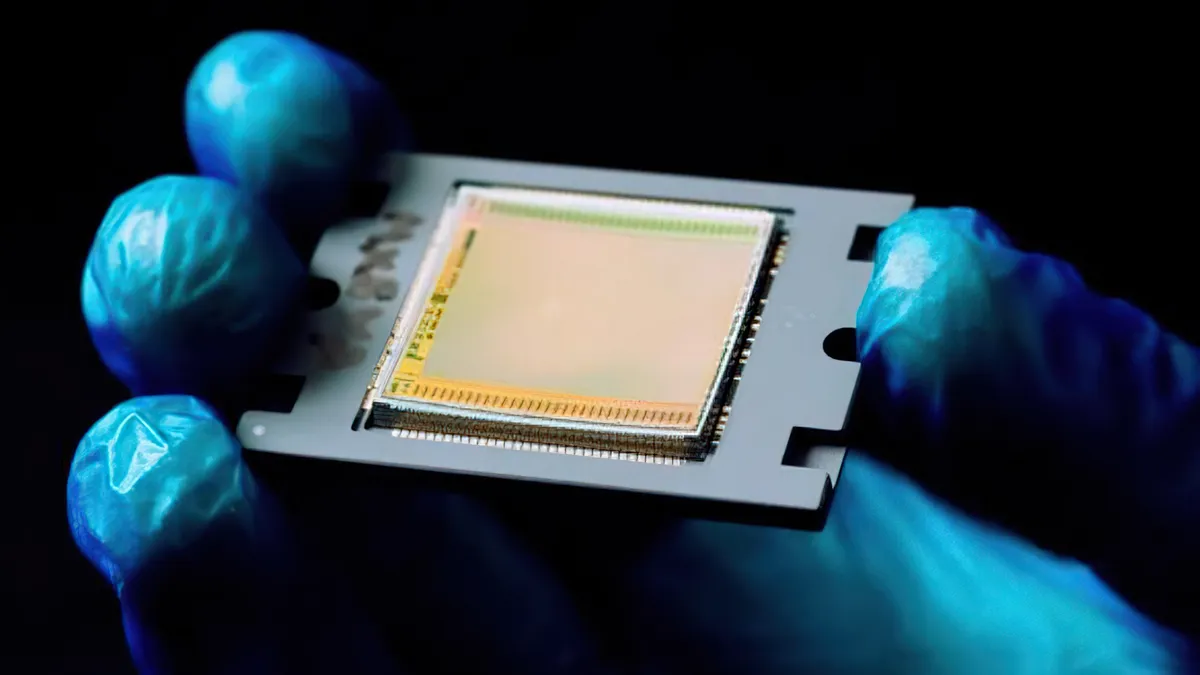
Instead, I think manufacturers will concentrate more on the sensor design rather than faster shooting. There’s no shortage of interesting new sensor technology in the works – and Sony has already blown us away with its global shutter in the A9 III.
We’re yet to see the likes of Canon or Nikon bring support such a sensor (in a sports camera, anyway – Canon has used the tech in cinema cameras like the EOS C700 family) but it would definitely be a mic-drop moment.
We’re likely to see more stacked sensor technology, which positions the wiring separately behind the sensor for faster readout speeds. There are also new lateral overflow integration capacitor (LOFIC) sensors on the horizon, promising a big advancement in dynamic range with a claimed 25 stops! By comparison, the Canon EOS R5 Mark II offers around 12 stops of dynamic range.
A truly revolutionary move would be to produce curved sensors to reduce the distortion of lenses. One day I would also like to see square sensors that make full use of the imaging circle from a lens, something that Apple did with the iPhone 17’s Center Stage front camera – but I think we’re still quite some way from this, if it ever happens for mirrorless cameras.
More AI!

Artificial Intelligence is the buzzword on everyone’s lips at the moment, so unsurprisingly I think we’ll see enhanced AI algorithms in the next generation of cameras.
We've seen most mirrorless cameras employ this for better subject detection and tracking, while cameras like the EOS R1 and R5 Mark II use AI to reduce noise and upscale images in-camera. Sony has even used algorithmic processing to improve white balance on the Sony A7 V.
But could we also get AI-powered image culling and the ability to automatically keyword our images? These would be very welcome time-saving additions.
I would also love to see more camera manufacturers including Content Credentials with their cameras. This is a great way to combat the tidal wave of AI-generated fake images, helping to authenticate your pictures from the instant you fire the shutter.
Next-generation screens
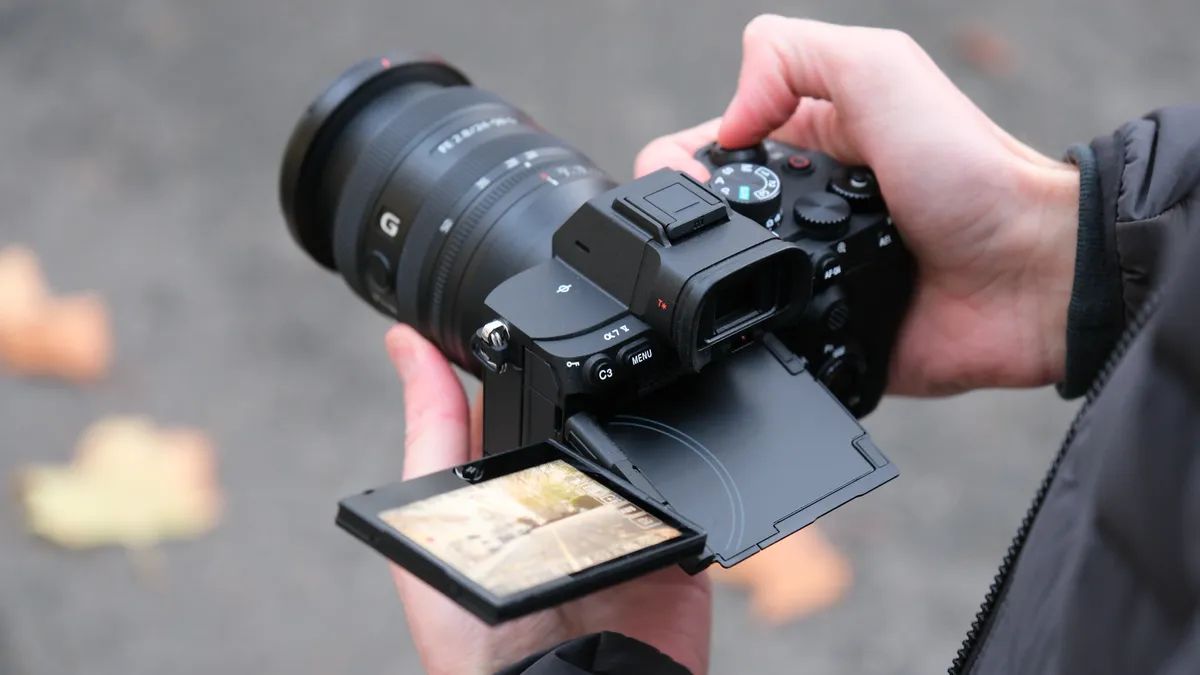
Sony and Fujifilm have already brought cameras to market with new three-axis screen designs, which make it more convenient to flip the LCD both up and down as well as to the side.
We are, however, still waiting for Canon and some of the other big names to bring out similar designs. I think they’ll need to adopt this popular mechanism for their next round of flagships if they want to go toe-to-toe with the competition.
We could also see higher-resolution LCD screens and viewfinders, along with enhanced refresh rates. With OLED screens becoming more affordable and mainstream, will we see this technology be adapted for camera screens for better contrast, inky blacks and less glare on the screen? I’d love to see it!
Video features

The latest professional cameras have become more ‘hybrid’ in recent years, so I fully expect them to be as capable for video as they are for stills. This means we’re likely to see higher resolutions such as 6K and 8K become the norm.
Open gate video has also become a popular feature for videographers looking to create content in multiple aspect ratios. Canon was the first of the "big three" to embrace the technology, in the Canon EOS R6 Mark III, after it was shepherded to the mirrorless arena by Panasonic and Fujifilm.
It will be interesting to see if this technology trickles up to the pro-tier cameras. If so, as is the case with high-resolution video, heat dissipation will be an even bigger issue to contend with. After all, no professional wants to be sat at the Olympics unable to take a photo because they're waiting for their camera to cool down!
Whatever the next wave of flagship cameras have in store, they're going to have their work cut out to top the existing generation. We'll be rooting for the camera brands just as much as the athletes!
You might also like…
Already own one of the current flagships? Take a look at the best lenses for the Canon EOS R1, along with the best lenses for the Nikon Z9 and the best lenses for the Sony A1.

