Digital Camera World Verdict
The Sirui Swift 40mm f/2.2 offers one of my favorite compromises in terms of focal length. Bridging the gap between more conventional 35mm and 50mm lenses, I really like the slightly wide but entirely natural perspective that this lens gives me on full-frame cameras. The ‘effective’ 60mm focal length on APS-C cameras, or in APS-C crop mode on a full-frame camera, can also come in useful. What’s more surprising is that the Sirui boasts impressive performance, weather-sealed build quality, and high-end handling extras, all at a rock-bottom price.
Reasons to buy
- +
Super-affordable
- +
Compact and lightweight
- +
Natural perspective
- +
Fn button and aperture ring
- +
Extensive weather seals
Reasons to avoid
- -
No aperture ring ‘A’ lock
- -
Lacks a de-click switch
- -
Only three mount options
Why you can trust Digital Camera World Our expert reviewers spend hours testing and comparing products and services so you can choose the best for you. Find out how we test.
I’m no stranger to Sirui. I remember when the company launched as a tripod manufacturer back in 2001, and I started reviewing their tripods and heads soon afterwards. Following in my own footsteps, I’ve actually just reviewed a Sirui photo/video ball head, gimbal head, and ‘versatile clamp’. Naturally, the camera lens that I’m reviewing here is something altogether different.
Although Sirui has its roots in tripod manufacturing, the company set about making quality anamorphic and cine lenses back in 2015. It later branched out into photographic lighting kits in 2022. Sirui camera lenses that are designed for hybrid stills and video capture are relatively new on the scene. A few months ago, I reviewed the full-frame compatible, fast, and relatively high-end Sirui Aurora 35mm f/1.4 and Sirui Aurora 85mm f/1.4. Both of these Aurora lenses are available in Sony E (FE), Nikon Z (FX), L-mount, and Fujifilm X versions, although Fujifilm X-system cameras are APS-C format.
The new Swift 40mm and its 20mm sibling are again full-frame compatible but are comparatively compact and very lightweight. Indeed, both lenses are virtually identical in terms of size, weight, and handling characteristics. They’re also very affordable, designed and built to be high-value, ‘entry-grade’ options for Sony E (FE), L-mount and Fujifilm X cameras. There are no Nikon Z versions on the cards so far, but the Sirui Swift 40mm nevertheless aims to be one of the best standard prime lenses and one of the best cheap lenses on the market for those looking for an inexpensive, bargain buy.
Sirui Swift 40mm f/2.2: Specifications
Mount options |
Sony E (FE), L-mount, Fujifilm X |
Full frame |
Yes |
Autofocus |
Yes |
Image stabilization |
No |
Lens construction |
11 elements in 8 groups |
Angle of view |
55.9 degrees |
Diaphragm blades |
9 |
Minimum aperture |
f/16 |
Minimum focus distance |
0.4m |
Maximum magnification |
0.14x |
Filter size |
58mm |
Dimensions |
70x62mm / 2.8x2.4in |
Weight |
210g / 7.4oz |
Sirui Swift 40mm f/2.2: Price
The Sirui is billed as a high-value, entry-grade lens and is priced accordingly, at just $149 / £129 / AU$242. By comparison, the Sigma 50mm f/2 DG DN | C ‘Contemporary’ lens available in Sony E and L-mount options is also designed as a relatively compact optic and features a similar dedicated aperture control ring, but is much pricier at $719 / £579 / AU$1,200. However, the Sigma is a relatively high-end lens with a metal build, right down to its metal hood and magnetic front cap.
More similarly priced to the Sirui are the full-frame compatible Viltrox AF 40mm f/2.5 Air in Sony E and Nikon Z mount options at $176 / £165 / AU$265, and the APS-C format Viltrox AF 35mm f/1.7 Air, which comes in Sony E, Nikon Z and Fujifilm X versions at $179 / £139 / AU$282. However, while these Viltrox ‘Air’ lenses are very compact and lightweight, they lack the AF/MF switch, aperture ring, and function button featured in the Sirui lens. On the face of it, the Sirui looks like standout value for money.
Sirui Swift 40mm f/2.2: Design & Handling
I feel that the design and handling of the Sirui 40mm make it an ideal lens for street photography. For me, it has an ideal focal length that bridges the gap between 35mm and 50mm lenses, offering a slightly wide view yet maintaining a very natural perspective. The design is also sufficiently small to enable candid shooting without drawing unwanted attention to myself, as well as being lightweight enough to carry around for hours on end without feeling any strain.
Playing the numbers game, it measures a mere 70x62mm / 2.8x2.4in, is a real featherweight at just 210g / 7.4oz, and has a relatively small 58mm filter attachment thread. In all these respects and more besides, it’s virtually identical to the ultra-wide-angle Sirui Swift 20mm f/2.4, but has an aperture rating that’s marginally faster.
Like the vast majority of other modern lenses for mirrorless cameras, the Sirui is an autofocus rather than manual-focus lens. Also like most others, it has an autofocus system that’s based on a linear stepping motor. This enables speedy autofocus for stills, as well as smooth and near-silent focus transitions when shooting video. Further good news for ‘hybrid’ photographers is that the lens is optimized for both stills and videography, with minimal focus breathing so that the perspective remains unchanged when altering the aperture.
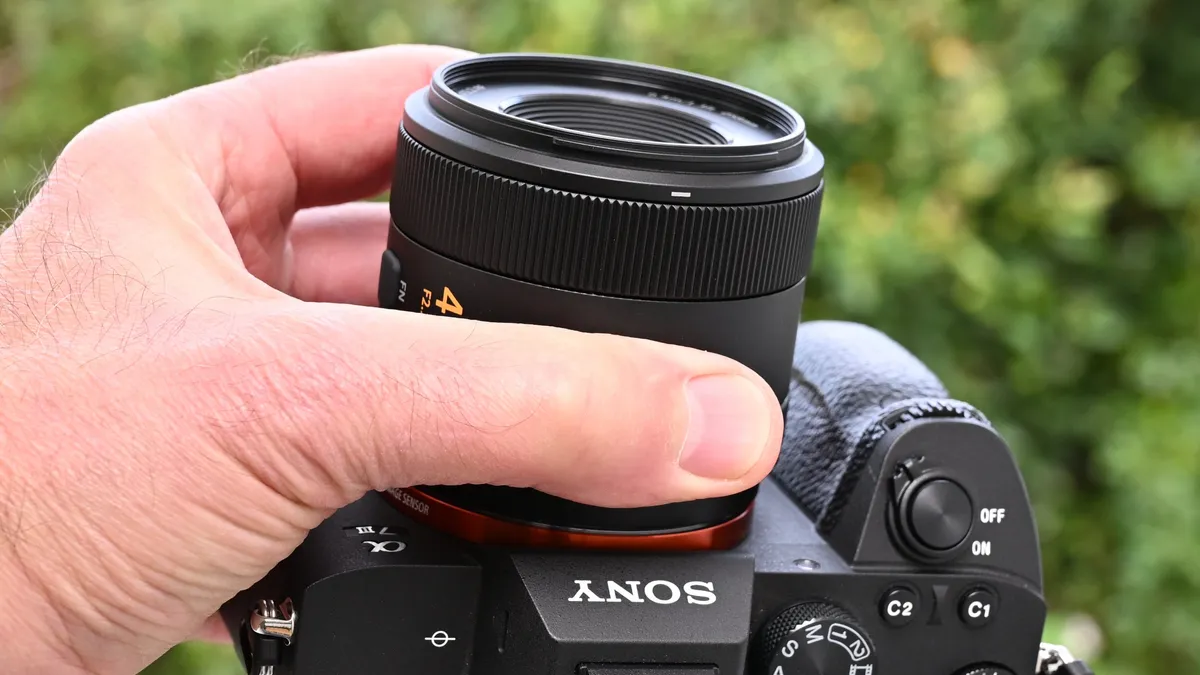
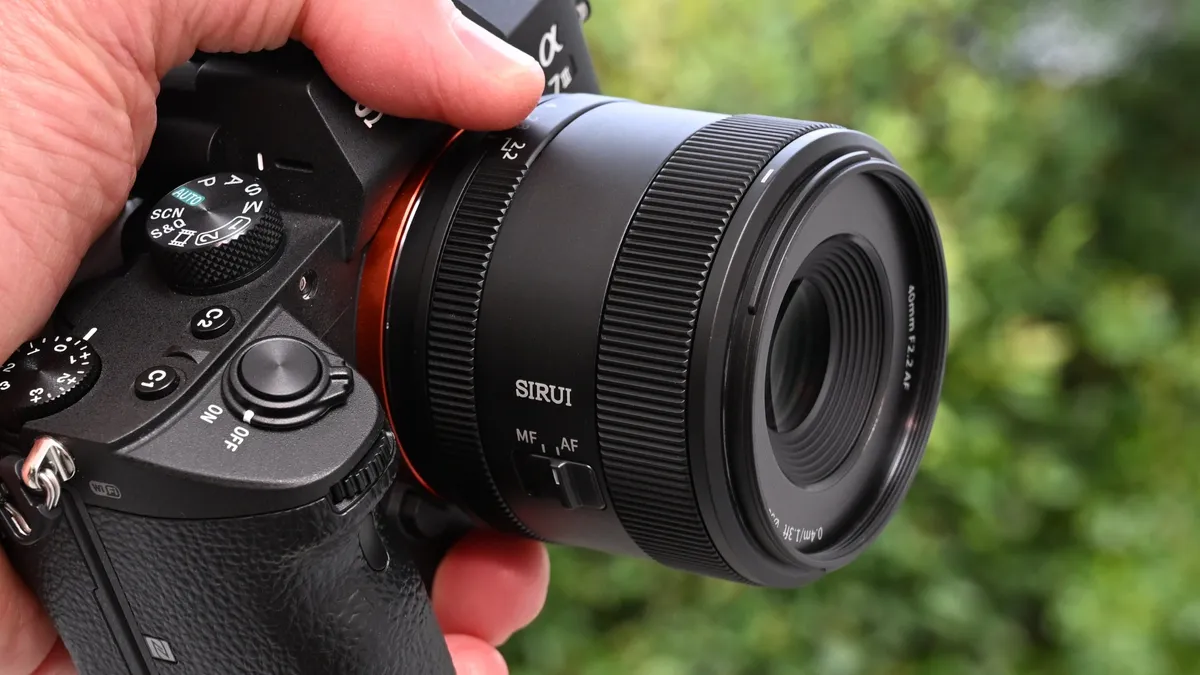
To enable quick and easy switching between autofocus and manual focus modes, the lens features an AF/MF switch. I always prefer this to hunting around in camera menus to make the change when time is of the essence. It works exactly as expected, although it’s unusually positioned on the right-hand side of the lens barrel, instead of on the left.
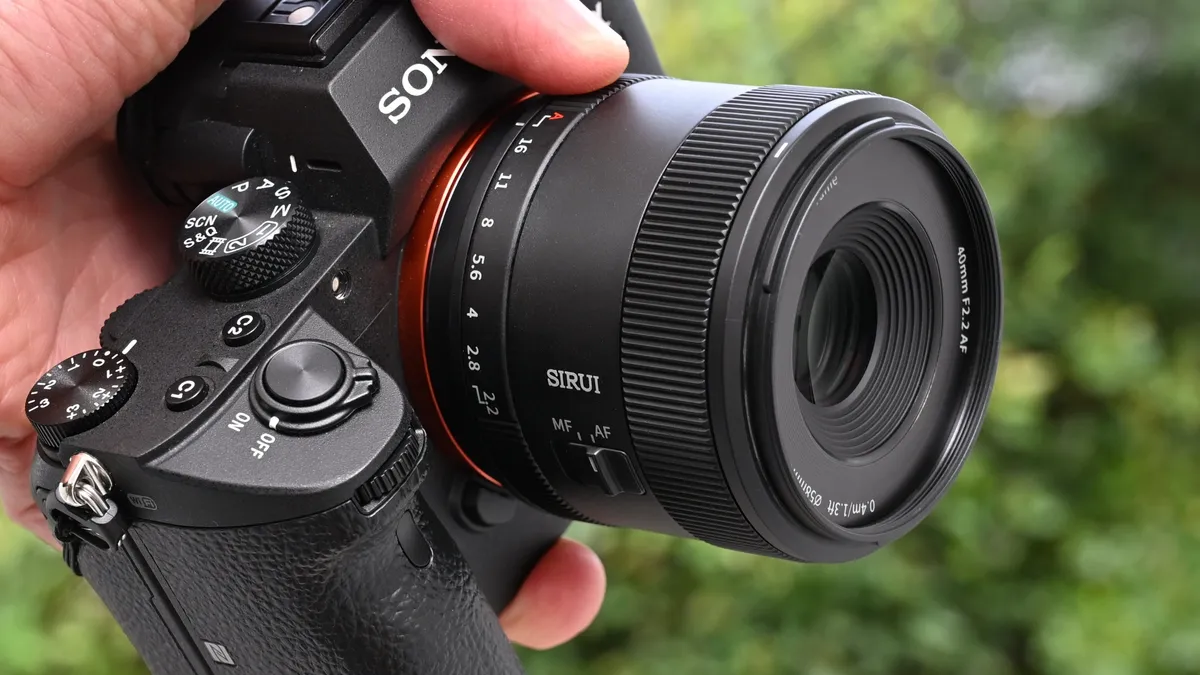
A bigger surprise, considering the very budget-friendly price of the Sirui, is that the lens features a couple of other handling extras that you’d normally only expect to find on more upmarket models. The first of these is a customizable function button. Depending on what’s available in your camera body, you can assign various functions to the button, but AF-hold is a favorite of many photographers. The button itself is positioned in a more conventional place than the AF/MF switch, on the left-hand side of the barrel.
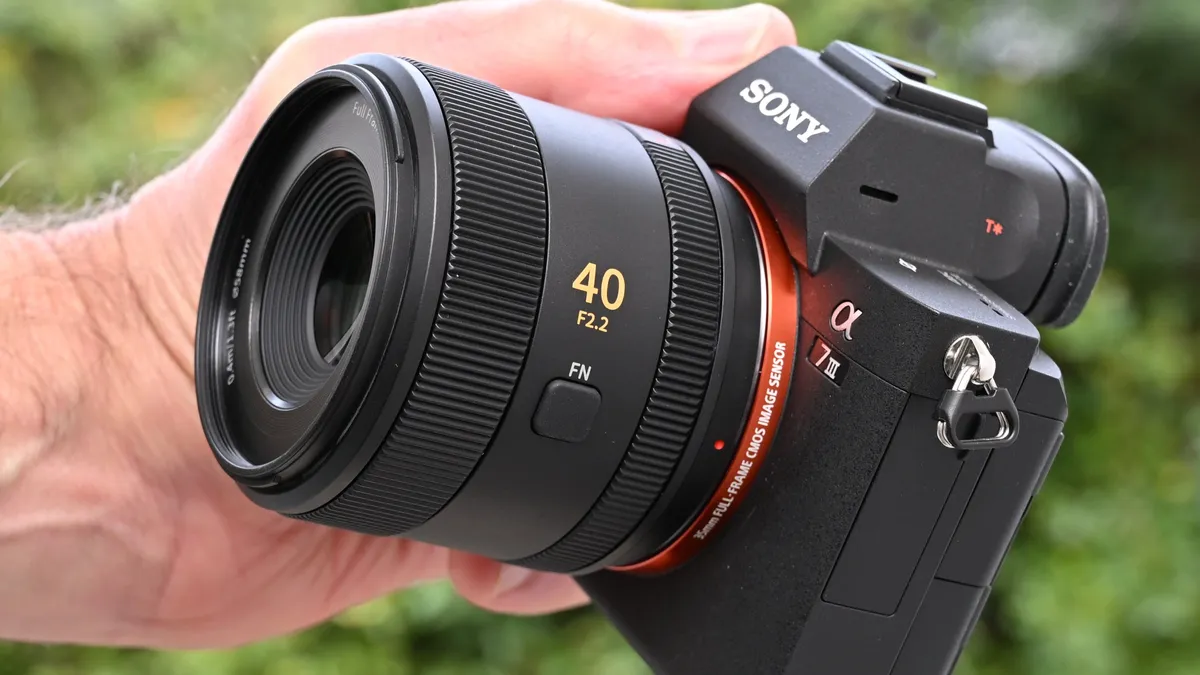
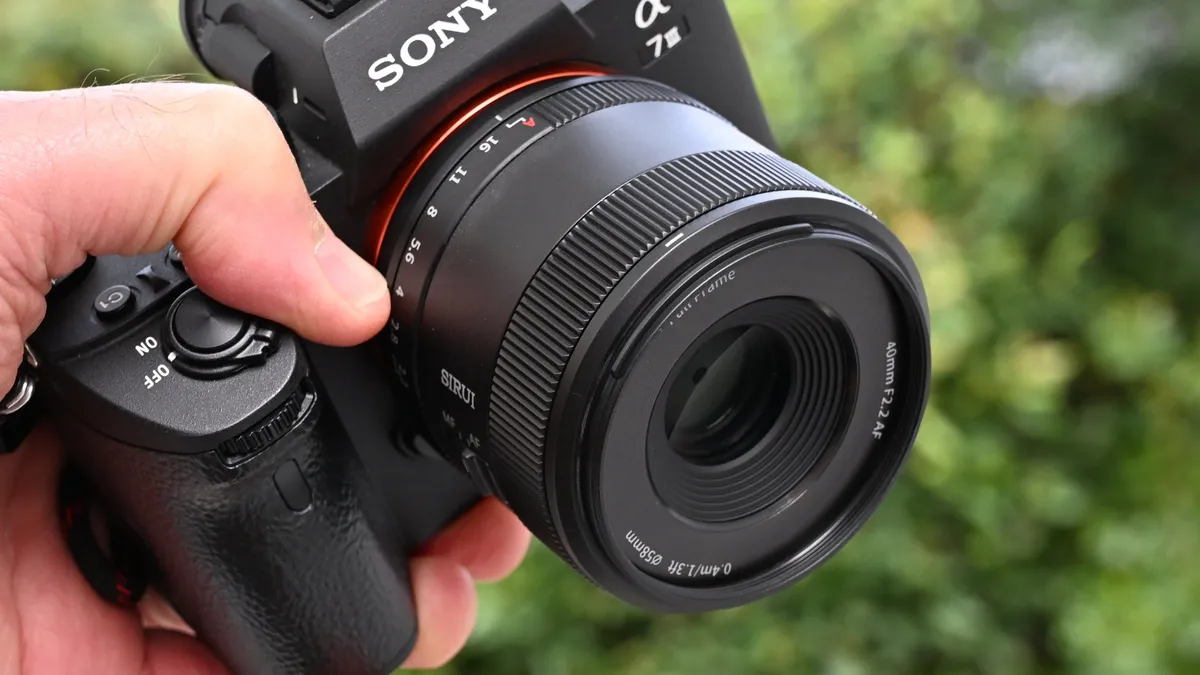
Building on the provision of the function button, the second unexpected handling extra in a lens at this price is its additional, dedicated aperture control ring. It enables you to set the aperture to any value in its f/2.2 to f/16 range, at one-third click step increments. There’s no de-click option for smooth, silent adjustments of the 9-blade aperture when using the control ring, but it does have the usual Auto position at the narrow end of the scale. This enables control of the aperture directly from the camera body, also ensuring compatibility with Program and Shutter-priority shooting modes.

The optical path of the lens is all-glass, so there are no plastic elements in its makeup. There are 11 elements in total, arranged in 8 groups, including one aspherical element and two ED (Extra-low Dispersion) elements. The front element is significantly recessed within the barrel, offering physical protection against knocks and scrapes as well as guarding against ghosting and flare. Even so, the lens is supplied complete with a bayonet-mount, petal-shaped hood.

The physical length of the hood is quite short, and it’s actually exactly the same hood that Sirui supplies with the lens’s companion Swift 20mm f/2.4 optic. That makes it arguably less effective on the 40mm lens, but even so, a plus side is that it adds very little to the overall length of the lens when fitted for duty.

As is usually the case these days, the lens is also supplied with a pinch-style front cap. This makes it easy to fit or remove the cap even when the hood is fitted in its forward-facing orientation.

Moving from the front of the lens to its rear, the mounting plate is made from metal rather than plastic. That’s often not the case with lenses that are designed to have a lightweight build. Better still, the metal mounting plate is fitted with a rubber weather-seal gasket, and that’s just one of several weather-seals that are fitted around all of the joints and switches in the construction. The mounting plate also plays host to a USB-C port, future-proofing the design by enabling the easy application of firmware updates. Back up at the front end, a fluorine coating is applied to the front element to repel moisture and grease.

All in all, the Sirui packs plentiful features for such a budget-friendly lens, and it’s not done yet. You also get a drawstring pouch for carrying the lens around, and the lens itself is backed by a 3-year warranty.

Sirui Swift 40mm f/2.2: Performance
I found that autofocus was swift and consistently accurate while testing the lens with a Sony A7 V camera body. I also found that there was plenty of sharpness on tap to satisfy the 33 megapixels of this camera’s image sensor. In real-world shooting scenarios, sharpness proved excellent in the central region of the image frame and held up well right out to the extreme edges and corners, especially when stopping down a little.

Color rendition is also very pleasing and natural, while the lens does a good job of suppressing unwanted aberrations, including color fringing, distortion, ghosting, and flare. As you’ll see in the ‘uncorrected’ image below, there's virtually no distortion, and color fringing is minimal, even around the dark tree branches against a bright sky, at both sides of the image frame.

Clarity and contrast are also good, and I found that the lens delivered nicely crisp images even when shooting indoors under dull ambient lighting. Again, the lens does well to retain high levels of sharpness, fine detail, and texture in these conditions.

Naturally, one of the attractions of a relatively ‘fast’ lens is that its wider apertures enable faster shutter speeds under low-light conditions, without having to bump up your camera’s ISO setting too far, as well as enabling a tight depth of field for isolating subjects within a scene. The Sirui does well on both counts and, for the latter, delivers a fairly smooth and natural-looking quality of bokeh. Bokeh remains attractive when stopping down a little, thanks to a well-rounded 9-blade aperture diaphragm.

Sirui Swift 40mm f/2.2: Sample Images
The example shots in the following gallery were taken in the English city of Wells, starting at the Bishop’s Palace and Gardens, then moving on to the neighboring Wells Cathedral. There’s a combination of autumnal outdoor shots and architectural interiors, taken at various aperture settings. I used a 33-megapixel Sony A7 V camera body throughout for testing the lens.


Sirui Swift 40mm f/2.2: Lab Results
We run a range of lab tests under controlled conditions, using the Imatest Master testing suite. Photos of test charts are taken across the range of apertures and zooms (where available), then analyzed for sharpness, distortion, and chromatic aberrations.
We use Imatest SFR (spatial frequency response) charts and analysis software to plot lens resolution at the center of the image frame, corners, and mid-point distances, across the range of aperture settings and, with zoom lenses, at four different focal lengths. The tests also measure distortion and color fringing (chromatic aberration).
Sharpness:

Sharpness is excellent in the central and mid-frame regions, and though it drops off a bit in the extreme corners, stop down to f/4 and the lens is sharp across the whole frame.
Fringing:

The Swift 40mm produces a little more fringing than its 20mm sibling, but it's still within acceptable limits.
Distortion: -0.19
There's a hint of barrel distortion, but this is as close to a zero-distortion lens as you'll find.
Sirui Swift 40mm f/2.2: Verdict
I feel that the Sirui Swift 40mm f/2.2 is ideal for street photography and everyday walkabout shooting. I’ve spent too much of my photographic life agonizing over whether a 35mm or 50mm lens is better in this sort of scenario, and really like the 40mm middle ground.
I also love the compact and ultra-lightweight build of the Sirui. It makes the lens very easy to live with and is a bonus for street photography, when I want to shoot candidly, without drawing attention to myself. And I like that the lens feels robust and features extensive weather seals, despite its featherweight construction, while also packing an AF/MF switch, a customizable function button and aperture control ring, even if the last of these can’t be ‘de-clicked’.
Naturally, being compact and lightweight is of little benefit if a lens’s performance isn’t up to muster. I found that the Sirui delivered fast and consistently accurate autofocus, along with very pleasing image quality in all respects, despite its rock-bottom selling price. All in all, it’s a very attractive and supremely affordable prime lens.
Features ★★★★½ |
The 40mm focal length and fairly fast f/2.2 aperture rating lead the way, but the lens adds an AF/MF switch, aperture control ring and customizable function button. |
Design ★★★★½ |
The compact and lightweight construction is ideal for street photography and walkabout shooting, with good build quality and an extensive set of weather seals. |
Performance ★★★★½ |
Autofocus is quick and consistently accurate, while image quality is very pleasing in all respects. |
Value ★★★★★ |
Considering its features, design, build quality and performance, this full-frame compatible lens is standout value for money at the price. |
Overall |
★★★★½ |

Alternatives