Digital Camera World Verdict
There’s a lot to love about the Viltrox AF 35mm f/1.4 Pro. Indeed, it’s a whole lot of lens, with a satisfying heft to it. Some might say it’s a bit on the weighty side but it’s what I’d expect of a properly pro-grade f/1.4 prime lens. I love the super-fast, consistently accurate and virtually silent autofocus, the high-end handling characteristics, and the beautiful blend of scintillating sharpness and super-smooth bokeh. It’s pricier than its ‘Pro’ stablemates but still great value for money.
Reasons to buy
- +
Gorgeous image quality
- +
Properly pro-grade build
- +
High-end handling
- +
Great value for money
Reasons to avoid
- -
A touch weighty
- -
No aperture ring lock
- -
Limited mount options
Why you can trust Digital Camera World Our expert reviewers spend hours testing and comparing products and services so you can choose the best for you. Find out how we test.
For some arcane reason, I was taught Latin at school, so here’s one for you… omne trium perfectum. According to the ancient Latin ‘rule of three’, things that come in threes are complete or perfect. As if to prove the point, the new Viltrox AF 35mm f/1.4 Pro for Nikon Z and Sony E completes a trilogy of full-frame compatible prime lenses with classic focal lengths and fast f/1.4 apertures. The existing dynamic due comprised the Viltrox AF 50mm f/1.4 Pro and the Viltrox AF 85mm f/1.4 Pro.
The triplet 35mm, 50mm and 85mm primes deliver my favorite focal lengths for everyday shooting, product photography, still life and portraiture. As well as having the same desirably fast f/1.4 aperture rating, all three lenses are virtually identical in terms of size, weight and handling characteristics. Does that matter? Well, to me it does. It means I can chop and change between lenses and everything feels the same, so there’s no interruption to the creative flow while I’m adjusting to a ‘different’ lens.
In a nutshell, the new 35mm Pro aims to be one of the best lenses for Nikon Z system cameras, best lenses for Sony E-mount cameras and best lenses for street photography. Let’s see if it can deliver on its promise.
Viltrox AF 35mm f/1.4 Pro: Specifications
Mount options |
Nikon Z (FX), Sony E (FE) |
Full frame |
Yes |
Autofocus |
Yes |
Image stabilization |
No |
Lens construction |
16 elements in 12 groups |
Angle of view |
62.6 degrees |
Diaphragm blades |
11 |
Minimum aperture |
f/16 |
Minimum focus distance |
0.3m |
Maximum magnification |
0.18x |
Filter size |
77mm |
Dimensions |
85x112mm / 3.3x4.4in |
Weight |
795g / 28oz |
Viltrox AF 35mm f/1.4 Pro: Price
The Viltrox AF 35mm f/1.4 Pro lists for $829 / £739 / AU$1,299. How much of a bargain is that? For context, the directly competing own-brand Sony FE 35mm f/1.4 GM sells for $1,498 / £1,429 / AU$1,999, while the E-mount Sigma 35mm f/1.4 DG II Art costs $1,059 / £849 / AU$2,049.
Over in the Nikon camp, the Nikon Z 35mm f/1.4 is a more basic, low-budget lens but still has an asking price of $678 / £649 / AU$1,129, whereas the faster Nikon Z 35mm f/1.2 S (S-line lens) has a gilt-edged price tag of $2,997 / £2,899 / AU$4,899.
All things considered, I’d say the Viltrox 35mm looks to be very competitively priced, although the previous lenses in the trilogy appear to be even better value for money, with the Viltrox AF 50mm f/1.4 Pro at $549 / £525 / AU$889 and the Viltrox AF 85mm f/1.4 Pro at $598 / £569 / AU$999.
Viltrox AF 35mm f/1.4 Pro: Design & Handling
If it ain’t broke, don’t fix it. Viltrox looks to have taken this advice onboard, so the new 35mm Pro lens adheres to the same winning formula as its 50mm and 85mm forebears. All three lenses look, feel and work exactly the same. The 35mm lens measures 85x112mm / 3.3x4.4in and weighs in at 795g / 28oz, making it essentially indistinguishable from the other two lenses. To be really picky, it’s one-tenth of an inch shorter than the 85mm lens and 0.2 ounces lighter, but nobody’s going to notice that.
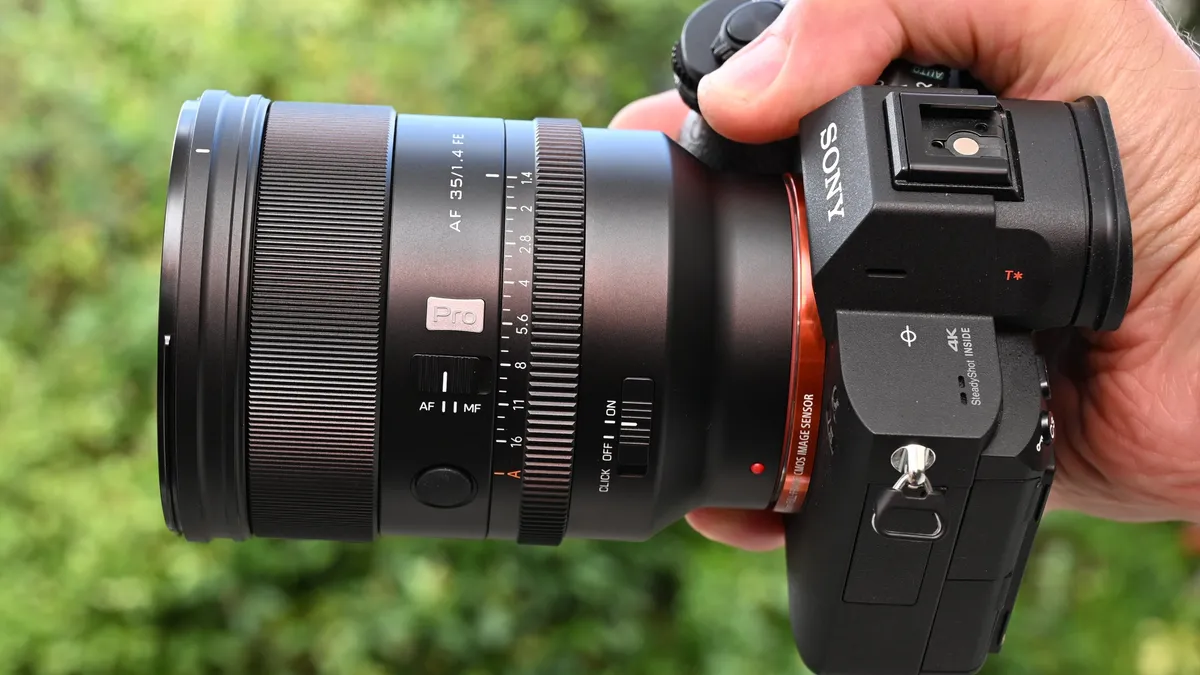
Staying on trend, the 35mm inherits the same HD Nano multi-layer coatings and fluorine coating on its front element. All three lenses also have the same 77mm front filter attachment thread. That’s naturally good news if you like using screw-in filters, as you can share one set of filters between all three lenses, without the need for using any step-up or step-down rings.
Another filter-friendly fact is that all three lenses have fully internal focus mechanisms (more on that in a moment), so the filter thread neither extends nor rotates during focusing, ideal for using the likes of circular polarizing and ND grad filters.
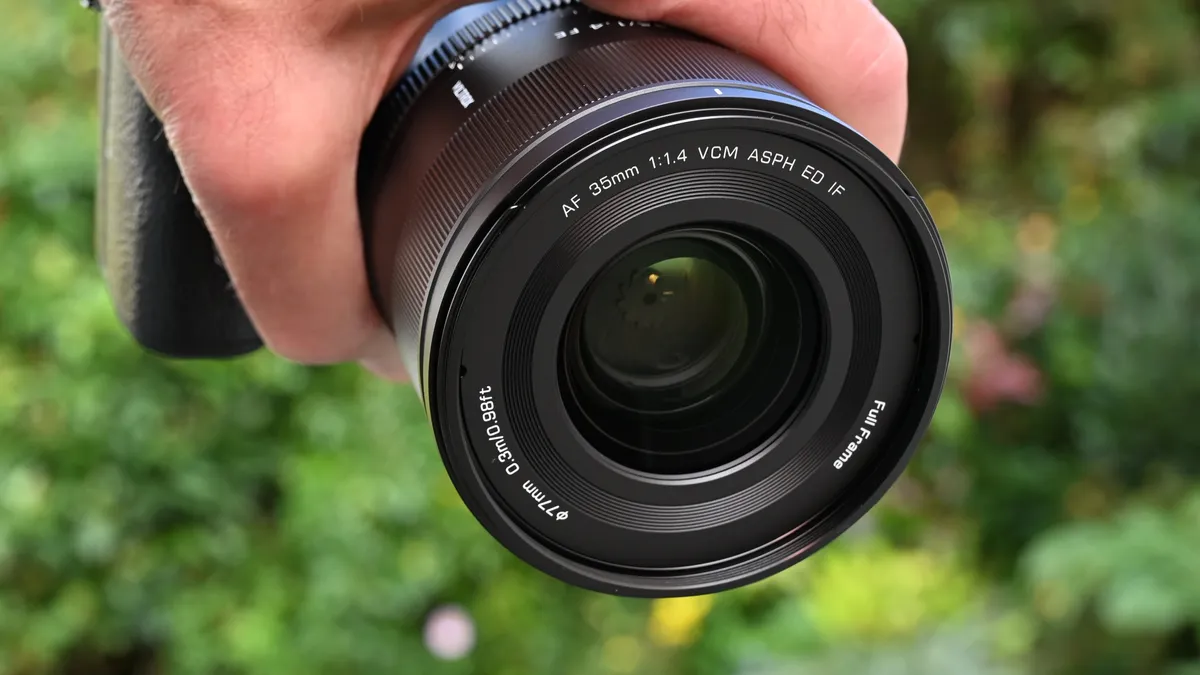
The autofocus system itself again follows suit in the Viltrox Pro range, being of the Hyper VCM (voice-coil motor) variety. That’s a step up in quality and performance, compared with the kind of linear stepping motor that’s usually fitted to modern lenses. Voice-coil motors tend to be even faster for acquiring and tracking subjects while still enabling smooth autofocus transitions when shooting video. They’re also virtually silent in operation, which is another bonus for videography.

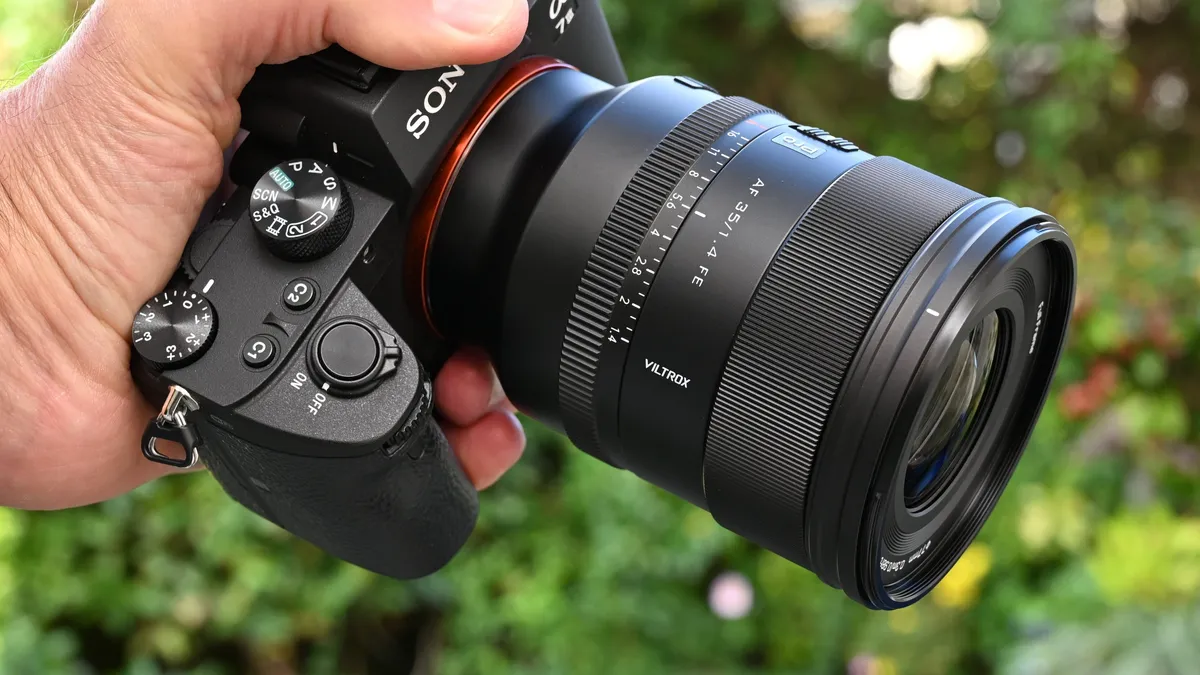
There’s an AF/MF (auto/manual) focus mode switch on the side of the barrel. I always much prefer this to having to delve around in camera menus when I want to make the change. It’s so much more immediate and intuitive. Another nice touch, so to speak, is that there’s a customizable function button just below the AF/MF switch. You can typically assign this to a range of actions, depending on the camera body, but a logical choice is AF/L (autofocus lock).

Towards the rear of the barrel is a dedicated aperture control ring. It’s clearly marked in one-third f/stops, going all the way from f/1.4 to the narrowest available aperture of f/16. Again, I prefer this arrangement to a ‘customizable’ aperture ring that can be used for various functions, but lacks any markings. With the dedicated option, you can literally see where you are, or at least what aperture you’ve set. Just off the scale at the narrow end, there’s an orange A (Auto) marking, for controlling the aperture from the camera body instead of using the control ring. It’s essential for shooting in Program and Shutter-priority modes. My only niggle with the aperture ring of this and other Viltrox lenses is that there’s no locking switch or button, to safely lock the ring in its Auto position.

Hybrid photography is all the rage nowadays and to keep in step, the lens is designed to deliver premium video performance as well as being eminently suitable for stills. Towards the rear of the barrel, behind the AF/MF switch and function button, there’s a Click off/on switch. De-click mode enables smooth, silent and step-free operation of the aperture control ring, ideal for videography, whereas the option of one-third f/stop click steps enables greater precision when shooting stills.

The optical path is relatively complex for a 35mm prime lens, based on 16 elements in 12 groups. There’s actually a difference in this respect from the 50mm and 85mm lenses, both of which have one less element and one less group in their configurations. High-tech glass includes two Ultra-Precision aspherical elements, three ED (Extra-low Dispersion) elements and four HR (High Refractive index) elements. The overall aim is to optimize sharpness and clarity, while minimizing unwanted aberrations like color fringing.

HD Nano multi-layer coatings are on hand to combat ghosting and flare and the lens is supplied with an efficient petal-shaped hood. It’s actually exactly the same hood that’s supplied with the 50mm lens, whereas the 85mm lens has a circular profile hood.

Build quality feels very robust. Again, continuing the theme set by the earlier 50mm and 85mm lenses, the 35mm has a sturdy metal barrel as well as a metal mounting plate. Extensive weather-seals are fitted throughout the lens, including a rubber gasket on the mounting plate, to guard against the ingress of dust and moisture through the joint between the lens and camera body. The mounting plate also features a USB-C port, for applying firmware updates if and when needed.

For the journey, the lens is supplied complete with a high-quality drawstring pouch. Even if you don’t use the pouch for carrying the lens, it can come in handy for protecting other bits and bobs in transit.

Viltrox AF 35mm f/1.4 Pro: Performance
Having been mightily impressed by the companion Viltrox AF 50mm f/1.4 Pro and Viltrox AF 85mm f/1.4 Pro, I had high hopes for this lens. I wasn’t disappointed. After extensively using the other two lenses over the last few months, I felt right at home with this one. The exact same high-end handling characteristics made the lens feel instantly familiar, and I’d class the excellent ergonomics as a performance plus point, when it comes to actually ‘getting the shot’. That’s especially true when nailing a definitive moment in street photography, for which the 35mm focal length is ideal.

Sharpness is thoroughly excellent, as demonstrated in the images above and below, within the bounds of depth of field. You can be assured of capturing ultra-fine detail and texture, and sharpness remains on song right out to the edges and corners of the frame.

Clarity, contrast and color rendition are equally impressive. I found that the lens had plenty of bite even when shooting outdoors under very dull, flat lighting on an overcast day, and indoors with no artificial lighting, just a bit of dull daylight seeping in through the windows.

For front to back sharpness in street scenes (or on a railway platform in the image below), a medium aperture setting of f/8 enables a generous depth of field at moderate focus distance settings, thanks to the 35mm focal length.

Naturally, you don’t need to buy a ‘fast’ lens if you only want a large depth of field. The flipside is that the widest aperture of f/1.4 enables a really tight depth of field, especially for close-ups. Sharpness remains excellent while the quality of bokeh is beautifully soft and smooth, with a natural fall-off between focused and defocused areas. You’ll see this in the shot below, featuring a row of levers in a lever frame, for operating signals and points in a restored railway signal box.

Not exactly creating a ‘toytown’ photographic effect from a real-world scene, the following shot is of an actual model village. Again though, the f/1.4 aperture enables a tight depth of field, isolating the model train within a scene by blurring the foreground and background areas.

The quality of bokeh remains excellent when stopping down, helped by the lens’s particularly well-rounded 11-blade aperture. It’s yet another facet that it shares with the 50mm and 85mm lenses, and helps to ensure that ‘bokeh disks’ caused by defocused lights and bright spots don’t take on noticeable multi-sided shapes. Bokeh disks look nice and smooth as well, free of the ‘onion ring’ effect that’s renowned for giving rise to concentric lines within the disks.

There’s hardly any distortion to be seen, even with automatic in-camera correction disabled. That’s a marked difference to most modern lenses designed for mirrorless cameras, which often rely massively on auto correction to the extent that you can’t disable it in camera menus. The same goes for color fringing, which again is extremely negligible.

Viltrox AF 35mm f/1.4 Pro: Sample Images
The following gallery contains a variety of images shot at the East Somerset Railway in the south west of England, which was inaugurated in 1855 and has more recently been lovingly restored by volunteers, the working railway being run as a registered charity. My shots were mostly taken outdoors on a gloomy, overcast day with very flat lighting, posing a challenge to any lens in terms of delivering good sharpness, clarity and contrast. That said, the sun did break through and make a welcome appearance every now and then. The indoor shots were taken without any artificial lighting, relying solely on light coming in through windows. I used wide and medium aperture settings, to give a more comprehensive picture of the lens’s performance and pictorial qualities.


Viltrox AF 35mm f/1.4 Pro: Lab Results
We run a range of lab tests under controlled conditions, using the Imatest Master testing suite. Photos of test charts are taken across the range of apertures and zooms (where available), then analyzed for sharpness, distortion and chromatic aberrations.
We use Imatest SFR (spatial frequency response) charts and analysis software to plot lens resolution at the center of the image frame, corners and mid-point distances, across the range of aperture settings and, with zoom lenses, at four different focal lengths. The tests also measure distortion and color fringing (chromatic aberration).
Sharpness:

For such a ‘fast’ lens, sharpness across the entire image frame is highly impressive at f/1.4. Edge-to-edge sharpness becomes completely excellent at a still wide aperture of f/2 and remains that way through most of the aperture range, only dropping off by a modest amount at f/16, due to the usual phenomenon of diffraction.
Fringing:

Lateral chromatic aberration is negligible throughout the entire aperture range, even at the extreme edges and corners of the frame. Longitudinal/axial chromatic aberration (sometimes referred to as bokeh fringing) is also minimal at f/1.4, which is a particular challenge for fast lenses at wide apertures, and can occur across the entire image frame where there are high-contrast transitions just in front of or behind the plane of focus.
Distortion: 0.89
There’s the slightest touch of pincushion distortion but even with automatic in-camera correction disabled, you’d be hard-pressed to spot it in real-world shooting.
Viltrox AF 35mm f/1.4 Pro: Verdict
I’ve been loving my Viltrox AF 50mm f/1.4 Pro and Viltrox AF 85mm f/1.4 Pro over the past few months. The former gives an entirely natural perspective, the latter is a pretty much perfect portrait lens. The only problem is that I tend to favor a 35mm focal length for walkabout and street shooting with a full-frame camera. This new 35mm fits the bill completely. I love that it’s a virtually identical size and weight to the other two lenses in the trilogy, so that if I’m on a shoot and need to swap between them, they feel the same and have identical handling characteristics, right down to the action and placement of the dedicated aperture ring and its click off/on switch, the AF/MF focus mode switch and the customizable function button.
Further similarities with the previous two lenses also make the 35mm a seriously pro-grade prime in its own right. These include Hyper VCM (voice-coil motor) autofocus, an 11-blade aperture diaphragm, a robust and weather-sealed metal barrel and high-end handling.
Image quality is the bottom line and it’s here that the lens really excels. It’s super-sharp with excellent clarity and contrast, even when shooting wide-open, while also delivering beautifully smooth bokeh. Meanwhile, color fringing, distortion, ghosting and flare are all negligible. It’s simply a fabulous lens that lives up to its ‘Pro’ billing on all counts, apart from its bargain price tag.
Features ★★★★★ |
High-end features include Hyper VCM (voice-coil motor) autofocus, a dedicated aperture ring with a click/de-click switch and a customizable function button. |
Design ★★★★★ |
The pro-grade, robust design is based on a metal barrel and mounting plate with extensive weather-seals. Handling and build quality are exemplary throughout. |
Performance ★★★★★ |
Autofocus is quick and consistently accurate, while image quality combines excellent sharpness, clarity and color rendition with beautiful bokeh. It simply delivers beautiful pictures. |
Value ★★★★★ |
The 35mm is pricier than its 50mm and 85mm Viltrox Pro f/1.4 siblings but is still excellent value for money. |
Overall |
★★★★★ |

Alternatives