Digital Camera World Verdict
There’s a lot that I love about the Sirui Aurora 35mm f/1.4. It’s robustly built with an aluminum barrel and plentiful weather-seals, and it has top-notch handling characteristics. It’s also immaculately finished and beautifully presented. My only reservations are unfortunately where it counts most. I’m not entirely convinced about its performance, both in terms of sharpness and the consistency of autofocus.
Reasons to buy
- +
High-end handling
- +
Premium build quality
- +
Smooth bokeh
- +
Great value
Reasons to avoid
- -
Lackluster sharpness
- -
Questionable autofocus accuracy
- -
Severe wide-aperture vignetting
Why you can trust Digital Camera World Our expert reviewers spend hours testing and comparing products and services so you can choose the best for you. Find out how we test.
I’ve been largely impressed with Sirui products over the years, and it’s been quite a few years at that. The company launched in 2001, becoming a well-known brand for tripods within five years. In 2015, Sirui branched out into anamorphic and cine lenses, as well as diversifying into the lighting market in 2022. On the lens front, Sirui is still most widely known (and highly regarded) for its cine lenses but the one I’m reviewing here is a full-frame autofocus lens for stills cameras, although of course that encompasses video shooting nowadays.
From the relatively recent Aurora range, this 35mm is currently one of two lenses on offer, the other being an 85mm prime that matches the 35mm for its fast f/1.4 aperture and has mostly the same handling characteristics. Both lenses aim high in terms of features, handling, build quality, performance and value for money, the 35mm intending to be among the best street lenses on the market.
The two lenses are available in a wide range of mount options, comprising Sony E (FE), Nikon Z (FX), L-mount and Fujifilm X. Although full-frame compatible, the 35mm lens has an ‘effective’ focal length of just over 50mm on APS-C format cameras, serving as a ‘nifty fifty’, which is naturally the only option with the Fuji X-mount edition.
Sirui Aurora 35mm f/1.4: Specifications
Mount options |
Sony E (FE), Nikon Z (FX), L-mount, Fujifilm X |
Full frame |
Yes |
Autofocus |
Yes |
Image stabilization |
No |
Lens construction |
16 elements in 11 groups |
Angle of view |
65.7 degrees |
Diaphragm blades |
13 |
Minimum aperture |
f/16 |
Minimum focus distance |
0.35m |
Maximum magnification |
0.14x |
Filter size |
62mm |
Dimensions |
76x103mm / 3.0x4.0in |
Weight |
490g / 17oz |
Sirui Aurora 35mm f/1.4: Price
The Sirui Aurora 35mm f/1.4 has a list price of $549 / £549 / AU$889, which makes it particularly affordable for a lens of this type. By comparison, the own-brand Sony FE 35mm f/1.4 G Master weighs in at a whopping $1,498 / £1,429 / AU$1,999, although Nikon makes a relatively budget-friendly (and more basic) Nikkor Z 35mm f/1.4 for $677 / £649 / AU$1,099. Independent Chinese competition includes the even faster Viltrox AF 35mm f/1.2 Lab at $999 / £869 / AU$1,649 and there’s the Japanese Sigma 35mm f/1.4 DG II Art for $1,059 / £849 / AU$2,049. Whichever way you look at it, the Sirui Aurora 35mm looks great value at the price.
Sirui Aurora 35mm f/1.4: Design & Handling
The Sirui Aurora 35mm f/1.4 is a sight to behold, even before you get it out of its packaging. It’s beautifully presented in a full-color printed box, complete with fabric lift-up tab and ID card. Inside that, the lens sits resplendent in its own posh soft case, reminiscent of the ones that up-market Sigma lenses come in, but in blue, silver and black instead of just plain black.
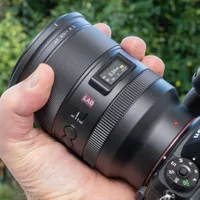
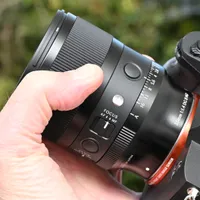
The lens itself follows suit, with a black anodized aluminum barrel, a full set of switches and function buttons, bright blue Sirui badge and an Aurora logo in a script font that makes the lens look like it’s been signed by hand. But as they say, looks can be deceiving, so I’m hoping not to be disappointed.
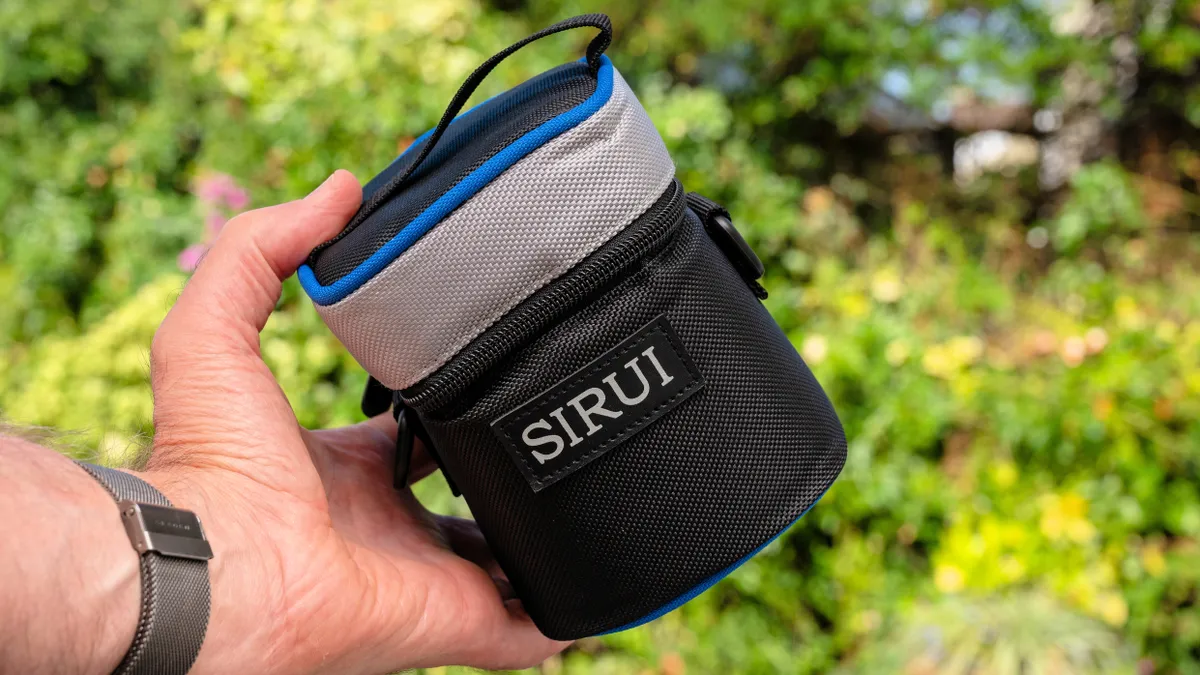
When you lift the lens from its padded case, the first impression is that it’s a high-quality item. Everything looks and feels up-market, from the weather-sealed metal base to the fluorine coated front element. It’s pretty lightweight for a 35mm f/1.4 prime as well, measuring 3x4 inches and weighing in at 490g, or a smidge over one pound.
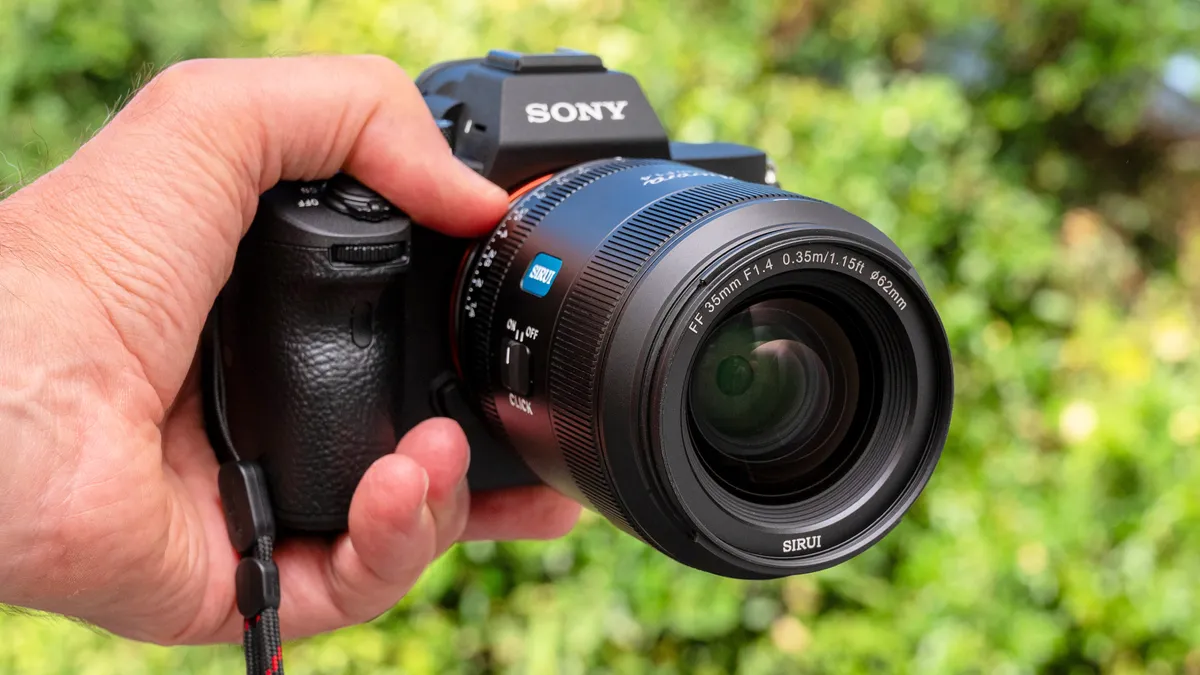
Like most lenses for mirrorless cameras nowadays, the Aurora has an autofocus system that’s based on a linear stepping motor. Typical of the breed, it’s quick and virtually silent in operation, and is electronically coupled to a manual focus ring. As is also generally the case, there’s no focus distance scale apart from the one you might have as an option in your camera body’s electronic viewfinder or rear screen.

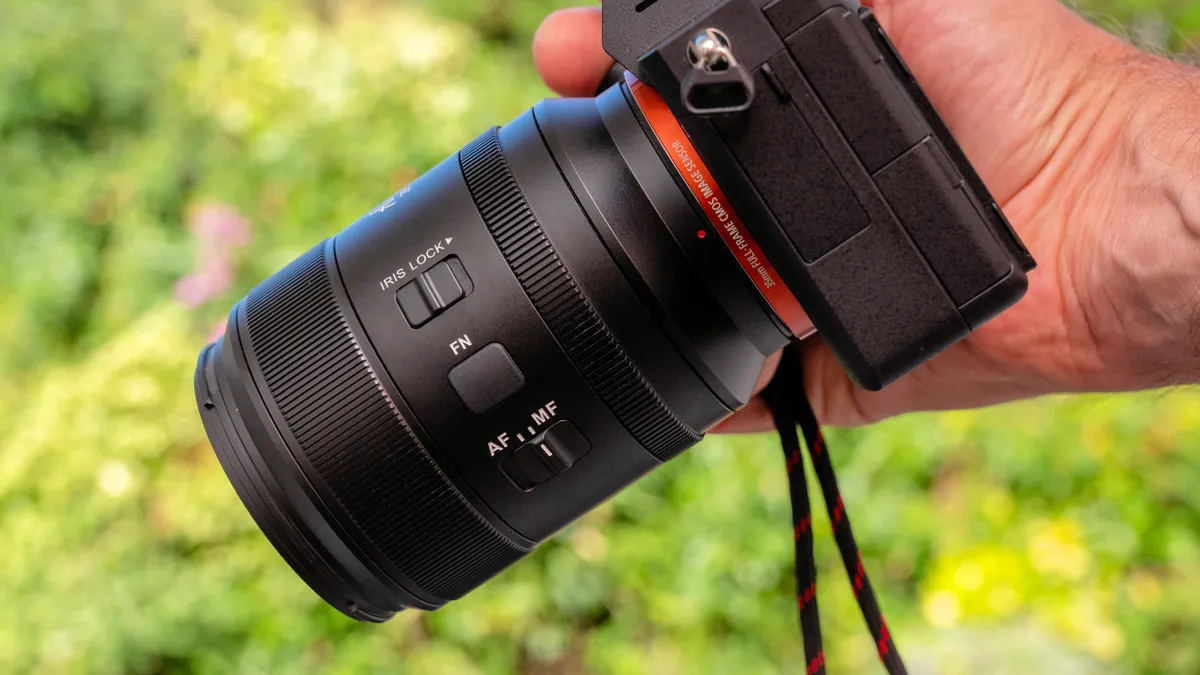
Swapping between autofocus and manual focus modes is a simple case of operating the AF/MF switch on the side of the lens barrel. That saves any time and effort faffing around in camera menus to make the change. Just above the switch is a customizable function button that I tend to use for AF-hold, although a range of other options is generally available depending on the camera body.

Like all the other switches and controls, the aperture ring is clearly marked, this time on one-third f/stop increments, all the way from the widest aperture of f/1.4 to the narrowest of f/16. That’s all well and good if you’re shooting in Aperture-priority or Manual shooting modes, but there’s also an A (Auto) position for camera-driven adjustments and for shooting in Program and Shutter-priority modes.

I don’t consider myself to be clumsy but I do find that it’s all too easy to nudge an aperture control ring from its Auto position to a narrow aperture setting by accident. The Aurora guards against this with the provision of an Iris Lock switch. I’m very much in favor of that.

Catering to both stills and video, the aperture ring also features a click/de-click switch, thus allowing for precise, one-third incremental steps or smooth and silent aperture transitions respectively. It’s another nice touch that is sure to find favor with hybrid shooters and content creators who alternate between stills and video.

One final word on aperture is that the lens has a particularly well-rounded diaphragm, based on no less than 13 curved blades. This helps to maintain the quality of bokeh when stopping down from the widest aperture of f/1.4. There’s plenty of quality glass in the optical path as well, with three aspherical elements, two ED (Extra-low Dispersion) elements, one Special ED element and two HRI (High Refractive Index) elements in the chain.

Like the lens itself, the hood feels a quality item, with an efficient petal-shaped profile, a grippy rubber handling ring, a ridged interior surface and a lock/release button. As usual, it also has a bayonet-fit design and can be reversed on the lens for compact stowage.

Maintaining the quality theme, even the lens caps look and feel nicely designed and well made. The front cap has a pinch-style release mechanism that makes it easy to fit or remove even when the hood is fitted to the lens in its business orientation.

Finishing up at the back end, there’s a metal mounting plate that features gold-plated electronic contacts and a rubber weather-seal ring. There’s actually a comprehensive set of weather-seals fitted through the whole lens. Another bonus is that the mounting plate includes a USB-C socket, which you can use for applying firmware updates.

Sirui Aurora 35mm f/1.4: Performance
After such high expectations based on the apparent quality, presentation and finish of the lens, performance turned out to be a bit of a mixed bag in my tests. Starting out with a positive, the f/1.4 aperture definitely delivers a tight depth of field along with attractively smooth bokeh, especially when shooting close-ups.

Producing soft defocused areas within images is certainly not a problem, but I found sharpness more of a challenge. I didn’t get the autofocus hit rate that I’m used to when using my Sony A7 III camera body and stepping motor-based lenses. Even manual focusing proved to be a bit hit and miss. When correctly focused, the lens still lacked sharpness towards the edges and corners of the frame, and that’s after stopping down to medium apertures of around f/5.6 and f/8. To demonstrate, the pair of images below show a full-frame image on the left, and an enlarged section from near one of the corners on the right.

In this correctly focused image taken at f/5.6, center-sharpness is good enough.
Image credit: Matthew Richards

However, this enlargement shows that things get a bit blurry towards the edges and corners of the frame.
Image credit: Matthew Richards
Back on the plus side, there was little evidence of any axial or lateral chromatic aberrations during my testing, the latter being minimal even right out at the edges of the frame. Ghosting and flare were also kept to small amounts.

There’s no real problem in terms of distortion either and unlike many modern lenses designed for mirrorless cameras, the Sirui doesn’t rely heavily on automatic in-camera corrections.

One of the tests that I often run for ‘fast’ lenses is to shoot a phrenology head in my back garden, starting with the widest available aperture and stopping down to a medium aperture in single f/stop increments. The results give good indications of sharpness and the quality of bokeh for defocused areas. Moreover, fast lenses often suffer from axial/longitudinal chromatic aberration at the widest apertures, also known as bokeh fringing. This displays as color fringing around high-contrast transitions, just in front of and behind the plane of focus. The black lines and writing on the white porcelain of the phrenology head are a good test for this as well.
The following gallery contains shots taken at full f/stop steps from f/1.4 to f/8. The lens does well in most respects but if you zoom in to the images for an enlarged view, you’ll notice a serious lack of wide-aperture sharpness. I initially suspected autofocus inaccuracies but repeated the entire sequence, focusing manually with maximum magnification in preview, and got much the same results. Wide-aperture vignetting (darkened corners) is also very severe.


Sirui Aurora 35mm f/1.4: Sample Images
Images in the sample gallery below were taken on a bright, sunny morning at the ‘floating harbor’ of Bristol Docks in the south west of England. I used a selection of wide aperture settings for a tight depth of field when shooting close-ups, and narrower apertures where I wanted edge-to-edge sharpness for more expansive subjects.


Sirui Aurora 35mm f/1.4: Lab Results
We run a range of lab tests under controlled conditions, using the Imatest Master testing suite. Photos of test charts are taken across the range of apertures and zooms (where available), then analyzed for sharpness, distortion and chromatic aberrations.
We use Imatest SFR (spatial frequency response) charts and analysis software to plot lens resolution at the center of the image frame, corners and mid-point distances, across the range of aperture settings and, with zoom lenses, at four different focal lengths. The tests also measure distortion and color fringing (chromatic aberration).
Sharpness:

Sharpness in the center of frame is excellent, but it soon drops off as you move towards the corners. Even in the mid-frame image quality is very soft, and it's downright dire as you reach the corners.
Fringing:

There's visible fringing in the corners of frame when you stop down past f/2.8, but it's not severe.
Distortion: 0.75
The lens produces a touch of pincushion distortion, but not enough to be distracting.
Sirui Aurora 35mm f/1.4: Verdict
I think that the Sirui Aurora 35mm f/1.4 looks and feels a highly impressive lens. It’s beautifully presented and robustly built with an anodized aluminum barrel and comprehensive weather-seals. It also features a wealth of handling exotica, including an AF/MF focus mode switch, customizable function button and an aperture control ring with an iris lock and click/de-click switch.
All in all, the Sirui looks unfeasibly great value for money, but I found a sting in the tail when it came to actual performance. Autofocus accuracy proved a little inconsistent in my tests, and sharpness across the image frame was a moveable feast, even when the lens was correctly focused. All in all, I think the Sirui looks a great lens, but it’s not really as good as it looks.
Features ★★★★☆ |
Useful features include an AF/MF switch, customizable function button and an aperture control ring with an iris lock and click/de-click switch. |
Design ★★★☆☆ |
The design looks and feels excellent with nice handling and solid build quality but seems a bit lacking where it really counts – in the optical layout. |
Performance ★★★☆☆ |
Performance is good in some respects but I found it was let down by a lack of consistent autofocus accuracy and poor sharpness. |
Value ★★★☆☆ |
The Sirui would be great value for money at the price but is let down by some performance issues. |
Overall |
★★★☆☆ |

Alternatives