Early Verdict
The Tamron 16-50mm f/2.8 is an unusually compact lens considering it still manages to fit in a bright f/2.8 aperture. Competitive in both size and price, the lens still manages to deliver solid sharpness and bokeh. Distortion and vignetting rely on lens profile corrections like many modern compact lenses, and there's some occasional but minor colored fringing.
Reasons to buy
- +
Very compact and lightweight
- +
Weather seals
- +
Bright f/2.8 aperture
- +
Decent sharpness
- +
Lovely lens flare (but with some ghosting)
- +
Affordable
Reasons to avoid
- -
No aperture ring
- -
No stabilization
- -
Some vignetting and distortion without lens profile
- -
Some minor chromatic aberration
Why you can trust Digital Camera World Our expert reviewers spend hours testing and comparing products and services so you can choose the best for you. Find out how we test.
The constant aperture f/2.8 zoom tends to be a lens category that’s both expensive and heavy, but there’s a growing number of options built specifically for APS-C that put that coveted f/2.8 into a zoom the size of a kit lens. The new Tamron 16-50mm f/2.8 A is one such lens.
Built for APS-C bodies across Sony E, Canon RF, Nikon Z, and Fujifilm X mounts, the lens comes in at a 10.8oz / 305g package. I twisted the lens on a compact Sony A6700 and took it on a fall color hike, and the price and aperture are going to make it a very tempting choice for everyday carry.
Tamron 16-50mm f/2.8 A review: Price and Availability
The Tamron 16-50mm f/2.8 A sits at a price point that feels excellent for APS-C shooters. It’s well under the price of first-party lenses like the Sony E 16-55mm f/2.8 G and the Fujifilm XF 16-55mm f/2.8 R LM WR II, but it also sits at a price that competes with other third-party optics like the Sigma 18-50mm f/2.8 DC DN Contemporary.
The lens price varies slightly by mount. The E-mount and X-Mount sit at $529 / CA$749, while the Z-Mount and RF-Mount sit at $549 / CA$749.
The E-Mount and RF-Mount ship first on October 29, with the Z-Mount following on November 19 and the X-Mount on December 17.
Tamron 16-50mm f/2.8 A review: Specs
Mount |
Sony E, Nikon Z, Fujifilm X, Canon RF |
Maximum aperture |
f/2.8 |
Optical construction |
14 elements in 10 groups |
Minimum object distance |
6” /0.15m (WIDE), 11.5”/ 0.29m (TELE) |
Maximum magnification |
1:4.5 (WIDE) / 1:4.8 (TELE) |
Length |
3.2” (79.6mm) for Sony E-mount 4.8” (121.3mm) for Nikon Z mount 3.2” (79.9mm) for Fujifilm X-mount 3.1 (77.6mm) for Canon RF mount |
Weight |
10.8oz (305g) for Sony E-mount 11.2oz (315g) for Nikon Z mount 10.8oz (305g) for Fujifilm X-mount 10.8oz (305g) for Canon RF mount |
Tamron 16-50mm f/2.8 A review: Build and Handling

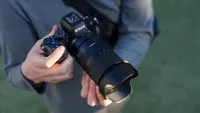
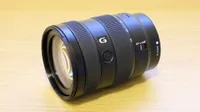
The Tamron 16-50mm f/2.8 A is deceptively small. It looks small enough to be a kit lens, not a constant-aperture zoom. The 10.8oz / 305g weight and 3.2 inch / 79.6mm length make it an easy lens to take on long hikes.
The lens is an external zoom type, which means the lens does get slightly longer as it zooms in.

The lens itself carries a minimalist design – there’s no bank of control switches at all, just a focus ring, a zoom ring, and a USB-C port for firmware updates and Tamron Link support.

My only complaint about the design? I would have loved an aperture ring, but tiny lenses can’t pack everything, and that’s one of the sacrifices to get a lens this lightweight.

But Tamron didn’t sacrifice weather seals in order to bring down the weight and price. The lens has several weather seals throughout. I only had a sunny weekend with the lens, but I gave the lens a few squirts with a plant mister, and the lens (and camera) was unbothered.
The lens ships with a removable petal-shaped lens hood.
Tamron 16-50mm f/2.8 A review: Performance
I took the Tamron 16-50mm f/2.8 A on a weekend hike to photograph the fall colors. The lens squeezes an excellent range and bright aperture into a lightweight optic. Close focusing capabilities up to 6 inches / .15m on the wide end and 11.5 inches / .29m on the long end add to that versatility.

Images coming from the lens have decent sharpness, with subjects that are crisp but without being overly so.

Unaltered, the lens has some barrel distortion at 16mm and barrel distortion at 50mm, but using the lens profile inside Lightroom corrects this in a click for RAW files.


Some images have a light vignetting at the corners, more noticeable at 50mm than at 16mm. Again, the lens profile does a nice job of quickly cleaning up those corners.
Turning from leaf peeping to pixel peeping, I did spot some occasional purple fringing when shooting backlit, high-contrast scenes and viewing the photos at 100 percent. This chromatic aberration was stronger in the untouched RAW files than on the JPEGs, and wasn’t strong enough to notice without viewing at 100 percent.

That f/2.8 creates some lovely bokeh. Large points of light create round bokeh balls; through smaller, more distant bokeh does take on some onion ringing.
Shooting towards the sun, I was able to capture some lovely, hazy lens flare. Filtered through the leaves, this flare looked like added sparkle. On the flip side of that lovely flare, however, there are some occasional purple ghosting spots when shooting into the sun.

I had just a weekend with the lens to test it out ahead of launch – lab testing and more challenging autofocus tests are needed before I can give the lens an official rating. But my initial experience is that the lens delivers a solid balance of sharpness and bokeh. There’s some minor purple fringing, while the vignetting and barrel distortion correction rely heavily on the lens profile to correct.


Tamron 16-50mm f/2.8 A review:
The Tamron 16-50mm f/2.8 A is so small that it feels like a kit lens, yet it packs in a constant f/2.8 aperture. The lens is a fantastic option to replace a narrow-aperture kit lens, but the versatile zoom and close-focusing capabilities also make it a great everyday lens, as well as a tempting travel lens.
It’s a lens that's light enough to carry around for hours, while still offering weather-sealing. I missed the aperture ring a little, but that may be a worthwhile sacrifice for the weight savings.
The lens expertly balances image quality with portability and price. Images are sharp, and bokeh and flare are lovely. There’s some vignetting and barrel distortion corrected by the lens profile, and some occasional purple fringing to contend with, however.
The price is also highly competitive, coming in close to the Sigma 18-50mm f/2.8 DC DN Contemporary, with a steep price difference compared to first-party lenses.
Alternatives