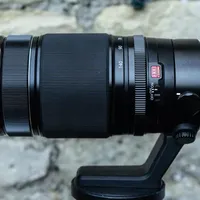
Digital Camera World Verdict
I love that the Sigma 50-120mm f/2.8 DC OS | C gives me (almost) a classic 70-200mm ‘effective’ zoom range with a desirable constant f/2.8 aperture rating. Better still, this ‘alternative trinity’ telephoto zoom for APS-C compact cameras is spectacularly compact, lightweight and easy to live with. Thankfully, it also features optical image stabilization, as IBIS is lacking in quite a few of the cameras for which it’s designed. And to seal the deal, it delivers excellent image quality and all-round performance, at a very reasonable price.
Reasons to buy
- +
Versatile tele zoom range
- +
Constant f/2.8 aperture
- +
Optical image stabilization
- +
Super-small featherweight
Reasons to avoid
- -
Not quite the classic ‘70-200mm’
- -
No aperture ring de-click
- -
No AF/MF, OS on/off switches
- -
No Nikon Z version
Why you can trust Digital Camera World Our expert reviewers spend hours testing and comparing products and services so you can choose the best for you. Find out how we test.
Can a lens ever be cute? Well, I think this Sigma is. It’s super-small, slender and lightweight, and looks a little beauty. And it looks pretty remarkable as well. I’ve known professional photographers who almost always shoot with prime lenses on their full-frame cameras. If they do have a zoom lens, it’s likely to be one of the best 70-200mm f/2.8 lenses. It’s a classic telephoto choice that combines a versatile zoom range with a fairly fast and constant f/2.8 aperture, making it one of the best choices of wedding and event photography lenses, and more besides.
Despite their huge popularity, I’m not totally sold on 70-200mm f/2.8 lenses, as I feel that they’re often big, heavy and very expensive to buy. As with wide-angle and standard zooms, we’re seeing more ‘alternative trinity’ telephoto zooms that retain the constant f/2.8 aperture but pack it into a much more conveniently compact, lightweight and affordable package. The Tamron 70-180mm f/2.8 Di III VC VXD G2 is a case in point, and one of my personal favorites.

The thing is, we don’t all shoot with full-frame cameras. There are particular advantages to crop-sensor cameras, and the APS-C format has long been a popular choice. Lenses tend to be smaller, lighter and less expensive, but that doesn’t mean we should have to compromise on quality or versatility. With that in mind, Sigma started making a set of alternative trinity f/2.8 zooms, kicking off with the wide-angle Sigma 10-18mm f/2.8 DC DN | C and standard Sigma 18-50mm f/2.8 DC DN | C lenses, in Canon RF-S, Fujifilm X, Sony E and L-mount options.
The eagerly awaited follow-up is the Sigma 50-120mm f/2.8 DC OS | C that I’m reviewing here. It follows suit in most of the same mount options, but not L-mount. I’m not surprised. Off the top of your head, can you think of any current APS-C format L-mount cameras? Anyway, the new Sigma tele zoom looks an absolute little gem. Let’s see if its beauty is more than just skin deep.
Sigma 50-120mm f/2.8 DC OS | C: Specifications
Mount options |
Canon RF-S, Fujifilm X, Sony E |
Full frame |
No (APS-C) |
Autofocus |
Yes |
Image stabilization |
Yes |
Lens construction |
18 elements in 13 groups |
Angle of view |
31.7 to 13.5 degrees |
Diaphragm blades |
11 |
Minimum aperture |
f/22 |
Minimum focus distance |
0.23m (W) 0.55m (T) |
Maximum magnification |
0.33x (W) 0.21x (T) |
Filter size |
55mm |
Dimensions |
67x99mm / 2.6x3.9in |
Weight |
390g / 13.8oz |
Sigma 50-120mm f/2.8 DC OS | C: Price
Splash out on a set of conventional, full-frame trinity zooms and you’ll need deep pockets to afford them and a deep bag to put them in. The APS-C format Sigma 50-120mm is comparatively small, light and affordable at $799 / £699 / AU$1,400. It completes the set, building on the previously launched Sigma 10-18mm f/2.8 DC DN | C at $729 / £649 / AU$1,178 and the Sigma 18-50mm f/2.8 DC DN | C at $659 / £479 / AU$807. If you want an even faster standard zoom, there’s also the Sigma 17-40mm f/1.8 DC Art at $919 / £799 / AU$1,650.
For further context, the full-frame compatible Sigma 70-200mm f/2.8 DG DN OS Sports costs $1,649 / £1,499 / AU$3,040, while the Tamron 70-180mm f/2.8 Di III VC VXD G2 sells for around $1,099 / £999 / AU$2,449. Equivalent APS-C format telephoto zooms with a constant f/2.8 aperture are very thin on the ground, but there’s the Fujifilm XF 50-140mm f/2.8 R LM OIS WR, which is about twice the price of the Sigma 50-120mm in most world regions, at $1,899 / £1,449 / AU$2,399.
Sigma 50-120mm f/2.8 DC OS | C: Design & Handling
The Sigma 50-120mm f/2.8 DC OS | C is so small that it comes in a pint-sized little cardboard box (with fully recyclable packing, no less). It’s so lightweight that when I picked up the box, I thought it was actually empty and they’re forgotten to put the lens in it. Talking specifics, or rather specifications, the Sigma measures 67x99mm / 2.6x3.9in and weighs 390g / 13.8oz. So it’s less than 4 inches long and weighs less than a pound. Over in the heavyweight corner of the ring, the Fujifilm XF 50-140mm f/2.8 R LM OIS WR is about 7 inches long and weighs 35oz (about 2.5x as much). Remarkably for a constant f/2.8 zoom, the Sigma also has a small 55mm filter attachment thread, compared with the Fujifilm’s 72mm thread.

The Sigma packs a complex optical path into its downsized design, comprising no less than 18 elements in 13 groups. Specialist glass includes 3 SLD (Special Low Dispersion) elements, one top-tier FLD (‘Fluorite’ Low Dispersion) element and 4 aspherical elements, the last of these enabling further physical shrinkage as well as enhancing image quality.

Before I get too carried away about just how small this lens is, I should point out that unlike most 70-200mm full-frame lenses, the Sigma physically extends at longer zoom settings. I say ‘most’, but not all full-frame lenses of the genre have an internal zoom mechanism, the Canon RF 70-200mm f/2.8L IS USM being a notable exception. But while the Sigma has an extending inner barrel, the total amount of physical extension is only about an inch, as you zoom from 50mm to the longest 120mm setting. You can see how that looks in real life by comparing the images above and below.

The zoom ring itself operates with smooth efficiency and has a nice tactile feel throughout its range. There are no stiff or jerky spots along the way and while only modest torque is required to rotate the ring, the lens doesn’t suffer at all from any zoom creep, even with the added weight of the hood being attached. Indeed, no zoom lock switch is featured in the design. There are also no switches for swapping between autofocus and manual focus modes, nor for switching the optical stabilizer on and off. In keeping with the compact design, these settings are deferred to menu options in the host camera body.

Further tech shoehorned into the lens includes an HLA (High-response Linear Actuator) autofocus motor, which is essentially a linear stepping motor by another name. It aims to deliver fast, snappy and consistently accurate autofocus for stills, along with smooth and virtually silent autofocus transitions when shooting video. As usual for this type of arrangement, the autofocus motor is also employed during manual focusing, being driven by the electronically coupled manual focus ring.

Although handling feels broadly similar to that of Sigma’s sibling 10-18mm and 18-50mm zooms, the 50-120mm lens gains a dedicated aperture control ring. It’s clearly labelled in full f/stop increments, with one-third f/stop interim marker lines. As usual, it has an A (Auto) setting just off the narrow end of the scale, next to the f/22 setting, which enables the aperture to be controlled from the host camera. This is essential for using the camera in Program and Shutter-priority shooting modes. As with AF/MF and optical stabilization, however, there are no companion switches for the aperture ring, so you don’t get a de-click option for shooting video, nor a locking switch for the Auto position.

The lens comes complete with a circular-profile hood. This has the usual bayonet fixing and can be reversed on the lens for compact stowage. It feels a high-quality item, perfectly matching the lens itself.

The hood is tailor-made and only adds about an inch to the physical length of the lens. Using the hood not only helps to fend off ghosting and flare when shooting into the light, but also offers physical protection for the front glass element against any knocks and scrapes.

Build quality feels very good throughout. The construction feels robust despite its lightweight design, and features multiple weather-seals including a rubber gasket around the metal mounting plate.

A nice finishing touch is that the lens is not only supplied with front and back caps and a hood, but also with a neat drawstring pouch. It’s rather a featherweight compared with the padded soft cases that Sigma often supplies, but more in keeping with the relatively small and lightweight nature of this lens.

Sigma 50-120mm f/2.8 DC OS | C: Performance
As advertised, the autofocus system proved rapid and consistently accurate in my tests. The lens is capable of a tight depth of field, especially when shooting wide-open at f/2.8 at short object distances or towards the long end of the zoom range. This makes consistently accurate autofocus all the more important. I also found that the autofocus system was well able to track fairly fast-moving objects.
An excellent hit rate is assured, not only by the autofocus system, but also by the optical stabilizer. I tested the lens with a Sony A6000 body that has no IBIS (In-Body Image Stabilizer) and that holds true for most APS-C format Canon EOS R system cameras, most back-catalog Sony Alpha cameras and some Fujifilm X system cameras. The Sigma’s optical stabilizer is definitely worth having, even if your camera does feature IBIS. Optical stabilizers tend to perform better than IBIS at telephoto focal lengths and this one’s worth from 6.5 stops to 4.5 stops as you stretch through the zoom range from 50mm to 120mm.

The ‘effective’ 75-180mm zoom range in full-frame terms isn’t quite a match for the 70-200mm of conventional ‘trinity’ telephoto zooms, but it’s not far off. The Canon RF-S mount actually comes a little closer at maximum telephoto reach, equating to 80-192mm in full-frame terms, thanks to Canon’s 1.6x rather than 1.5x APS-C crop factor. Using the Sony E-mount version, I didn’t notice any real difference at the short end of the zoom range, and if you desperately need that extra bit of reach at the long end, a little creative cropping can often suffice. Either way, the images above and below demonstrate the overall zoom range, taken of the same subject from the same position at focal lengths of 50mm and 120mm respectively.

I found that levels of sharpness and clarity to be excellent, both throughout the entire zoom range and across the whole image frame. Color rendition is also beautiful. I was less enamored that the aperture ring rotates with clearly audible click steps. That can be problematic when shooting video, as there’s no de-click option for the aperture ring. Naturally, due to the telephoto nature of the lens, you’ll need to stop down to medium apertures to gain sufficient depth of field, when shooting 3-dimensional objects that are fairly close by. At least, you will if you want most or all of them to look sharp, as demonstrated in the bicycle image below.

For this kind of lens, there’s another facet of performance comes to the fore, and that’s the quality of bokeh. It can be a struggle for APS-C format lenses to deliver a tight depth of field, as this is more dependent on the ‘actual’ rather than ‘effective’ focal length. Again though, the Sigma impresses with attractively soft and smooth bokeh in defocused areas, along with a natural looking roll-off between focused and defocused elements in a composition. The aperture diaphragm is particularly well-rounded, being based on 11 blades, which helps to maintain the quality of bokeh when stopping down.

Axial/longitudinal chromatic aberration (also referred to as ‘bokeh fringing’) is also well controlled around high-contrast transitions just in front of or behind the plane of focus. All of these facets are demonstrated in my test shot below, taken of a phrenology head at a focal length of 92mm, wide-open at f/2.8.

There’s fairly good control over distortion which is well within the boundaries of automatic in-camera correction, and there’s virtually no color fringing to be seen even with in-camera correction disabled. The lens also does well to maintain clarity and contrast while minimizing ghosting and flare, when shooting against the light. For the following image, I was shooting towards the sun, with lots of light coming in from the sky as well as bouncing off the sea. The lens maintains good contrast while keeping ghosting and flare very much at bay.

Sigma 50-120mm f/2.8 DC OS | C: Sample Images
The following gallery comprises images taken on a sunny morning at Weston-Super-Mare, a popular tourist destination on the boundary of the Severn Estuary and Bristol Channel in South West England. The first few shots in the gallery were taken in pairs, captured of the same scene from the same position, but at both extremities of the zoom range. This gives you an idea of the total zoom range on offer. I also shot a variety of other images, using various focal lengths and aperture settings, including the widest aperture of f/2.8 to show the quality of bokeh with the minimum depth of field.


Sigma 50-120mm f/2.8 DC OS | C: Lab Results
We run a range of lab tests under controlled conditions, using the Imatest Master testing suite. Photos of test charts are taken across the range of apertures and zooms (where available), then analyzed for sharpness, distortion and chromatic aberrations.
We use Imatest SFR (spatial frequency response) charts and analysis software to plot lens resolution at the center of the image frame, corners and mid-point distances, across the range of aperture settings and, with zoom lenses, at four different focal lengths. The tests also measure distortion and color fringing (chromatic aberration).
Sharpness:


Center-sharpness is very good wide-open at f/2.8, becoming excellent with just a single f/stop reduction to f/4, throughout the entire zoom range. Extreme edge-sharpness doesn’t look too great based on short-range shooting of our lab charts, but at more typical focus distances, it proved impressive in our real-world tests, as you can see in my sample images.
Fringing:

Both lateral and axial chromatic aberrations are entirely negligible. You’d hard pressed to see any color fringing anywhere in the image frame, even with automatic in-camera correction disabled. That holds true throughout the entire zoom and aperture ranges.
Distortion:

There’s a little pincushion distortion at 50mm, a little more at 70mm, and it can become fairly noticeable towards the long end of the zoom range. However, the Sigma relies much less on automatic in-camera correction for distortion, compared with many modern lenses for mirrorless cameras, especially those designed with compactness in mind. With auto correction applied, distortion becomes a non-issue.
Sigma 50-120mm f/2.8 DC OS | C: Verdict
I have a bit of a love / hate relationship with ‘proper’ trinity telephoto zoom lenses. I love their versatility and usefulness for anything and everything from daily shooting to action, sports, wildlife and portraiture, and especially for weddings and events. But I hate that they’re typically big, heavy and very expensive to buy. The Sigma 50-120mm f/2.8 DC OS | C for APS-C format Canon, Fujifilm and Sony cameras gives me all of the good stuff, but miniaturized into an amazingly compact and lightweight package that’s also much more affordable to buy.
That ‘good stuff’ includes an effective 75-180mm zoom range (80-192mm for Canon), complete with fast, virtually silent and consistently accurate autofocus and effective optical image stabilization. Image quality is top-drawer, combining superb sharpness, clarity, contrast and color rendition with smooth and dreamy bokeh.
I like that the lens includes a dedicated aperture control ring, but I feel it’s a bit of a shame there’s no click/de-click switch, nor switches for auto/manual focusing modes and stabilization on/off. However, I’m happy to forego these in the pursuit of downsizing, and it also keeps the control layout relatively simple and straightforward. Ultimately, this Sigma makes a compelling case for using a crop-sensor camera instead of a full-frame body. It’s a proper pocket rocket!
Features ★★★★½ |
Fab features include a constant f/2.8 aperture, fast autofocus, optical stabilization and a dedicated aperture ring, but there are no focus/stabilization switches nor a de-click option. |
Design ★★★★★ |
The ultra-compact and featherweight design is truly remarkable, making the Sigma a joy to use, yet it’s robust, has lovely handling characteristics and includes weather-seals. |
Performance ★★★★★ |
Image quality is gorgeous in all respects, from scintillating sharpness to beautiful bokeh, backed up by fast and consistently accurate autofocus and effective stabilization. |
Value ★★★★★ |
Considering that the lens competes so well with ‘trinity’ telephoto zoom lenses for full-frame cameras, this APS-C format lens is great value for money. |
Overall |
★★★★★ |

Alternatives