Digital Camera World Verdict
The Sirui Aurora 85mm f/1.4 makes a mighty first impression. It’s sturdily built with an aluminum barrel and extensive weather-seals. It’s also beautifully turned out in a luxury soft case and has plentiful handling exotica. That’s all backed up by mostly very good performance although color fringing can be problematic. Even so, it’s an attractive lens at a very attractive price.
Reasons to buy
- +
Quality construction
- +
Advanced handling
- +
Dreamy bokeh
- +
Value for money
Reasons to avoid
- -
Noticeable color fringing
- -
Only one function button
- -
No iris lock switch
Why you can trust Digital Camera World Our expert reviewers spend hours testing and comparing products and services so you can choose the best for you. Find out how we test.
I still remember reviewing my first ever Sirui tripod for the print edition of our sister publication, Digital Camera magazine, and that was about 20 years ago. I was impressed at the time, and it was around then that Sirui started to make it big in tripod manufacture, after originally launching back in 2001. Fast forward to 2015 and Sirui became better know as a designer and manufacturer of quality anamorphic and cine lenses.
More mainstream, the 85mm prime that I’m reviewing here is one of a pair of relatively new ‘Aurora’ lenses for mirrorless cameras, geared to shooting stills as well as video. Its companion is the Aurora 35mm f/1.4, which has the same fast f/1.4 aperture and similar handling characteristics. They look and feel an impressive pair of lenses, the 85mm aiming to be among the best portrait lenses on the market.
Sirui’s Aurora lenses thus far are both available in a variety of mount options, including Sony E (FE), Nikon Z (FX), L-mount and Fujifilm X. They’re full-frame compatible but can also be used on APS-C format cameras, on which the 85mm has an ‘effective’ focal length of about 127.5mm, stretching further into telephoto territory. Naturally, APS-C is the only option with the Fuji X-mount version of the lens.

Sirui Aurora 85mm f/1.4: Specifications
Mount options |
Sony E (FE), Nikon Z (FX), L-mount, Fujifilm X |
Full frame |
Yes |
Autofocus |
Yes |
Image stabilization |
No |
Lens construction |
14 elements in 9 groups |
Angle of view |
28.6 degrees |
Diaphragm blades |
15 |
Minimum aperture |
f/16 |
Minimum focus distance |
0.85m |
Maximum magnification |
0.12x |
Filter size |
67mm |
Dimensions |
80x102mm / 3.2x4.0in |
Weight |
540g / 18oz |
Sirui Aurora 85mm f/1.4: Price
The Sirui Aurora 85mm f/1.4 carries a price tag of $599 / £549 / AU$959, which makes it very affordable for a lens of this type. The own-brand Sony FE 85mm f/1.4 G Master II will set you back a comparatively huge $1,948 / £1,799 / AU$2,998. The Japanese Sigma 85mm f/1.4 DG DN Art is also a fair bit pricier at $1,289 / £979 / AU$1,596, although the more directly competing Chinese Viltrox AF 85mm f/1.4 Pro is similarly priced at $598 / £569 / AU$919. Another hot new Chinese contender is the Meike 85mm f/1.4 Mix II, which launched in mid 2026 at $569 / £429 / AU$826. All in all, the Aurora 85mm f/1.4 looks outstanding value compared with Japanese competition, less so against alternative Chinese offerings.
Sirui Aurora 85mm f/1.4: Design & Handling
First impressions might not always be correct but they still count for something. This Sirui gives an instant feelgood factor, with its smart retail box, complete with fabric lift-up loop and ID card. Open the box and you’re rewarded with a really high-quality soft case, somewhat reminiscent of high-end Sigma lenses but created in an eye-catching colorway of blue, silver and black.
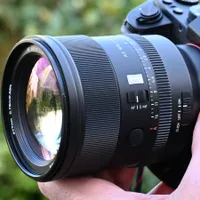
It already looks like the lens has a lot to live up to but sure enough, it maintains the theme with a luxurious anodized aluminum barrel, a slew of control rings, switches and a function button, a colorful blue Sirui badge and an Aurora logo printed in a script font that makes it look like the lens has been lovingly signed by hand. As I say, first impressions…

The impression of quality is reinforced when you take the lens from its padded case and hold it in your hand. Everything about it says ‘up-market’, from the weather-sealed metal base at the back to the imposingly large, fluorine-coated optical element at the front. It’s conveniently compact and lightweight for an 85mm f/1.4 prime as well, measuring about 3x4 inches and tipping the scales at 540g / 18oz. For comparison, it’s about the same size as the Aurora 35mm lens and just a single ounce heavier.

Like most self-respecting lenses for mirrorless cameras nowadays, the Aurora has autofocus, and its based on the mainstream type of system that relies on a linear stepping motor. True to type, it’s rapid and virtually silent in operation, as well as featuring an electronically coupled manual focus ring, which works with smooth precision.

When I’m ‘in the moment’, shooting in time-critical scenarios, one thing I hate is having to delve into camera menus to swap between autofocus and manual focus modes, if the need arises. The Sirui comes to the rescue with a straightforward AF/MF switch on the side of the lens barrel, which is more intuitive and a whole lot quicker to operate. Just above the switch, again on the left hand side of the barrel, there’s a customizable function button.
I usually use the function button for AF-hold and it’s suitably labelled as AFL (AF-Lock) but there’s normally a bunch of other custom options available, depending on what camera body you’re using. My only gripe is that, considering that the 85mm f/1.4 lens is so ideal for portraiture, I wish there was a second function button up on top of the barrel, which would be more neatly under the thumb when shooting in portrait (upright) orientation.

Continuing the clarity of design and its white-on-black labelling, the aperture control ring is clearly marked in increments of one-third f/stops throughout the entire range from f/1.4 to f/16. It therefore gives you a direct, hands-on approach to aperture control via the lens itself if you’re shooting in Aperture-priority or Manual exposure modes. For Full Auto, Program and Shutter-priority shooting modes, there’s an A (Auto) position on the ring that defers aperture control to the camera body.

One thing that’s featured in the Aurora 35mm lens but omitted in the 85mm is an Iris Lock switch. I’m sorry to see it go, as I like the security of being able to lock the aperture ring in its Auto position to avoid accidentally nudging it to a narrow aperture while carrying or shooting. Back on the plus side, I’m pleased that the lens features a Click On/Off switch for the aperture ring, which enables precise click steps for aperture control during stills, or smooth and silent transitions when shooting video.

Before we leave the topic of aperture control, it’s worth noting that the lens has an incredibly well-rounded diaphragm. It’s based on no less than 15 curved blades, which helps to maintain optimum quality of bokeh when stopping down from the widest aperture of f/1.4, giving ‘bokeh disks’ from lights and bright spots a similarly well-rounded appearance.

The optical design is based on 14 elements arranged in 9 groups. These include an aspherical element, two ED (Extra-low Dispersion) elements and three HRI (High Refractive Index) elements. The overall aim is to enhance resolution, clarity and color rendition while keeping unwanted aberrations to a minimum – more on that later when I get to ‘performance’.

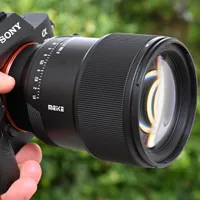
In keeping with the lens itself, the hood feels very well made. It has a circular profile with a grippy rubber handling ring and a ridged interior surface. However, unlike the petal-shaped hood that’s supplied with the Aurora 35mm lens, the 85mm hood lacks a lock/release button. As usual though, it has the same kind of bayonet-fit mechanism and enables compact stowage by reversing its orientation on the lens.

I even like the design of the lens caps, which look purposeful and chunky. The front cap has a pinch-style release mechanism that makes it easy to fit or remove even when the hood is fitted to the lens in its front-facing orientation.

Bringing up the rear, the mounting plate is made from solid metal and features gold-plated electronic contacts, along with a rubber weather-seal ring to avoid the ingress of dust and moisture through the joint between lens and camera body. Moreover, the lens features a comprehensive set of weather-seals throughout its length. As I’ve seen increasingly in recent lenses, there’s also a USB-C socket for the application of firmware updates, if and when needed.

Sirui Aurora 85mm f/1.4: Performance
You can make a strong case for the quality of blur being more important than outright sharpness for a portrait lens. Photographers often use a wide aperture to isolate the main subject within a scene by blurring a fussy background, and this is something that the Sirui does very well. It’s not just that the f/1.4 aperture enables a tight depth of field, it’s that the quality of bokeh itself is smooth and dreamy.

It’s not just about sharpness and blur. 85mm lenses are also favored for portraiture because the short telephoto focal length gives the illusion of compressing perspective, which can be flattering for facial features. And it’s not only for portraiture either. That compression of perspective can be a creative bonus for landscape, cityscape and other shooting scenarios.

Given that you can use an 85mm for all sorts of general shooting opportunities, edge-to-edge sharpness can be important in some situations. The Sirui does well here as well, when called upon to render objects sharply from the center of the frame to the edges and corners.

During testing, I found that while sharpness remained good towards the edges and corners of the image frame, control over lateral chromatic aberration really didn’t. Indeed, green and magenta fringing around high-contrast edges like the window frames in the image below were clear to see, even with automatic in-camera correction for fringing switched on in my Sony A7 III camera body. The pair of images shown comprise the full frame on the left, and an enlarged section from the top right hand corner on the right.

Despite automatic in-camera correction being enabled for chromatic aberration in my Sony A7 III, green and magenta fringing is clear to see.
Image credit: Matthew Richards

This enlarged section of the top right hand corner of the full image (left) more clearly shows the fringing around the high-contrast window frames.
Image credit: Matthew Richards
There’s also a touch of pincushion distortion, which isn’t uncommon in 85mm prime lenses. Unlike lateral chromatic aberration, however, it’s fairly minor and the Sirui certainly doesn’t rely heavily on automatic in-camera correction for distortion, unlike many recent lenses designed for mirrorless cameras.

I often run a specific test on ‘fast’ lenses, shooting a phrenology head in my back garden at various apertures from wide-open to a medium setting. The results give good indications of sharpness and the quality of bokeh for defocused areas. Moreover, fast lenses often suffer from axial/longitudinal chromatic aberration at the widest apertures, also known as bokeh fringing. This displays as color fringing around high-contrast transitions, just in front of and behind the plane of focus. The black lines and writing on the white porcelain of the phrenology head are a good test for this as well. The Sirui does well in most respects, although wide-open sharpness lacks a little bite.


Sirui Aurora 85mm f/1.4: Sample Images
Images in the sample gallery below were taken on a bright, sunny morning at the ‘floating harbor’ of Bristol Docks in the south west of England. I used a selection of wide aperture settings for a tight depth of field when shooting close-ups, and narrower apertures where I wanted edge-to-edge sharpness for more expansive subjects.


Sirui Aurora 85mm f/1.4: Lab Results
We run a range of lab tests under controlled conditions, using the Imatest Master testing suite. Photos of test charts are taken across the range of apertures and zooms (where available), then analyzed for sharpness, distortion and chromatic aberrations.
We use Imatest SFR (spatial frequency response) charts and analysis software to plot lens resolution at the center of the image frame, corners and mid-point distances, across the range of aperture settings and, with zoom lenses, at four different focal lengths. The tests also measure distortion and color fringing (chromatic aberration).
Sharpness:

Sharpness in the center of frame is good wide open, and becomes excellent once you stop down to f/2.8, remaining so until f/11. There isn't that much of a reduction in sharpness in the mid-frame, though at the extreme corners image quality is noticeably softer.
Fringing:

Fringing is noticeable in the corners of frame at all apertures other than f/1.4.
Distortion: 2.63
There's noticeable pincushion distortion, visible when shooting geometric subjects.
Sirui Aurora 85mm f/1.4: Verdict
I feel that the Sirui Aurora 85mm f/1.4 offers an ‘affordable’ choice of portrait lens, compared with top-flight, own-brand primes from some camera manufacturers. Despite its relatively budget-friendly price tag, it’s immaculately turned out and has a robust aluminum weather-sealed build. It also has a wealth of handling extras including an AF-Lock button and aperture control ring with a click/de-click switch. So far, so good.
While the Aurora 85mm looks and feels standout value for money, I found that performance and image quality were also mostly very good, combining pleasing sharpness, clarity and color rendition with beautiful bokeh.
However, I also found a bit of a glitch in performance, in that the lens produced significant lateral chromatic aberration towards the edges and corner of the frame, that was still clearly visible with automatic correction enabled in my Sony A7 III. That’s a bit of an upset as far as I’m concerned, but I think the Sirui is a very appealing lens in all other respects.
Features ★★★★★ |
There are plentiful features packed into this reasonably compact lens, including an AF/MF switch, customizable AF-L button and an aperture control ring with a click/de-click switch. |
Design ★★★★★ |
The lens looks and feels an up-market item with a weather-sealed aluminum barrel, high-end handling characteristics and a particularly well-rounded 15-blade aperture diaphragm. |
Performance ★★★★☆ |
Performance is very good in terms of autofocus, sharpness, clarity and color rendition but lateral chromatic aberration is problematic towards the edges and corners of the image frame. |
Value ★★★★☆ |
The Sirui is much more affordable than various Japanese contenders but has a similar price to Chinese competition from the likes of Viltrox and Meike. |
Overall |
★★★★☆ |

Alternatives