Digital Camera World Verdict
I love that the extra-large viewing angle of the Panasonic Lumix S 20mm f/2.5 is packed into an amazingly compact and lightweight, yet tough and weather-resistant build. It’s definitely one for the journey, ideal for travel and street photography as well as for selfies and vlogging, when you want to set the scene by including the backdrop. Image quality and all-round performance are good but I found that the lens was susceptible to ghosting and flare, and there’s no hood.
Pros
- +
Expansive viewing angle
- +
Compact & ultra-lightweight
- +
Refined handling
- +
Weather-sealed build
Cons
- -
Poor wide-aperture edge-sharpness
- -
No lens hood
- -
Susceptible to hosting and flare
Why you can trust Digital Camera World Our expert reviewers spend hours testing and comparing products and services so you can choose the best for you. Find out how we test.
Panasonic full-frame mirrorless cameras have been through quite a downsizing regime since the Lumix S system was first launched back in 2019. The diminutive but perfectly capable Panasonic Lumix S9 is currently the smallest of the group, the lack of a viewfinder helping to enable a particularly svelte and slender build. Naturally, that advantage is lost if you mount a big clunky lens on your slimline, lightweight body.
To keep everything in well-matched proportion, Panasonic has already released a couple of desirable lightweight full-frame lenses, ideally suited to the Lumix S9. The Panasonic Lumix S 18-40mm f/4.5-6.3 launched as the world’s smallest and lightest zoom lens, complete with an intriguing zoom range that packed big viewing angles into its small build. Then there’s the Panasonic Lumix S 40mm f/2 prime lens, neatly bridging the gap between 35mm and 50mm optics and proving itself to be very versatile.
The new Panasonic Lumix S 20mm f/2.5 that I’m reviewing here is virtually identical to the 18-40mm zoom and 40mm prime in size and weight, giving an appealing symmetry and synergy to the trio. As a compact yet wide-angle prime lens, the 20mm is geared to walkabout, street and travel photography, landscapes, cityscapes and architectural interiors, and maybe even a bit of stargazing. It’s also pretty ideal for taking selfies, vlogging and video content creation. Who said that prime lenses lacked versatility? All in all, the S 20mm aims to be one of the best L-mount lenses and best lenses for the Lumix S9, and certainly one of the most lightweight and affordable.
Panasonic Lumix S 20mm f/2.5: Specifications
Mount options |
L-mount |
Full frame |
Yes |
Autofocus |
Yes |
Image stabilization |
No |
Lens construction |
TBA |
Angle of view |
94.5 degrees |
Diaphragm blades |
7 |
Minimum aperture |
f/22 |
Minimum focus distance |
0.18m |
Maximum magnification |
TBA |
Filter size |
62mm |
Dimensions |
69x41mm / 2.6x1.6in |
Weight |
142g / 5oz |
Panasonic Lumix S 20mm f/2.5: Price
The Panasonic Lumix S 20mm f/2.5 comes with a price tag of $499 / £429 / AU$TBA. That makes it a bit pricier than the Panasonic Lumix S 40mm f/2 at $399 / £349 / AU$699 but less expensive than the Panasonic Lumix S 18-40mm f/4.5-6.3 at $548 / £519 / AU$899.
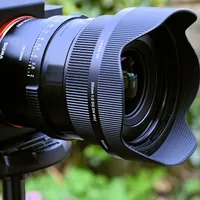
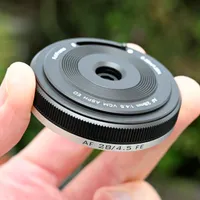
For further price comparisons, the faster and more sophisticated Sigma 20mm f/2 DG DN | C unsurprisingly costs more at $769 / £589 / AU$1,200, whereas the ultra-thin (half-inch) but relatively basic Viltrox AF 28mm f/4.5 pancake lens is super-cheap at $99 / £90 / AU$149. I’d say that the Lumix S 20mm is fairly priced but not bite-your-hand-off value for money.
Panasonic Lumix S 20mm f/2.5: Design & Handling
Available in either black or silver, the Panasonic Lumix S 20mm f/2.5 is seriously lightweight. When I picked up the retail box I thought it was empty. Lifting the lid was the only thing that convinced me there was actually a lens enclosed. It’s really small too. Talking in numbers, it measures 69x41mm / 2.6x1.6in and weighs just 142g / 5oz. Both the size and weight are virtually identical to those of the S 18-40mm zoom and S 40mm prime.
I know what you’re thinking. Okay, I don’t, but I’m guessing it’s something along the lines of flimsy lightweight lenses being cut to the bone and having plastic mounting plates. Well, think again. The Panasonic is a tough little cookie, with a dust, splash and freeze-resistant design. Not only does it include weather-seals and a metal mounting plate, it even has a keep-clean fluorine coating on its little front element and some advanced handling finery.
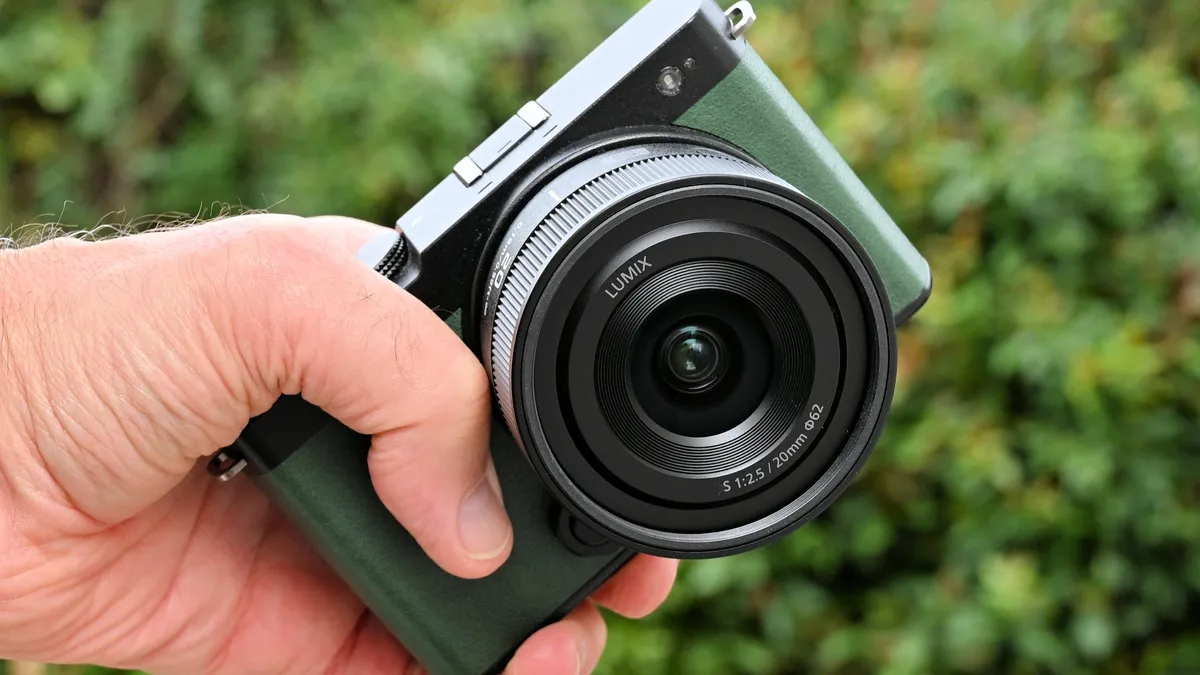
It almost goes without saying but the Panasonic is an autofocus lens, employing the usual stepping motor to drive the requisite elements. It’s a fully internal system, so the front element neither extends nor rotates during focusing. That’s a bonus for handling, especially if you’re using a rotation-specific filter like an ND-grad or circular polarizer. However, the angle of view might be a bit too wide for effective use of a polarizer, as you tend to get an uneven strength of effect across the frame.
Focusing is typically quick and extremely quiet, ideal for both stills and videography. Further video credentials are that the lens is designed to suppress focus breathing, so the field of view doesn’t change when you alter the focus setting. For manual focusing, there’s a control ring with a nicely ridged and grippy surface.
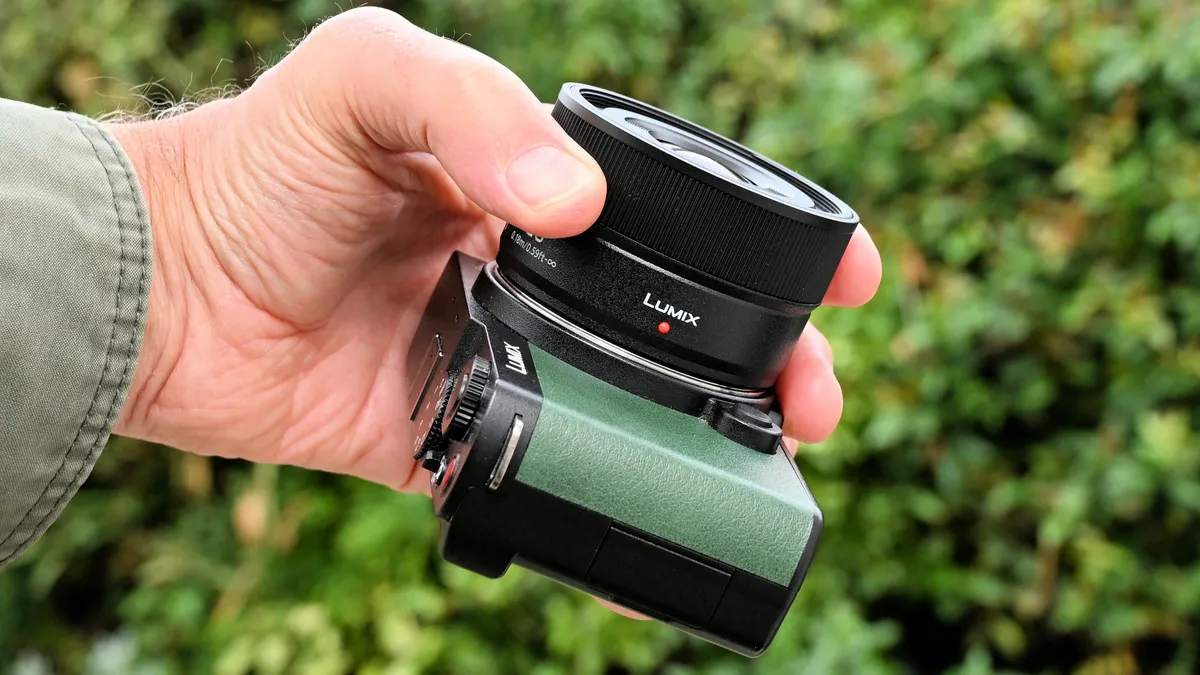
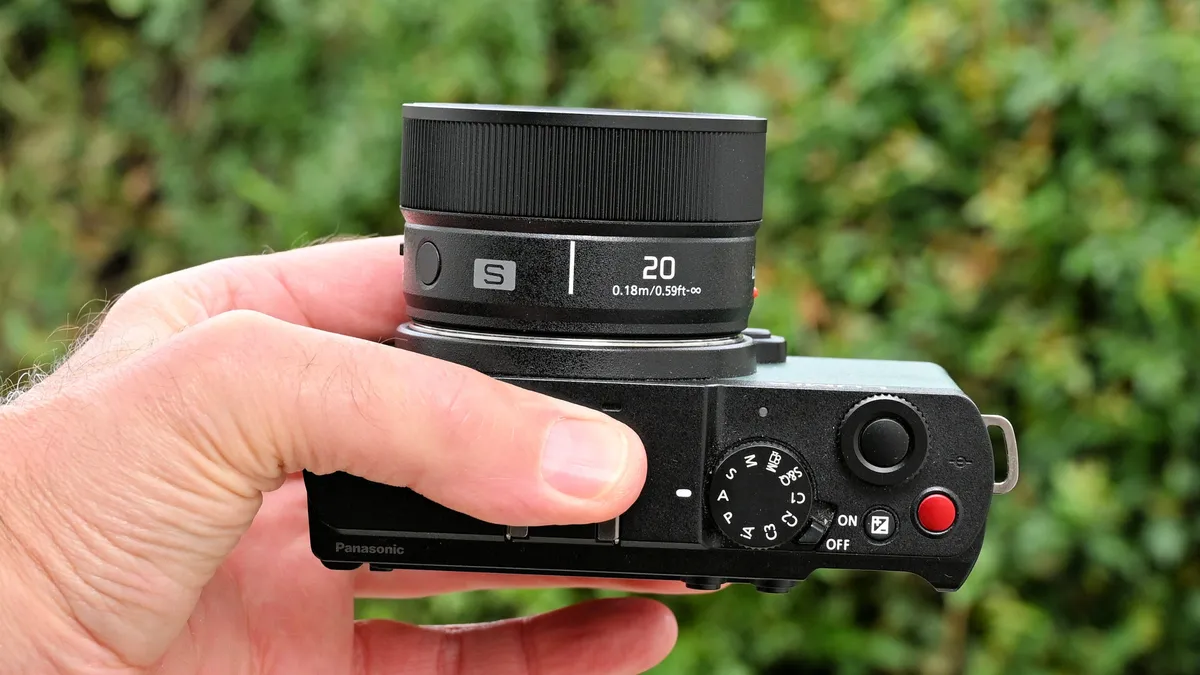
The image below shows how well proportioned the lens is, in relation to the Lumix S9 body. Another small measurement, as written on the side of the barrel, is that the minimum focus distance is a mere 0.18m or 0.59ft, as measured from the image sensor in the camera body. Suffice it to say that there’s some serious close-up potential. That’s great as far as I’m concerned, as I love getting in really close with an ultra-wide-angle lens, to exaggerate the perspective effect. It also puts selfies and vlogging firmly on the agenda, as there’s no problem shooting yourself from arm’s length.
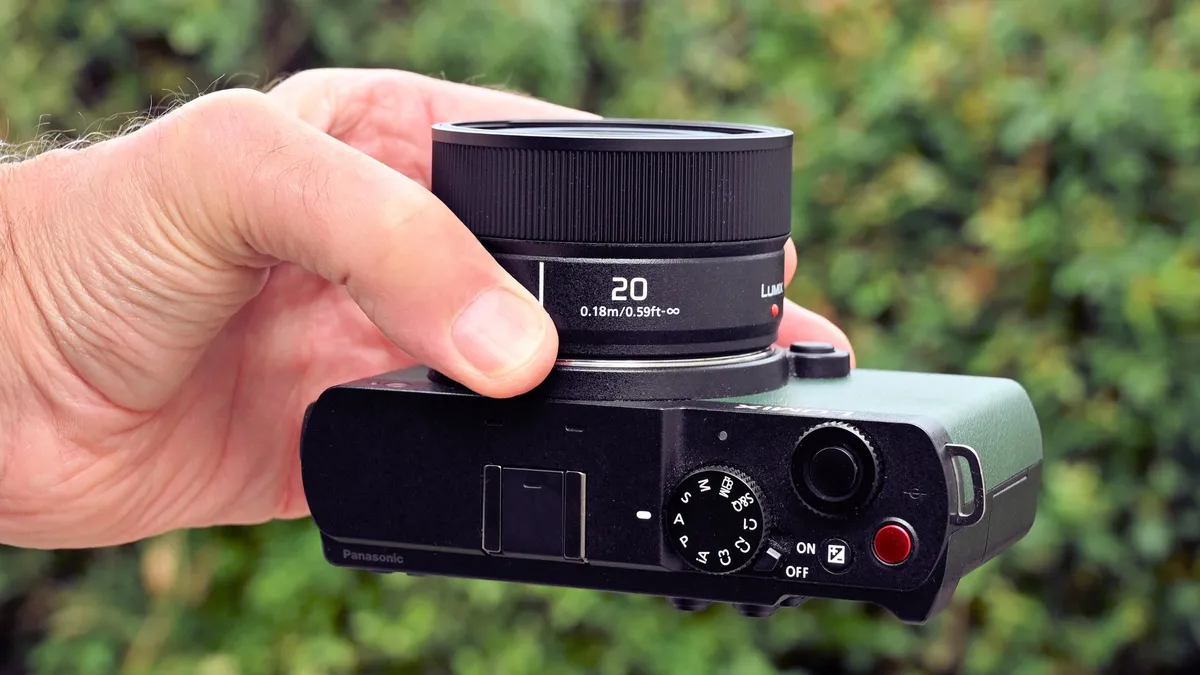
I’ve seen all too many ‘compact’ lenses that use downsizing as an excuse to strip out important features. There’s none of that here, and I’m glad that Panasonic resisted the temptation to do away with an AF/MF focus mode switch. One of my pet hates is having to rummage around in camera menus to make the change, when a simple switch on the lens makes it so much quicker and easier. It’s present and correct in this lens.

As well as the AF/MF switch, there’s also the bonus of a customizable function button. This really is something unexpected on such a small lens but it’s completely in keeping with the design of the companion 40mm, ensuring further similarities in handling characteristics. It’s neat being able to swap between the two lenses without any adjustment to your creative flow. I like that it’s placed on the diagonal, making it easy to get at in both landscape and portrait orientation shooting.
I’d usually use the function button for autofocus-hold/lock but an interesting alternative is Panasonic’s ‘crop zoom’ facility. This enables you to apply a crop factor on the fly, gaining a longer ‘effective’ focal length, albeit with a loss in megapixel count. It’s similar to using the APS-C crop mode featured in many full-frame cameras, although the amount of crop on offer depends on the specific Panasonic camera body.

As I mentioned earlier, the lens has a sturdy metal rather than plastic mounting plate. It comes complete with a weather-seal gasket to guard against the ingress of dust and moisture through the joint between lens and camera body. And as I’d expect nowadays, the electronic data contacts are gold-plated.

Panasonic Lumix S 20mm f/2.5: Performance
Just how much can you squeeze into a really small lens? Quite a lot as it turns out, because the S 20mm has a properly wide field of view. Swap from a typical 24-70mm standard zoom to this lens and the difference is more than obvious as soon as you put your eye to the camera’s viewfinder (not the Lumix S9 actually has one). This makes the lens something of a vlogger’s delight, for which the vari-angle screen of the S9 comes in very handy, with its front-facing facility. The bottom line is that you can capture yourself at arm’s length while shoehorning a lot of the background into the frame, to set the scene. That said, the lens doesn’t go as wide as the same-sized S 18-40mm zoom.

Sharpness is excellent in the central region of the frame but drops off towards the edges and corners when shooting wide-open at f/2.5. Edge-sharpness doesn’t really come on song until you stop down as far as f/8. With the sibling S 40mm lens, I found that I only had to stop down to f/4 for much-improved edge-sharpness. Even so, I’d say that the S 20mm delivers perfectly adequate edge-sharpness at f/4 and f/5.6, even if it’s not entirely great. Sharpness across the entire frame is impressive at f/8 and f/11. Overall, levels of sharpness are very good, considering that the lens crams so much viewing width into such a small and lightweight package.

A bonus for shooting architectural interiors and starry skies is that the f/2.5 aperture can pull in a fair amount of light. Okay, it’s not as fast as many prime lenses but the 20mm is still a little faster than a ‘trinity’ f/2.8 zoom lens. And for reasonably well lit interiors, you can shoot at middling aperture settings for a greater depth of field, and still not need to push your camera’s ISO setting very far, as demonstrated in the image below.

Autofocus proved quick and consistently accurate throughout my testing period. I was impressed by the lens’s sharpness, clarity and color rendition, but there is one sizeable fly in the ointment. Make that two flies… Ghosting and flare. The front optical element is quite small and it’s recessed from the front of the lens barrel. On top of that, there’s a ridged sloping surface that acts as a lens hood of sorts. With that in mind, I wasn’t expecting the lens to be as susceptible to ghosting and flare as it turned out to be.
Panasonic doesn’t supply a hood with the lens, nor does it sell one as an optional extra. You can get around the problem by shielding the lens from stray light with a spare hand, but I reckon you’d be well advised to buy an after-market hood that screws into the 62mm filter attachment thread. Shooting against the light with no hood mounted on this lens can often give rise to the kind of result shown below.

Panasonic Lumix S 20mm f/2.5: Sample Images
The following gallery of sample shots was taken at the East Somerset Railway in the South West of England. It’s a delightful historic railway that’s run as a charity by a friendly bunch of volunteers, and is well worth a visit. Weather conditions were very pleasant on a sunny, late summer morning. The collection of photos was taken outdoors and inside the station buildings and nearby engine shed.


Panasonic Lumix S 20mm f/2.5: Lab Results
We run a range of lab tests under controlled conditions, using the Imatest Master testing suite. Photos of test charts are taken across the range of apertures and zooms (where available), then analyzed for sharpness, distortion and chromatic aberrations.
We use Imatest SFR (spatial frequency response) charts and analysis software to plot lens resolution at the center of the image frame, corners and mid-point distances, across the range of aperture settings and, with zoom lenses, at four different focal lengths. The tests also measure distortion and color fringing (chromatic aberration).
Sharpness:

Sharpness in the central region is superb, even wide open. We'd expect a marked reduction in sharpness as you move out towards the corners of frame, as this is inevitable when shooting our large, flat test chart at such a close distance. However, sharpness drops off particularly steeply with the Panasonic 20mm, especially at larger apertures - you'll need to stop down to f/8 to get decent sharpness across the entire image frame.
Fringing:

Fringing is very well controlled at all apertures and across the whole frame - it won't be visible in general shooting.
Distortion: -5.52
The lens produces significant barrel distortion, but this is corrected automatically by firmware.
Panasonic Lumix S 20mm f/2.5: Verdict
I’m mostly impressed with the Panasonic Lumix S 20mm f/2.5. For me, the main attraction is that it shoehorns a generously wide viewing perspective into a compact and incredibly lightweight build. The combination is all I could wish for when picking a prime lens for walkabout, street and travel photography. And while it’s superlatively lightweight, the Panasonic doesn’t skimp on features and build quality. Handling extras include an AF/MF focus mode switch and customizable function button, while the construction includes a metal mounting plate and multiple weather-seals.
Although lacking any zoom facility, it’s a very versatile lens, catering to landscape and cityscape photography, architectural interiors, selfies, vlogging and much more besides. I’d give it full marks for sterling performance wrapped up in a diminutive and travel-friendly construction, but I’ve knocked the rating down a bit because edge/corner-sharpness is a little lacking at wide apertures, and the lens is very susceptible to ghosting and flare. Stop down a little and shield it with a spare hand against oncoming light, or buy an aftermarket hood, and you’re good to go.
Features ★★★★☆ |
Useful features include a fairly fast aperture, close focusing, AF/MF switch and customizable function button, but there’s no dedicated aperture control ring. |
Design ★★★★½ |
The crafty design packs an immersive wide-angle perspective into a remarkably compact and lightweight, yet robust and weather-resistant build. |
Performance ★★★★☆ |
The autofocus system is swift and consistently accurate. Image quality is mostly very good but the lens is susceptible to ghosting and flare. |
Value ★★★★☆ |
I feel that the lens is fairly priced but it’s not particularly excellent value for money. |
Overall |
★★★★☆ |
Alternatives