



Digital Camera World Verdict
The Yashica City 200 gives me a sense of déjà vu. I’ve seen something very similar before, in the slightly more slimline guise of the Yashica City 100. This is essentially the same camera, but with a 10x optical zoom lens, rather than a 3x zoom lens. It feels and works better than many really cheap digital cameras and the flip-around screen is useful for selfies and vlogging, but it’s not going to win any prizes for image quality.
Reasons to buy
- +
Flip-around screen
- +
10x optical zoom lens
- +
Fairly inexpensive
Reasons to avoid
- -
Mediocre image quality
- -
No touchscreen
- -
No viewfinder
- -
Quite chunky
Why you can trust Digital Camera World Our expert reviewers spend hours testing and comparing products and services so you can choose the best for you. Find out how we test.
Yashica made its first camera all the way back in 1953 – a twin-lens reflex, no less. The City 200 is a different kettle of fish entirely. It’s designed as a point and shoot compact for Gen Z snappers and while it’s never going to be one of the best compact cameras, nor one of the best retro cameras, it strives to be one of the best cheap cameras for anyone who wants a bit of photo fun on a tight budget.
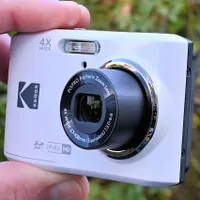
I’ve seen some pretty dire cheap cameras over the last year or so, promising 50+ megapixel resolution but serving up images and video that were only fit for the bin. The Yashica City 100 is a cut above those in terms of build, handling and performance, and the City 200 raises the bar a little higher, with a more versatile 10x rather than 3x zoom lens. Like the Kodak PixPro FZ45, AgfaPhoto Realishot DC8200 and Minolta MND25, the Yashica comes from a famous name with a lot of photographic heritage. However, those names have all been sold on, the cameras themselves having nothing to do with the original companies.

Yashica City 200: Specifications
Photo Resolution |
72MP (13MP native) |
Video Resolution |
5K30 |
Image Sensor |
13MP, 1/3" CMOS |
Selfie mirror |
Flip screen |
Display |
2.8-inch flip LCD |
Touchscreen |
No |
Battery |
Li-ion |
Connections |
USB-C, Mic |
Size (WHD) |
107 x 62 x 73mm |
Weight |
238g |
Yashica City 200: Price
Compared with ultra-cheap plastic digital cameras, the Yashica City 200 costs relatively serious money. It sells for around $300 / £255 / AU$524, which is around three times as much as the Kodak PixPro FZ45. It also costs a bit more than the Yashica City 100, which sells for around $260 / £195 / AU$443. That’s the price you pay for that more powerful 10x zoom lens.
Yashica City 200: Design & Handling
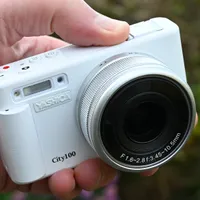
Color, like taste, is a matter of personal preference. Like the City 100, the City 200 is available in black or white, the latter with a metallic silver color lens barrel. You’d think that with a 10x rather than 3x optical zoom range, the lens of the City 200 would be chunkier, and you’d be absolutely right. Even so, it’s not overly large. However, the lens isn’t retractable in either camera, making them a bit large to slip into a spare pocket.

That 10x optical zoom range stretches from 33.8-338mm in full-frame terms. Compared with the effective 25.4-76.3mm effective zoom of the City 100, it’s noticeably less wide-angle at the short end, but naturally very much powerful at the long end, giving serious telephoto reach. That’s quite a compelling argument for using the City 200 in preference to shooting stills and video on your mobile phone. Another notable difference is that the City 100 has a twist-action zoom ring on its lens, whereas the City 200 has a rocker switch on its top panel for operating the zoom, which is motorized in both cases.

Let’s lift the hood and check out the image sensor at the heart of the camera. We’re back in step with the City 100 again, as both feature exactly the same, physically small 1/3-inch Sony image sensor with a native resolution of 13 megapixels. Yashica follows suit with a lot of other makers of low-budget cameras, in advertising them as capable of delivering 72 megapixel still images. That outlandish claim is based on a lot of digital interpolation and is rather misleading as far as I’m concerned, but at least Yashica redeems itself by also clearly stating the ‘actual’ megapixel count of the image sensor.

There’s more to the front of the camera than just the 10x zoom lens. It also sports a small built-in flash module and a sculpted hand grip. A secure grip comes in very handy, considering the long telephoto reach of the lens and the camera’s lack of image stabilization. To the right and to the left, there are two pairs of holes on the side panels for attaching the supplied wrist strap, suiting both right-handers and left-handers. I like that a wrist strap is included as part of the kit, along with a cord for attaching the lens cap. The latter is useful as the magnetic lens cap can be accidentally knocked off and would otherwise be lost quite easily.

The camera isn’t limited to its tiny built-in flash, as it has a hot-shoe on its top panel for attaching a separate flash. Unlike the ‘range-topping’ City 300 camera, however, the additional flash module isn’t supplied as part of the kit. Next to the hot-shoe is a built-in microphone for video capture. Another upgrade over the cheapest cameras out there is that the City 200 has a socket for an external mic. There’s also a USB-C port for charging the battery and downloading images and video clips.
Inherited from the City 100, buttons on the top panel include a shutter release with half-press action for autofocus and metering, video recording start/stop, mode selector, AEL/AFL (auto exposure lock and autofocus lock) and power on/off. The City 200 also adds a rocker switch for motorized zoom.

The choice of shooting modes is expansive, including full ‘intelligent’ Auto, Program, Shutter-priority, Scene modes, Macro and Movie. Dig a little deeper and you’ll also find that the scene modes include options for landscape, portrait, sports, night portrait, night scene, food, sunset, backlight and high-ISO. All in all, the modes cater to a diverse range of shooting scenarios and preferences.

Most of the back panel’s real estate is taken up by a 2.8-inch LCD screen. It’s not a touchscreen, which is only to be expected at this price point. Unlike in many cheap cameras, however, it’s a flip-around screen which is fairly unusual for the price bracket. Advantages include being able to shoot around corners, but the main bonus is that it works as a front-facing screen for taking selfies and vlogging.

Simple but effective, the control layout on the back panel includes a 4-way pad for access to display options, exposure compensation, +/- and an OK button at its center. You also get Info, Menu, Playback and Trash buttons. In keeping with its target audience, the menu system is simple and intuitive, ideal for beginners.

The bottom panel of the camera includes a tripod mounting socket with a standard 1/4” thread, which is sadly lacking in some small compact cameras. A locking flap uncovers the rechargeable Li-ion battery that’s supplied with the camera, and a slot for a microSD card, which isn’t supplied so you’ll have to buy one separately.

Yashica City 200: Performance
Photos taken under good lighting look vibrant and richly saturated, even in the standard picture style. There’s also a wealth of scene modes and ‘filter’ options (picture styles) like vivid, natural, monochrome and several more, to tailor the treatment. However, there’s no RAW capture option, so you need to choose between filter options wisely at the shooting stage.
As with the City 100, I found that the camera was rather prone to purple color fringing. The City 200’s much bigger ‘effective’ zoom range of 33.8-338mm, compared with the City 100’s 25.4-76.3mm sounds an attractive proposition but you lose out on wide-angle coverage. Another minus point is that sharpness and the retention of fine detail and texture drop off towards the long end of the zoom range. The lack of image stabilization can also impact on long-zoom sharpness in practical terms.
The following gallery of images demonstrate the overall zoom range, taken of the same scene from the same vantage point, starting off with the most wide-angle setting and stepping through to the most telephoto focal length.


The Achilles heel of many inexpensive cameras with small 1/3” image sensors is low-light performance, or rather the lack of it. There’s actually a pretty generous sensitivity range on offer, of ISO 100-3200, along with an Auto ISO option. I shot the following sequence of a motorcycle model under low-level indoor ambient lighting, at all manual sensitivity settings from ISO 100 to ISO 3200. As I’d expect, images become noisier at higher ISO settings, with a progressive loss of fine detail, but the Yashica doesn’t do too badly compared with similar cameras.


The advertised maximum resolution of 72 megapixel sounds too good to be true and that turned out to be the case in my tests. I found no good reason to bump up the resolution from the Sony image sensor’s native 13 megapixels of its Sony sensor. The higher you go in megapixel count, the more obvious interpolation becomes, with images looking pixelated and blotchy, with diagonal lines becoming jaggy. Ultimately, it’s best to stick with a lucky number 13.
Yashica City 200: Sample Images
The following example shots were taken in the English city of Wells, including the marketplace, Bishop’s Palace Gardens and the cathedral. Weather conditions for all of the outdoor shots was bright and sunny, while the interior shot of the cathedral was taken with just indoor ambient lighting.


Yashica City 200: Video
Along with its ambitious claim of 72 megapixel stills, the Yashica promises 5K30 and 4K60 video capture. I found no benefit in going beyond 1080p and, even then, there’s nothing much to be gained from sticking with the base video resolution of 720p. Image stabilization is on the menu for both stills and movie capture but I didn’t find any practical advantage when switching it on. The example video footage below is a short clip taken at 1080p. Video quality is generally acceptable but nothing special, as with competing low-budget compact cameras.
Yashica City 200: Verdict
By and large, I think you get what you pay for with the Yashica City 200. It’s a relatively inexpensive point-and-shoot compact camera with a 10x optical zoom lens. It’s quite fun to use and picture quality is pleasantly bright and vibrant for shots taken under good lighting conditions. Sharpness drops off towards the long end of the zoom range but is still acceptable for snapshots. The flip-around screen is a bonus for selfies and vlogging but I miss the greater wide-angle potential of the Yashica City 100 for this sort of shooting.
Features ★★★★☆ |
The 10x optical zoom lens is versatile and the flip-around LCD screen adds potential for selfies and vlogging. |
Design ★★★★☆ |
Build quality doesn’t feel particularly robust but the design works well with a decent layout of controls. |
Performance ★★★☆☆ |
With good lighting, image quality is pleasing with good vibrancy and color rendition, but long-zoom sharpness is mediocre. |
Value ★★★☆☆ |
This camera costs considerably more than many ‘cheap’ compacts but I think it’s worth the extra and is reasonable value. |
Overall |
★★★½ |

Alternatives