






Digital Camera World Verdict
For astrophotographers looking to travel light — or spend less time setting up — the DwarfLab Dwarf Mini is a tempting solution. It doesn’t offer the resolution or flexibility of a full imaging setup, but for wide-field targets, solar and lunar imaging, and deep-sky snapshots, it’s hard to resist. Built-in equatorial tracking for up to 90 seconds, and stacked exposures are of particular appeal to the astrophotographer – as is the ability to observe the sun without the need for additional purchases.
Reasons to buy
- +
Genuinely compact and lightweight
- +
Excellent automation and app control
- +
Built-in filter wheel
- +
Included solar filter
- +
EQ tracking mode for extended exposures
Reasons to avoid
- -
Low 2MP resolution
- -
Four-hour battery life
- -
No tripod or carry case included
- -
Stellar Studio processing is slow.
Why you can trust Digital Camera World Our expert reviewers spend hours testing and comparing products and services so you can choose the best for you. Find out how we test.
While many smart telescopes focus on ease of use at the expense of precision, the DwarfLab Dwarf Mini carves out a different niche. With its flask-sized form factor and basic resolution, it’s clearly not aiming to replace a full-size astrophotography rig, but for those looking for a compact, capable, and self-contained imager to take on the road, it’s a compelling option.
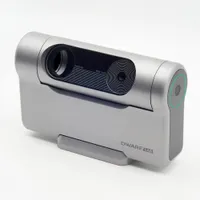
The Dwarf Mini is built around a 30mm f/5 apochromatic refractor, with a Sony IMX662 image sensor and a fully-motorized mount that handles both object tracking and image stacking. Like most smart telescopes, there's no eyepiece — all interaction is via a smartphone app — and it’s designed to make the process of capturing nebulae, galaxies, and clusters as seamless as possible.
From solar imaging with the included filter to deep-sky observations through its built-in filters, the Dwarf Mini performs well across the board, but never excels. Crucially, it supports equatorial (EQ) tracking for up to 90-second exposures.
For more serious astrophotographers — or simply those who want to travel light — this feature alone will set it apart from many of its competitors. For others, the chance to take images of the sun and moon with a pocket-sized device will be enough to justify its place in a camera bag—or even a pocket.

Specifications
Optical design: Apochromatic refractor
Sensor: 1/2.8in Sony IMX662
Resolution: 2 megapixels
Aperture: 1.18 inches / 30mm
Focal length: 150mm / 5.91 inches (f/5)
Field of view: 50.59 x 45.06° (wide) / 2.45 x 2.14° (telephoto)
Battery life: 4 hours (7,000mAh)
Weight: 1.8lb / 840g
Mount type: Motorized alt-azimuth / EQ mode
Accessories: USB-C cable, solar filter
Price and availability

The Dwarf Mini is available for around £359 / $399 / AU$595, making it compete in competition with other entry-level smart scopes like the ZWO Seestar S30. While it undercuts the larger Dwarf 3 and Seestar S30 Pro, it lacks a carry case or tripod (though custom-made add-on products are available from DwarfLab). For astrophotographers who already own tripods and camera bags, these omissions may be irrelevant, as the Dwarf Mini uses a standard 1/4-inch thread (making it compatible with any basic tabletop tripod or travel tripod) and is easy to store in a camera bag or even a jacket pocket.
Build and handling

In the hand, the 1.8lb / 840g Dwarf Mini is surprisingly dense for its size, but remains impressively compact — smaller than most long lenses and easy to pack alongside other camera gear. It’s sensible to use it with a tall tripod to achieve a wide-field view of the night sky, but it’s so small that it can be mounted on a tripod support arm alongside a DSLR or mirrorless camera.
About half the size of a credit card, the included solar filter attaches magnetically and is well-made, though there’s no case or drawstring pouch to protect it from bumps or scratches. More concerning is the lack of any hard case for the scope itself, which would benefit from sturdier travel protection given its purpose-built portability. Again, one is available on the DwarfLab website — though we used a large sock.


One issue we did encounter was with the built-in sky atlas — planetarium software that can be used to locate an object, or frame an image of the wide-field night sky. Although it works very well, it does require an initial large download and often a top-up, so it’s worth logging in to the app while still on WiFi before venturing to a remote location. The same applies to common firmware updates.
Performance
The Dwarf 3 is very easy to use and has some advanced modes that make it much more than a quick-hit novelty device. Initial setup is refreshingly quick. Power on the Dwarf Mini, connect your phone to its WiFi signal and launch the DwarfLab app. When using an iPhone, we did experience some connectivity issues that made the process longer than we had hoped — not something we encountered with an Android device. Once it’s connected, its built‑in star atlas can be used to select a target, with the scope using plate solving to automatically align itself with the night sky to find the object.


Like all smart telescopes, the Dwarf Mini captures short exposures (typically 10 seconds). She stacks them automatically in real time to reduce noise and enhance contrast, producing vibrant, usable images of bright deep-sky objects within minutes. The images improve constantly, but you can’t see the current image until it’s saved. It makes no difference for astrophotography, but it does make it less appealing for outreach when you want to share images of the night sky in real-time.
During testing from a suburban location, we successfully imaged popular winter targets such as the Orion Nebula (M42), the Pleiades (M45), and several open clusters — all from under heavy light pollution.
While the 2MP resolution is modest, results are crisp and colourful on phone and tablet screens. DwarfLab’s own Stellar Studio can make adjustments within the app, though it’s worth noting that this tool only works when connected to the scope, and processing is slow. It’s rather time-consuming and cumbersome, though for open clusters, the “star correction” tool finally plate-solves all the images in the stack and produces a sharp-looking result. It’s also possible for advanced users to export low-res JPEG, mid-res PNG and hi-res FITS files for post-processing.


One standout feature is EQ (equatorial) mode, which allows a telescope to track the sky in sync with Earth’s rotation. Once manually aligned with Polaris — something the app walks you through — the Dwarf Mini can track objects for up to 90 seconds per exposure. That’s a significant improvement over the 15 seconds or so typical of alt-azimuth mounts. This is especially useful for imaging objects near the zenith, where field rotation can cause star blurring and streaking. For more casual users, EQ mode is not strictly necessary. Without it, you still get share-worthy results with minimal effort.
Unlike most smart telescopes, the Dwarf Mini can also be used by day. Solar imaging with the included magnetic filter revealed detailed sunspots. At the same time, results with the moon, both in the day and after dark, were sharp and well-defined considering the scope’s compact optics.


Verdict
For seasoned astrophotographers looking to travel light — or spend less time setting up — the DwarfLab Dwarf Mini is a tempting solution. It doesn’t offer the resolution or flexibility of a full imaging setup, but for wide-field targets, solar and lunar imaging and deep-sky snapshots, it’s hard to resist as a supplementary travel-friendly astro-rig.
Features |
A dual-lens setup, EQ tracking, and a solar filter make this a rig worthy of beginners and advanced users. |
★★★★☆ |
Design |
There’s no tripod or carry case, but with built-in filters and a compact chassis, its design is impressive. |
★★★★☆ |
Performance |
Easy to use and with an intuitive app, it’s quick to set up, and its low-resolution images impress, with its built-in Stellar Studio editing suite helping out. |
★★★☆☆ |
Value |
The Dwarf Mini delivers wide-field, deep-sky, solar, and lunar images for online sharing, with some advanced manual controls. |
★★★★☆ |
Alternatives
Check out our full guide to the best smart telescopes

