Digital Camera World Verdict
The Lomography Lomo MC-A is a genuinely surprising compact film camera. It feels far more premium than Lomography’s usual output, delivers characterful images with solid sharpness, and is a joy to use day to day. It’s not perfect – the autofocus is loud, vignetting is strong, and there are a few ergonomic quirks – but as a modern alternative to aging premium compacts, it’s one of the most compelling new film cameras you can buy.
Pros
- +
Excellent build quality with a genuinely premium feel
- +
Characterful image quality with good sharpness for a compact
- +
Thoughtful modern touches like auto shutdown and rechargeable CR2 battery
Cons
- -
Autofocus is loud and can be jarring in quiet environments
- -
Screen and exposure information feel underutilised
- -
Some minor handling quirks
Why you can trust Digital Camera World Our expert reviewers spend hours testing and comparing products and services so you can choose the best for you. Find out how we test.
Lomography has built its reputation on playful, experimental film cameras that celebrate imperfection. So when the company announced the Lomo MC-A, a sleek, metal-bodied 35mm compact that looks far more Contax than Diana, I was immediately curious. This is Lomography clearly trying to appeal to photographers who love film but also value good design, and dependable, everyday usability.
After spending time shooting with the MC-A, I can safely say this is one of the most refined cameras Lomography has ever made – though it isn’t without a few quirks that remind you of its lo-fi roots – but it surprised me how much I enjoyed shooting with this camera, and how close I am to adding one to my own camera collection.

Specifications
Film Format |
35mm |
Lens |
32mm Minitar-II |
Available Apertures |
f/2.8, f/4, f/5.6, f/8, f/11, f/16 |
Shutter Speed |
Auto 1/500 – 20 s; Manual bulb (B), 1/500 – 1 s |
Available ISOs |
12, 25, 50, 100, 200, 400, 800, 1600, 3200, DX Auto |
Multiple Exposure |
Yes |
Battery |
1 × CR2 (3 V) or CR2 rechargeable (3.7 V) |
Price
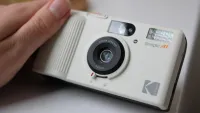
At $499 / £499, it’s safe to say the Lomography Lomo MC-A sits firmly as a more premium compact film camera. It’s priced well above toy cameras and plastic compacts from Lomography or Kodak, but while it undercuts the eye-watering second-hand prices of classics like the Ricoh GR1 or Contax T-series, there are a lot of quality second-hand compact film cameras you can pick up for less than this.
However, given the build quality and features on offer here, the pricing feels largely justified, especially when you consider how scarce and fragile many vintage compacts have become. You don’t have to look hard for tales of broken ribbon cables or burned-out screens on classic models. Here you are getting a new camera, with a warranty and the peace of mind that brings – should anything go wrong.
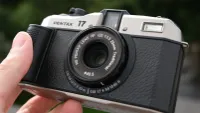
The MC-A also matches the price of the Pentax 17, which, if you want a new camera more advanced than a plastic Kodak point-and-shoot, is really your only other option.
Design & Handling
This is where the MC-A really surprised me. Lomography cameras usually lean into bold colors and quirky styling, but the MC-A is sleek, restrained, and genuinely premium looking. I had the black version to test, and it’s really an attractive object, and honestly, one of my favourite-looking compact film cameras, right up there with the Ricoh GR1 and Contax T3.
The metal body feels substantial in the hand and reassuringly robust. Although I will say the inscription on the top plate, I definitely could have done without it. Personally, it’s a little too “live, laugh, love” for my taste, but that will come down entirely to personal preference. Maybe next time it can just come as an optional decal in the box.
The strap eyelets feel strong and are a good choice, opening the camera up to a lot of third-party straps – the MC-A looked fantastic paired with my Peak Design Form leather strap.

Up top, the most surprising addition is a small screen displaying camera settings. It's a simple design, and is the only way you can check/change the ISO (between 12 and 3200), flash settings, battery, and how many shots you have left on your roll. It can also flash up key settings like shutter speed and aperture when the shutter is half pressed, and show a countdown for a self timer.
However, I do feel that the screen real estate could maybe be better utilised. It has the space to show more information at once, for example, the camera only shows ISO when you press the ISO button, but it could show it all the time, as a lot of the space is otherwise empty. Exposure compensation is also shown only as a symbol, rather than an actual numerical value. I’d prefer to at least have the option to switch between a simple view and a more information-overloaded setting.

Operationally, the camera is excellent. Auto shutdown is a great touch, both saving battery life and protecting the lens by retracting it into the body. The lens has a 32mm focal length, so it is a balanced option for street and travel, as well as group shots. The lens also has a filter thread for attaching UV, polarising, or ND filters.
Available apertures are f/2.8, f/4, f/5.6, f/8, f/11, and f/16, paired with a 1-500 second shutter speed. The aperture markings around the lens ring are clear, but some are quite close together, so I occasionally had to triple-check which setting I was in, as often it isn't immediately clear which number is the most upward.
The inset wind lever looks great and feels equally good to use, with a smooth, satisfying action, and it being inset into the camera body means the MC-A can keep a sleeker profile. I didn't have any of the issues with the lever not winding far enough and stopping me from shooting that some reviewers have reported, although there were some overlapping frames in my developed film (jump to the next section for more on that).
The buttons are a little on the small side, but not annoyingly so, and are easy to press with responsive feedback. Dials hold their position well and have a satisfying click to them. They didn’t easily slip about when being pulled in and out of my pocket, although they were easy to turn with just a thumb or finger.

Autofocus was pretty spot on. I shot four rolls of film with the MC-A, and the only time it missed focus was when I got too close to my subject (I need to practice my distances). The autofocus is not subtle; it is a little loud and piercing, and in quiet environments it can be jarring. Other vintage compact cameras’ autofocus is also noisy, but in 2026, I kind of hoped modern technology might have solved that problem.
As well as autofocus, the camera has manual focus using a zone focus system accessed with a dial on the front of the camera. Although I stuck mostly to autofocus for this review, I tried a few shots, and the zones seem to be accurate.
The viewfinder, while functional, is cramped, and the internal LED lights reflect around the frame more than I’d like, occasionally making it harder to see clearly.

Film loading is straightforward: push the leader into the spool and close the door. I found it easy, but it might take a little adjustment for anyone used to simpler drop-in systems. However, there is no film advance indicator, so you just have to trust that your film has been properly loaded. The rewind mechanism works well so long as you go in the right direction, with clear tactile and audible feedback when the film comes off the spool.
The door latch is well-designed. You have to lift and twist it to open the camera, and I felt like it would be extremely unlikely that I would manage to do this by accident. The camera also has a tripod thread; however, this is positioned right in the corner, which leaves the camera feeling unbalanced on smaller tabletop tripods, but it is fine on larger ones.
Power comes from a single CR2 battery, which is thankfully still easy to find, although Lomography includes a rechargeable CR2 with a built-in USB-C charging port, which I didn’t know where a thing, but glad that they are!

Performance
Image quality surprised me a lot, if I'm honest, just expected this to have more of Lomography's usual lo-fi camera vibes. But instead, images are very much in line with what I’d expect from a lot of compact film cameras. You can get cleaner, sharper results from an SLR with big lenses packed with more glass elements, but photos from the MC-A look pretty great.
Wide open, there can be some strong vignetting, which, depending on your take, either gives images a distinct character or ruins them, but I don’t mind it here and plays into the lo-fi Lomo vibe. Corners are soft at maximum aperture but improve noticeably when stopping down, while central sharpness remains solid throughout.


Overall, the MC-A produces images with character, sharp enough to look far more premium than a toy camera or cheap plastic point-and-shoot, but not clinically perfect. Although this still won't be everyone's cup of tea, I think it strikes a good balance between the photos Lomography cameras might usually be known for and a more standard film compact.
My only major gripe was that there were a few instances of slightly overlapping frames, with it happening once or twice per roll. Although I can’t attest to whether it was just my copy or a wider issue with the camera, other reviewers have noted a few issues with the wind lever as well. It wasn’t frequent enough to put me off the MC-A, but it’s worth noting if you’re expecting absolute mechanical precision.
Editor's Note: Lomography has confirmed that this is a known issue with some early pre-production samples, and it should be fixed in the final version.


Sample Images
Below are sample images all taken on the Lomo MC-A. I have included a little of the film borders, so you can peek at the sharpness and vignetting right up to the edges of the frame.


Verdict
The Lomography Lomo MC-A is a fascinating and surprising camera. It’s far more refined and premium than I expected, and in many ways feels like Lomography’s most “serious” camera to date. The build quality is excellent, the design is genuinely lovely, and the shooting experience is mostly a joy.
There are minor frustrations – the loud autofocus, some vignetting, and a few ergonomic oddities – but none of them fundamentally undermine the experience. If you’re looking for a modern, reliable alternative to aging premium film compacts, and still with a little character baked into your images, the MC-A is one of Lomography’s strongest efforts yet, and one I am considering adding to my own film camera rotation.
Features ★★★★☆ |
The MC-A offers a classic film compact with solid set of modern conveniences. |
Design ★★★★½ |
Sleek, premium, and beautifully built, the MC-A is easily one of Lomography’s best-looking and best-feeling cameras to date. |
Performance ★★★★☆ |
Image quality is sharp and characterful for a compact, let down only slightly by a loud autofocus and minor mechanical quirks. |
Value ★★★★½ |
Pricey compared to some second hand options, but justified by its build quality, warranty, and the peace of mind of buying new. |
Overall |
★★★★☆ |

Alternatives