Digital Camera World Verdict
The Panasonic Lumix S 18-40mm f/4.5-6.3 is a very likeable lens. Some like it hot, some like it wide. If you fall into the latter category as a vlogger or someone who majors on shooting landscapes, cityscapes, architectural interiors or real estate, there’s a lot to like about this lens. Firstly, there’s not a lot of it – it’s amazingly compact and lightweight with its retractable design, yet its zoom range offers generous wide-angle coverage stretching to a near-standard focal length. Build quality and performance are good for such a keenly priced zoom lens, but edge-sharpness could be better.
Pros
- +
Compact, retractable design
- +
Very lightweight
- +
Useful wide-angle zoom range
- +
Weather-resistant build
Cons
- -
Lackluster edge/corner-sharpness
- -
Slow long-zoom aperture
- -
Basic handing
- -
No lens hood
Why you can trust Digital Camera World Our expert reviewers spend hours testing and comparing products and services so you can choose the best for you. Find out how we test.
The Panasonic Lumix S 18-40mm f/4.5-6.3 was launched back in October 2024, coming to market as the ‘world’s smallest and lightest zoom lens for full-frame cameras’. Perhaps not surprisingly, it’s a kit lens option for the Panasonic Lumix S9, which also happens to be the smallest and lightest full-frame camera in the Lumix S-series line-up. Indeed, we recently carried a story on how shooting with this combination feels more like using a point-and-shoot camera, and that the kit is actually less expensive than some of the best compact cameras.
Naturally, there’s no telephoto ability shoehorned into this ultra-compact, retractable and amazingly lightweight zoom lens. As such, the long-end focal length falls short of classic standard zooms like the Panasonic Lumix S Pro 24-70mm f/2.8. The flipside is that the S 18-40mm is only about a quarter of the price to buy, and that’s if you purchase it separately instead of as part of a kit with a camera body. For vlogging, landscapes, cityscapes, architectural interiors or shooting for real estate, the extra wide-angle coverage will be far more beneficial than extra telephoto reach. With that in mind, the S 18-40mm aims to be one of the best wide-angle lenses for L-mount cameras, especially if you want to travel light and to keep your costs down.

Panasonic Lumix S 18-40mm f/4.5-6.3: Specifications
Mount options |
L-mount |
Lens construction |
8 elements in 7 groups |
Angle of view |
100-57 degrees |
Diaphragm blades |
7 |
Minimum aperture |
f/22-32 |
Minimum focus distance |
0.15m (W) 0.35m (T) |
Maximum magnification |
0.28x at 21mm zoom |
Filter size |
62mm |
Dimensions |
68x41mm / 2.7x1.6in |
Weight |
155g / 5.5oz |
Panasonic Lumix S 18-40mm f/4.5-6.3: Price
A quick glance at the price tag reveals that the Panasonic Lumix S 18-40mm f/4.5-6.3 represents a frugal purchase, at just $548 / £519 / AU$899. The zoom range certainly isn’t a million miles away from the (also compact) Panasonic Lumix S 20-60mm f/3.5-5.6, but that lens is pricier to buy at $640 / £619/ AU$1,149, as well as being more than twice the physical length and more than twice the weight, at 77x87mm / 3.1x3.4in and 350g / 12.4oz.
The next own-brand step up in price and size is the less wide-angle but faster, constant-aperture Panasonic Lumix S 24-60mm f/2.8 at $1,048 / £899 / AU$1,609, weighing in at 84x100mm / 3.3x3.9in and weighing 544g / 1.2lb. There are also a couple of relatively compact and lightweight independent zooms to consider, namely the Sigma 16-28mm f/2.8 DG DN Contemporary at $989 / £799 / AU$1,700 and the Schneider-Kreuznach LK Samyang AF 14-24mm f/2.8 at $1,199 / £1,050 / AU$1,999, both of which are also available in Sony E-mount as well as L-mount, the latter suiting Panasonic S-series cameras.
Panasonic Lumix S 18-40mm f/4.5-6.3: Design & Handling
Thinking of design and handling, my mind wanders back to the dawn of Panasonic’s first foray into the full-frame mirrorless market. There were criticisms that the initial cameras were big and hefty, more like DSLRs than comparatively slimline mirrorless models. The company has been steadily addressing that issue with smaller subsequent camera body launches, especially the decidedly compact Panasonic Lumix S9.
There’s also been a lot of downsizing of lenses over recent times, and this 18-40mm is a standout example of just how small and lightweight they can be, at just 68x41mm / 2.7x1.6in and 155g / 5.5oz.

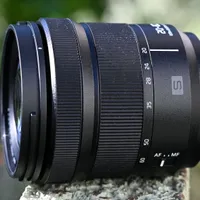
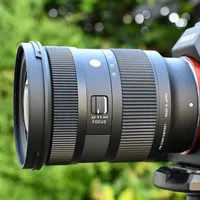
A physical length of about one and a half inches is seriously short for any full-frame lens, prime or zoom – almost sneaking into pancake territory. However, you have to take into account that the Panasonic has a retractable design. So while it’s amazingly small for stowage, it does extend considerably when in use. The images above and below show how the lens looks in its retracted and extended states.

A further indication of the lens’s compact size is that it has a modest 62mm filter attachment thread at the front. And despite being small, the lens boasts sturdy build quality, featuring Panasonic’s usual resistance to dust, splashing and freezing. The front element also has a water/oil-resistant fluorine coating.

One thing you won’t find up front is a lens hood. I originally thought that Panasonic was following the lead of some other camera manufacturers, by selling the hood as an optional accessory rather than including it with the lens. As it turns out, there’s simply no official hood, even as an optional extra, so if you feel the need for one you’ll have to buy an independent hood that can screw into the 62mm filter thread.

Getting past the fluorine-coated front element, the lens is based on a modest count of eight elements in total, arranged in seven group. Keeping the quantity of elements down to a minimum helps with the compact and lightweight design. To enable this, there are no less than three specially shaped aspherical elements in its optical path. There are also two ED (Extra-low Dispersion) elements and one UHR (Ultra High Refractive) element in the chain, to help enhance contrast and clarity while minimizing color fringing.

The zoom range is pretty modest, as I’d expect from such a compact lens. It does however kick off at a generously wide viewing angle of 100 degrees. That can be ideal not only for landscape and architectural photography, but also for vlogging when you want to put yourself in front of the camera and include your surroundings to set the scene. Although the lens has a wide maximum viewing angle, it’s less ideal for astrophotography, due to its pedestrian aperture rating. The aperture itself is adjusted by a 7-blade diaphragm, so it’s not overly well-rounded.

Autofocus is typically quick and near-silent for a linear stepping motor-based system, with the usual electronically coupled manual focus ring. A useful handling extra is the AF/MF focus mode switch, which saves you having to negotiate camera menus to make the change. The minimum focus distance is 0.15m at the wide-angle end of the zoom range, stretching to 0.35m at the telephoto end. The maximum magnification factor is a pretty healthy 0.28x, achieved at a focal length of 21mm.

Although there’s no lens hood, a pinch-style front cap is included with the lens. Usually, this would enable removal and fitment with the hood fitted in its front-facing orientation, but its familiar workings are worth having either way. Moving from front to back, the lens has a metal rather than plastic mounting plate, despite the design focusing on lightness of weight, and the plate includes a weather-seal gasket.

Panasonic Lumix S 18-40mm f/4.5-6.3: Performance
The first thing you notice when you put your eye to the viewfinder, or rather the rear screen if you’re coupling the lens with the Lumix S9, is that the maximum viewing angle is truly expansive for such a little lens. You can shoehorn a lot of subject matter into the image frame at the shortest zoom setting of 18mm, even if the longest focal length of 40mm doesn’t cover any real distance in telephoto terms.

Sharpness in the central region of the frame is very good, although it pays to stop down a little at both ends of the zoom range. Away from the central region, sharpness is less impressive and it’s quite mediocre towards the edges and corners of the frame. Unlike with center-sharpness, there’s nothing to be gained by stopping down a little. Indeed, at most focal lengths edge-sharpness can actually get a little worse at medium aperture settings. For the sake of comparison, the images shown above and below are of the same scene, shot from the same position and taken at the shortest and longest zoom settings.

I was pleased to see that the lens is very resistant to ghosting and flare, even when shooting against the light. That’s an important factor, considering that Panasonic doesn’t offer a hood for the lens, even as an optional extra. One thing that’s entirely expected for such a compact wide-angle lens is that it relies heavily on automatic in-camera corrections for distortion, especially at the short end of the zoom range. That’s par for the course nowadays, with recent lens designs for mirrorless cameras, but it does enable a relatively small build.

Living up to its billing, autofocus is fast, near-silent and consistently accurate. Clarity, contrast and color rendition are all impressive but there’s one area in which the lens definitely doesn’t excel. The wide-angle to near-standard zoom range coupled with a fairly slow f/4.5-6.3 aperture rating makes it difficult to isolate subjects within a scene by using a narrow depth of field. I invariably found it hard to blur the background, even when shooting at the widest available apertures.

Panasonic Lumix S 18-40mm f/4.5-6.3: Sample Images
The following gallery of sample images was shot in and around the Floating Harbour, Underfall Yard and Wapping Wharf in the English city of Bristol. Most of the images in the sequence follow in pairs, taken at the shortest and longest zoom settings, to demonstrate the overall zoom range of the lens and the image quality in both scenarios.


Panasonic Lumix S 18-40mm f/4.5-6.3: Lab Results
We run a range of lab tests under controlled conditions, using the Imatest Master testing suite. Photos of test charts are taken across the range of apertures and zooms (where available), then analyzed for sharpness, distortion and chromatic aberrations.
We use Imatest SFR (spatial frequency response) charts and analysis software to plot lens resolution at the center of the image frame, corners and mid-point distances, across the range of aperture settings and, with zoom lenses, at four different focal lengths. The tests also measure distortion and color fringing (chromatic aberration).
Sharpness:


Levels of sharpness are good in the central region of the frame but less impressive in the area outside of this, and disappointing out towards the edges and corners of the image frame. Edge/corner-sharpness tends to get worse at medium aperture settings throughout the zoom range, compared with shooting wide-open, which is rare.
Fringing:

Color fringing is controlled very well, and hard to spot when shooting at any combination of focal length and aperture setting, even out at the extreme edges and corners of the image frame.
Distortion:

There’s a little pincushion distortion in the 35-40mm sector of the zoom range and noticeable barrel distortion at 24mm. Barrel distortion is extreme at the shortest zoom setting of 18mm. However, it’s a bit of a moot point because, as with many lenses designed for mirrorless cameras, this one relies extensively on automatic in-camera corrections which effectively take distortions out of the equation.
Panasonic Lumix S 18-40mm f/4.5-6.3: Verdict
I feel that the Panasonic Lumix S 18-40mm f/4.5-6.3 is good in some areas, not exactly bad in others, and never ugly. On my hit list of things I like are the amazingly compact and lightweight, retractable design. Despite this, the lens feels solid and robust, complete with weather-seals, so that’s another tick on the ‘good’ list. The wide-angle to nearly standard zoom range can be really handy for many shooting scenarios, from vlogging and selfies to landscapes, city scenes and real estate. That’s another tick.
Things I’m less enamored with are that edge/corner-sharpness is merely mediocre. The aperture rating is also quite slow at the long end of the zoom range, making it hard to gain a tight depth of field for isolating subjects against a blurred background. The lens is also less than ideal for use under low lighting, and a bit of a non-starter for astrophotography.
Back in the harsh light of day, you might also wish that it came with a hood, or at least that Panasonic made one as an optional extra. Ultimately, the S 18-40mm is a very attractive lightweight lens at a keen selling price, but it’s not altogether perfect.
Features ★★★★☆ |
The fairly typical range of features stretches to a stepping motor-based autofocus system and an AF/MF switch, but there’s no lens hood nor a function button. |
Design ★★★★½ |
The lens is amazingly compact and lightweight with its retractable design, but still robust and well built. |
Performance ★★★★☆ |
Like most compact lenses for mirrorless cameras, this one relies heavily on automatic in-camera corrections, but the end results are impressive. |
Value ★★★★½ |
You get a lot of bang for your buck with this zoom lens, whether you’re buying it as part of a camera kit or in its own right. |

Alternatives