




Digital Camera World Verdict
The Viltrox AF 35mm f/1.8 Evo II ticks a whole bunch of boxes on my wish list. For prime, fixed focal length lenses, 35mm is one of my favorites for street photography and everyday shooting. The Viltrox packs that into a compact and lightweight yet robust, weather-resistant build. It also has excellent handling characteristics and performs really well, from the speed and accuracy of its autofocus system to its image quality. And it does all this at a very attractive price, making it a bargain buy.
Reasons to buy
- +
Metal, weather-resistant build
- +
Click/de-click aperture ring
- +
Customizable function button
- +
Compact, lightweight, affordable
Reasons to avoid
- -
Not the ‘fastest’ aperture
- -
No aperture ring lock switch
Why you can trust Digital Camera World Our expert reviewers spend hours testing and comparing products and services so you can choose the best for you. Find out how we test.
I’ve been heavily into Viltrox lenses for a few years now, originally investing in a trilogy of APS-C format Viltrox AF 23mm f/1.4, Viltrox AF 33mm f/1.4 and Viltrox AF 56mm f/1.4 for my Nikon Z fc camera. They’re a perfect fit, being compact and lightweight yet featuring a sturdy metal build and an aperture control ring that fits well with the retro design and handling of the Z fc. These lenses are also available in Canon EF-M, Fujifilm X and Sony E mount options, but have largely given way to the more featherweight, plastic-bodied and ultra-affordable Viltrox ‘Air’ series of lenses for both full-frame and crop sensor cameras, whereas Viltrox ‘Pro’ and ‘Lab’ lenses are the most exotic, up-market lines from the Chinese manufacturer.
Taking the middle ground between Air and Pro / Lab line-ups, I’ve recently been very impressed with the full-frame compatible Viltrox AF 85mm f/2.0 Evo, which was launched in October 2025 and is available in Nikon Z and Sony E mount options. The first of a new series, it aims to combine a metal build and high-end handling with a compact, lightweight design at a bargain price – very much like my older APS-C format lenses. Two more Evo lenses are now available, comprising a 55mm f/1.8 prime, and the 35mm f/1.8 lens that I’m reviewing here. All of them are pretty much the same size and weight, as well as having identical handling characteristics, making it easy to chop and change between them without interrupting your creative flow.

All in all, the 85mm Evo aims to be one of the best portrait lenses, this new 35mm aims to be among the best lenses for street photography, and the 55mm seeks to be one of the best standard primes, each of them also vying to be a bargain at the price. And just to be clear, there was no earlier version of the 35mm Evo lens, the ‘II’ in its title is to distinguish it from a previous Viltrox 35mm f/1.8 lens that was from a different line-up.
Viltrox AF 35mm f/1.8 Evo II: Specifications
Mount options |
Nikon Z (FX), Sony E (FE) |
Lens construction |
13 elements in 10 groups |
Angle of view |
63 degrees |
Diaphragm blades |
9 |
Minimum aperture |
f/16 |
Minimum focus distance |
0.34m |
Maximum magnification |
0.1x |
Filter size |
58mm |
Dimensions |
69x78mm / 2.7x3.1in |
Weight |
350g / 12.3oz |
Viltrox AF 35mm f/1.8 Evo II: Price
Although not as fast as an f/1.4 or f/1.2 prime, the Viltrox AF 35mm f/1.8 Evo boasts excellent build quality, with a metal barrel and mounting plate, complete with multiple weather-seals. It also has high-end handling, including an aperture control ring with a click/de-click switch and a customizable function button. That makes the $395 / £385 (AU$ TBA) asking price a bargain, as far as I’m concerned. Even so, the lens is significantly more expensive than the Viltrox AF 85mm f/2.0 Evo, which retails at $275 / £265 / AU$449.
Viltrox AF 35mm f/1.8 Evo II: Design & Handling
To my mind, the Viltrox AF 35mm f/1.8 Evo II strikes an excellent balance between robustness and compact lightness. Indeed, it feels beautifully balanced and a perfect partnership on my Nikon Z6 III camera body. The metal casing adds a touch of class and rigidity, and the weather-seals add reassurance for shooting in damp or dusty conditions. But that’s not the whole story. The lens is designed as a moderately wide-angle optic for full-frame cameras but thanks to its diminutive dimensions, it also works great as a ‘nifty fifty’ on APS-C format cameras like my Nikon Z fc, where it has an ‘effective’ focal length of 52.5mm.

Up front, the lens has the same 58mm filter attachment thread as the other two lenses in the Evo line-up, making it quick and easy to use the same filters on any of the lenses without the need for step-up or step-down rings. Diving in behind the front element, there’s a fairly complex optical arrangement of 13 elements in total, arranged in 10 groups. These include an aspherical element, two ED (Extra-low Dispersion) elements and three HR (High Refractive index) elements.
The combination aims for optimum sharpness and clarity with accurate color rendition, along with the minimum of unwanted aberrations. Indeed, Viltrox advertises the lens as an APO (Apochromatic) optic, suppressing color fringing and lateral chromatic aberration, which I’ll come to later in ‘performance’.

Some top-flight Viltrox ‘Pro’ and ‘Lab’ series lenses use high-tech Voice Coil Motor systems to power autofocus but this Evo lens employs a more mainstream linear Stepping Motor arrangement. There’s nothing wrong with that, as it’s typically fast, accurate and near-silent in operation. As usual, the manual focus ring is electronically coupled and works with smooth precision.

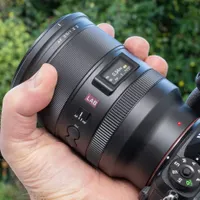
Swapping between autofocus and manual focusing is courtesy of a time-honored AF/MF switch, conveniently situated on the left hand side of the barrel. Just below this is a lens-function button, which falls neatly under the thumb in landscape-orientation shooting. You can generally customize the action of this button via the host camera’s menu system, but I’d generally use it for either AF-On or AF-Hold. It works a treat but there’s no secondary button up on top, which would enable easier access when shooting in portrait orientation mode.

Towards the rear of the lens is a dedicated aperture control ring. This gives access to the entire aperture range of f/1.8 to f/16, and there’s the usual A (Auto) position at the narrow end of the aperture range, for adjusting the aperture from the host camera body instead. The Auto option is essential when shooting in Program and Shutter-priority modes. However, one slight niggle is that there’s no locking switch for confining the ring to its Auto position, so you need to exercise a little care not to nudge it from this setting accidentally.

Nowadays, video capture is usually somewhere on the agenda for even the most stills-focused photographers, at least to some extent. Catering to smooth and silent aperture adjustments, the lens features a click/de-click switch on the right hand side of the barrel. This enables you to switch between one-third f/stop click steps for stills and stepless aperture control when shooting video.

Unlike budget-friendly lenses from some camera manufacturers (I’m thinking especially of Canon and to a lesser extent, Nikon), the Viltrox is supplied complete with a hood. It’s an efficient petal-shaped hood that has the usual bayonet-fit action and is reversible for compact stowage. The front lens cap is a pinch-style affair that enables easy fitment or removal with the hood in its forward-facing orientation.

Moving from front to back, the lens has a metal mounting plate, complete with a rubber weather-seal ring. The plate also plays host to a USB-C port that you can use with Viltrox’s computer-based software for applying firmware updates, if and when necessary. This gives a little extra peace of mind and future-proofing.

Viltrox AF 35mm f/1.8 Evo II: Performance
What I really want from a relatively fast prime lens in terms of performance is a good blend of sharpness and clarity with soft and smooth bokeh. Naturally, depth of field can shrink to small proportions, especially when shooting close-ups at wide apertures, so a consistently accurate autofocus mechanism is also firmly on the wish list.

For sharpness and clarity, I’m impressed that the lens delivers really crisp, detailed images even when shooting wide-open at f/1.8. Meanwhile, the quality of bokeh is beautifully smooth for a 35mm f/1.8 lens, rivalling that of many f/1.4 lenses that I’ve used. The roll-off between focused and defocused areas looks nice and natural, and there’s virtually no lateral or axial chromatic aberration to be seen. The latter, often referred to as ‘bokeh fringing’ can often be a problem with fast lenses. As such, the lens earns its Apochromatic credentials.

To demonstrate the quality of sharpness, smoothness of bokeh, and control over unwanted aberrations, I shot a series of images of a phrenology head against a backdrop of garden plants and flowers. These were taken at all major aperture steps between f/1.8 and f/8. It’s also a good test for axial chromatic aberration, which would show up as colored fringes around the high-contrast black lines on a white background, just in front of or behind the plane of focus. As you’ll see, there’s no problem here, even wide-open at f/1.8.


Viltrox AF 35mm f/1.8 Evo II: Sample Images
The following gallery majors on example shots that were taken in the gardens of the Bishop’s Palace in the English city of Wells, in early spring. The peaceful and beautiful location is highly popular with locals and visitors from far and wide. Throughout this period of testing the lens, I used my Nikon Z6 III camera body.


Viltrox AF 35mm f/1.8 Evo II: Lab Results
We run a range of lab tests under controlled conditions, using the Imatest Master testing suite. Photos of test charts are taken across the range of apertures and zooms (where available), then analyzed for sharpness, distortion and chromatic aberrations.
We use Imatest SFR (spatial frequency response) charts and analysis software to plot lens resolution at the center of the image frame, corners and mid-point distances, across the range of aperture settings and, with zoom lenses, at four different focal lengths. The tests also measure distortion and color fringing (chromatic aberration).
Sharpness:

This lens is seriously sharp even when shooting wide-open at f/1.8, all the way out to extreme edges and corners of the image frame. Things get even better if you stop down to f/2.8 or medium apertures.
Fringing:

Our lab tests revealed noticeable color fringing at the extreme edges and corners of the image frame, at least for uncorrected images. However, the amount of fringing is easily within the remit of automatic in-camera correction, applied to JPEGs and flagged in RAW files.
Distortion: -0.35
It’s not technically a zero-distortion lens but the amount of barrel distortion is so slight that it’ll generally go unnoticed in images, even with automatic in-camera correction disabled.
Viltrox AF 35mm f/1.8 Evo II: Verdict
I’ve come to expect a lot from Viltrox lenses, and for comparatively little outlay compared with equivalent own-brand lenses from various camera manufacturers. Even so, the Viltrox AF 35mm f/1.8 Evo II really comes up trumps with excellent all-metal build quality despite its compact and lightweight construction, along with advanced handling characteristics that include a click/de-click aperture ring and a customizable function button.
More importantly as far as I’m concerned, the autofocus mechanism is fast, near-silent and consistently accurate, while image quality is superb in terms of sharpness and clarity, smooth bokeh and a minimum of unwanted aberrations. All in all, this Viltrox Evo lens is a brilliant buy at the price.
Features ★★★★★ |
There’s a fine feature set for such a budget-friendly lens, including a click/de-click aperture control ring and a customizable function button. |
Design ★★★★★ |
The all-metal casing and mounting plate feel robust and well-engineered, there are weather-seals and the design is nicely compact and lightweight. |
Performance ★★★★½ |
Autofocus is fast and reliably accurate, while image quality is highly impressive in all respects. |
Value ★★★★★ |
Like other Viltrox lenses, this one is standout value for money and you get a great deal for your outlay. |

Alternatives