



Digital Camera World Verdict
The Yashica DigiPix 100 is wonderfully compact and lightweight, ideal for family days out. Better still, it’s so cheap to buy that I have no qualms about passing it around so that the kids can all share in the snap-happy fun. At this price, however, I wouldn’t expect properly good image quality which is just as well, as the little Yashica only features a basic fixed lens and a 5 megapixel image sensor. Suffice it to say that photos look a little lo-fi.
Reasons to buy
- +
Astoundingly inexpensive
- +
Slim, lightweight, pocketable
- +
White or silver color schemes
Reasons to avoid
- -
It’s 5MP, not 44MP
- -
No optical zoom
- -
No flip-around screen
Why you can trust Digital Camera World Our expert reviewers spend hours testing and comparing products and services so you can choose the best for you. Find out how we test.
Yashica is a camera brand that predates me by a few years, so it has a lot of history behind it. The company’s first twin-lens reflex camera came to market in 1953, and the iconic Yashica FX-3 SLR film camera pitched up when I was a teenager in 1979. That FX-3 is now copied by the retro-styled Yashica FX-D 100, 200, 300 and S300 digital cameras, and there’s also a range of more modern point-and-shoot style Yashica City 100, 200 and 300 cameras, all of them badged Yashica but made under license by a Hong Kong-based company that paid for the name.
The Yashica DigiPix 100 camera that I’m reviewing here is the most affordable in the current Yashica stable. I’d go so far as to say that it’s downright cheap to buy. Sure, it only has a relatively humble 5 megapixel image sensor and a basic fixed lens but it’s priced accordingly. All in all, it aims to be one of the best cheap cameras on the market and, considering its bargain basement price tag, maybe one of the best cameras for kids as well.

Yashica DigiPix 100: Specifications
Photo Resolution |
44MP effective (5MP native) |
Video Resolution |
1080p FHD |
Image Sensor |
5MP |
Selfie mirror |
No |
Display |
2.4-inch fixed LCD, 320x240 pixels |
Touchscreen |
No |
Battery |
Li-ion |
Connections |
USB-C |
Size (WHD) |
94x58x24mm / 3.7x2.4x0.9in |
Weight |
256g / 9oz |
Yashica DigiPix 100: Price
What price would you put on treasured memories? I’m used to spending proper money on cameras, always have been. But I’m quite precious about them too. There’s something to be said for a cheap camera that you don’t mind taking on beach holidays with the kids or muddy walks with the dogs, passing it around with family and friends, and generally not worrying if it gets treated without the utmost respect in the process.
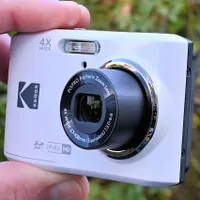
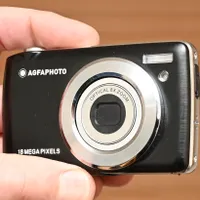
The Yashica DigiPix 100 literally fits the bill perfectly, with a list price of $89 / £67 / AU$119. Put in the context of a weekly shop at the supermarket or a family meal out, this camera is as cheap as chips. Ultimately, the Yashica has an iconic name but is one of the cheapest digital cameras on the market, much like the Kodak PixPro FZ45 at $90 / £94 / AU$169 and the AgfaPhoto Realishot DC8200 at $120 / £99 / AU$149. Those two competitors are actually rather pricier in some world regions but, either way, let’s see if the bargain-basement Yashica is actually worth the money.
Yashica DigiPix 100: Design & Handling
The beating heart of any digital camera is its image sensor, although you could argue a case for throwing the image processor into the mix as well. Depending on where you look, you might see the Yashica DigiPix 100 advertised as a 44 megapixel camera. It’s not. And frankly, I’d be amazed if it was. After all, my high-end, full-frame Nikon Z6 III only has a 24.5MP sensor, little more than half of the megapixels claimed for the Yashica.
As it turns out, the DigiPix 100 actually has a 5 megapixel sensor, which is very low-rent by any standards, in this day and age. Even the Nikon Coolpix 7900 compact camera that I bought more than two decades ago had a 7MP sensor. Even so, I’m happy with 5 megapixels for snapshots and for creating postcard sized prints from digital images. What I’m less enamored with is the growing ranks of cameras that claim exorbitant megapixel counts, when those claims are based on in-camera ‘interpolation’ rather than what’s actually coming off the sensor.

At least Yashica has the good grace to state the ‘actual’ megapixel count as well as the maximum ‘interpolated’ amount. Why does it matter? Software interpolation is notorious for degrading image quality while it goes about its upsizing business. It gives rise to blotchy images that look pixelated and turns diagonal lines in subject matter into zig-zags. I’m not a fan.
Speaking of software interpolation, the camera doesn’t feature an optical zoom lens. It therefore relies on further interpolation to deliver up to 16x ‘digital zoom’. Again, this involves the time-honored process of trying to best-guess what’s in between the pixels that the camera can actually see, or rather the pixels that the sensor can actually record. The lens itself is 7.36mm f/3.2 fixed prime and doesn’t add anything to the overall size of the camera. That’s because it doesn’t extend or retract when switching the camera on or off, and has no optical zoom facility. A plus side of the lens fitting flush with the camera casing is that it makes the camera more pocketable.

Designed for the journey, the DigiPix 100 is a very pocketable camera, which is one of its key strengths. Measuring less than an inch thick and weighing just 9oz, you can stash it away in the smallest of places. That makes it all the better for taking anywhere and everywhere, including places where you’d rather not risk carrying an expensive camera. The front panel of the camera also plays host to a miniature flash but, as I’ve seen in other cheap cameras, it has a very low power rating and isn’t particularly effective.

Up on top there’s a small on/off button and a larger shutter-release button, in the otherwise clutter-free layout. Around the back, there’s a low-res 2.4-inch fixed screen with a paltry 320x240 pixels (0.08 megapixels in total). Unsurprisingly at this price point, the screen lacks a mechanism for tilt, swivel or full articulation, and it’s not a touchscreen. Most of Yashica’s more up-market (or perhaps I should say mid-market) cameras feature a flip-around screen that’s ideal for vlogging and taking selfies.

The control cluster on the back panel features the usual 4-way pad with an OK button at the center, a couple of W/T digital zoom buttons at the top and two more buttons at the bottom. It’s a pretty generic layout that you’ll find in many cheap cameras, so at least the layout looks and feels familiar.

The camera features eyelets for fitting the supplied wrist strap. Other included accessories feature a soft drawstring carrying pouch, a USB cable and even a cartoony keyring. It’s neat that the manufacturer has included a few extras, despite the ultra-low selling price.

Of more practical use, the camera comes complete with a removable, rechargeable Li-ion battery. The big bonus of this is that you can buy additional batteries. Why? Well, the battery is charged in-camera via its USB-C port, so you can’t actually use the camera if it’s plugged into a wall socket via a USB charger, back at home or in a hotel room, while the battery is charging. A spare battery or two will keep you going through the day if you’re out and about.

There’s a flap on the bottom panel of the camera that covers the battery compartment, as well as a microSD slot that takes cards of up to a suggested maximum capacity of 64GB. I’m personally not a fan of microSD cards compared with regular SD cards, as I feel they’re overly thin and flimsy, but they are at least ultra-small and ultra-lightweight.
Yashica DigiPix 100: Performance
The performance of the Yashica DigiPix 100 is somewhat reminiscent of digital cameras from a bygone era. Turn the clock back to the early 2000s and the comparatively low-fidelity and not quite photorealistic image quality that you used to get from some of the first consumer-level digital cameras is similar to what’s on offer here.

For sharpness and the retention of fine detail and texture, I’d recommend sticking with the native resolution of 5MP, rather than bumping up the interpolated resolution to as much as 44MP. It’s actually set at 24MP by default. Each upgrade in terms of interpolated image size represents a downgrade in image quality. The following gallery of sample shots was taken at 5MP, 24MP and 44MP respectively.


Dynamic range is nothing to write home about but is at least sufficient to retain some detail in bright highlights and moderately dark shadows. Color rendition is reasonably vibrant and there are various ‘Effects’ for tailoring the look of images.

As I’d feared, the retention of fine detail really takes a knock when you use large amounts of digital zoom to give a telephoto effect. The following pair of shots were taken at the most wide-angle and telephoto settings respectively.

No zoom
Image credit: Matthew Richards

Maximum zoom
Image credit: Matthew Richards
One of the potential upsides of the low megapixel count of the image sensor is that individual pixels can be larger, with more light-gathering potential. You might therefore expect relatively good high-ISO image quality in low-lit shooting, but this is ultimately limited by the physically small overall size of the image sensor. As it turns out, the maximum sensitivity setting on the menu is a lowly ISO 400. I actually think the designers could have pushed the sensitivity range a bit further, as images are still fairly noise-free and quite detailed at ISO 400. And lest we forget, you could buy faster ISO 800 color negative 35mm film about 30 years ago.

Yashica DigiPix 100: Sample Images
The sample images in the following gallery were taken in and around the Bishop’s Palace Garden in the English city of Wells. A couple of sequential shots were taken at the minimum and maximum digital zoom settings, effectively with no zoom and full zoom.


Yashica DigiPix 100: Video
Pretty much any modern camera can shoot video as well as stills and the DigiPix 100 follows suit, at least to some extent. Again, in keeping with the rock-bottom price, the video specs are pretty humble and moving images are captured in the antiquated AVI format. On the plus side, you can shoot in Full HD 1080p, as used in the following sample clip, even if the camera doesn’t stretch to 4K UHD.
Yashica DigiPix 100: Verdict
As far as I’m concerned, the Yashica DigiPix 100 isn’t a camera for delivering high-quality stills and video. Considering its super-low selling price, I wouldn’t really expect it to. It’s more of a camera to appeal to casual users who want to take family snapshots with a device that’s cheap to buy and easy to use. Unlike with an expensive camera or even a mobile phone, the cheap selling price means I’d have no reservations taking the Yashica on beach holidays and passing it around to share with family and friends of any age and ability.
The camera is nothing if not basic but even so, image quality could be better. There are other cheap cameras out there that make a better stab at quality, whereas the Yashica delivers pictures that look very dated in a low-fidelity kind of way. Ultimately, it’s cheap to buy but I’m not convinced it’s really worth the money.
Features ★★★☆☆ |
There aren’t really any features to get excited about, from the fixed lens at the front to the fixed, very low-res screen at back, and the 5MP sensor in between. |
Design ★★★☆☆ |
In keeping with the price, the Yashica feels cheap and plasticky. A plus point of the basic design is that at least the camera is simple to use and it’s certainly compact and lightweight. |
Performance ★★★☆☆ |
Image quality is lackluster, even by the standards of other cheap cameras, and the same goes for video. |
Value ★★★☆☆ |
Sure, the Yashica is one of the cheapest cameras on the market that’s made by a name (if not an actual company) that you’ve heard of, but it’s still not great value. |

Alternatives