Digital Camera World Verdict
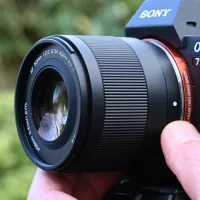
With its compact and lightweight build, the Viltrox AF 55mm f/1.8 Evo gives me a tough choice. Should I use it on my full-frame Nikon Z6 III or my APS-C format Nikon Z fc? The short answer is ‘both’. It works equally well as a full-frame standard prime lens, and as a portrait prime for APS-C format cameras, on which it has an ‘effective’ focal length of 82.5mm. Despite its downsized design, the lens is well-built with an all-metal, weather-resistant construction. Image quality is excellent and, as a Viltrox lens, it’s typically terrific value for money. The 55mm Evo is definitely a keeper as far as I’m concerned.
Reasons to buy
- +
Compact, lightweight, affordable
- +
Aperture ring with click/de-click
- +
Customizable function button
- +
Metal, weather-resistant build
Reasons to avoid
- -
Aperture rating isn’t the fastest
- -
Lacks an aperture ring lock switch
Why you can trust Digital Camera World Our expert reviewers spend hours testing and comparing products and services so you can choose the best for you. Find out how we test.
My Viltrox journey started a few years ago when I bought a matching set of three APS-C format Viltrox AF 23mm f/1.4, Viltrox AF 33mm f/1.4 and Viltrox AF 56mm f/1.4 for my Nikon Z fc camera. I was attracted by the fast aperture, compact and lightweight metal build and the inclusion of an aperture control ring, perfectly suited to the retro styling and control layout of the Z fc. These lenses have become old news, with featherweight, plastic-bodied Viltrox ‘Air’ series lenses at the bottom end of the price scale coming to the fore for both full-frame and crop sensor cameras, while Viltrox ‘Pro’ and ‘Lab’ lenses sit at the top of the tree in terms of quality, performance and asking prices.
Full-frame ‘Evo’ lenses are comparatively new, the first Viltrox AF 85mm f/2.0 Evo prime for Nikon Z and Sony E mount cameras being launched in October 2025. The design ethos is to pack high-end handling characteristics into a compact and lightweight yet robust all-metal build. The initial 85mm lens has now been followed up by 35mm f/1.8 and 55mm f/1.8 Evo lenses, the latter being the one that I’m reviewing here. All three are pretty much the same size and weight and are identical in terms of controls and layout. The 55mm is naturally designed as a standard prime for full-frame cameras but thanks to its dinky dimensions, it’s equally adept as a portrait lens for APS-C format Nikon and Sony cameras, on which it has an ‘effective’ focal length of 82.5mm.

As a kind of new set of ‘trinity’ primes, the three lenses so far include the 85mm Evo which aims to be one of the best portrait lenses, whereas this new 55mm Evo aims to be among the best standard primes and the 35mm Evo sets out to be one of the best lenses for street photography, each of them being extremely competitive on price.
Viltrox AF 55mm f/1.8 Evo: Specifications
Mount options |
Nikon Z (FX), Sony E (FE) |
Lens construction |
13 elements in 9 groups |
Angle of view |
43 degrees |
Diaphragm blades |
9 |
Minimum aperture |
f/16 |
Minimum focus distance |
0.43m |
Maximum magnification |
0.1x |
Filter size |
58mm |
Dimensions |
69x78mm / 2.7x3.1in |
Weight |
385g / 13.6oz |
Viltrox AF 55mm f/1.8 Evo: Price
The Viltrox AF 55mm f/1.8 Evo isn’t the fastest lens around, being either two-thirds or a full f/stop slower than f/1.4 and f/1.2 primes, respectively. Even so, it boasts solid build quality, with a metal barrel and mounting plate, complemented by a set of weather-seals. Handling is high-end, especially for such a budget-conscious lens, with an aperture control ring that has a click/de-click switch. You also get a customizable function button. If performance and image quality turn out to match the build quality and handling, the lens is potentially a real bargain at $370 / £359 (AU$ TBA). That said, it’s rather more expensive than the Viltrox AF 85mm f/2.0 Evo, which was the first Evo lens out of the traps and retails at $275 / £265 / AU$449.
Viltrox AF 55mm f/1.8 Evo: Design & Handling
Ticking a bunch of boxes on my list of ‘things I like to have’, the Viltrox AF 55mm f/1.8 Evo has a smartly finished and solid-feeling metal casing and metal mounting plate, but is nevertheless compact and lightweight. It feels right at home on my Nikon Z6 III camera body where, in terms of focal length, it’s slightly longer than the average ‘nifty fifty’. Those extra 5mm actually pay dividends when I’m using the Viltrox as a portrait prime on my APS-C format Nikon Z fc, where the lens has an ‘effective’ focal length of 82.5mm. That pretty much equates to portraiture perfection in my books.

Saving time, money and effort, the lens matches the 35mm and 85mm Evo primes in having a 58mm filter attachment thread. You therefore only need to buy one set of filters to fit all three lenses, without having to use any stop-up or step-down rings. The optical path itself is based on 13 elements arranged in 9 groups. Highlights include an aspherical element, two ED (Extra-low Dispersion) elements and two HR (High Refractive index) elements.
The overall aim is to deliver excellent sharpness and clarity with accurate color rendition, while keeping unwanted aberrations to a minimum. Like the 35mm Evo, Viltrox advertises this lens as being an APO (Apochromatic) optic. As such, it’s designed to suppress color fringing and lateral chromatic aberration, further enhancing the overall image quality.

Autofocus is driven by the now highly popular option of a Linear Stepping Motor. Typical of the breed, it’s quick and near-silent in operation, while also being used for manual focusing via an electronically coupled control ring. It’s not in the same league as the Voice Coil Motor systems used in some top-flight Viltrox ‘Pro’ and ‘Lab’ series lenses but is highly effective nonetheless.

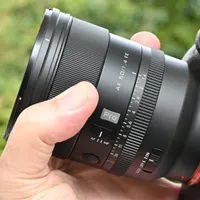
As well as a physical AF/MF switch on the left hand side of the barrel, there’s a customizable lens-function button. It’s ideally placed to fall under the thumb when shooting in landscape-orientation mode, but there’s no secondary button up on top to repeat the favor when you’re shooting in portrait-orientation mode. Even so, it’s useful for the likes of AF-On or AF-Hold functions, which you can typically set from in-camera menus.

For those of us who prefer setting the aperture on the lens rather than via the camera body, there’s a dedicated aperture control ring. A simple twist can take you all the way from f/1.8 to f/16 in one-third f/stop click steps. There’s also the usual A (Auto) position just to the side of the narrowest f/16 setting, so you can adjust the aperture from the host camera body instead. The Auto position is essential for effectively using the lens in Program and Shutter-priority shooting modes. As is often the case nowadays, there’s no Auto locking switch, so you need to be careful not to jog the aperture ring from its Auto position accidentally.

Hybrid shooting is all the rage nowadays and the lens obliges by catering to both stills and video capture. To give the option of smooth and silent aperture adjustments, there’s a click/de-click switch on the right hand side of the barrel. This enables you to switch between one-third f/stop click steps for stills and stepless aperture control when shooting video.

I always find it irksome that budget-friendly lenses from the likes of Canon and Nikon are generally supplied with no hood. The ‘optional extra’ hood is often a surprisingly expensive add-on, making these lenses worse value for money than they seem on the surface. Like most other independent lens manufacturers, Viltrox typically supplies a hood with pretty much all of its lenses, unless there’s a particularly good reason not to (like with the unfeasibly thin Viltrox AF 28mm f/4.5 pancake prime). With this 55mm lens, you get an efficient petal-shaped hood that has the usual bayonet-fit action and is reversible for compact stowage.

Around the back of the lens is a sturdy metal mounting plate. Not just a solid component in its own right, the mounting plate features a rubber weather-seal ring to resist the ingress of moisture and dust. It also incorporates a USB-C port for applying firmware updates if and when needed, via Viltrox’s computer-based app.

Viltrox AF 55mm f/1.8 Evo: Performance
I always hope that a prime lens is going to pay dividends in terms of image quality and all-round performance. Zoom lenses, by design and definition, can be a bit of a compromise. This Viltrox prime gave me instant satisfaction when using it on both full-frame and APS-C format cameras. It’s impressively sharp and crisp even when shooting wide-open at f/1.8, where it also delivers sumptuously soft and smooth bokeh. Bokeh remains of very good quality when stopping down a little, thanks to a well-rounded 9-blade aperture diaphragm.

True to its apochromatic claims, I found color fringing and both lateral and axial chromatic aberrations to be extremely negligible. Axial/longitudinal chromatic aberration is also often referred to as ‘bokeh fringing’. It can be problematic with fast lenses in particular when shooting at or near the widest aperture settings, showing up as color fringes around high-contrast transitions just in front of or behind the plane of focus, and across the entire image frame instead of just towards the edges and corners.

To test the quality of sharpness and bokeh, and to check that color fringing was minimal, I took a series of test shots of a phrenology head against a backdrop of garden plants and flowers. I kicked off at the widest aperture of f/1.8 and went through to a medium aperture of f/8. The black lines printed on the white surface of the phrenology head are a stringent test for color fringing in general and for axial chromatic aberration in particular. The series demonstrates how well the Viltrox controls these aberrations, even wide-open at f/1.8.


Viltrox AF 55mm f/1.8 Evo: Sample Images
The following gallery majors on example shots that were taken in the gardens of the Bishop’s Palace in the English city of Wells, in early spring. The peaceful and beautiful location is highly popular with locals and visitors from far and wide. Throughout this period of testing the lens, I used my Nikon Z6 III camera body.


Viltrox AF 55mm f/1.8 Evo: Lab Results
We run a range of lab tests under controlled conditions, using the Imatest Master testing suite. Photos of test charts are taken across the range of apertures and zooms (where available), then analyzed for sharpness, distortion and chromatic aberrations.
We use Imatest SFR (spatial frequency response) charts and analysis software to plot lens resolution at the center of the image frame, corners and mid-point distances, across the range of aperture settings and, with zoom lenses, at four different focal lengths. The tests also measure distortion and color fringing (chromatic aberration).
Sharpness:

Levels of sharpness are seriously impressive, from the center of the frame right out to the extreme edges and corners. And that holds true even when shooting wide-open at f/1.8.
Fringing:

Color fringing is very well controlled and difficult to spot in real-world images, even out at the edges and corners of the image frame. And that’s with automatic in-camera correction disabled.
Distortion: -0.35
There’s the merest hint of barrel distortion but it’ll generally go completely unnoticed and, as with color fringing, that’s with in-camera correction disabled.
Viltrox AF 55mm f/1.8 Evo: Verdict
Viltrox lenses have found a place in my heart (as well as a regular place in my camera bag) over the last few years. I’ve really enjoyed the high levels of performance and image quality that they deliver, at extremely competitive prices. This AF 55mm f/1.8 Evo follows suit, delivering highly impressive image quality in all respects, along with fast and consistently accurate autofocus.
The all-metal construction feels robust while also being compact and lightweight, along with luxuries like an aperture control ring with a click/de-click switch, and a customizable function button. I love using this lens on both full-frame and APS-C format camera bodies, as a standard or portrait prime respectively, and think it’s fabulous value at the price.
Features ★★★★★ |
The feature set belies the budget asking price, including a click/de-click aperture control ring and a customizable function button. |
Design ★★★★★ |
Build quality feels very substantial, with an all-metal casing and mounting plate that include weather-seals. The design is also refreshingly compact and lightweight. |
Performance ★★★★½ |
Image quality is excellent with impressive sharpness, clarity and color rendition, along with the absence of unwanted aberrations. Autofocus is fast and consistently accurate. |
Value ★★★★★ |
I’ve yet to find a Viltrox lens that’s not excellent value for money. This one’s worth every cent and more besides. |

Alternatives