Digital Camera World Verdict
I feel that the Nikon Z 24-105mm f/4-7.1 is a neat travel buddy to take along for the journey. It’s compact, lightweight, and delivers sufficient zoom range to cover a wealth of shooting scenarios, from tourist attractions to sweeping landscapes in the great outdoors. Sure, the aperture rating is rather on the slow side, but that’s the price you pay for a generous, full-frame zoom range shoehorned into such a small build. Image quality and all-around performance are pleasing, and the lens is relatively affordable to buy, making it a tempting proposition.
Pros
- +
Compact and lightweight
- +
Generous zoom range
- +
0.5x macro facility
- +
Weather seals
Cons
- -
Slow long-end aperture
- -
No AF/M focus switch
- -
Hood sold separately
- -
Macro is blurry towards the edges
Why you can trust Digital Camera World Our expert reviewers spend hours testing and comparing products and services so you can choose the best for you. Find out how we test.
The Z 24-105mm f/4-7.1 has a tough act to follow, or rather a string of tough acts in the variety show that stars Nikon Z-mount standard zooms. The most recent previous release is the mighty Nikon Z 24‑70mm f/2.8 S II, which is arguably the best standard zoom on the planet, although it’s big, heavy, very expensive, and definitely not for everybody. A more budget-friendly ‘trinity’ alternative is the Nikon Z 28-75mm f/2.8, although its wide-angle coverage is relatively limited.
Then there’s the super-skinny Nikon Z 24-50mm f/4-6.3, which comes up short in telephoto reach. And let’s not forget the Nikon Z 24-70mm f/4 S, which is my all-time favorite ‘kit zoom’ lens. So, is there really a gap in the line-up for this new lens? Well, the Nikon Z 24-120mm f/4 S has been Japan’s best-selling lens for two years running, and while the new 24-105mm doesn’t quite match its telephoto reach, it’s only about half the price to buy, and not much more than half the weight. I think I spot a gap being filled!
All in all, the Z 24-105mm aims to be one of the best Nikon standard zooms, as well as one of the best lenses for Nikon Z cameras. But as if to prove there’s nothing new under the sun, with its 50% telephoto extension over 24-70mm zooms and a 0.5x macro facility, it very much reminds me of the Canon RF 24-105mm f/4-7.1 IS STM that was launched no less than six years ago, the Canon having the same aperture rating and a ‘center macro’ ability.

Nikon Z 24-105mm f/4-7.1: Specifications
Mount options |
Nikon Z |
Lens construction |
12 elements in 10 groups |
Angle of view |
84-23.2 degrees |
Diaphragm blades |
7 |
Minimum aperture |
f/22-40 |
Minimum focus distance |
0.2m (W) 0.28m (T) |
Maximum magnification |
0.5x |
Filter size |
67mm |
Dimensions |
74x107mm / 2.9x4.2" |
Weight |
350g / 12.4oz |
Nikon Z 24-105mm f/4-7.1: Price
I’d generally expect lenses with ‘slower’ aperture ratings to be relatively inexpensive to buy. They equate to smaller-diameter glass in the optical path, which is cheaper to manufacture and results in a more budget-friendly build. Sure enough, the Z 24-105mm f/4-7.1 is 1.67 f/stops slower than Nikon’s f/4 constant-aperture zooms and 2.67 f/stops slower than f/2.8 zooms, at least at the long end. The upside is that it costs a relatively affordable $547 / £529 / AU$899, compared with the Nikon Z 24-120mm f/4 S at $1,147 / £1,049 / AU$1,849, the list price of which is about twice as expensive. Meanwhile, the top-flight Nikon Z 24‑70mm f/2.8 S II will set you back $2,797 / £2,599 / AU$4,599, about five times as much.
For a more like-for-like comparison, the Canon RF 24-105mm f/4-7.1 IS STM that I mentioned earlier costs $459 / £519 / AU$729, significantly undercutting the Nikon in some world regions. Ultimately, you can look at the bottom line in two ways – either the Nikon will save you a bunch of money compared to more exotic glass, or leave you with enough in the bank to buy other lenses and accessories to grow your kit.
Nikon Z 24-105mm f/4-7.1: Design & Handling
Let’s address the elephant in the room. This is the second-slowest Z-mount lens that Nikon has ever made, although the outright winner for sluggishness goes to the Nikon Z 28-400mm f/4-8 VR, due to its colossal zoom range. Is that necessarily a bad thing? One of the biggest buzzwords in photography lately has been ‘bokeh’, with faster lenses that can deliver a tight depth of field gaining popularity. But that’s not the whole story. For casual walkabout and travel photography, a more compact, lightweight, and affordable lens is often more preferable, and that’s one of the biggest attractions of the Z 24-105mm. Many of us tend to use apertures of around f/8 for general shooting, and let’s not forget the surprise winner in the race between hare and tortoise.

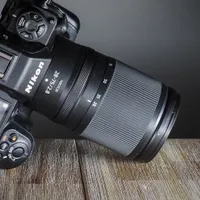
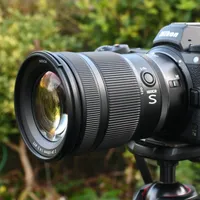
So what are the good, better, and best bits of the Nikon’s design and handling? The starring attraction is the 24-105mm zoom range that gives you seriously wide-angle potential and substantially more telephoto reach than a 24-70mm lens. That’s a big tick in a big box for versatility. And the large zoom range is packed into an eminently portable package, measuring just 74x107mm / 2.9x4.2" and weighing a mere 350g / 12.4oz. The lens is nothing if not small and light, although typically it extends considerably as you stretch through the zoom range from 24mm to 105mm, as demonstrated in the product shots above and below. Playing the numbers game, the overall length stretches from 107mm / 4.2" to 163mm / 6.4", which works out to about 50%.

The optical design is based on a relatively modest count of 12 elements arranged in 10 groups, and includes one ED (Extra-low Dispersion) element and two aspherical elements, aiming to boost image quality. The lens isn’t retractable, so there are no ‘folding optics’, which makes the small build even more impressive. Autofocus (as well as manual focusing) is taken care of by a linear stepping motor, which is typically quick and virtually silent in operation.

While the STM autofocus system is par for the course nowadays, the actual focusing range is rather more distinctive. Going further, or rather nearer than most, the lens focuses right down to just 0.2m at the short end of the zoom range and 0.28m at the long end. This results in a 0.5x macro magnification ratio at the minimum focus distance, throughout the 70-105mm sector of the zoom range. That puts extreme close-ups on the agenda, further boosting the versatility of the lens. And in macro photography, narrow apertures are generally preferred, so the lack of a bright aperture is even less of an issue. Even so, macro shooting isn’t all you might imagine, as I’ll come to later.

As I’ve come to expect in budget-friendly Nikon Z-mount lenses, there are only two control rings rather than three. These are nominally for zoom and manual focus, but the latter can be customized via in-camera menus. This enables you to use the control ring for the likes of aperture adjustment, ISO, and exposure compensation while in autofocus mode.

Switching between autofocus and manual focus modes is one of the less appealing facets of the design and handling. There’s no physical switch for quickly and easily making the change, forcing you into the relatively long-winded method of making the change via in-camera menus. There’s also no VR on/off switch, unsurprisingly, because there’s no optical VR (Vibration Reduction).
That’s a non-issue if you’re shooting with an FX (full-frame) Z-system camera, as they all feature IBIS (In-Body Image Stabilization). However, I think the ‘effective’ zoom range of 36-157.5mm on a Nikon DX (APS-C format) body, coupled with the compact, lightweight build, makes the lens an appealing option for cameras like the Nikon Z50 II and Z fc. And here the lack of VR really is an issue, because there are, so far, no Nikon DX bodies with IBIS.

Building on the lens’s travel-friendly credentials, it features multiple weather seals to avoid the ingress of dust and moisture. However, many will see the inclusion of a plastic rather than a metal mounting plate as a downside to the design. On the upside, though, it does help to keep the build as lightweight as possible, and the plastic plate should prove sufficiently durable. I’m more miffed that, like some of Nikon’s other cut-price lenses, this one comes without a carrying pouch or, more importantly, a lens hood. The ‘optional’ petal-shaped, bayonet-fit, reversible HB-93B hood will cost you an additional $37 / £35 / AU$49, so it doesn’t come cheap.
Nikon Z 24-105mm f/4-7.1: Performance
As I’ve constantly enjoyed from the start of my Nikon Z system adventure, the Z 24-105mm has smooth handling characteristics, with a tactile, high-precision feel to its zoom and focus/customizable control rings. That said, they’re the only handling attributes of the lens, as it lacks any switches or a tertiary control ring.
If you’re shooting the likes of landscapes, cityscapes, and architecture on your walkabout and travel photography pursuits, the chances are you’ll want a fairly large depth of field, which is definitely within the remit of this lens. The flipside is that you’ll struggle to get a tight depth of field for isolating the main subject within a busy scene by blurring the background. That’s especially true towards the long end of the zoom range, where the widest available aperture shrinks to f/7.1.

The shots above and below, taken on a very overcast and drizzly day at Bristol Floating Harbour in the UK, demonstrate the extremities of the somewhat generous zoom range, from the 24mm wide-angle shot above to the 105mm telephoto shot below. As you’d expect, telephoto reach is considerably greater than when using a 24-70mm lens.

At least, the struggle for a tight depth of field holds true for general shooting. However, the lens is capable of a tight depth for close-ups throughout its entire zoom range. And you can certainly get in close, with up to 0.5x macro magnification on tap. However, unlike ‘proper’ macro lenses, the 24-105mm doesn’t retain sharpness in extreme close-ups towards the edges and corners of the image frame. Again, I’m reminded of the Canon RF 24-105mm f/4-7.1 IS STM and its advertised ‘center macro’ facility. Image quality gets quite blurry towards the edges of the frame in macro shooting, and it’s not because the lens isn’t a ‘flat field’ lens like most genuine macro optics. Edges are just plain blurred, as demonstrated on the left and right-hand sides of the close-up shot of color pencils shown below.

But let’s get away from extreme close-ups and back to general shooting. I’ve never heard of a lens being referred to as ‘blunt’, but I’m yet to test a Nikon Z-mount lens that’s anything other than impressively sharp. I speak from a standpoint of testing pretty much all of them, and I own several myself, very much enjoying my stash.
I tested the lens with a high-resolution, 45.7MP Nikon Z8, which puts high demands on the ability of any lens to resolve fine detail. In this case, the Z 24-105mm delivers excellent center-sharpness throughout most of the zoom range, dropping off a little at the long end. Extreme edge/corner-sharpness is more of a movable feast, being mostly pretty decent but dipping a little in the 50-70mm sector of the zoom range.

Distortions are minimal at any zoom setting, but that’s due to automatic in-camera corrections (which can’t be disabled in the menu system) rather than the optical prowess of the lens. Color fringing is generally a non-issue but benefits from in-camera correction at the short end of the zoom range.
Nikon Z 24-105mm f/4-7.1: Sample Images
The gallery below comprises sample images taken in and around Isambard Kingdom Brunel’s SS Great Britain, ‘the ship that changed the world’. A revolutionary vessel that was iron-hulled, steam-powered, and propeller-driven, she was launched in 1843, eventually scuttled on the Falkland Islands in 1936, then towed some 8,000 miles back to her birthplace in Bristol in 1970, where she has undergone meticulous restoration and is currently a major tourist attraction, floating on a ‘glass sea’ in dry dock.


Nikon Z 24-105mm f/4-7.1: Lab Results
We run a range of lab tests under controlled conditions, using the Imatest Master testing suite. Photos of test charts are taken across the range of apertures and zooms (where available), then analyzed for sharpness, distortion and chromatic aberrations.
We use Imatest SFR (spatial frequency response) charts and analysis software to plot lens resolution at the center of the image frame, corners and mid-point distances, across the range of aperture settings and, with zoom lenses, at four different focal lengths. The tests also measure distortion and color fringing (chromatic aberration).
Sharpness:


Center-sharpness is excellent in the 24-70mm sector of the zoom range, and still very good at the longest zoom setting of 105mm. Edge/corner-sharpness is good rather than great, dipping noticeably at some aperture settings in the 50-70mm zoom sector.
Fringing:

There’s barely any color fringing in the 50-70mm section of the zoom range, and it only rises slightly at the 105mm mark. There’s a bit more fringing at the shortest end of the zoom range but it’s entirely within the remit of automatic in-camera correction.
Distortion:

With help from in-camera corrections, the lens delivers very slight barrel distortion at all zoom settings, a little more at 24mm. Like many recent lenses for mirrorless cameras, compactness comes at the expense of a reliance on these corrections, which can’t be switched off in the camera’s menu system.
Nikon Z 24-105mm f/4-7.1: Verdict
I didn’t take to the Nikon Z 24-105mm f/4-7.1 at all when I saw it on paper. One number in particular put me off, and that number is 7.1. I just didn’t feel the need for such a ‘slow’ lens. In the flesh, though, the Nikon won me over with its compact, lightweight build, making it a very travel-friendly lens with an expansive zoom range that adds versatility.
A tight depth of field and soft bokeh naturally aren’t among the lens’s strong points, but as a general-purpose lens for everyday photography, it performs well and delivers pleasing image quality, with good sharpness, clarity, and bite. The 0.5x macro facility is a bonus to some extent, although only the central region of the image frame is sharp, with the edges being pretty blurry. The lens is keenly priced for an own-brand Nikon zoom, and all in all, it’s an attractive proposition.
Features ★★★★☆ |
It’s a basic lens without even an AF/M focus mode switch and you have to buy the hood separately, but it features a speedy stepping motor-based autofocus system and 0.5x macro of sorts. |
Design ★★★★☆ |
The design majors on compactness and lightness of weight, right down to the plastic mounting plate, but that makes it very travel-friendly, and it does feature weather seals. |
Performance ★★★★☆ |
Image quality relies on automatic correction for distortion and the long-zoom aperture shrinks to f/7.1, but the net results are pleasing. |
Value ★★★★½ |
It’s very good value for an own-brand Nikon Z-system lens, and one of the least expensive options in the collection of standard zooms. |

Alternatives