Digital Camera World Verdict
I’m impressed. The Sigma 12mm f/1.4 DC | C combines an ultra-wide viewing angle with a really fast aperture, in an amazingly compact and lightweight lens. It’s definitely one for the journey, stowing away in very small spaces, yet has superb build quality, handling and performance, all at a very competitive price.
Reasons to buy
- +
Ultra-wide-angle perspective
- +
Fast f/1.4 aperture
- +
Aperture / control ring
- +
Compact and lightweight
Reasons to avoid
- -
Limited range of mount options
- -
No AF/MF focus mode switch
- -
No click/de-click switch
Why you can trust Digital Camera World Our expert reviewers spend hours testing and comparing products and services so you can choose the best for you. Find out how we test.
Sigma has a history of fast, f/1.4 prime lenses for crop-sensor cameras. There’s a trilogy that springs to mind in the diminutive shapes of the 16mm, 30mm and 56mm f/1.4 DC DN Contemporary lenses. I first saw these in Canon EF-M mount but they’ve since become available in a wide range of Canon EF-M, Canon RF-S, Fujifilm X, L-Mount, Micro Four Thirds, Nikon Z DX and Sony E options. The new 12mm lens adds ultra-wide-angle potential to the mix, ideal for landscapes and cityscapes, architectural interiors, selfies, vlogging, travel, astrophotography and more besides. However, the mount options are relatively limited, so far only covering Canon RF-S, Fujifilm X and Sony E, with an ‘effective’ focal length of 18mm in full-frame terms (19mm for Canon). Even so, it aims to be one of the best wide-angle lenses and best landscape lenses for these cameras.

Sigma 12mm f/1.4 DC | C: Specifications
Mount options |
Canon RF-S, Fujifilm X, Sony E |
Lens construction |
14 elements in 12 groups |
Angle of view |
99.6 degrees |
Diaphragm blades |
9 |
Minimum aperture |
f/16 |
Minimum focus distance |
0.17m / 0.57ft |
Maximum magnification |
0.12x |
Filter size |
62mm |
Dimensions |
68x69mm / 2.7x2.7in |
Weight |
225g / 7.9oz |
Sigma 12mm f/1.4 DC | C: Price
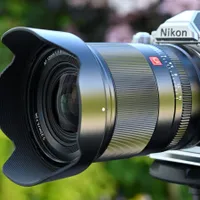
Back when this lens was launched, Sigma was keen to point out that it was the most wide-angle autofocus prime lens for APS-C format cameras, at least with a fast f/1.4 aperture. There’s not much in it though, as I was very impressed with the Viltrox AF 13mm f/1.4 for Fujifilm X, Nikon Z and Sony E mount cameras when I reviewed it back in 2022. Like other Sigma lenses, the 12mm is made in Japan but is still very competitively priced at $579 / £519 / AU$1,099. The Chinese Viltrox lens is even more budget-friendly, at $486 / £440 / AU$799.
Sigma 12mm f/1.4 DC | C: Design & Handling
The first thing that struck me about the design of this ultra-wide-angle prime is how compact and lightweight it is. It’s noticeably smaller and barely more than half the weight of the metal-bodied Viltrox AF 13mm lens, the weight loss being partly thanks to Sigma’s typical use of TSC (Thermally Stable Composite) components, which are tough but lightweight. Long story short, the Sigma measures a mere 68x69mm / 2.7x2.7in and weighs in at just 225g / 7.9oz in Sony E-mount. It’s a real featherweight contender and only marginally heavier in other mount options, so far including Fujifilm X at 235g / 8.3oz and Canon RF-S at 250g / 8.8oz.

Although it’s a small lens, the Sigma has a large and comfortable manual focus ring. As usual these days, it’s electronically coupled to a stepping motor based autofocus system and operates with smooth precision. Again, typical of the breed, there’s no focus distance scale but this is often substituted by an in-camera display. There’s also no AF/MF focus mode switch, which I’m less than happy about but can overlook, considering the super-small design of the lens.

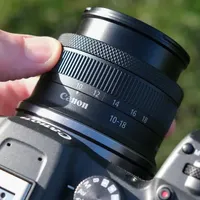
Just behind the focus ring, there’s a smaller, dedicated aperture ring in the Fujifilm X and Sony E mount versions of the lens, as shown above. I’ve also tested the Canon RF-S mount edition, which has a customizable control ring instead. It operates in click steps and is assignable to many and varied functions, via in-camera menus. None of the different versions of the lens features a click-de-click switch, so there’s no option for stepless and silent aperture control.

Whereas many own-brand APS-C format lenses from the likes of Canon and Nikon have plastic mounting plates, the Sigma has a hard-wearing metal plate. This also features a weather-seal gasket as part of the overall dust-resistant and splash-resistant design. The electronic communication contacts are gold-plated.

Up front, the forward element has a fluorine coating to repel moisture and greasy fingermarks. There are 14 elements in total, arranged in 12 groups. These include two SLD (Special Low Dispersion) elements and three double-sided aspherical elements. The SLD elements help to enhance contrast and clarity while reducing chromatic aberrations, while the aspherical elements help to enhance image quality while reducing the overall size of the lens.

Multiple coatings are applied and the overall design aims to minimize ghosting and flare. As I’d expect, a bayonet-fit, petal-shaped hood is also supplied with the lens to further reduce ghosting and flare, while also offering physical protection to the front element. Unlike with some ultra-wide-angle lenses, I’m pleased that the hood is removable, enabling the attachment of filters via a modestly sized 62mm thread.

Sigma 12mm f/1.4 DC | C: Performance
Understandably, the lens is designed with performance in mind, as well as just compactness and lightness of weight. Given the suitability of the wide viewing angle and fast aperture for astrophotography, it’s good news that the lens is sharp right out to the edges and corners of the frame, even when shooting wide-open at f/1.4. A further bonus is that there’s minimal sagittal coma flare, so pinpricks of light like stars and nighttime lights of cityscapes retain a true-to-life appearance instead of taking on irregular shapes, like with ‘batwing coma’.

Autofocus is snappy for stills and smooth for video, while being near-silent in operation. There’s also minimal focus breathing, further enhancing performance for video capture. Swap to manual focusing and the focus ring operates smoothly and precisely. The minimum focus distance is a paltry 0.17m / 0.57ft, so you can get in really close to small subjects and shoot them against an expansive backdrop, courtesy of the ultra-wide viewing angle. The f/1.4 aperture plays into your hands if you also want to blur the background with a tight depth of field for close-ups, although the focal length makes it hard to get anything other than a large depth of field at more regular shooting distances.

Another tick on the performance checklist is that color fringing is very well controlled. Lateral chromatic aberration is negligible, even out at the edges and corners of the frame, and that’s without relying on automatic in-camera correction. I can’t say the same for barrel distortion, which is pretty extreme. As with many ‘compact’ lenses designed for mirrorless cameras these days, this Sigma relies heavily on automatic in-camera correction for distortion. As is often the case, distortion correction can’t be disabled in the camera’s menu system.

Sigma 12mm f/1.4 DC | C: Sample Images
The following gallery starts with a mix of outdoor shots taken on a sunny morning in the gardens of the Bishop’s Palace in the English city of Wells, in early spring. From there, I moved on to Wells Cathedral to shoot some architectural interiors.


Sigma 12mm f/1.4 DC | C: Lab Results
We run a range of lab tests under controlled conditions, using the Imatest Master testing suite. Photos of test charts are taken across the range of apertures and zooms (where available), then analyzed for sharpness, distortion and chromatic aberrations.
We use Imatest SFR (spatial frequency response) charts and analysis software to plot lens resolution at the center of the image frame, corners and mid-point distances, across the range of aperture settings and, with zoom lenses, at four different focal lengths. The tests also measure distortion and color fringing (chromatic aberration).
Sharpness:

Shooting wide-open at f/1.4, levels of sharpness are already very good across the entire image frame, and are better still at f/2. Sharpness is also impressively consistent across the image frame and throughout almost the entire aperture range.
Fringing:

There’s a little color fringing towards the edges and corners of the frame but it generally goes unnoticed, even when uncorrected in-camera or at the editing stage.
Distortion: -5.19
Native barrel distortion is severe but I’ve seen much worse from modern lenses for mirrorless cameras that are designed to be compact and lightweight. Either way, automatic in-camera correction is on hand to take care of distortion.
Sigma 12mm f/1.4 DC | C: Verdict
The Sigma 12mm f/1.4 is incredibly versatile for a prime lens. I feel that it’s ideally suited to landscapes and cityscapes, architectural interiors and a whole lot more besides. It’s great for selfies and vlogging, where its ultra-wide-angle perspective enables you to set the scene by capturing a large area of your surroundings and backdrop.
The incredibly compact and lightweight build also makes this lens superb for travel and street photography, for which the weather-resistant construction is a bonus. Meanwhile, the bright f/1.4 aperture adds astrophotography to the can-do list. Distortion relies on automatic in-camera corrections, which is no surprise, but image quality and all-round performance are excellent. All in all, it’s a brilliant ultra-wide-angle lens for Canon, Fujifilm and Sony APS-C format mirrorless cameras. When can I have a Nikon Z-mount version, pretty please?
Features ★★★★★ |
Despite the compact and lightweight build, the lens packs an aperture ring (customizable control ring for Canon) and a fast and virtually silent autofocus system. |
Design ★★★★½ |
The design is robust but refreshingly compact and lightweight, but it’s a shame there’s no A/M focus mode switch, nor a click-de/click switch for the aperture control ring. |
Performance ★★★★★ |
It’s impressively sharp across the entire image frame, even when shooting wide-open at f/1.4, although it relies on the usual in-camera correction for distortion. |
Value ★★★★☆ |
It’s certainly more expensive than the Chinese Viltrox AF 13mm f/1.4 (unavailable in Canon RF-S mount) but still very good value at the price. |

Alternatives