Digital Camera World Verdict
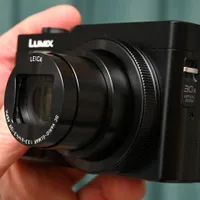
The Panasonic Lumix TZ300 / ZS300 picks up neatly from where my mobile phone leaves off. I love that it’s genuinely small enough to fit in a spare pocket, yet packs a really powerful 15x zoom lens that covers everything from a generous wide-angle perspective to powerful telephoto reach. I like the image quality and overall performance but feel shortchanged that Panasonic has ditched the (albeit small) viewfinder from preceding models, and that the fixed touchscreen isn’t conducive to travel selfies and vlogging.
Reasons to buy
- +
1.0-inch BSI CMOS sensor
- +
15x optical zoom
- +
5-axis Hybrid O.I.S.
Reasons to avoid
- -
Fixed touchscreen
- -
No viewfinder
- -
Fairly slow aperture
Why you can trust Digital Camera World Our expert reviewers spend hours testing and comparing products and services so you can choose the best for you. Find out how we test.
I have many happy recollections of high days and holidays in years gone by, and photographic evidence to prove it. That’s thanks to my trusty Panasonic Lumix TZ100. I bought the camera back in 2016, as a high-end compact that was genuinely small enough to carry in a spare pocket, mostly for family outings when my DSLR kit seemed too cumbersome. That Panasonic ‘Travel Zoom’ camera was superseded by the SZ200 / TZ200 in 2018, and then followed by the SZ300 / TZ300 that I’m reviewing here, fresh for 2026.
Like its forebears, the latest SZ300 (USA) / TZ300 (most of the rest of the world) features a relatively large 1-inch format image sensor and a zoom lens of generous proportions, at least in terms of optical zoom range. Even so, the retractable nature of the lens in each subsequent model makes the cameras truly pocketable, and while the original camera had a 10x optical zoom lens, it stretched to 15x for the 200 and 300 models, equating to 24-360mm in full-frame equivalence. All in all, the latest edition aims to follow suit in being one of the best travel cameras, best zoom cameras, and best point-and-shoot cameras on the market.

All in all, the camera seeks to address a wide remit but one thing holds true throughout… The SZ300 / TZ300 with its mighty zoom range and telephoto reach is one of those compact cameras that still has something to offer in an age where so many people rely on their mobile phones for daily shooting.
Panasonic Lumix ZS300 / TZ300: Specifications
Image sensor |
20.1MP 1.0-inch BSI CMOS |
Lens |
15x zoom 24-360mm (equivalent) f/3.3-6.4 |
Screen |
3.0-inch 1,840k dots, touch, fixed |
Viewfinder |
None |
Image stabilization |
5-axis Hybrid O.I.S. (except for 4K video) |
Memory |
SD/HC/XC UHS-I |
Shutter speed |
1/2,000 to 60 sec (mechanical) 1/16,000 to 1 sec (electronic) |
Max shooting speed |
10fps (AF-S) 7fps (AF-C, Live View) |
ISO |
ISO 125-12,800 (80-25,600 extended) |
Autofocus |
49-area, 1-area, pinpoint, full area touch |
Video |
4K 30p, 1080 120p |
Connectivity |
USB-C, microHDMI typeD, Wi-Fi, Bluetooth |
Battery life |
360 shots |
Size (WHD) |
111.2 x 66.4 x 45.2 mm / 4.38 x 2.61 x 1.78 in |
Weight |
337g / 11.9oz with battery and card |
Panasonic Lumix ZS300 / TZ300: Price
The Panasonic Lumix SZ300 / TZ300 hit the market with a price tag of $899 / £849 / AU$1,599. For comparison, the recently launched sibling Panasonic Lumix SZ99 / TZ99 ‘travel zoom’ camera isn’t much more than half price, at $498 / £469 / AU$1,099. Another travel-friendly option is the Canon PowerShot SX740 HS at $550 / £499 / AU$999. Both of these alternatives have a more generous optical zoom range of 30x and 40x respectively, but a physically much smaller 1/2.3-inch image sensor.
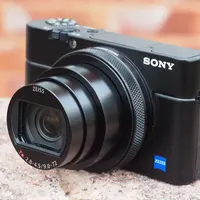
Like the SZ300 / TZ300, the SZ99 / TZ99 lacks a viewfinder but does add a flip-over mechanism for its touchscreen, lacking in the pricier Panasonic. The Canon also has a flip-around screen but it’s not a touchscreen and none of the cameras has a viewfinder. For an arguably more like for like comparison, the Sony RX100 VII has a 20.1MP 1-inch stacked CMOS sensor and a 24-200mm f/2.8-4.5 effective Zeiss lens, but is rather more expensive at around $1,699 / £1,049 / AU$1,799.
Panasonic Lumix ZS300 / TZ300: Design & Handling
The Panasonic Lumix SZ300 / TZ300 builds on the design ethos of the former 100 and 200 models, aiming to be your constant travel companion. It looks deceptively small from the front, at least with the lens retracted for stowage, but the camera has a big heart in the shape of a 20.1 megapixel 1.0 type BSI CMOS image sensor. Coupled with a 15x 24-360mm (effective) optical zoom lens, the intention is that it can capture anything from sweeping landscapes and cityscapes to long shots of distant objects and wildlife.
The camera also aims to be on call 24/7, the size and sensitivity of the image sensor making it suitable for night shots and indoor scenarios, where lighting is low. Even extreme close-ups are within the camera’s remit, with a minimum focus distance of just 3cm / 1.2in complete with autofocus in Macro mode.

Let’s get back to front and start our more detailed examination with the rear of the camera. Everything looks pretty standard, with a familiar layout of control buttons, a 4-way pad with a Menu/Set button at its center, and a well-proportioned 3.0-inch touchscreen with a generous 1,840k dots of resolution. That’s just as well as you’ll need to compose all of your shots on the touchscreen, in the absence of a viewfinder, which was actually featured in the previous 100 and 200 cameras.
Okay, let’s get that glaring omission out of the way. To my mind, most self-respecting travel cameras nowadays should accept that you’re likely to want to put yourself in the picture, at least some of the time. A flip-around screen is therefore the order of the day, enabling you to compose selfies and do a spot of vlogging if and when you feel the need to be sociable. I’m surprised therefore that the camera lacks a fully articulated screen, or even a flip-around mechanism, as featured in the SZ99 / TZ99.

Now we’ve got that over and done with, let’s get back to the positive. A big plus point is the 15x zoom lens, with its ‘effective’ 24-360mm range in full-frame terms. That covers everything from generous wide-angle coverage to serious telephoto reach. The images above and below show what that looks in physical terms, when the lens springs to life from its retracted state and stretches from its most wide-angle setting (above) to its most telephoto setting (below).

The lens comes complete with a control ring that’s nominally used for adjusting the aperture. In the time-honored tradition, this also acts as Program-shift, so you can alter the aperture and thus the overall exposure settings when in Program shooting mode. Switch to Shutter-priority mode and the control ring enables you to set the shutter speed.

The top panel of the camera hosts many of the essentials for creative shooting. The shooting mode dial includes PASM options, although the aperture range of the lens is fairly limited. That’s typical of most compact cameras. You also get ‘intelligent Auto’, Movie, two custom settings, a bunch of Scene modes and no less than 22 creative filter effects to choose from. To the right of the shooting mode dial there’s the shutter-release button with a motorized zoom lever situated around it, a movie start/stop button and a rotary control dial at the right hand edge.

Just under the thumb in the image above is a pop-up flash module. It’s pretty tiny and not particularly powerful but is useful for supplementing dull ambient lighting as well as supplying fill-in flash to banish unsightly shadows in sunny-day portraiture.

Well connected, the camera has built-in Bluetooth and Wi-Fi, making it easy to link to a mobile phone and to share photos while you’re out and about. Physical connections include a USB-C port for data transfer and charging the battery, along with a mini-HDMI port.

Considering the generous 360mm maximum zoom range in such a small camera that you need to operate at arm’s length, in the absence of a viewfinder, image stabilization is all but essential. The Leica-certified lens has optical image stabilization that works in tandem with 5-axis in-body stabilization, coming to the fore at long focal lengths and when low lighting conditions dictate slow shutter speeds. It’s particularly advantageous under low lighting if you don’t want to push your ISO setting too far, as the lens has a fairly pedestrian aperture rating of f/3.3-6.4.

I’ve seen a few cameras and other gadgets recently with internal batteries that you can’t get at. I’m glad to see that the Panasonic has a removable Li-ion battery. You still charge it in-camera but at least you have the choice of buying extra batteries and swapping to a spare while you’re out and about, so you don’t have to leave your camera on charge if and when the battery goes flat.

Panasonic Lumix ZS300 / TZ300: Performance
A major performance boost comes in the extending shape of the 15x zoom lens, its mighty (effective) 24-360mm range leaving mobile phones and most other compact cameras for dead. You can really cover the distance for wildlife and bird photography, as well as getting closer to the action and to faraway subjects. Sharpness remains satisfying throughout the entire zoom range, right through to longest telephoto setting.

The camera also beats most ‘superzoom’ lenses for interchangeable lens bodies when it comes to reach, stretching to serious telephoto reach. The entire range is demonstrated in the example shots above and below, taken at the shortest and longest optical zoom settings respectively.

For other aspects of image quality, color rendition is rich and vibrant while still looking very natural in the standard setting. Pictures tend to look lively with good contrast, and there’s good retention of detail in both bright highlights and areas of dark shadows.

As I’ve said, the lens is not the quickest in terms of aperture rating, although autofocus is swift. For indoor and late night handheld shots, image stabilization comes to your aid and the camera does well to suppress image noise at high ISO settings, without losing too much in the way of fine detail and texture.

Panasonic Lumix ZS300 / TZ300: Sample Images
The following gallery starts off with some example shots that were taken on a sunny morning in the gardens of the Bishop’s Palace in the English city of Wells, in early spring. Some of the shots in the sequence start at the most wide-angle zoom setting, progress through a mid-zoom setting and finish with the longest zoom setting. For a low-light challenge, I moved on to the interior of Wells cathedral, bumping up the camera’s sensitivity setting to ISO 3200.


Panasonic Lumix ZS300 / TZ300: Video
Above: sample video taken using the Panasonic Lumix ZS300 / TZ300
Panasonic cameras usually score highly for video and this one’s no exception. It records at up to 4K 3840x2160 as well as giving you a 4K Photo stills option at up to 30 frames per second. For slow-mo, Full HD is on the menu at 120fps. 5-axis HYBRID O.I.S.+ helps to keep things steady for handheld video shooting.
Panasonic Lumix ZS300 / TZ300: Lab results
We don't lab test many compact cameras, so there aren't many direct rival cameras in our database with which we can compare the TZ300. Our closest option is Panasonic's own TZ99, which has 30x zoom, but a much smaller 1/2.3-inch sensor.
However, with the TZ300 costing the thick end of $1000, you could have a decent APS-C interchangeable lens camera with kit lens for similar money. The Fujifilm X-M5 equipped with a 15-45mm lens is around the same price as the TZ300, and is almost as compact.
Lastly, we're including the Ricoh GR IIIX as an example of a premium APS-C compact camera. It does cost more than the TZ300, but not much more in some markets.
Resolution (line widths/picture height):

The larger, more pixel-packed sensors in the Fujifilm and Ricoh cameras we always going to come out on top in this test. They resolve significantly more detail than the TZ300, though its 1-inch sensor does give it an advantage at higher sensitivities over the small-sensor TZ99.
Dynamic range (EV):

Dynamic range is a measure of a camera's ability to record extreme brightness ranges and still retain detail in the brightest and darkest parts of the scene. It's measured in EV (exposure values, or 'stops').
The TZ300 does well to match the dynamic range of the APS-C cameras at low sensitivies, but at ISO800 and above it starts to struggle, capturing 1-1.5EV less dynamic range than the Fujifilm and Ricoh cameras. However, the gap between the two Panasonic cameras is huge, helping the TZ300 justify its considerably price premium over the TZ99.
Signal to noise ratio (decibels):

This test compares the amount of random noise generated by the camera at different ISO settings as a proportion of the actual image information (the 'signal'). Higher values are better and we expect to see the signal to ratio fall as the ISO is increased.
The 1-inch sensor in the TZ300 proves its worth over the small 1/2.3-inch sensor in the TZ99, as its larger individual pixels are more light-sensitive and therefore generate less noise. Even so, step up in size to APS-C and noise levels drop again, and noticeably so.
Panasonic Lumix ZS300 / TZ300: Verdict
I think there’s a lot to like in the Panasonic Lumix ZS300 / TZ300, but also a few niggles to contend with. Kicking off with the positives, the 1.0-inch BSI CMOS sensor enables very pleasing image quality in all sorts of shooting conditions, even late into the evening or indoors when lighting is low. The 15x optical zoom lens makes the Panasonic a tremendously versatile camera for travel photography, taking wildlife, action and general telephoto shooting in its stride. That’s backed up with a powerful 5-axis Hybrid O.I.S. system that helps to keep the going steady.
The niggles, to my mind at least, are that the fixed touchscreen has no tilt or full articulation facilities. I’d expect a ‘travel camera’ nowadays to allow me to put myself in the picture for if and when I want to take selfies on my travels, as well as for vlogging opportunities. And sure, the small viewfinders of the preceding models weren’t particularly impressive but they were certainly better than not having a viewfinder at all.
Finally, the lens has a fairly slow aperture rating, especially towards the longest end of its zoom range, although that’s only to be expected considering the massive overall zoom range. All in all, the Panasonic is a smart travel camera that’s wonderfully compact and ideal for the journey, although I think it could be even better.
Features ★★★★☆ |
Useful features include a 1.0-inch BSI CMOS sensor, 15x optical zoom range and 5-axis Hybrid O.I.S., but there’s no viewfinder nor any articulation for the fixed rear touchscreen. |
Design ★★★★☆ |
Despite the generously proportioned image sensor and huge zoom range, Panasonic has managed to shoehorn everything into a really compact and genuinely pocketable form factor. |
Performance ★★★★☆ |
Image quality is pleasing in all respects and I found that autofocus was both accurate and consistent in my tests. |
Value ★★★★☆ |
It’s quite expensive for a ‘travel zoom’ camera compared with some other models on the market, but that’s partly due to its relatively large image sensor. |

Alternatives