



Digital Camera World Verdict
The two things I like most about the Panasonic Lumix S 40mm f/2 are its focal length and aperture rating. I find that shooting with a 40mm focal length on full-frame cameras gives me a really natural perspective, neatly bridging the gap between a 35mm and 50mm lens. Meanwhile, the f/2 aperture delivers a fairly tight depth of field while enabling a compact and lightweight manageable build, especially in the case of this lens. It’s a good performer that’s keenly priced and very easy to live with.
Reasons to buy
- +
Very compact and lightweight
- +
Fairly fast f/2 aperture
- +
Good handling characteristics
- +
Robust weather-resistant build
Reasons to avoid
- -
Mediocre edge-sharpness at f/2
- -
No lens hood
Why you can trust Digital Camera World Our expert reviewers spend hours testing and comparing products and services so you can choose the best for you. Find out how we test.
Panasonic S-series full-frame mirrorless cameras and lenses date back to 2019. The first models were well received on the technical front but if I had to sum them up in two words, they’d be ‘big’ and ‘hefty’. To my mind (and hands) the early cameras felt much more like chunky DSLRs than slimline mirrorless models, and the same applied to the lenses. It seems that Panasonic has been on something of a downsizing mission since then, designing some refreshingly lightweight lenses and more compact bodies, typified by the surprisingly small Panasonic Lumix S9 and its kit 18-40mm zoom lens.
Further evidence that things are getting smaller and more easily manageable is delivered by this ultra-lightweight 40mm f/2 prime, which looks to be a downsized delight and reasonably inexpensive to buy. It’s the perfect prime partner to the Panasonic S 18-40mm f/4.5-6.3 zoom, and aims to be one of the best standard prime lenses if you’re on a tight budget, as well as one of the best L-mount lenses.

Panasonic Lumix S 40mm f/2: Specifications
Mount options |
L-mount |
Lens construction |
7 elements in 6 groups |
Angle of view |
57 degrees |
Diaphragm blades |
7 |
Minimum aperture |
f/22 |
Minimum focus distance |
0.3m |
Maximum magnification |
0.17x |
Filter size |
62mm |
Dimensions |
69x41mm / 2.6x1.6in |
Weight |
144g / 5.1oz |
Panasonic Lumix S 40mm f/2: Price
What price a fast prime lens? Well, some might say that a ‘fast prime’ should really have an aperture rating of f/1.4 or maybe even f/1.2, but these lenses are often fiendishly expensive and let’s not forget that an f/2 prime is still a whole f/stop faster than an f/2.8 trinity zoom lens. The lightweight Panasonic Lumix S 40mm f/2 is easy on the back and easy on the wallet, with a list price of $399 / £349 / AU$699.
When I’m thinking of alternative lightweight, affordable lenses for L-mount cameras, my mind goes directly to Sigma’s ‘Contemporary’ line-up, which includes the Sigma 35mm f/2 DG DN | C and Sigma 50mm f/2 DG DN | C . Both of these lenses match the Panasonic for an f/2 aperture rating, but they’re both considerably more expensive to buy, costing $719 / £579 / AU$1,100 each. That potentially makes the Panasonic a bit of a bargain.
Panasonic Lumix S 40mm f/2: Design & Handling
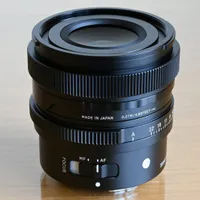
Open the box and the first thing that strikes you about the Panasonic Lumix S 40mm f/2 is just how small it is. You’d be forgiven for thinking that it’s maybe a lens for Panasonic’s Micro Four Thirds system but sure enough, this is a full-frame S-series lens. Remarkably, it’s only 69x41mm / 2.6x1.6in in size and weighs in at a mere 144g / 5.1oz. Like I said, it’s super-small and a real featherweight. And what you see is what you get because, unlike a number of skinny zoom lenses, this prime number isn’t retractable. As such, it’s fully ready for action despite only measuring about an inch and a half in length, almost qualifying as a pancake prime.
Before we get too carried away, the ultra-lightweight 40mm f/2 prime category isn’t exactly revolutionary. I tested (and bought) the Nikon Z 40mm f/2 lens quite a while ago. The Nikon is only slightly larger and about an ounce heavier, but has relatively basic handling characteristics and build quality, with a plastic rather than metal mounting plate.

I’m impressed that despite the lightweight build, the lens feels very solid, robust and well made. Indeed, it features Panasonic’s usual dust, splash and freeze-resistant construction and even has a fluorine coating on the front optical element to repel moisture and grease, and to aid easy cleaning.

While we’re up at the front of the lens, I’ll mention that no hood is supplied as part of the package. I was expecting it to be sold separately as an optional extra, following suit with budget-priced lenses from a few other manufacturers. As it turns out, Panasonic doesn’t make a hood for this lens – period, either bundled or available to buy separately. If you want to use a hood, you’ll have to buy one that’s independently manufactured and screws into the filter thread.
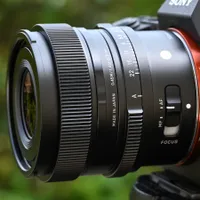
The most noticeable item in terms of handling is the manual focus ring, which takes up about half the length of the lens. As such, it’s large enough to use comfortably and operates with a smooth and precise feel. Moreover, you can assign other functions to the control ring when in autofocus mode, including ‘Crop Zoom’, when using compatible Panasonic cameras.

Typical of most modern lenses designed for mirrorless cameras, this one features a stepping motor system to drive autofocus (and manual focus, come to that). True to type, autofocus is quick and near-silent in operation, and the manual focus ring that I mentioned just now is electronically coupled to the motor to drive the relevant optical elements when focusing manually. I’m glad that despite the downsized design, Panasonic has made room for an AF/MF focus mode switch. Even if you’re the most ardent fan of autofocus, you might want to focus manually on occasion, and it’s good to have a simple, quick-action switch to make the change.

More surprising, especially on such a compact and reasonably priced lens, is the addition of a ‘Focus Button’. As with the manual focus ring, the button is customizable so that you can apply different functions to it. AF-Lock and AF-On are two of the favorites but other options are available, depending on camera menu options.

There are no specialist ED (Extra-low Dispersion) or UHR (Ultra High Refractive index) optical elements claimed for this lens. The optical path is also quite spartan in terms of the total count of elements, equating to seven arranged in six groups. Even so, the layout does include no less than three aspherical elements, aiming to optimize image quality while keeping size and weight to a minimum. As I’d fully expect, the lens comes complete with both front and rear lens caps.

Panasonic Lumix S 40mm f/2: Performance
Autofocus worked as expected throughout my tests. It delivered quick-action performance for tracking moving subjects, along with consistent accuracy. Manual focusing is smooth and precise so, all in all, focusing is everything I’d hope for in a lens that features a linear stepping motor.
Sharpness, clarity, contrast and color rendition are all of a very high standard, despite the lens not featuring any specialist glass elements apart from its three aspherical elements. Having said that, extreme edge/corner-sharpness is a bit lackluster when shooting wide-open at f/2 but picks up well at f/2.8 and really comes on song at f/4. For best sharpness in all regions of the frame, it pays to stick to apertures of f/4 through to f/11.

Naturally, there’s a lot more to image quality than just sharpness, especially when you’re talking about fast prime lenses, or at least those that are faster than your average zoom. The f/2 aperture enables a fairly tight depth of field when shooting close-ups, so that you can isolate the main subject in a scene by blurring the background. The quality of bokeh is nice and soft, which is more important to me than sharpness at the edges and corners of the frame when shooting wide-open at f/2.

The aperture is controlled by a 7-blade diaphragm which isn’t overly well rounded, so bokeh disks caused by defocused lights and specular highlights take on a noticeable 7-sided appearance. Even so, the overall quality of bokeh remains pretty good when stopping down a little. The lens is also impressively resistant to ghosting and flare, which is an important factor given the lack of a hood. As I mentioned, a hood is neither supplied nor sold separately as an optional extra.
There’s a large and growing rank of compact lenses designed for mirrorless cameras that rely very heavily on automatic in-camera corrections for distortion. This Panasonic isn’t one of them. It controls optical distortion very well in its own right, with just a hint of pincushion distortion being discernable. Color fringing is also kept to a minimum, even out at the edges and corners of the image frame. All in all, the little Panasonic S 40mm is an impressive performer.

Panasonic Lumix S 40mm f/2: Sample Images
The following gallery of sample images was taken in and around the Floating Harbour, Underfall Yard and Wapping Wharf in the English city of Bristol. Lighting conditions were mostly sunny and I used a range of wide and medium apertures for the shots.


Panasonic Lumix S 40mm f/2: Lab Results
We run a range of lab tests under controlled conditions, using the Imatest Master testing suite. Photos of test charts are taken across the range of apertures and zooms (where available), then analyzed for sharpness, distortion and chromatic aberrations.
We use Imatest SFR (spatial frequency response) charts and analysis software to plot lens resolution at the center of the image frame, corners and mid-point distances, across the range of aperture settings and, with zoom lenses, at four different focal lengths. The tests also measure distortion and color fringing (chromatic aberration).
Sharpness:

Center-sharpness is very good even when shooting wide-open at f/2, and excellent between the apertures of f/2.8 and f/11, after which the usual issue of diffraction takes a toll at very narrow apertures. Edge/corner-sharpness is comparatively disappointing at f/2 but good at f/2.8 and very good between f/4 and f/11.
Fringing:

Color fringing is controlled very well. Unusually, it’s technically worse in the central region of the image frame than out at the edges and corners. Even here though, it’s difficult to spot in real-world images, and that’s with automatic in-camera correction disabled.
Distortion: 0.46
There’s a very subtle amount of pincushion distortion but it’ll generally go unnoticed in images. Automatic in-camera correction is available but you’re unlikely to really need it. The lens definitely bucks the trend of many modern, compact primes and zooms for mirrorless cameras that rely heavily on in-camera correction.
Panasonic Lumix S 40mm f/2: Verdict
I’m not as keen on carrying around a big, heavy backpack of extra lenses as I used to be. I need a good reason to carry any extra lenses at all, but this Panasonic S 40mm presents a very good case. It delivers something that a compact zoom lens can’t, namely a relatively fast aperture that can freeze motion under dull lighting, and a tight depth of field for isolating subjects against a blurred background, or simply for creative effect.
I also really like the focal length of 40mm, which I find great for street photography and everyday shooting. The perspective is usefully a little wider than that of a standard 50mm lens, but still entirely natural. Best of all from a ‘carrying it around’ point of view, the lens is wonderfully compact and lightweight, yet delivers very pleasing image quality and impressive all-round performance, at a very affordable price. I reckon this Panasonic is a keeper!
Features ★★★★½ |
Smart features include a fairly fast f/2 aperture rating, a customizable multi-function/manual focus ring, an AF/MF switch and a customizable AF-Hold/multi-function button. |
Design ★★★★½ |
The design packs a lot into a really compact, lightweight build, while build quality itself is reassuringly robust with weather-seals and a sturdy metal mounting plate. |
Performance ★★★★½ |
Edge/corner-sharpness could be better at f/2 but I’m more concerned that bokeh is of good quality. All things considered, image quality is really pleasing and autofocus is fast and consistently accurate. |
Value ★★★★½ |
The lens is excellent value at the price. Sure, it’s not one of the ‘cheapest’ lenses on the market but you get a lot for a modest outlay. |

Alternatives