Digital Camera World Verdict
The Yashica FX-D 100 sits at the bottom of the FX-D pile at the time of writing this review. Compared with the more up-market FX-D 300 and FX-D S300, it has a physically smaller, lower-resolution image sensor, and is the most inexpensive to buy. But in some ways, I actually prefer the more budget-friendly camera’s image quality and the bonus of a 3x zoom lens, compared with the other cameras’ fixed focal length lenses. One thing in common is that all three cameras aim to give you a choice of ‘digital’ and ‘analog’ shooting styles, the latter based on film simulation options and even a physical ‘film advance lever’. The styling will certainly appeal to fans of all things retro.
Reasons to buy
- +
3x optical zoom
- +
Classic retro styling
- +
Analog and digital shooting styles
- +
Flip-around rear screen
Reasons to avoid
- -
‘Only’ 13 megapixels
- -
Prone to color fringing
- -
No touchscreen
Why you can trust Digital Camera World Our expert reviewers spend hours testing and comparing products and services so you can choose the best for you. Find out how we test.
The name Yashica takes me right back to the golden age of film photography. The company launched its first twin-lens reflex camera in 1953 (before I was even born) and the iconic Yashica FX-3 35mm SLR came to the market in 1979 while I was still a teenager. With its classic styling, great ergonomics and robust build quality, the FX-3 was an instant hit and is still regarded by many as one of the all-time top SLRs.
Fast forward to 1983 and Yashica was acquired by Kyocera, before being shut down in 2005. The name was later bought by a Hong Kong based company, who set about making digital cameras for the modern market. A mix of ancient and modern, the FX-D 100 is a digital camera that takes its styling cues from the FX-3 film camera, not only looking similar but also featuring handling extras that make it feel very much like an old film camera. That said, it has a relatively lightweight, plastic build and a fixed rather than interchangeable lens.

The FX-D 100 certainly isn’t one of the best compact cameras that money can buy, nor one of the best retro cameras on the market, but it might qualify as one of the best cheap cameras if you’re after something with a stylish retro design that offers a different kind of dual-personality shooting experience.
Yashica FX-D 100: Specifications
Photo Resolution |
13MP (24MP interpolated) |
Video Resolution |
4K30 |
Image Sensor |
13MP, 1/3.06-inch |
Selfie mirror |
Flip screen |
Display |
2.8-inch flip LCD |
Touchscreen |
No |
Battery |
Li-ion |
Connections |
USB-C, Mic |
Size (WHD) |
121x80x82mm / 4.8x3.2x3.2in |
Weight |
400g / 14.1oz |
Yashica FX-D 100: Price
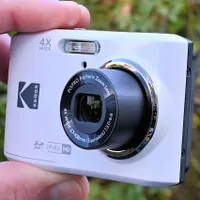
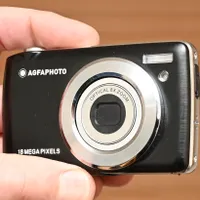
What qualifies as a ‘cheap camera’ is a bit of a moot point. The Yashica FX-D 100 is certainly less expensive to buy than many digital compact cameras, but I certainly wouldn’t call it cheap. It sells for around $342 / £259 / AU$455, which is considerably more than the price of some digital cameras with similarly famous (but also latter-day licensed) names, like the Kodak PixPro FZ45 at $99 / £94 / AU$149 and the AgfaPhoto Realishot DC8200 at $129 / £99 / AU$149. Even the same-brand Yashica City 100, which has many of the same features but wrapped up in a more mainstream modern build, significantly undercuts the FX-D 100 (at least in the USA) at a cost of around $230 / £219 / AU$443. On the face of it, whether the FX-D 100 is worth the money depends on how much you want its retro styling and alternative shooting modes.
Yashica FX-D 100: Design & Handling
At a glance, the Yashica FX-D 100 looks very similar to the more up-market FX-D 300 and FX-D S300. All three cameras aim to give you a choice of ‘digital’ and ‘analog’ shooting styles. Indeed, they all have the same retro styling that includes rotary control dials, a large viewfinder cowl and a ‘film advance lever’. Switch to ‘analog’ shooting mode and everything is purposefully slowed down. Part of that particular process is that you can’t take subsequent shots without manually twisting the film advance lever around, despite the camera not actually featuring physical film. Even so, a variety of film simulation modes becomes available, which I’ll come back to later.
There are some notable between the FX-D 100 and its pair of up-market siblings. Compared with the pricier cameras, this one has a relatively small image sensor. Instead of a 1/1.56-inch sensor typical of those in recent mobile phones, the FX-D 100 has a much smaller 1/3.06-inch sensor, more often used in older phones. And instead of being advertised as a 50 megapixel sensor, it’s quoted as being a 13 megapixel sensor. A couple of the other major differences are more apparent from the outside, as I’ll come to presently, but from the back the FX-D 100 looks identical to the FX-D 300.

The lens isn’t retractable and extends considerably from the front of the body. The upshot is that the Yashica isn’t a pocketable camera. A headline change from the other two cameras in the range is that the FX-D 100 is the only one that features a zoom lens rather than a fixed focal length lens. It’s actually a 3x zoom with an ‘effective’ range of 25-75mm in full-frame terms, with an aperture rating of f/1.6-2.8. Even so, it looks extremely similar to the fixed focal length lens of its two companion cameras, right down to the zoom control ring and large plastic disc that covers the frontal area.

Getting back to the back of the camera, as it were, a notable similarity with the FX-D 300 is that while there’s a full-sized viewfinder cowl, it’s purely for show. From a styling point of view, the cowl fits the retro design theme to a tee but there’s no actual viewfinder. To my mind, this makes the cowl look like an architectural folly that serves no practical purpose. The FXS-D S300 is the only camera of the three that does actually feature a viewfinder.
The layout of the top panel is the same in all three cameras. Viewed from behind, there’s a rotary control dial on the left for cycling through the various filter effects when you’re shooting in ‘digital’ mode, or through the available film simulations when you’re in ‘analog’ mode. A hot-shoe takes center stage, playing host to universal flashguns as there are no supplementary connection pins for dedicated models. On the right is a shooting mode dial, along with a shutter-release button and the ‘film advance lever’.

All that’s needed to change from ‘digital’ to ‘analog’ shooting style is to simply pull out the ‘film advance lever’ from its retracted position. Once extended a little, it stays that way until you push it back in again to revert to ‘digital’ mode. As I’ve mentioned, when you’re in ‘analog’ mode, you need to fully rotate the lever every time you want to ‘advance’ and take a subsequent shot. The idea is that the process is slowed down to a more pedestrian pace, forcing you to think more about what you’re doing instead of just constantly snapping away.

There’s more going on behind the scenes when you switch from digital to analog. In digital, you get a range of filter effects on offer, whereas in analog there are film simulation modes to choose from. The latter includes Ruby 60s for soft and nostalgic warmth, Sapphire 70s for cool tones, classic Yashica 400 for portraiture, Golden 80s for a sun-soaked look, and finally Mono 400 and B&W 400 for alternative retro black & white styles.

For connectivity, the FX-D 100 features built-in Wi-Fi and a USB-C port, and there’s also a standard jack socket for attaching an external microphone. The USB-C port is used for recharging the Li-ion battery when it’s installed in the camera, as well as enabling a data link. A protective flap on the left hand side of the camera keeps the USB port and mic socket out of harm’s way when you’re not using them.

Let’s take another look at that 3x optical zoom lens. As with digital zoom in the FX-D 300 and FX-D S300, you can operate the zoom facility via a rocker lever on the rear of the camera. The zoom and fixed lenses also have the same control ring, marked with a ‘D’ for Digital and equivalent focal lengths of 24mm, 35mm, 50mm and 75mm (the ‘300’ cameras top out at 60mm). In both of the ‘300’ cameras, applying digital zoom via the lens control ring applies progressive cropping of the 50MP image size, whereas optical zoom in the FX-D 100 retains the full native 13MP image area. In ‘digital’ mode, a further 4x digital zoom is available, in addition to the 3x optical zoom.

Another difference between the FX-D 100 and the other two cameras in the range is that the 100 can only shoot stills in JPEG quality mode, whereas there’s a JPEG + DNG mode in both of the 300-series cameras. That said, if you enable RAW shooting in the two pricier cameras, the maximum available 50MP image size shrinks to a fixed 12 megapixels.

The camera has a removable rather than fixed internal Li-ion battery, which I’m a fan of. This makes it possible to buy spare batteries and charge them up ahead of shooting, so you’re not stuck without a camera while recharging your one and only battery via the USB-C port. I’m also pleased that the camera takes full-sized SD/HC/XC memory cards, rather than the relatively tiny and fragile microSD cards that are used in Some of Yashica’s more compact cameras.
Yashica FX-D 100: Performance
I was expecting the Yashica FXD-D 100 to be a poor relation to the FX-D 300 and S300 in terms of outright image quality. Compared to the 50MP, 1/1.56-inch image sensors in the 300-series cameras, the 100 only has a modest 1/3.06-inch sensor which is physically much smaller and only has a 13MP resolution. In practice, however, image quality is arguably better from the FX-D 100, with pictures looking less pixellated and with better retention of fine detail and texture. There’s a menu option to upscale images to 24MP but I found that quality suffers from the digital interpolation that’s required.

One relative failing that I did notice was that the zoom lens of the FX-D 100 was much more prone to color fringing than the fixed focal length lenses of the 300-series cameras. This often showed up as purple fringing around high-contrast transitions in subject matter.

Back on the plus side, the camera delivers reasonably clean images under low lighting conditions, right up to and including its maximum sensitivity setting of ISO 3200. In this case, the retention of fine detail and texture does take a knock but image noise isn’t as big a problem as I’ve often seen in compact digital cameras.

There are nine scene modes on offer, all of which are available via the menu system once you select the Scene shooting mode on the top panel’s control wheel. The usual suspects include the likes of like Landscape, Portrait, Sports, Night Scene and a few more.

Boosting performance for selfies and vlogging in practical terms, the LCD screen at the rear is hinged and can flip through 180 degrees. This makes it easy to compose images and video accurately when you’re in front of the camera.

Yashica FX-D 100: Sample Images
The gallery below comprises a number of shots taken in the English city of Bath on a sunny morning. I used both the native resolution of 13 megapixels throughout testing, along with the Standard picture style. You’ll notice a couple of sequences of the same subject matter, taken at the shortest and longest zoom setting, with one or two extra shots in between.

Image credit: Matthew Richards

Image credit: Matthew Richards

Image credit: Matthew Richards

Image credit: Matthew Richards

Image credit: Matthew Richards

Image credit: Matthew Richards

Image credit: Matthew Richards

Image credit: Matthew Richards

Image credit: Matthew Richards

Image credit: Matthew Richards

Image credit: Matthew Richards

Image credit: Matthew Richards

Image credit: Matthew Richards

Image credit: Matthew Richards

Image credit: Matthew Richards

Image credit: Matthew Richards

Image credit: Matthew Richards

Image credit: Matthew Richards

Image credit: Matthew Richards

Image credit: Matthew Richards

Image credit: Matthew Richards

Image credit: Matthew Richards
Yashica FX-D 100: Video
Above: video samples shot with the Yashica FX-D 100
The Yashica has 4K30 video capture on the menu but I found no benefit in going beyond 1080p. Indeed, you might just as well stick with the base resolution of 720p. I also found that while image stabilization is on the menu for both stills and movie capture, it gave practically no benefit in handheld shooting throughout my testing. The example video footage below is based on two clips shot at 1080p. I’d say that video quality is acceptable rather than anything special, but again much better than with some of the budget compact cameras I’ve used in the past.
Yashica FX-D 100: Lab results
We've now lab tested three of Yashica's FX-D cameras; the FX-D 100, the 50MP FX-D 300, and the EVF-equipped FX-D S300. To give some context, we're also including the Kodak Pixpro FZ45 in our resolution comparison. This is a basic 16MP compact camera that costs way less than the FX-D 100, so it should in theory be outperformed by all three FX-D cameras.
We were only able to lab test the resolution of the FX-D 100, as the camera lacks manual exposure control which we require in order to conduct our usual dynamic range and signal-to-noise lab tests.
Resolution (line widths/picture height):

The 13MP, 1/3.06-inch Sony IMX458 sensor in the FX-D 100 is very small, and it's therefore very susceptible to image noise. Even at relatively low ISOs noise obscures fine detail. The $100 Kodak FZ45 is able to capture way more detail in the ISO200-1600 range.
Yashica FX-D 100: Verdict
Sometimes less is more, and that’s how I feel about the Yashica FX-D 100. Sure, it looks inferior to its pricier siblings on paper, the FX-D 300 and FX-DS300 boasting physically larger and higher-resolution 50MP image sensors. By comparison, the smaller 13MP is rather inferior, in theory, but I found its outright image quality to be more appealing, at least in terms of the retention of fine detail and texture. The 3x optical zoom lens is also a plus point, whereas the two more expensive stablemates both have fixed focal length lenses. The downside is that the zoom lens exhibits much more purple color fringing, which can be problematic.
Upsides in common for all three cameras include a handy flip-around rear screen, although it’s not a touchscreen, and properly retro styling that gives rise to both ‘digital’ and ‘analog’ shooting modes. The latter features a ‘film advance lever’, despite the absence of any physical film, but does give you a more film-like experience, complete with film simulation styles on offer. The viewfinder cowl in this case is just for show, the S300 being the only camera of the three to fill the space with an actual viewfinder. All in all, the FX-D 100 gives a certain feelgood factor but doesn’t deliver particularly great value at the price.
Features ★★★☆½ |
The 3x optical zoom lens is good to have and the flip-around LCD screen is useful for selfies and vlogging. |
Design ★★★☆☆ |
The design is perhaps a triumph of retro style over substance, with the omission of a viewfinder and the dubious advantage of a ‘film advance lever’. |
Performance ★★★☆½ |
Image quality is superior to that of many cheap compact cameras, this one punching above the weight of its 1/3.06-inch sensor. |
Value ★★★☆☆ |
It’s considerably more expensive than some compact cameras but all things considered, it’s decent value for money. |

Alternatives