Digital Camera World Verdict
The DJI Osmo Pocket 4 is a powerful gimbal camera with a host of refinements over its beloved predecessor, including impressive dynamic range and much better low-light performance. It has a 4K camera, can operate in widescreen and portrait, and now has built-in storage so you can side-step memory cards if you like.
Reasons to buy
- +
Surprisingly good battery life for the size
- +
Records long clips
- +
Built-in beauty & glamour effects for vlogging
- +
10-bit LOG video image quality
- +
107Gb storage
Reasons to avoid
- -
Digital rather than optical zoom at every level
- -
Still possible to get a bit lost in the menus
- -
Vulnerable camera component
- -
Not on sale in USA
Why you can trust Digital Camera World Our expert reviewers spend hours testing and comparing products and services so you can choose the best for you. Find out how we test.
The Pocket 4 has a job to do – to follow up on the Pocket 3. That camera managed to make, somehow, the third iteration into the definitive camera of DJI's handheld vlogging camera. So far, anyway.
Until then, the device was a weird niche, sticking one of DJI's drone-like camera gimbals ontop of a handle. After that it was the must-have tool for content creators, capturing amazingly stable shots with all kinds of motion. The Steadicam alternative for the TikTok era.
You'd see everyone carrying them on vacation, or when making movies, and there were good reasons why. For many lone creators, it was like having a friend to film, who has the skills to pick up rotating shots and follow subjects – just as you need to stand out from the crowd online.
We've waited two years for a new model, and such is the popularity of the camera that there have been pages and pages devoted to rumors about it. Is this what we were hoping for?
Price
The Osmo Pocket 4 starts at £445 for the standard combo and £549 for the Creator Combo with the Mic 3 TX, the fill light and a big enough carrying bag! In both cases, that seems like equally fair value to the camera's predecessor.
Thankfully, that's nothing like the price jump from the Pocket 2 (at $349) to the Pocket 3 (at $519), but there was a significant jump in specs on that occasion, and it clearly paid off.
Specs
| Row 0 - Cell 0 | Pocket 4 |
Pocket 3 |
Sensor |
1-inch CMOS |
1-inch CMOS |
Video (max) |
4K / 240fps 10-Bit D-Log |
4K / 120fps HLG D-Log M |
Stills (max) |
37MP (7680 x 4320) |
9.4MP |
Photo formats |
JPEG / DNG |
JPEG / DNG |
Battery |
1545 mAh / 240 mins |
1,300 mAh |
Screen |
2-inch / 1,000 nits |
2-Inch |
Storage |
107GB + MicroSD |
MicroSD only |
EFL |
20mm |
20mm |
Filters |
Beauty Filters + App Glamour Effects |
App Glamour Effects |
Weight |
190.5g |
179g |

Build and Handling
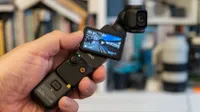
The idea is that the Pocket 4 is a stabilized camera on a simple handle – controlled with a couple of buttons. Simple.
In practice, things are a little more complex, which in fact is why one of the most noticeable changes between this camera and its predecessor is the arrival of two physical buttons beneath the rotating 2-inch touchscreen that, when open, provide tactile control for zoom and a customizable option.

The screen on the DJI Pocket 4 rotates from straight in line with the device's body to horizontal, making it as big as reasonably possible. It also acts as an on switch and (depending on your settings) a horizontal/portrait switch.
The camera in the gimbal does not rotate, but you can rotate the screen back to portrait format to shoot for TikTok etc. and the camera now switches to the best cropped resolution it can manage – 3K – which seems adequate.
There are a lot of other settings available via the camera's touchscreen, which operates a 'swipe from the side' approach which is simple on the face of it, but can get quite in depth.

To keep this in the 'compact camera' class, while offering flexibility when it comes to battery, DJI makes the bottom of the grip removable. The standard handle – which just extends it to the length needed for my big hands – can be removed by pressing a button on the front and replaced by a 'Battery Grip' to offer more life (at the cost of more weight).
Without one or the other fitted, though, you find yourself without a tripod thread at the base of the camera; a USB-C port is there instead. That port allows transfers of up to 800Mb/s from the built-in 107Gb of storage that renders a MicroSD card very much optional with this version of the device – one more step toward easier usability.

The camera's 2-inch screen, at 16:9, still isn't massive, but it seems big enough to feature all the controls. It is slightly easier, too, to control the zoom – which is at least lossless at 2x – using the new buttons beneath the screen.
The trick is to get used to swiping from the sides of the screen and the other hope for the bulky-fingered is that the DJI Mimo app can act as your friend; you have remote control of the device via your phone, as well as the ability to view and download content.

Content creators will be very pleased by the arrival of low light capture that works with the ActiveTrack feature, as well as the improved frame rate for slow motion.
Other features which are brilliant fun and offer great variety are the switchable modes, like the FPV mode, which can create cool rotating shots – the one down side being that the gimbal cannot turn 360-degrees so it cannot spin infinitely.

The camera also has some significant new features for new creators – built in AI glamour effects (skin smoothing options) – and some film effects. These are actually pretty impressive, and might be a good reason to buy for a lot of vloggers.
Performance
In the few weeks I've been testing the camera, it has been apparent to me that there are real improvements available here to vloggers, even without the long-anticipated second camera.
If I were looking for issues (and, you know, that is my job), I'd say that on some of the pans where the camera follows a slow subject – I had it follow a clipper boat up the Thames – it seems to judder ever so slightly. That's because the very smooth movement of the subject exposes the motion of the motors, but you don't see it at other times.
Sample images


Overall verdict
Taken on its own, the Pocket 4 remains an amazing camera, and it's easy to see why DJI has chosen to make refinements rather than go with the large-scale changes that some predicted. If it isn't broken, why fix it?
The answer to that question might come from a competitor soon enough, but for now, there isn't one – just this vague suspicion many had that a second camera was the solution (after all, it happened to their phones, didn't it, not to mention the DJI Air 3S drone).
For now, though, the image sensor does a good job, with great standard colors, so despite the ability to apply a profile to Log I found myself perfectly happy using the camera defaults. The subject tracking was quick and responsive. Focusing can be close enough to make this a good vlogging device too – unlike some action cameras.
So, this camera comes along in a category DJI has defined and gets everything right. It doesn't make a huge leap forward, so it might not make much sense on an upgrade list for Pocket 3 owners, but for anyone else, the brilliant smoothing is hard to argue and given the price is still well below full-frame vlogging cameras, this seems a natural first choice.
Features |
With 10-Bit video recording, generous built-in storage, simple microphone connection, and so much more this can feel like a mobile TV studio for the post-TV generation. |
Design |
So long as you accept that a protruding, mototrized camera is a bit of a risk, this design has a lot to mitigate it and a lot to help ease of use. |
Performance |
Low-light performance, slow-mo and other imaging is striking given the size of the camera. Perhaps only slow smooth pans give away the tech. |
Value |
This is not the cheapest of technologies, but it does offer flexibility which might save money so long as you're not proposing the kind of risk that a traditional action cam devotee might! |
Alternatives