Digital Camera World Verdict
I like how the Meike AF 85mm f/1.8 SE II doesn’t put a massive hole in my bank balance. With its 85mm focal length, it’s most ideal as a portrait prime for full-frame cameras but if portraiture is only an occasional pursuit, the money-spinning nature of this lens makes perfect sense. Image quality is satisfying, handling is basic but pretty good, and the mirrorless version is available in three mount options. Let the cost-saving commence!
Reasons to buy
- +
Supremely affordable
- +
Quite compact and lightweight
- +
11-blade aperture diaphragm
Reasons to avoid
- -
f/1.8 isn’t particularly fast
- -
Not fully weather-sealed
- -
No aperture control ring
Why you can trust Digital Camera World Our expert reviewers spend hours testing and comparing products and services so you can choose the best for you. Find out how we test.
If you’re not familiar with Meike, it’s a Hoing Kong-based company that’s been making waves as a manufacturer of cut-priced camera and cine lenses, plus lens adapters and other accessories. It operates under the slogan of ‘realize your vision’ and if you need to do that within strict price limits, there’s a growing range of tempting products.
I was recently pretty impressed with the full-frame compatible Meike 35mm f/1.8 Pro AF lens for Nikon Z and Sony E-mount cameras. The 85mm that I’m reviewing here is from Meike’s SE rather than Pro line-up, and has relatively basic handling without an aperture control ring or a customizable function button. Ultimately, this Meike prime keeps things simple but still aims to be one of the best portrait lenses, at least if you’re on a tight budget. The company also produces Canon EF mount and Nikon F mount versions of the lens that are physically shorter, if you’re hankering after a portrait prime for your DSLR.

Meike AF 85mm f/1.8 SE II: Specifications
Mount options |
Nikon Z (FX), Sony E (FE), L-mount |
Lens construction |
11 elements in 7 groups |
Angle of view |
27.8 degrees |
Diaphragm blades |
11 |
Minimum aperture |
f/16 |
Minimum focus distance |
0.65m |
Maximum magnification |
Unspecified |
Filter size |
62mm |
Dimensions |
76x100mm / 3.0x3.9in |
Weight |
369g / 13oz |
Meike AF 85mm f/1.8 SE II: Price
Portrait prime lenses can be notoriously expensive but the Meike AF 85mm f/1.8 SE II cuts the cost all the way down to $229 / £190 / AU$410. That seriously undercuts the price of the same company’s Meike 35mm f/1.8 Pro AF at $379 / £399 / AU$573, although the ‘Pro’ badged 35mm does have a more up-market feature set, including an aperture control ring and customizable function button. Back in 85mm territory, those additional handling extras are also featured in the 7Artisans AF 85mm f/1.8 at $299 / £279 / AU$439 and the Viltrox AF 85mm f/2 Evo $275 / £265 / AU$425, which aren't massively more expensive than the Meike.
Meike AF 85mm f/1.8 SE II: Design & Handling
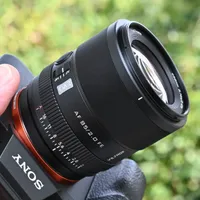
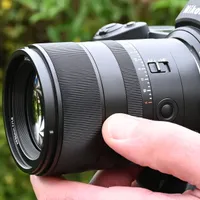
The Meike AF 85mm f/1.8 SE II looks and feels a simple and straightforward lens. There’s not much in the way of fancy features but you do get 11 optical elements arranged in 7 groups, along with a stepping motor-based autofocus system. It’s designed to be compact and lightweight, fulfilling its downsized brief with measurements of 76x100mm / 3.0x3.9in and a weight of just 369g / 13oz.
The Meike feels well balanced on both full-frame and APS-C format slimline mirrorless cameras. It has a 127.5mm ‘effective’ focal length on the latter, more ideal for tight head shots rather than the more usual head-and-shoulders and half-length portraits on a full-frame camera.

Despite its compact build, the Meike has a fully internal focus mechanism, so the overall physical length remains fixed at all focus distances from 0.65m to infinity. That shortest focus distance is actually a little shorter than with some 85mm lenses, although Meike doesn’t quote a maximum magnification ratio for the lens.

Although basic in its handling characteristics, the lens isn’t completely bereft of switches. There’s an AF/MF focus mode switch on the left hand side of the barrel, so you can make the change without resorting to menu systems in your camera body. It’s nice to have but autofocus mode is probably favorite for most of us, and the lens is compatible with face/eye detection and tracking in cameras that have this option.

I’m a little surprised (more like exasperated) that some own-brand camera/lens manufacturers like Nikon and more especially Canon still insist on selling lens hoods separately as ‘optional extras’, rather than supplying them with some of their consumer-level lenses. The cynic in me says it’s just a way of making the lenses appear better value than they really are, and gaining a little extra money on the side (or rather on the front). Like most other independent lens manufacturers, Meike includes a hood with even its least expensive lenses, a bayonet-fit, circular-profile hood being bundled with this one.

In its forward-facing orientation for active duty, the hood doesn’t add massively to the overall length of the lens and, being made of plastic, it’s very lightweight and doesn’t alter the balance of the lens.

Another saver of both weight and money, among some company’s budget lenses, is that the mounting plate is made from plastic rather than metal. The Meike feels relatively robust in this respect, with a metal mounting plate that even features a USB-C port for applying firmware updates, if and when needed. The mounting plate also features a rubber weather-seal ring to resist the ingress of dust and moisture between the camera and lens, although Meike doesn’t claim that any other weather-seals are fitted.

Meike AF 85mm f/1.8 SE II: Performance
Autofocus speed proved a little pedestrian in my tests but able to keep up with movements in human subjects during portraiture. If people were running around, keeping track of them might be more of a challenge.

Purists and speed demons might say that f/1.8 isn’t properly fast and that you really need an f/1.4 or even an f/1.2 lens. You don’t. The widest aperture of this lens enables quick shutter speeds even under very low lighting levels, and gives you a fairly tight depth of field. In practice, I found the Meike was well able to isolate subjects against a fussy background, blurring the latter to good effect. Ultimately, it combines good levels of sharpness with attractively smooth bokeh, which is exactly what I want from an 85mm prime lens.

The following gallery of images of a phrenology head against a garden background serves a variety of purposes. Taken at all major aperture steps between f/1.8 and f/11, you can gauge sharpness levels on the fine text and lines of the head, as well as the quality of bokeh in the background. The composition also draws attention to any axial chromatic aberration (bokeh fringing) around high-contrast transitions just in front of or behind the plane of focus, which can be problematic for fast lenses at or near their widest aperture.


Stop down a little and bokeh remains nice and smooth, helped along by the particularly well-rounded 11-blade aperture diaphragm. Numerically, that goes above and beyond what I’d expect in a budget lens. Stop down a little more to medium apertures and levels of sharpness hold up pretty well right out to the edges and corners of the image frame.

Meike AF 85mm f/1.8 SE II: Sample Images
The gallery of example shots below was taken outdoors, on an overcast morning in the English city of Bath, as well as in the city’s indoor market and a local bookshop. I used a medium aperture setting for some of the shots, and the widest available aperture of f/1.8 for others.


Meike AF 85mm f/1.8 SE II: Lab Results
We run a range of lab tests under controlled conditions, using the Imatest Master testing suite. Photos of test charts are taken across the range of apertures and zooms (where available), then analyzed for sharpness, distortion and chromatic aberrations.
We use Imatest SFR (spatial frequency response) charts and analysis software to plot lens resolution at the center of the image frame, corners and mid-point distances, across the range of aperture settings and, with zoom lenses, at four different focal lengths. The tests also measure distortion and color fringing (chromatic aberration).
Sharpness:

Sharpness is excellent in the central region, even wide open, and stays consistently so throughout the aperture range. Corner sharpness takes a little longer to come on song, but at f/2.8 and beyond it's very respectable.
Fringing:

Color fringing is negligible at all apertures and very hard to spot in real-world images.
Distortion: 1.65
There's a touch of pincushion distortion, but it's nothing too noticeable.
Meike AF 85mm f/1.8 SE II: Verdict
There’s nothing wrong with cheap thrills, in the right context. The Meike AF 85mm f/1.8 SE II has the look and feel of a lens that’s built down to a price, and doesn’t boast any fancy features like an aperture control ring or function buttons. However, it covers all the basics, from a capable optical system to a whisper-quiet autofocus system, along with an AF/MF mode switch. And although compact and lightweight, it has a weather-sealed metal (rather than plastic) mounting plate and comes complete with a hood.
I’d say the lens is sufficiently sharp and has pleasingly soft bokeh, delivering good overall image quality. It’s not going to satisfy the demands of the most critical photographers or the resolutions of the most high-megapixel cameras, but it achieves its goal in being a decent portrait prime at a really low-rent price.
Features ★★★★☆ |
Useful features include the coupling of an 85mm focal length with a fairly fast f/1.8 aperture and stepping motor-based autofocus system, complete with an AF/MF switch and bayonet hood. |
Design ★★★★☆ |
The design and handling are fairly basic but unlike many ‘cheap’ lenses, the Meike has a weather-sealed metal mounting plate decent overall build quality. |
Performance ★★★★☆ |
It’s not the sharpest tool in the box but delivers good overall clarity and soft bokeh for portraiture, which is the ideal subject matter for the lens. |
Value ★★★★☆ |
The Meike might not be flashy or ultra-fast, but it covers all the most important bases for a portrait prime and is very good value for money. |

Alternatives