
What a camera! As I’m tapping out this buying guide on my computer keyboard, the Sony A7 V has just outsold all other cameras at a top Japanese photographic store for an entire month, outnumbering all four of the next-placed cameras – combined! What makes it so special?
Well, a new partially stacked image sensor, AI-powered subject-detection autofocus and a blistering burst rate spring to mind, straight off the bat. But as with its recent forebears in the A7 line, it’s the camera’s sheer versatility that makes it so appealing to massed ranks of photographers. Its broad remit stretches to travel, sports, landscapes, portraits, weddings and pretty much every other photographic genre, the A7 V taking them all in its stride.
With that in mind, I’ve picked out a selection of nine different lenses to suit pretty much any and every category from walkabout shooting and street photography, through sports and wildlife, to macro and astrophotography. As a mid-range camera however, it’s not the body that the most big-spending buyers will choose. And with that in mind, I’ve kept one eye on the budget when earmarking the best-buy lenses for this camera. Let’s get into it…

Matthew Richards is a photographer and journalist who has spent years using and reviewing all manner of photo gear. He is Digital Camera World's principal lens reviewer – and has tested more primes and zooms than most people have had hot dinners! He is our go-to man whenever new lenses are released, and has personally tested the lenses on this list.
Best lenses for the Sony A7 V
Why you can trust Digital Camera World Our expert reviewers spend hours testing and comparing products and services so you can choose the best for you. Find out how we test.
Best standard zoom lens for the A7 V


It hasn’t escaped my attention that Sony updated and upgraded its long-standing kit zoom lens, to do justice to the performance increases in the A7 V. Even so, the replacement FE 28-70mm f/3.5-5.6 OSS II remains a relatively slow, variable-aperture standard zoom.
Back in my DSLR days, the original Sigma 24-70mm Art was my go-to lens for everyday shooting, and I loved it. The first edition of the replacement ‘DN’ zoom for mirrorless cameras was a marked improvement and this revamped Mark II is even better. It has a redesigned optical path for greater edge-to-edge sharpness, as well as reducing sagittal coma flare, so pinpricks of light don’t take on irregular shapes. Along with excellent sharpness, the lens delivers smooth bokeh, the quality of which is enhanced by a particularly well-rounded 11-blade aperture.
I really like the handling of this lens. Additions over the previous incarnation include an aperture control ring, which comes complete with a click/de-click switch and a locking switch to avoid accidental operation. The de-click option is great for shooting video, and the lens has also been designed to minimize focus breathing. That’s another box ticked for shooting video, ideal for cameras like the A7 V which is tailor-made for 'hybrid shooters'. The Mark II also doubles up on customizable function buttons, catering to both portraitand landscape orientation shooting, and they can be customized for other functions in camera menus.
Autofocus is about three times faster than in the original lens, and well able to keep pace when tracking moving subjects, based on an HLA (High-response Linear Actuator) motor. That's another tick in the box for use with the A7 V. All in all, it’s a brilliant lens for everyday shooting and I’d go as far as to say it’s pretty much as good as the Sony FE 24-70mm F2.8 G Master II which costs about twice as much to buy. This Sigma is a steal at the price.
Read more: Sigma 24-70mm F2.8 DG DN II Art review
Features ★★★★★ |
Advanced features include a click/de-click aperture ring and two Fn buttons. |
Design ★★★★★ |
The Mark II sheds a little weight while enhancing autofocus speed and quality. |
Performance ★★★★★ |
Fast and consistently accurate autofocus teams up with excellent image quality. |
Value ★★★★★ |
Compared with own-brand ‘trinity’ standard zooms, the Sigma Mark II is bargain. |
Best wide-angle zoom for the A7 V
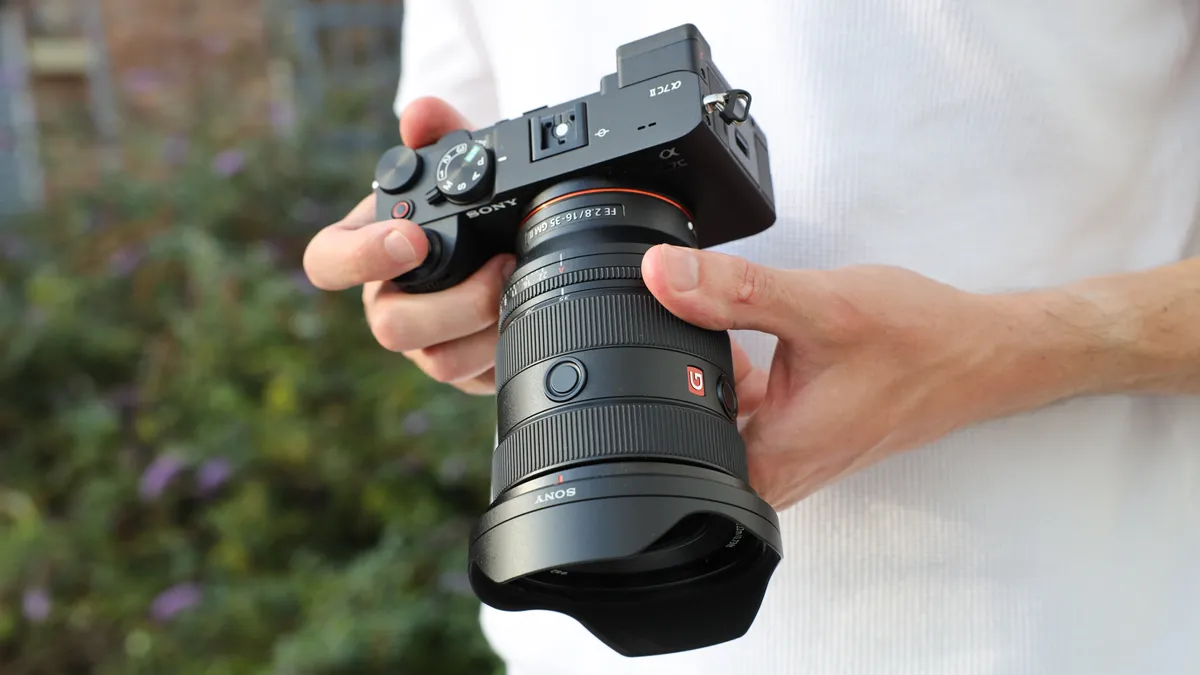


Sony’s G Master lenses have a reputation for optical quality, so it’s no surprise that this second-generation version of Sony’s 16-35mm f/2.8 zoom comes with a hefty price tag. If this is your favored focal range for stills and video, this lens will be your dream buy; otherwise, take a look at the Sony FE PZ 16-35mm f/4 G, which is less than half the price.
You might also want to check out third-party alternatives. The Sony FE 16-35mm f/2.8 G Master II justifies its cost, however, with no fewer than four Linear XD focus motors and suppressed focus breathing. It really is quite a lens with stunning pictorial quality and all-round performance, and a lens that you'll probably want to keep for a lifetime.
Read more: Sony FE 16-35mm f/2.8 GM II review
Features ★★★★★ |
There are no less than four XC autofocus motors, a click/de-click aperture ring with locking switch and dual function buttons. |
Design ★★★★★ |
The clever design is 20% lighter and 10% smaller than the previous edition of the lens. |
Performance ★★★★★ |
Image quality is excellent, as is the speed and consistency of autofocus. |
Value ★★★★☆ |
You get what you pay for to some extent but third-party options can cost a lot less. |
Best telephoto zoom for the A7 V


I have very happy memories of the DSLR version of this lens. I firmly believed it was one of the very best 70-200mm ‘trinity’ zooms on the market, paid good money for it, and it served me very well indeed through many weddings and events, sports and wildlife shoots, and more besides. As with the Sigma 24-70mm, the ‘DN’ version of this telephoto zoom is completely redesigned, revamped and revitalized for mirrorless cameras, also being available in L-mount as well as Sony E.
Well able to keep up with the Sony A7 V’s super-speedy and ‘intelligent’ autofocus system, the Sigma has really rapid yet virtually silent AF, driven by two HLA (High-response Linear Actuator) motors. Sharpness in practical terms is boosted by a highly effective optical image stabilizer, worth 7.5 stops at the short end and 5.5 stops at the long end of the zoom range, complete with switchable static and panning modes.
Quality glass includes with three aspherical elements, two SLD (Special Low Dispersion) elements and six top-grade FLD (‘Fluorite’ Low Dispersion) elements. The resulting image quality is superb, combining impressive sharpness and clarity with beautifully smooth bokeh. What’s more, while the original DSLR lens was very hefty at 1,805g, the DN version for mirrorless cameras takes a huge 470g off the weight, making it much more easily manageable.
Read more: Sigma 70-200mm f/2.8 DG DN OS Sports review
Features ★★★★★ |
The feast of features includes an aperture control ring, switches for focus mode, focus range limiter, stabilization and custom settings. |
Design ★★★★½ |
The original DSLR lens was criticized for its heavy weight but this version sheds just over a pound while retaining robustness and weather-seals. |
Performance ★★★★½ |
Fast, reliable autofocus and effective optical stabilization help to deliver consistent sharpness, and the lens gives beautiful bokeh. |
Value ★★★★★ |
Compared with equivalent own-brand lenses from various other camera manufacturers, the Sigma is standout value for money. |
Best super-telephoto zoom for the A7 V


I’ve been impressed by the Sony FE 100-400mm f/4.5-5.6 G Master OSS super-tele zoom for E-mount mirrorless cameras, but the newer 200-600mm really boosts telephoto reach, with only a minimal narrowing of the aperture rating. It’s also considerably less expensive, has similarly refined handling, and delivers superb performance and image quality
Handling is excellent, with a switchable triple-mode optical stabilizer, an autofocus range limiter, and customizable AF-on/AF-lock buttons. Unusually for this type of lens, the overall physical length remains fixed throughout the zoom range.
The Direct Drive Super Sonic Motor autofocus system is fast, accurate, and ultra-quiet. The optical stabilizer works best in conjunction with in-body stabilizers featured in recent Sony cameras, and sharpness is both scintillating and consistent. It feels a bit hefty on the A7 V but well worth the weight.
Read more: Sony FE 200-600mm f/5.6-6.3 G OSS review
Features ★★★★★ |
There are all the up-market controls, switches and handling extras you could hope for. |
Design ★★★★★ |
It’s a necessarily big lens but less of a heavyweight than some, along with robust build quality. |
Performance ★★★★★ |
Image quality is great throughout the entire zoom range, with effective stabilization and fast autofocus. |
Value ★★★★☆ |
It’s pricier than the alternative Sigma lens but not bad value for an own-brand Sony G zoom. |
Best standard prime for the A7 V
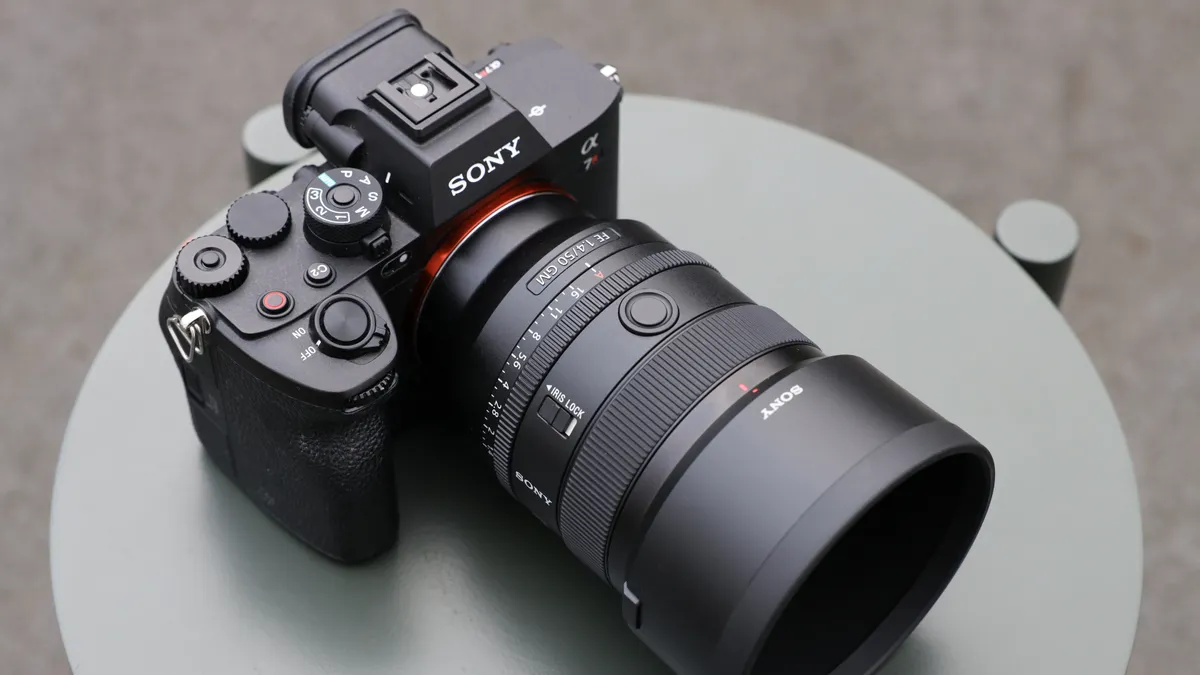


I reckon that this Sony standard prime is the best fit for for the A7 V. It's impressively light and compact, but doesn't compromise one bit on optical quality. It's practically perfect in terms of center-sharpness and only has a small falloff towards the edges of the frame, along with some vignetting when shooting wide-open, which is only to be expected.
The 50mm focal length delivers an entirely natural perspective, and it is definitely a lens that can be left on your camera for wide-ranging shooting scenarios. If you don't need the extra aperture stop, or the added size, weight, or considerable cost of the FE 50mm f/1.2 GM, then the Sony FE 50mm f/1.4 will suit you to a tee.
Unfortunately, the downside is the lens is expensive when compared to similar rivals, with much cheaper third-party glass out there that will achieve similar visual results. However, few have quite the same lightning-fast autofocus and solid, moisture-resistant construction that this lens offers.
Read more: Sony FE 50mm f/1.4 GM review
Features ★★★★★ |
It has all the features and trappings that I’d expect from a Sony G Master lens. |
Design ★★★★★ |
It’s pretty chunky for a 50mm f/1.4 lens but the build quality is excellent. |
Performance ★★★★★ |
There’s some noticeable vignetting when uncorrected in-camera but overall performance is superb. |
Value ★★★★☆ |
Sony G Master lenses tend to command a high price and this one’s no different. |
Best portrait prime for the A7 V





Sony's gorgeous G Master lenses have garnered a reputation as being among the finest optics you can buy, and this long-awaited update to the 85mm f/1.4 follows suit. It manages to improve on what many people thought was a near-perfect lens, delivering a configuration that's ideal for most portraiture scenarios.
Where you need sharpness, it's sharp as a tack. Where you need dreamy, bokehlicious softness, it gives it to you in spades. It achieves this by doubling the complement of XA (extreme aspherical) elements included in the optical construction.
Autofocus speed has also been upgraded, driven by two XD (extreme dynamic) linear motors that Sony promises will deliver a seven-fold improvement in tracking of moving subjects. Somehow, even with all this, the weight has been reduced from the previous version, making the lens easier to use handheld. The aperture ring has a de-clicked option, and there's an Iris Lock switch to prevent it from being knocked out of place. It's undeniably a considerable investment but for portraiture, it rules the roost.
Read more: Sony FE 85mm F1.4 GM II review
Features ★★★★★ |
From its optical path to its fast autofocus and handling exotica, the lens is packed with features. |
Design ★★★★★ |
High-end design includes an aperture control ring with click/de-click options and dual function buttons. |
Performance ★★★★★ |
Performance is simply fabulous, from all aspects of image quality to quick, reliable autofocus. |
Value ★★★★☆ |
It’s a very expensive lens, costing about twice as much as the directly competing Sigma. |
Best street prime for the A7 V


Like other manufacturers, Sony makes premium lenses that are really rather big and heavy. That's par for the course. But it's the last thing you need for street photography, where you want to be inconspicuous and avoid drawing attention to yourself.
Going hand in glove with the slimline A7 V, this lens is a relatively small, lightweight prime, but there's a lot shoehorned into its diminutive build. The FE 40mm f/2.5 G also has an ideal focal length, being a little wider than a 'standard' 50mm prime and squeezing more into the frame, again ideal for street photography. As a G Master lens, it's very impressive in terms of image quality, with standout sharpness throughout the aperture range, and right across the frame.
This lightweight lens is perfect to attach to your A7 V and just walk around with for hours on end. The balance and feel is so much better than with a hefty zoom or prime, and the autofocus is fast and accurate enough to catch pretty much anything. Sony has done a great job here, and any Alpha-using street photographer should definitely make this lens a prime consideration in every way.
Read more: Sony FE 40mm f/2.5 G review
Features ★★★★★ |
Advanced features include four XD autofocus motors, an aperture ring with a de-click switch, refined manual focusing and Optical SteadyShot. |
Design ★★★★★ |
The design is something of a masterstroke, packing 1.4x macro magnification into a reasonably compact lens with top-end handling characteristics and weather-seals.. |
Performance ★★★★★ |
The lens is super-sharp and delivers fabulously detailed macro images, along with fast autofocus and great quality in general shooting. |
Value ★★★★☆ |
It’s undeniably expensive for a macro lens but this Sony really is something rather special, making it good value at the price. |
Best macro lens for the A7 V
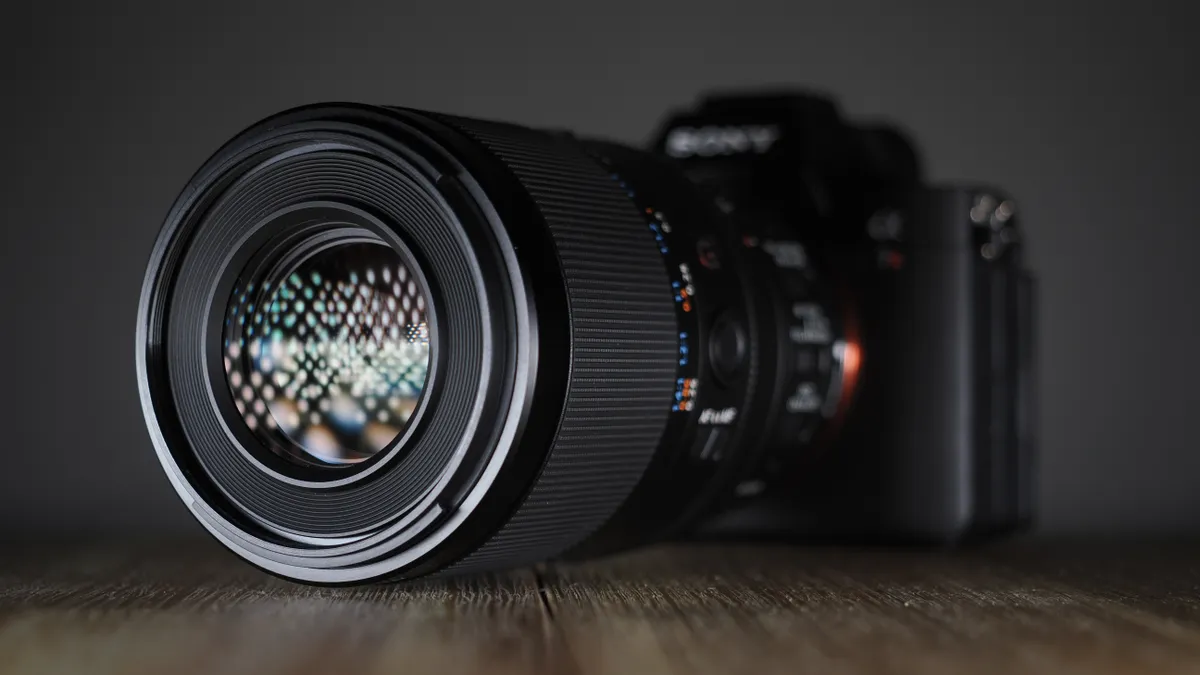


Sony’s time-honored FE 90mm macro lens has been looking a bit old and tired for some time now. Enter the new FE 100mm, which is everything I’d hope for (and more) in a top-end macro lens. For starters, it goes extra-large on maximum magnification, boasting 1.4x magnification at its minimum focus distance, instead of the more usual 1.0x. And if that’s still not enough, you can boost it to as much as 2.8x for revealing near-microscopic levels of detail, if you add a 2x teleconverter.
While the maximum magnification is highly impressive, there’s a lot more to this lens than just acting as a magnifying glass for your Sony A7 V. There’s a smorgasbord of handling exotica, including a calibrated manual focus scale (I typically prefer manual focusing for macro shooting), an AF/MF switch, focus range limiter, stabilizer on/off and an iris lock switch to go with the aperture control ring.
High-performance glass includes two ED (Extra-low Dispersion) elements and two XA (eXtreme Aspherical) elements, along with a particularly well-rounded 11-blade aperture diaphragm. Nano AR Coating II and fluorine coatings are also applied. The lens isn’t a one-trick pony either. Great for portraiture or just as a short telephoto prime, it has no less than four XD (eXtreme Drive) linear motors to power its fast and virtually silent autofocus system.
Read more: Sony FE 100mm f/2.8 Macro GM OSS review
Features ★★★★★ |
Advanced features include four XD autofocus motors, an aperture ring with a de-click switch, refined manual focusing and Optical SteadyShot. |
Design ★★★★★ |
The design is something of a masterstroke, packing 1.4x macro magnification into a reasonably compact lens with top-end handling characteristics and weather-seals. |
Performance ★★★★★ |
The lens is super-sharp and delivers fabulously detailed macro images, along with fast autofocus and great quality in general shooting. |
Value ★★★★☆ |
It’s undeniably expensive for a macro lens but this Sony really is something rather special, making it good value at the price. |
Best astrophotography lens for the A7 V


This imposing lens is tailor-made for astrophotography. It offers an ultra-wide 14mm focal length that squeezes vast areas of the night sky into the frame, along with a super-fast f/1.4 aperture that sucks in as much starlight as possible. It's simply perfect for capturing epic nightscapes of the Milky Way.
Sigma's previous 14mm fast prime for DSLR cameras could only manage f/1.8, and this f/1.4 mirrorless version is a world-first. Its light-gathering powers come into their own after dark, but the lens isn't just for nightlife.
The Sigma also excels at landscapes, cityscapes, and architectural interiors, giving fabulous image quality backed up by superb handling and excellent build quality. As proved by our laboratory tests, levels of sharpness are thoroughly excellent across the whole image frame, even when shooting wide-open at f/1.4.
Read more: Sigma 14mm f/1.4 DG DN Art review
Features ★★★★★ |
Top features include an autofocus lock button, manual focus lock and click/de-click aperture ring. |
Design ★★★★★ |
The lens is designed with astrophotography in mind but works great for other scenarios. |
Performance ★★★★★ |
Sharpness is excellent across the whole frame even at f/1.4, which is no mean feat for such a wide-angle lens. |
Value ★★★★☆ |
It’s a pricey lens but there’s some big, extremely high-precision glass inside. Overall, it’s very good value. |
How we test lenses
The lens experts in our testing lab run a range of tests under controlled conditions, using the Imatest Master testing suite. Photos of test charts are taken across the range of apertures and zooms (where available), then analyzed for sharpness, distortion and chromatic aberrations.
We use Imatest SFR (spatial frequency response) charts and analysis software to plot lens resolution at the centre of the image frame, corners and mid-point distances, across the range of aperture settings and, with zoom lenses, at four different focal lengths.
There's more to it than just the technical side, though! Beyond the lab, our reviewers test lenses in real-world environments – and sometimes on professional shoots! We work with lenses both indoors and outdoors, in studio conditions and in natural light, with as many different subjects as is possible (or appropriate – there's no point testing a landscape lens' ability to shoot a portrait!).
We take into account everything from handling and ease of use to speed of autofocus and the overall quality of the images produced.
Find out more about how we test and review on Digital Camera World
Lab test data and comparisons
The graphs below show the comparative performance of the lenses in this guide, based on our in-house lab tests. The Sony FE 50mm and 85mm come up trumps for sharpness, while the FE 100mm Macro and FE 40mm aren't far behind. Color fringing and distortions are pretty low across the board, apart from the Sigma 14mm, which shows clearly noticeable barrel distortion. Automatic in-camera corrections for these aberrations are available with the Sony A7 IV.
For zoom lenses, we repeat our test at the widest and longest ends of the zoom range, plus intermediate 'mid-wide' and 'mid-telephoto' settings. Use the dropdown menus to select between them (for primes, the same data appears on all the graphs for comparison purposes).
For more detailed graphs of each lens's performance, which give the full picture, check out the graphs in our full standalone lens reviews.
Center sharpness
Use the dropdown menu to select between wide-angle, mid-wide, mid-tele, and telephoto zoom settings (prime lens data is replicated across all charts for ease of comparison)
| Timestamp (f-stop) | Sigma 24-70mm f/2.8 DG DN II | A () | Sony FE 16-35mm f/2.8 GM II () | Sigma 70-200mm f/2.8 DG DN OS () | Sony FE 200-600mm f/5.6-6.3 G OSS () | Sony FE 50mm f/1.4 GM () | Sony FE 85mm f/1.4 GM II () | Sony FE 40mm f/2.5 G () | Sony FE 100mm f/2.8 Macro GM OSS () | Sigma 14mm f/1.4 DG DN | A () |
|---|---|---|---|---|---|---|---|---|---|
| 1 | N/A | N/A | N/A | N/A | 3078 | 2678 | N/A | N/A | 2128 |
| 2 | N/A | N/A | N/A | N/A | 3371 | 3161 | N/A | N/A | 2613 |
| 3 | 2699 | 2789 | 1690 | N/A | 3488 | 3086 | 2836 | 2759 | 2725 |
| 4 | 2535 | 2734 | 2254 | N/A | 3245 | 2893 | 2731 | 2982 | 2590 |
| 5 | 2546 | 2832 | 2003 | 2199 | 3052 | 2942 | 2714 | 2993 | 2592 |
| 6 | 2463 | 2551 | 1980 | 2435 | 2591 | 2481 | 2420 | 2668 | 2404 |
| 7 | 2147 | 2156 | 2020 | 2144 | 2238 | 2046 | 2165 | 2207 | 2190 |
| 8 | 1834 | 1818 | 1673 | 1759 | 1766 | 1612 | 1758 | 1763 | 1856 |
| 9 | 1356 | 1393 | 1382 | 1348 | N/A | N/A | 1375 | 1365 | N/A |

Fringing @ f/8
| Product | Value |
|---|---|
| Sigma 24-70mm f/2.8 DG DN II | A | 0.05 |
| Sony FE 16-35mm f/2.8 GM II | 0.36 |
| Sigma 70-200mm f/2.8 DG DN OS | 0.08 |
| Sony FE 200-600mm f/5.6-6.3 G OSS | 1 |
| Sony FE 50mm f/1.4 GM | 0.44 |
| Sony FE 85mm f/1.4 GM II | 0.14 |
| Sony FE 40mm f/2.5 G | 0.16 |
| Sony FE 100mm f/2.8 Macro GM OSS | 0.12 |
| Sigma 14mm f/1.4 DG DN | A | 0.2 |
Distortion
Use the dropdown menu to select between wide-angle, mid-wide, mid-tele, and telephoto zoom settings (prime lens data is replicated across all charts for ease of comparison)
| Product | Value |
|---|---|
| Sigma 24-70mm f/2.8 DG DN II | A | -2.25 |
| Sony FE 16-35mm f/2.8 GM II | -1.8 |
| Sigma 70-200mm f/2.8 DG DN OS | 1 |
| Sony FE 200-600mm f/5.6-6.3 G OSS | 1.56 |
| Sony FE 50mm f/1.4 GM | 1.06 |
| Sony FE 85mm f/1.4 GM II | 0.56 |
| Sony FE 40mm f/2.5 G | -1.38 |
| Sony FE 100mm f/2.8 Macro GM OSS | 0.28 |
| Sigma 14mm f/1.4 DG DN | A | -3.62 |
How to choose the best lenses for the Sony A7 V
The Sony A7 V, like all Alpha 7 cameras, uses the Sony E lens mount. Sony’s own E-mount lenses have either FE or E in their model names. FE lenses are designed for use with full-frame Sony cameras, including A7 V, so these should be your first choice. If you are buying a third-party E-mount lens, check that the lens is designed for use with full-frame Sonys.
Sony lenses with an E (rather than FE) prefix are designed for APS-C format cameras such as the A6000 series. On the A7 V, they produce a cropped image, so they’re not an ideal choice.
Check out our guide to the best Sony lenses if you want to know more
