Digital Camera World Verdict
The Vivo V70 is the most polished V-series phone I’ve used yet. It looks and feels far more premium than its predecessor, and more than its humble price suggests. I’ve long been a fan of Vivo’s cameras in its flagships, but the 50MP Zeiss main and telephoto cameras took me a little by surprise at how genuinely impressive they are for this level of device. Inside, it's the same processor and battery as last time, so performance gains are modest, but battery life remains excellent. If you don’t have a huge budget but want a genuinely usable long-range zoom, then the V70 offers a stylish Android phone that is easy to recommend, its just a shame its not more widely available.
Reasons to buy
- +
Excellent 50MP telephoto and main camera
- +
Premium design with a range of color options
- +
Very good battery life
- +
6 years of security updates
Reasons to avoid
- -
Performance only a modest upgrade over V60
- -
Pre-installed bloatware and annoying Vivo apps
Why you can trust Digital Camera World Our expert reviewers spend hours testing and comparing products and services so you can choose the best for you. Find out how we test.
Vivo’s V series has always sat in that interesting middle ground, not quite flagship, not quite budget, but designed to offer a slice of premium experience at a more accessible price. The Vivo V70 continues that tradition, bringing triple Zeiss co-engineered cameras and a redesigned look for a phone that feels more high-end than previous generations.
Although if you look beyond the new style and a slight bump in screen resolution, you might be a little underwhelmed, as there isn't really a huge amount of hardware updates to separate it from last year's V60.
The headline remains the same 50MP Zeiss Super Telephoto camera with a periscope structure and a 1/1.95-inch sensor as featured in the V60, but it's still something you don’t always see at this level. The V70 also introduces 4K 60p video to the V series and more AI options for portrait photography scenes.
After spending time shooting, editing, and living with it, here’s how it really stacks up.

Vivo V70: Specifications
Processor |
Qualcomm Snapdragon 7 Gen 4 |
RAM / Storage |
8GB + 256GB / 12GB + 256GB / 12GB + 512GB |
Display |
6.59-inch AMOLED, 2750 x 1260 (1.5K), 120Hz |
Main Camera |
50MP, 23mm equivalent, 1/1.56" |
Ultrawide Camera |
8MP, 15mm equivalent |
Telephoto Camera |
50MP, 73mm equivalent (3x), 1/1.95" |
Front Camera |
50MP, |
Video |
Up to 4K 60fps |
Battery & Charging |
6,500mAh, 90W FlashCharge |
Operating System |
OriginOS 6 (Android 16) |
Dimensions |
157.52 x 74.33 x 7.40mm |
Weight |
187g–194g (depending on finish) |
Vivo V70: Price & Availability
The Vivo V70, like most of Vivo’s output, will only be coming to select markets in Asia, the Middle East, and Europe, which is a shame for a compelling mid-range option. Converted, it works out around $450 for the 8GB+256GB version and US$550 for the 12GB+512GB version.
The closest competition is perhaps the Xiaomi 15T, which also squeezes in three cameras for roughly the same price. Compared to other rivals like the Pixel 10a or OnePlus 15R, Vivo leaps ahead in telephoto capabilities.
If you’re thinking of upgrading from the V60, however, the gains aren’t that dramatic, but you might be tempted by the swish new design.
Vivo V70: Design
The V70 might look a little familiar if you’ve been keeping one eye on phone releases over the last few months, with an eerily similar design to the recent OnePlus 15 and Oppo Find X9 Pro. Of course, no one really owns phone design, and those phones both borrow from other models, but it is interesting that Vivo chose to follow in such a similar style so close to those releases.

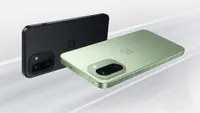
Regardless, the V70 looks and feels great – and I think much better than the V60. Picking it up, it does feel more expensive than it is.
I’ve been using the “Golden Hour” version with the Sunset Glow design. It’s really not personally my taste – I tend to prefer more understated matte finishes – but I can absolutely see the appeal. The etched glass catches the light beautifully, and it genuinely stands out in a sea of grey slabs. If that’s too bold, Alpine Gray, Sandalwood Brown, Canary Yellow, and Authentic Black offer more restrained options.

The aerospace-grade aluminium frame gives the V70 a reassuring solidity and feels good in the hand. The matte rail also blends seamlessly with the same metallic camera module.
The camera island sits neatly in the top-left corner, which keeps it out of the way of fingers, and it now houses all three lenses and the halo ring light in one unified block, which I prefer over the design of last year's phone that kicked the ultrawide off on its own.

At 157.5mm tall and under 195g, it’s marginally smaller and lighter than many current flagships. For anyone who finds today’s ultra-sized devices a bit unwieldy, this is a nice compromise.
The display is a 6.59-inch 1.5K AMOLED panel at 120Hz. It’s bright, colourful and sharp – not class-leading, but very good for the price, and a noticeable bump in resolution and quality over the V60. The flat screen with rounded corners is a big win for me. I’ve never loved curved displays, and this feels practical and modern.
There are multiple colour modes: Natural (my preferred setting), Professional (a touch warm and muted to my eye), and a more vibrant option if you like punchy tones. You can also manually tweak the colour temperature, which I appreciate.
Durability is another highlight with IP68 and IP69 ratings for water resistance, and a 10-point drop resistance. Vivo even includes a clear silicone case in the box. While I’m not usually a fan of clear cases as they tend to yellow over time, the case is good quality and a welcome inclusion.
Vivo V70: Camera Performance
- Wide camera: 50MP, 23mm equivalent, 1/1.56"
- Telephoto camera: 50MP, 73mm equivalent (3x), 1/1.95"
- Ultrawide camera: 8MP, 15mm equivalent
The 50MP main camera is very good. Images are sharp and detailed without excessive artificial sharpening. HDR is well controlled, and skies stay realistically blue. In low light, quality dips slightly, as you’d expect, but Vivo’s Night mode does a solid job. I consistently came away with usable, balanced images without that overprocessed look some mid-range phones suffer from.
There are quite a lot of color tuning options available in the native camera app. Zeiss colour tuning was my go-to. It delivers more natural tones than the default Vivid mode, but if you prefer bolder colors, then that is the one to go for. There are also several stylised options, including film-inspired looks that don't really look like film, but they do add an easy way to stylize photos without having to do any editing.


The 50MP Zeiss Super Telephoto with its periscope structure, though, is the star of the show, and genuinely impressive at this price. The telephoto has a native focal length equivalent of 73mm (or 3x), which is great for portraits. The 50MP resolution allows for in-sensor zoom, with options for 88mm and 141mm, which gets you a bit more distance without much of a dip in quality.
Digital zoom performance is though is also pretty strong. I was able to get usable shots equivalent to around 243mm with only a little excessive sharpening. Beyond that, the computational AI kicks in harder. At extreme zoom levels, textures become overly smooth, and digital sharpening is more obvious. But within sensible limits, this is one of the better telephoto experiences in the segment.
There is also Vivo's Stage Mode, which is designed specifically for balancing harsh spotlights and isolating performers at concerts.


The 8MP ultra-wide is clearly the weakest link. In good light, it’s fine for social use, but pixel peeping reveals muddier detail and more aggressive sharpening. The camera also sometimes produced images with a slightly different white balance than the other two lenses.
At night, it struggles noticeably more than the other two lenses. It’s usable, but you can feel where the budget constraints landed.


There is also Vivo's “Instant Camera” mode, which borrows heavily from Fujifilm's Instax Mini with image borders and stickers. You can then “print” your photos to your camera roll. Fun? Sure. Essential? Not really for me.
Macro photography is fine, it's not flagship-grade, but it's decent enough for casual use. Macro images suffer from too much computational sharpening and an occasional ethereal glow around fine detail.
There also seems to be a specific macro mode or macro indication on the phone, and the camera does bounce between lenses a little when you are trying to find the nearest focus, although the guide text tells you to move back if you're too close.


The 50MP selfie camera is sharp and clear in balanced light. It struggles a bit in backlit scenes with overzealous HDR. There are also numerous retouching options, but you can dial these down as you see fit. Portrait mode cuts out subjects well. Hair remains the usual challenge, but edge detection is solid overall.


Vivo V70: Phone Performance
The Vivo V70 runs on the Snapdragon 7 Gen 4 with either 8GB or 12GB of RAM – I have the latter version for review. If that sounds familiar, then it might be because it’s the same processor as last year’s V60. Although the Snapdragon 7 Gen 4 is still one of the go-to processors for most phones in this price/performance bracket.
Day-to-day performance is smooth. Apps open quickly, multitasking is fluid, and I didn’t notice any significant slowdowns. If you aren't going to push your phone with heavy editing or gaming, it's hard to argue that more powerful chips are necessary.
For upgraders, Vivo has had a bit more time to tune the phone, but benchmark improvements over the Vivo V60 are modest, with it just edging past the V60 on Geekbench's CPU testing and 3DMark's GPU tests (see below).
In my real-world tests, the V70 exported 100 RAW photos to 2048px JPEGs using Adobe Lightroom in one minute and five seconds, which is middle of the pack. It took 6 minutes and 9 seconds to complete my video export test, exporting a 10-minute, 4K 10-bit video into 1080p using CapCut. This was quite slow, and interestingly, slower than the previous model. That may improve with firmware updates, but for now, this is still solid mid-range performance, but not creator powerhouse territory.
| Row 0 - Cell 0 | Vivo V70 |
Vivo V60 |
Geekbench 6 (Single Core / Multi Core) |
1348 / 4119 |
1193 / 3521 |
3DMark Wildlife Extreme |
2063 |
1815 |
Lightroom RAW export (100 RAW to JPEG) |
1 min 5 sec |
1 min 13 sec |
CapCut Video Export (4K to 1080p) |
6 min 9 sec |
4 min 8 sec |
Battery life is excellent. It has the same 6,500mAh cell as the last model, and it comfortably lasted a day and a half with general use. However, heavy filming and editing brought that under a day. For topping up, the V70 can take advantage of Vivo’s proprietary 90W FlashCharge – although whether a charger is included in the box likely depends on your market.
When charging via Power Delivery (PD) chargers, the V70 reached 30% with a 15-minute charge, 55% in 30 minutes, and was full in 61 minutes.
The V70 ships with OriginOS 6, built on top of Android 16, with Vivo promising four OS upgrades and six years of security updates. This replaces Vivo’s FunOS and is both a visual and functional improvement over previous Vivo skins. It feels more cohesive, slicker, and more modern, but there’s still too much pre-installed bloatware, and even Vivo’s VApp store and other Vivo apps' persistent notifications are a headache until you disable them.
Vivo V70: Verdict
Of the Vivo V-series phones I've tested, the V70 is the most refined to date. Yes, it heavily borrows some design cues from other phones, but I think it looks stylish, has a wealth of color options, and it feels more premium than its price tag. The spec sheet might also be a little disappointing to anyone considering this over the V60, but it has a noticeable bump in screen resolution, and still offers excellent battery life and decent long-term software support.
For photographers, this is a serious mid-range option. The Zeiss-tuned camera system is very good, the telephoto a particular standout and genuinely impressive for this class, but the overall shooting experience is consistent and enjoyable. Yes, the ultra-wide is weaker, but the other two lenses make up for its shortcomings.
If you’re upgrading from the V60, don’t expect huge performance leaps. But if you’re coming from an older device and want a stylish, photography-forward Android mid-ranger, then the V70 is a very solid choice – if you are in one of the select markets the V70 releases in.

Design ★★★★½ |
Although it looks very similar to other recent phones, the premium design make this one of the best-looking mid-range phones I’ve used recently. |
Camera Performance ★★★★☆ |
A superb telephoto and strong main camera are slightly let down by a weaker ultra-wide. |
Phone Performance ★★★★☆ |
Smooth for daily use but can be quite slow for heavier editing work. Battery life is very good. |
Value ★★★★½ |
Good performance, battery life and a strong trio of cameras, including a rare decent telephoto at this price point. |
Overall |
★★★★☆ |
Alternatives