
The rise of the point-and-shoot has sparked another trend: the pancake lens. The pancake lens is a tiny optic that can make a mirrorless camera feel more like a point-and-shoot. As a pro photographer, the pancake lens is my favorite hack for creating a point-and-shoot dupe of hard-to-find cameras like the Fujifilm X100VI. But, there are a few key things to know before buying one.
Pancake lenses get their name from the breakfast favorite thanks to the slim design. While a point-and-shoot is a camera with a fixed lens, a pancake lens is a hack to make an interchangeable lens camera more compact – you have to buy a camera body to go with a pancake lens.
But, despite a pancake lens requiring a separate mirrorless camera, in some cases, a mirrorless camera with a kit lens can sometimes be more affordable than luxury compact cameras, at least in cases of pricier options like the Fujifilm X100VI or the Sony RX1R III. This is especially true for photographers who already have a mirrorless camera but want to make it more portable.
As a pro photographer who has shot with both compact cameras and pancake lenses, this is what you should know before building a compact camera dupe with a pancake lens.
Pancake lenses with a mirrorless are small, but not pocketable

Pancake lenses are rising in popularity for the ability to make a mirrorless camera feel like a compact camera. And pancake lenses do a fantastic job of that – but that doesn’t mean a mirrorless with a pancake is going to fit into a pocket.
A mirrorless with a pancake lens tends to be a little larger than a point-and-shoot camera – although this, of course, depends on which lens and camera you pick up. Some pancake lenses may fit into a larger jacket pocket – but I wouldn’t store one that way without at least a protective sleeve. That’s a pricey investment to risk storing in a pocket, even if it does fit.
Mirrorless cameras are more likely to get dust on the sensor than a point-and-shoot
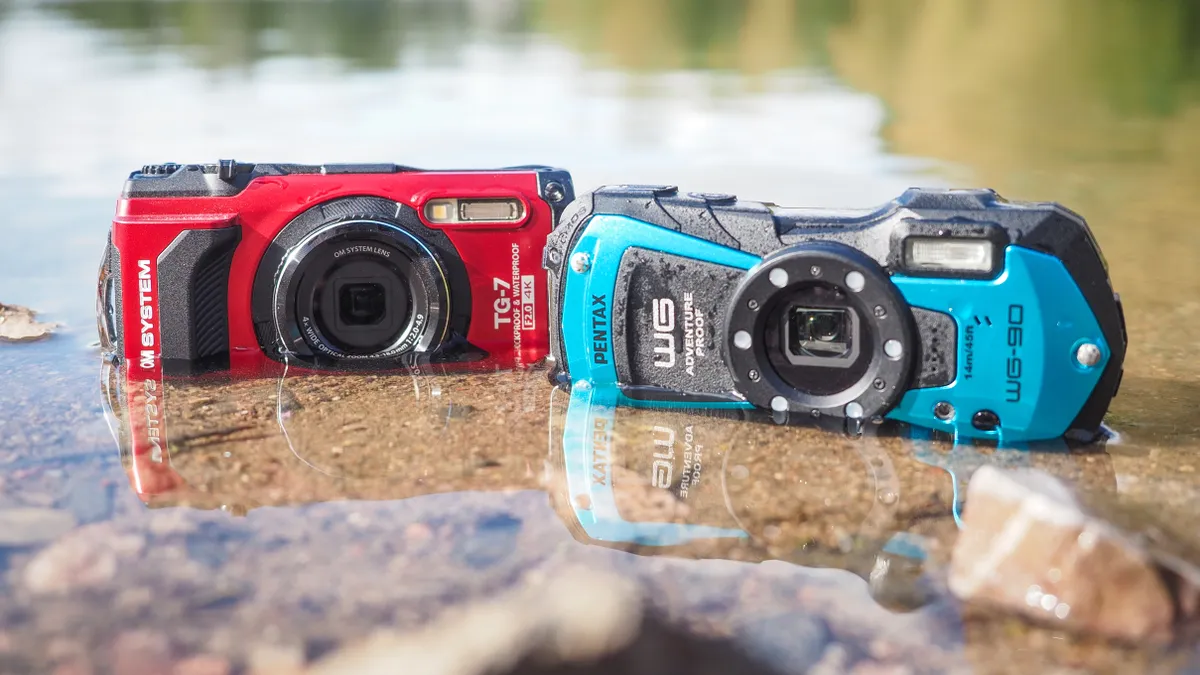
A point-and-shoot may be less versatile, but the fixed lens tends to mean there’s a much lower risk to getting dust inside the camera itself. With a point-and-shoot, you can’t take the lens off, so there’s no gap or lens swaps to risk getting sand or dust on the camera sensor.
That doesn’t mean that a point-and-shoot won’t get ruined in poor conditions – I’ve experienced the tragedy of sand ruining a point-and-shoot camera before. But, the biggest reason that I’ll grab my point-and-shoot of choice, the OM System Tough TG-7, over my mirrorless camera is that it's waterproof. Not all point-and-shoots are waterproof, but even the most durable mirrorless cameras can’t be submerged without extra waterproof housing.
If sand and rain are a concern, but you want to go the pancake lens route, you’ll want to make sure both the body and lens are weather-sealed.
Pancake lenses won’t have the same image quality as larger, heavier lenses


I love the way that a pancake lens makes a mirrorless camera feel far more portable, but there’s typically a trade-off. Brighter apertures tend to add weight and bulk to a camera, which means pancake lenses often aren’t as bright as heavier lenses.
The Fujifilm 23mm f/2.8 R WR pancake, for example, is tiny and lightweight, but the Fujifilm XF 23mm f/1.4 R LM WR is far brighter. I loved using the Fujifilm X-E5 and 23mm kit lens as a travel camera, but I did miss my brighter lenses on occasion.
Not all pancake lenses have a single focal length – pancakes like the Nikon Z DX 16-50mm f/3.5-6.3 VR and Olympus M.Zuiko 14-42mm f/3.5-5.6 EZ have zoom. But there are still some sacrifices made to get to that small size, including an aperture that narrows the more you zoom in.
A mirrorless with a pancake lens isn’t going to be the right point-and-shoot alternative for everyone. But if you’re willing to sacrifice some of the pocketability, a tiny lens is a great alternative to a tiny camera – especially for photographers who already own a mirrorless body.
You may also like
Browse the best pancake lenses or the best compact cameras.

