







Digital Camera World Verdict
The Fujifilm XF 23mm f/2.8 R WR is the ideal travel lens for the X System. Less than an inch long, the lens makes carrying around a mirrorless camera feel more like using a compact camera. There are a few sacrifices to get to that small size, like an f/2.8 instead of an f/1.4 and some autofocus misses, but for travel, the 23mm is an excellent lens.
Reasons to buy
- +
Tiny and lightweight
- +
Still has aperture ring
- +
More affordable than f/1.4
- +
Lovely colors and flare
Reasons to avoid
- -
Some autofocus misses
- -
Larger primes offer brighter apertures
Why you can trust Digital Camera World Our expert reviewers spend hours testing and comparing products and services so you can choose the best for you. Find out how we test.
After the Fujifilm X100 series' viral fame made the compact camera hard to find, Fujifilm’s smallest pancake lens became similarly a rarity. But when Fujifilm launched the X-E5 mirrorless camera, the brand introduced another option for photographers looking to DIY an X100-like camera from a mirrorless body: The Fujifilm 23mm f/2.8 R WR.
Pancake is a suitable term for the Fujifilm 23mm f/2.8 lens, which adds less than an inch (23mm) to the front of the camera and weighs around 3.17 oz / 90g. I spent a few weeks with the 23mm attached to the Fujifilm X-E5, and I could almost forget that I was shooting with a mirrorless camera.
While the 23mm was originally only available as a kit lens option for the X-E5, Fujifilm is bringing the pancake to all X-Mount fans in December 2025 as the lens launches outside of a kit for the first time.
Fujifilm 23mm f/2.8 R WR: Specs
Focal length |
23mm |
Aperture |
f/2.8-f/16 |
Mount |
Fujifilm X |
Format |
APS-C |
Minimum focus distance |
7.9" / 20cm |
Aperture blades |
11 |
Focus type |
Autofocus |
Stabilization |
No |
Filter size |
39mm |
Dimensions |
2.4 x L: 0.9" / 61.8 x L: 23 mm |
Weight |
3.2oz / 90g |
Fujifilm 23mm f/2.8 R WR: Price & Availability
Originally available only with the Fujifilm X-E5 kit, the Fujifilm 23mm f/2.8 R WR becomes available without a body in December 2025. Fujifilm’s increasing popularity means that many of its newest launches take some time before they’re available without a waitlist. I wouldn’t be surprised if the 23mm follows the same fate, so check the shipping date when you order.
The Fujifilm 23mm f/2.8 R WR retails for about $500 / £400 / CA$560. (Australia pricing has not yet been announced.)
Fujifilm 23mm f/2.8 R WR: Design

The Fujifilm XF 23mm f/2.8 R WR crams a moderately bright aperture into a lens that’s less than an inch / 90mm long. The lens weighs just 3.17 oz / 90g. When it comes to building a compact camera kit, the lens choice matters, and the 23mm mounted on one of Fujifilm’s more compact bodies feels very much like a Fujifilm X100VI.
Cramming a lens into a length less than an inch, of course, leaves less space for controls, but the essentials are still intact. There’s the aperture control (a must-have in my book), which also has an A position with a lock for automatic exposure modes. It’s a clicked ring that’s nicely labeled with a texture around most of the ring.

The focus ring is so tiny it feels more like a filter frame than a focus ring, but it’s still there and turns smoothly.
That small size leaves out other features. The most noticeable missing control is a manual-to-autofocus switch, but it’s far from the first Fujifilm lens to control the autofocus on the camera body rather than the lens.


Outside of the lens’ small size, I think my favorite feature is that it’s also available in silver. That really highlights the retro look of Fujifilm’s bodies, but there’s the longstanding black too.
The WR in the lens name stands for weather-resistant. (Oddly enough, the X-E5 that the lens was originally paired with is not weather sealed, so make sure you pair this lens with a sealed body before heading out in rain or snow, and use a camera cover for bodies that are not sealed.)
Fujifilm 23mm f/2.8 R WR: Performance

The Fujifilm 23mm f/2.8 R WR is built to prioritize size, not image quality – but it’s still no slouch, even paired on Fujifilm’s 40.2MP camera bodies.
The 23mm pancake isn’t Fujifilm’s sharpest lens, but it is quite good. Sharpness is excellent in the center wide open. Photographing a test chart, lines towards the edges of the frame were almost just as sharp. In real-world use, I occasionally wanted to tweak that sharpness slider a bit for off-center subjects. It’s not Fujifilm’s sharpness lens, but it’s acceptably sharp in most scenarios.
As a 23mm lens, this pancake lens captures a fairly wide view, but not so wide that there’s a lot of distortion to contend with. Turn off the built-in lens correction profile on RAW files, and there’s some bending and vignetting at the corners. Use the lens profile, however, and most of that corner darkening and bending is remedied.

Wide-angle lenses aren’t known for bokeh, and the wider 23mm perspective is another strike against the Fujifilm 23mm pancake’s bokeh. Still, capturing bokeh isn’t impossible, especially when getting up close to the subject.
Bokeh is often round with soft edges, shifting towards a cat-eye shape at the corners of the image. Extremely bright light sources can create a more mixed bag of bokeh. In the shot below, using the sun hitting the snow to create bokeh, some of the bokeh balls have a hard “onion ring” edge to them, and others take on a rainbow of colors.

I’m a fan of lens flare, and there’s plenty to be had there, directing the Fujifilm 23mm pancake towards the sun. Golden hour creates a nice warm lens flare, but mid-day light will create brighter flares with some potential light color shifts in the surrounding area.

I used the 23mm on a mix of travel photography, landscapes, and wide portraits. I did have a few occasional autofocus misses, which seemed to happen more frequently when working with backlighting.
I was pleasantly surprised at how close the lens could focus for such a small optic. The Fujifilm 23mm f/2.8 R WR can focus as close as 7.9 inches or 20 cm from the front.
Fujifilm 23mm f/2.8 R WR: Images


Fujifilm 23mm f/2.8 R WR: Verdict
The Fujifilm 23mm f/2.8 R WR isn’t Fujifilm’s best lens – but it’s Fujifilm's best travel prime. The 23mm is fantastic for how small it is. The pancake lens makes a mirrorless feel more like a compact camera, and for photographers who already have a Fujifilm body, at a price far less than options like the X100VI. I loved that the design still had enough room for an aperture ring.
Outside of the biggest feature – the size – the lens delivered images on par with what I would expect from a Fujifilm optic at this price point. No, an f/2.8 aperture isn’t the brightest option out there, but Fujifilm’s 23mm f/1.4 R LM WR costs twice as much (not to mention the size difference). There’s little chromatic aberration, and barrel distortion is similarly nearly absent. Lens flare is lovely at golden hour, though it has a larger impact on colors midday.
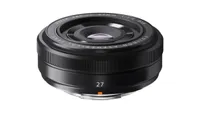
I experienced a few occasional autofocus misses in my travel shots with this lens, so like the 27mm pancake, there’s a little room for autofocus improvements. Bokeh can also occasionally take on a harder onion ring edge with the harshest light sources.
Alternatives
You may also like
Browse the best Fujifilm X Mount lenses or the best Fujifilm cameras.

