




NASA has detected a precursor or progenitor to a supernova for the first time – and it's all thanks to old photos. Researchers have now been able to study some of a supernova's progression by comparing images from the James Webb Space Telescope.
The star, designated 2025pht, was located in the galaxy NGC 1637 and died some 40 million years ago. It took the light from the cosmic explosion this long to reach the All-Sky Automated Survey for Supernovae (ASAS-SN) – NASA’s multi-telescope system for detecting supernovae.
Researchers first spotted the supernova in June of 2025, but, most importantly, the exploding star is in a region that the telescope has photographed before. Researchers then got to work identifying the progenitor – the star that died – by aligning and analyzing archive images of Galaxy NGC 1637 taken by the Hubble and James Webb telescopes before it exploded. It's the first time that a supernova progenitor has been photographed by Webb, NASA says.

NASA has photographed a supernova before, but this time, researchers had old photos to use as a reference and gather data about what happened before the star became a supernova.
"We’ve been waiting for this to happen – for a supernova to explode in a galaxy that Webb had already observed," explained the study's lead author, Charlie Kilpatrick of Northwestern University. "We combined Hubble and Webb data sets to completely characterize this star for the first time,”
The researchers found that the supernova progenitor star was a “surprisingly red” supergiant in 2024, indicating that it was surrounded by dust blocking shorter wavelength blue light.
“It’s the reddest, most dusty red supergiant that we’ve seen explode as a supernova,” said graduate student and co-author of the results paper published on the analysis, Aswin Suresh of Northwestern University.
The James Webb Telescope uses a MIRI (Mid-Infrared Instrument) and NIRCam (Near-Infrared Camera) to create images of the night sky.
NIRCam observes near-infrared light with wavelengths (0.6–5 microns) slightly longer than those of visible light to capture crisp images of stars and early galaxies, while MIRI observes longer mid-infrared wavelengths (5–28 microns) to detect cooler cosmic dust, gas, and proto-stars.
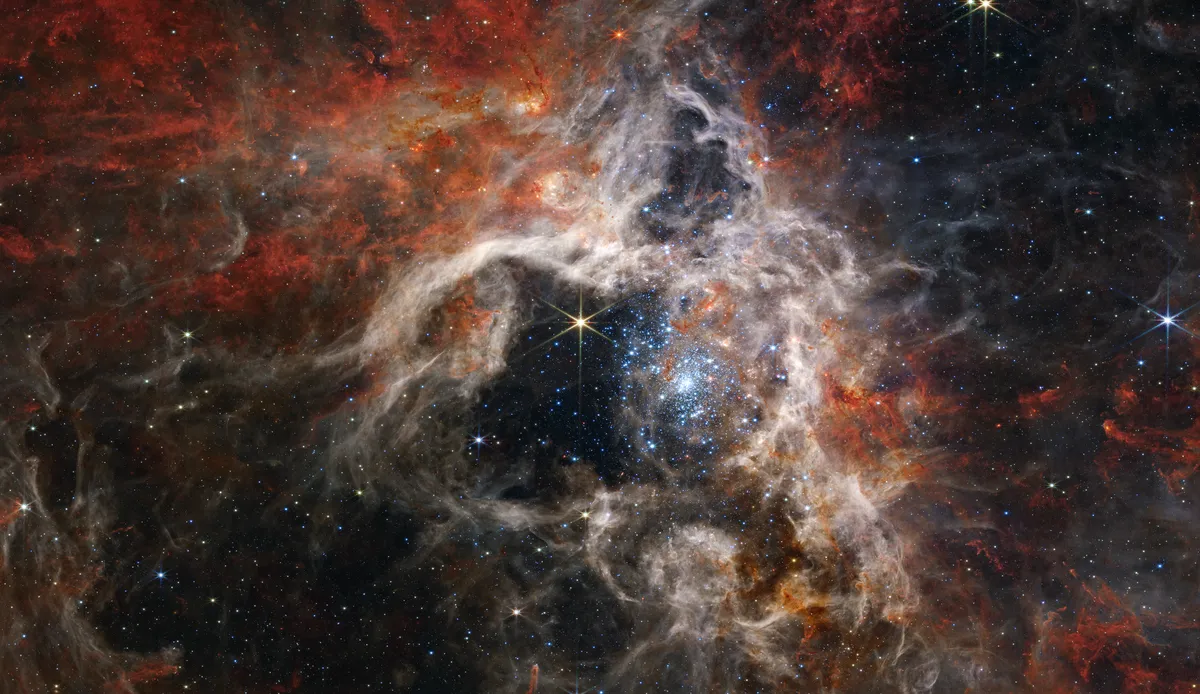
NASA launched the James Webb Telescope in 2021 with the mission of studying “every phase of the history of the universe” from the Big Bang to the formation of solar systems that can support life.
Since then, the telescope has captured unbelievable images, including of the most distant galaxy ever photographed and previously undiscovered planets.
Earlier this year, NASA announced it'll launch a new space telescope by May 2027. The Nancy Grace Roman Space Telescope will boast a 288MP camera and work in collaboration with James Webb to reveal ”billions of stars, hundreds of black holes and hundreds of forming planetary systems."
You might also like…
Check out these mesmerizing images from the James Webb Telescope, enabling you to gaze into a black hole and see the “jewelled ring” in the cosmos.

