




There’s a chance you’ve never even heard of the Nikon 1 J5, or even the Nikon 1 system for that matter. When anybody claims that Nikon was late to the mirrorless camera party with the release of the Nikon Z6 and Nikon Z7, it was actually bang on time. The problem was that the ‘Big N’ backed the wrong horse. Roughly seven years before the launch of the Z Mount, Nikon released an interchangeable-lens system with a tiny 1-inch sensor. Even the Micro Four Thirds crowd was like: “Say what!?”
The upside was that the Nikon 1 system really was compact. I’m guilty of calling all sorts of cameras compact, because they’re small for their class. But what I would actually define as a compact camera is a very small, fixed-lens device. However, if ever there were an interchangeable system that could be dubbed a compact camera, it would be the Nikon 1 system. During its less-than, seven-year lifespan, the 1 system spawned a modest collection of 13 Nikon-branded lenses and 11 cameras. And they were all tiny.

But by far my favorite of the bunch, was the Nikon 1 J5, released in April 2015. A delightful retro camera built around a 20.8-MP sensor. Upon its release it boasted the world’s fastest continuous shooting with AF, delivering speeds of up to 20fps. It was also the first Nikon camera to shoot 4K video (albeit at a rather useless 15p).
The J5’s miniscule body weighed just 231g. Let’s stack that up against some modern compact cameras: the Ricoh GR IV is 262g, the Fujifilm X100VI is 478g, and the Kodak PixPro FZ45 is 117g (expect roughly 160-170g with two AA batteries and an SD card).
Obviously, the Nikon 1 J5 was heavier with a lens, but with the compact Nikon 1 11-27.5mm f/3.5-5.6 attached, it still weighed only 314g. As such, it can certainly mix it with modern compact cameras. Modern comparisons to the Nikon 1 would be the Fujifilm X-M5 or Olympus PEN-EP7. Both incredibly small mirrorless cameras, with bodies weighing just 355g and 337g, respectively.
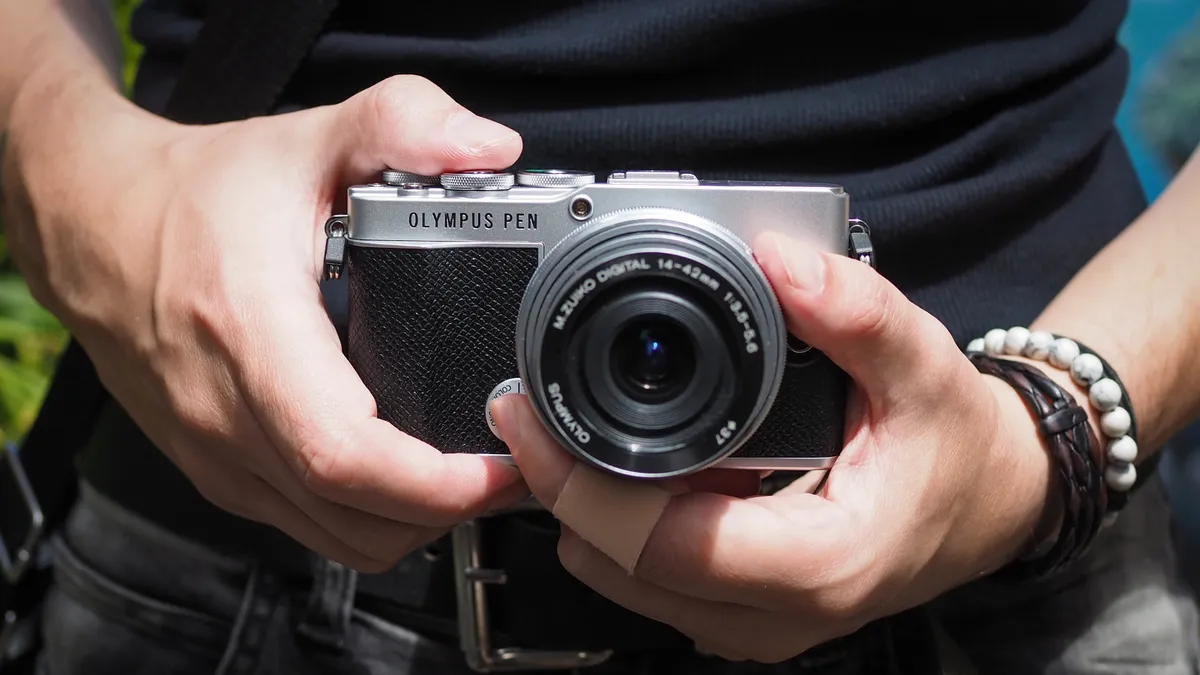
Both of these cameras are very well priced – the Fujifilm X-M5 retails for around £799 / $799 / AU$1,449.00 and the Olympus PEN EP-7 retails for £849 (it was never officially released in the US or AUS). Of course, they are also technically far superior to the Nikon 1 J5, but we know from experience that older cameras that are small and retro have a habit of becoming trendy with casual social media photographers.
And that’s why I’m surprised the Nikon 1 J5 hasn’t enjoyed a bit of a resurgence. Granted, looking at online auction sites, I don’t think they’re as cheap, nor as easy to get hold of, as perhaps they used to be. But in a world where older Fujifilm cameras are holding their price – sometimes to a ridiculous degree – a Nikon 1 J5 could be a smart little purchase for the right photographer.
Ultimately, it’s never going to be a camera that I recommend for beginners. It’s the kind of camera where you’ve already got your number one and you fancy something a little bit quirky you can shove in your rucksack on outings, and don’t want to pay premium Fujifilm camera prices.
Building its first mirrorless system around a 1-inch sensor ensured that the Nikon 1 system was doomed from the start. However, I often wonder what would have happened if these cameras had APS-C sensors. The idea was definitely there and if anything else, the system stands as a rather unique experiment, even if it never really took off.
You might also like...
Interested in Nikon cameras? Check out the best Nikon cameras and the best Nikon Z lenses. Maybe you're wondering if there's life in the old DLSR yet? Dinosaur DSLR cameras just won’t die: 39% of you say a DSLR is still your main camera!

