
In this guide, I'll be suggesting the best wide-angle zooms for Nikon cameras. When I say 'wide-angle', I'm talking about really wide zooms that have a minimum focal length of 18mm or less for full-frame Nikon FX cameras, or about 12mm for DX (APS-C format) cameras.
These focal lengths give phenomenally wide angles of view, ideal for shoehorning expansive landscapes and cityscapes into the frame, or for shooting architectural interiors. Ultra-wide lenses with relatively fast aperture ratings of f/2.8 are also ideal for astrophotography, capturing the expanse of the Milky Way. These are often referred to as 'trinity' zooms, as listed in this guide.
The flipside to long-range shooting is that you can get in really close to terrestrial subjects with a wide-angle lens and exaggerate the perspective between foreground and background areas.
I've split the guide into lenses for Z-series mirrorless cameras and those for F-mount DSLRs. The latter are getting thinner on the ground, but the ones included in this guide were all available to buy new at the time of writing. Bear in mind that while you can use an FX lens on a DX camera, the 1.5x crop factor or 'focal length multiplier' means that you'll lose most or all the wide-angle potential for which these lenses are designed. Let's take a closer look at all the contenders...

Adam was previously editor of N-Photo magazine, and loves wide-angle photography, so is just the fellow to help you pick the best wide-angle lens, whatever Nikon camera you use.
Best wide-angle zooms for Nikon Z FX cameras
The best wide-angle zoom lenses for full-frame Z-mount mirrorless cameras, such as the Nikon Z5 II, Zf, Z6 III, Z7 II, Z8 and Z9.
Best buy Z FX wide-angle zoom

This wide-angle is designed specifically for Nikon Z-series full-frame mirrorless cameras, and although it has a slightly disappointing maximum aperture of f/4, it does have internal optics that ensure pin-sharp image quality. It has 14 elements in total, split into 11 groups, and the control ring can be assigned to the user's preferred functions, such as focus, ISO, exposure compensation, and so on.
The stepping motor autofocus system is fast, accurate, and practically silent, meaning the lens is a solid choice for videos as well as stills. The lens is also nice and lightweight, suiting the Z-mount mirrorless cameras perfectly.
Providing superb sharpness and excellent operability, the Nikon Z 14-30mm f/4 S is an extremely solid lens all-around, as long as you can live with that f/4 maximum aperture.
See our full Nikon Z 14-30mm f/4 S review


Best 'trinity' Z FX wide-angle zoom

The Nikon Z 14-24mm f/2.8 S is Nikon's latest effort to attract pros to the Z mount system. Completing the holy trinity of fast f/2.8 S-line zooms, it slots in neatly next to the Nikon Z 24-70mm f/2.8 S and promises uncompromising wide-angle image quality.
The 16-element optical stack includes 3 aspherical elements, along with Nikon’s Nano Crystal and ARNEO Coat for reducing ghosting and flare. The front element gets a smear-resistant fluorine coating, and the lens is fully weather-sealed. Add the included HB-98 lens hood and huge 112mm filters can be used – Nikon offers Neutral Color and Circular Polarizer options.
See our full Nikon Z 14-24mm f/2.8 S review


Best value Z FX wide-angle zoom

Like a few other Z lenses, this is more or less a rebadge of a popular Tamron lens, the brains at Nikon being smart enough to know a good thing when they see it. Delivering excellent image quality in a lightweight and portable body, the Z 17-28mm f/2.8 is a fairly straightforward lens, built around that constant f/2.8 aperture.
This lens is significantly smaller and lighter than you'd expect an f/2.8 zoom to be, due in part to the omission of such features as stabilization, an OLED display, Fn buttons, or a third control ring. So long as you can live without those extras, you get absurdly good image quality for the money here – this lens received the full five stars in our testing.
See our full Nikon Z 17-28mm f/2.8 review


Best wide-angle zooms for Nikon Z DX cameras
The best wide-angle zoom lenses for DX-sensor Z-mount mirrorless cameras, such as the Nikon Z50 II, Zfc and Z30.
Best Z DX wide-angle zoom

The widest zoom currently available for APS-C Z-mount cameras (a category currently consisting of the Z50 II, Z fc, and Z30), the Nikon Z DX 12-28mm f/3.5-5.6 PZ VR has been equipped with a number of features that make it particularly tempting for vloggers.
The motorized Power Zoom mechanism offers 11 speed options for precise control, and the body of the lens also stays the same length throughout the zoom range, which is handy if it's mounted onto a gimbal. Image quality is good – I was impressed over the course of my testing – and overall this lens provides excellent value for both video and stills shooters.
See our full Nikon Z DX 12-28mm f/3.5-5.6 PZ VR review


Best wide-angle zooms for FX format DSLRs
The best Nikon wide-angle zoom lenses for Nikon full-frame FX DSLRs, such as the Nikon D850 or the Nikon D780.
Best 'trinity' F-mount FX wide-angle zoom

Weighing in at 1kg, the Nikon AF-S 14-24mm packs a mighty maximum viewing angle of 114 degrees. Build quality is of a fully professional standard, complete with weather seals. The zoom and focus rings are large and have a smooth action, but the relatively short rotational travel of the focus ring makes manual focusing a bit fiddly for applications like astrophotography.
Ring-type ultrasonic autofocus is fast and whisper-quiet, and comes with an ‘M/A’ mode that gives priority to manual focusing while in autofocus mode. It’s an advantage in that you don’t need to wait for autofocus to be achieved before applying manual override. High-grade optics include two ED (Extra-low Dispersion) elements, three aspherical elements, plus nano-structure coatings.
Own-brand lenses from Nikon are often expensive when compared to third-party equivalents, and this is no exception. However, it is solidly built and delivers good all-around performance.
See our full Nikon AF-S 14-24mm f/2.8G ED review
Best value F-mount FX wide-angle zoom

Noticeably smaller than most other FX-format lenses, this Nikon AF-S 16-35mm f/4G ED VR is little more than half the weight of some competitors, thanks to the combination of a relatively modest maximum viewing angle and an f/4 rather than f/2.8 aperture rating. It also features a filter attachment thread and a removable hood.
Two ED (Extra-low Dispersion) elements in the optical path help to optimize image quality, and a Nano Crystal coat minimizes ghosting and flare. Build quality feels very solid, complete with a weather-sealed mounting plate.
Image quality is particularly good at the short end of the zoom range, although sharpness drops off a bit at the long end. The ‘VR’ optical stabilizer is nice to have, especially for shooting in cathedrals, museums, and other locations where you might not be allowed to use a tripod. However, it only has a 2.5-stop effectiveness.
See our full Nikon AF-S 16-35mm f/4G ED VR review
Best wide-angle zooms for DX format DSLRs
The best Nikon wide-angle zoom lenses for Nikon DX DSLRs, such as the Nikon D3500, D5600, D7500, and D500.
Best F-mount DX wide-angle zoom

This wide-angle zoom is refreshingly small and lightweight. There are a couple of catches though. First up, the mounting plate is plastic rather than metal, and the overall build feels less robust than some lenses, but that's the price you pay for improved portability. Secondly, it's recently been discontinued so if you want a brand new one rather than buying second-hand, you'll need to get your skates on.
Unlike Nikon’s older DX format wide-angle zooms, this one adds VR (Vibration Reduction), with a 3.5-stop effectiveness in beating camera shake. There’s also a virtually silent AF-P stepping motor autofocus system, which works well for stills and movie capture alike. However, this does make both autofocus and manual focusing impossible with a number of older DSLRs, and there’s no focus distance scale.
Sharpness is very good at the centre of the frame but drops off noticeably towards the corners. Performance could be better in terms of distortion and color fringing but, overall, it’s a neat and very travel-friendly lightweight zoom.
See our full Nikon AF-P DX 10-20mm f/4.5-5.6G VR review
Best 'trinity' F-mount DX wide-angle zoom
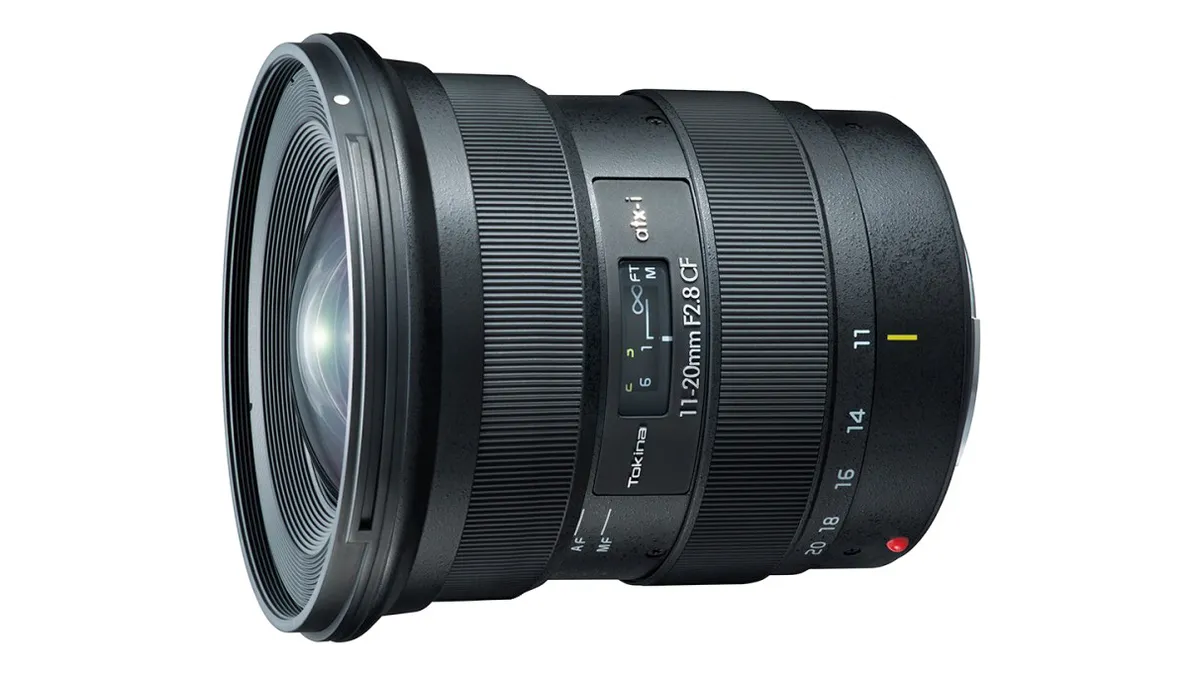
The original edition of Tokina’s ATX 11-16mm was one of the first ultra-wide zooms for DX format Nikon DSLRs. The Mark II edition added an internal autofocus motor, enabling autofocus on cameras that lack an in-body AF drive. This most recent version is from Tokina’s ‘atx-i’ stable, ‘i’ standing for ‘interactive’ mutual communication between photographer and lens. It’s redesigned with a more streamlined, up-to-date look and feel but retains the original lens’s high standard of build quality.
Further similarities include a fast and constant f/2.8 aperture rating and Tokina’s trademark ‘One-touch Focus Clutch’ mechanism, which enables switching between autofocus and manual focus with a push-pull action of the focus ring. The optical path includes exotic, high-tech elements that help to deliver very good image quality.
See our full Tokina ATX-i 11-16mm f/2.8 CF review
How we test lenses
The lens experts in our testing lab run a range of tests under controlled conditions, using the Imatest Master testing suite. Photos of test charts are taken across the range of apertures and zooms (where available), then analyzed for sharpness, distortion and chromatic aberrations.
We use Imatest SFR (spatial frequency response) charts and analysis software to plot lens resolution at the centre of the image frame, corners and mid-point distances, across the range of aperture settings and, with zoom lenses, at four different focal lengths.
There's more to it than just the technical side, though! Beyond the lab, our reviewers test lenses in real-world environments – and sometimes on professional shoots! We work with lenses both indoors and outdoors, in studio conditions and in natural light, with as many different subjects as is possible (or appropriate – there's no point testing a landscape lens' ability to shoot a portrait!).
We take into account everything from handling and ease of use to speed of autofocus and the overall quality of the images produced.
Find out more about how we test and review on Digital Camera World
Lab test data and comparisons
The graphs below show the comparative performance of the lenses in this guide, based on our in-house lab tests. The Nikon Z system lenses beat their F-mount counterparts for sharpness, and it’s actually the budget-friendly Nikon Z 17-28mm f/2.8 that comes out on top, ahead of the more exotic S-line lenses. That said, it’s also the least ‘ultra-wide-angle’ of the full-frame-compatible zooms.
For zoom lenses, we repeat our test at the widest and longest ends of the zoom range, plus intermediate 'mid-wide' and 'mid-telephoto' settings. Use the dropdown menus to select between them (for primes, the same data appears on all the graphs for comparison purposes).
For more detailed graphs of each lens's performance, which give the full picture, check out the graphs in our full standalone lens reviews.
Center sharpness
Use the dropdown menu to select between wide-angle, mid-wide, mid-tele, and telephoto zoom settings (prime lens data is replicated across all charts for ease of comparison)
| Timestamp (f-stop) | Nikon Z 14-30mm f/4 S () | Nikon Z 14-24mm f/2.8 S () | Nikon Z 17-28mm f/2.8 () | Nikon Z DX 12-28mm f/3.5-5.6 PZ VR () | Nikon AF-S 14-24mm f/2.8G ED () | Nikon AF-S 16-35mm f/4G ED VR () | Nikon AF-P DX 10-20mm f/4.5-5.6G VR () |
|---|---|---|---|---|---|---|---|
| 3 | N/A | 2954 | 2997 | 2059 | 2015 | N/A | N/A |
| 4 | 2869 | 2786 | 3374 | 2028 | N/A | 2102 | 1635 |
| 5 | 2587 | 2845 | 3049 | 2168 | 2421 | 2237 | 1821 |
| 6 | 2482 | 2353 | 2816 | 1945 | 2185 | 2187 | 1843 |
| 7 | 2073 | 2200 | 2213 | 1622 | N/A | N/A | 1413 |
| 8 | 1753 | 1815 | 1918 | 1300 | 1752 | 1680 | 1184 |
| 9 | 1411 | 1436 | 1398 | N/A | 1319 | 1330 | 863 |

Fringing @ f/8
Use the dropdown menu to select between wide-angle, mid-wide, mid-tele, and telephoto zoom settings (prime lens data is replicated across all charts for ease of comparison)
| Product | Value |
|---|---|
| Nikon Z 14-30mm f/4 S | 0.24 |
| Nikon Z 14-24mm f/2.8 S | 0.45 |
| Nikon Z 17-28mm f/2.8 | 0.13 |
| Nikon Z DX 12-28mm f/3.5-5.6 PZ VR | 0.03 |
| Nikon AF-S 14-24mm f/2.8G ED | 0.49 |
| Nikon AF-S 16-35mm f/4G ED VR | 0.36 |
| Nikon AF-P DX 10-20mm f/4.5-5.6G VR | 0.86 |
Distortion
Use the dropdown menu to select between wide-angle, mid-wide, mid-tele, and telephoto zoom settings (prime lens data is replicated across all charts for ease of comparison)
| Product | Value |
|---|---|
| Nikon Z 14-30mm f/4 S | 0.51 |
| Nikon Z 14-24mm f/2.8 S | -0.01 |
| Nikon Z 17-28mm f/2.8 | -1.05 |
| Nikon Z DX 12-28mm f/3.5-5.6 PZ VR | -0.11 |
| Nikon AF-S 14-24mm f/2.8G ED | -5.23 |
| Nikon AF-S 16-35mm f/4G ED VR | -5.51 |
| Nikon AF-P DX 10-20mm f/4.5-5.6G VR | -4.43 |
How to choose a wide-angle zoom
Nikon wide-angle zoom lenses come in two different mounts, and for use with two different sensor sizes – so in all there are four different types of Nikon wide-angle lenses. Nikon DX lenses are made for Nikon's APS-C (DX) format cameras, Nikon FX lenses are for Nikon's full-frame FX cameras. DSLRs use the Nikon F mount, while Nikon mirrorless models use the Z mount.
Pairing a wide-angle zoom lens with your Nikon camera allows you to fill the frame with your subject. You can produce a wide perspective that's perfect for landscapes, cityscapes and architecture. Wide-angle lenses are also often nice and small, making them ideal for travel and for shooting situations where space is limited. For example, if you’re shooting indoors and constrained by walls and other obstacles, a wide-angle zoom can be a massive help.
One thing to bear in mind, however, is that a lens's focal length does depend on the camera you pair it with. FX-format (i.e. full frame) lenses can be paired with Nikon cameras with full-frame or APS-C sensors (known as FX and DX cameras), however, the smaller APS-C DX sensor will change the angle of light entering the camera and extend its focal length. So, a lens that's wide on a full-frame FX camera won't be as wide on a DX-format camera. Always check what kind of camera you're using and make your choice accordingly.
FAQs
What are wide-angle zooms used for?
A good wide-angle zoom can be useful for just about any type of photography. They are particularly prized for landscape photography, where a wide-angle perspective is favoured for filling the frame with sumptuous vistas, and a zoom is useful for fine-tuning your compositions in situations where that's less easy to do by moving your feet. They also are popoular among architecture photographers for creating frame-filling images of large buildings. Elsewhere, wide-angle zooms can also play a part in street, documentary and even creative portraiture. It's all about how you use them.
Another big use of wide-angle zooms is in video and vlogging, where you generally want a nice wide perspective. As such, some wide-angle zooms have video-friendly features such as Power Zoom functionality (motorized zoom for smooth movement that looks good on camera), silent focusing, or a fixed physical length that doesn't change when the lens zooms – handy for use with a stabilizing gimbal.
Can you use Nikon F-mount lenses on Nikon Z-mount cameras?
Yes – as long as you have an FTZ adapter, most F-mount DSLR lenses will work on Z-mount mirrorless cameras with full functionality of stabilization and autofocus. This process does not work the other way around – Z-mount lenses cannot be mounted onto DSLRs.

