
I feel that the best lenses for the Sony A7R V, A7R IV, and A7R III play to the key strength of these full-frame cameras, feeding their high-resolution image sensors with everything they need to resolve the utmost in ultra-fine detail and texture. And let’s face it, the A7R series of mirrorless cameras is all about the details, with mighty megapixels under the hood for unleashing incredible resolving power. However, that won't mean a jot if you pair these cameras with lenses that don't achieve the same high standards. That's where this guide comes in.
With many more years under the mirrorless full-frame belt than Canon and Nikon, Sony has had the time to develop an incredible range of G and G Master lenses. These ‘Gold’ standard optics have built an enviable reputation for delivering stellar sharpness, with premium optical prowess that enables you to really get the best out of A7R series cameras. And to maintain optimum sharpness in handheld shooting, these cameras have highly effective in-body image stabilization, so, up to a point, in-lens stabilization is unnecessary, and designers can focus fully on optical quality. The exception is in telephoto and macro lenses, where optical stabilization can team up with IBIS for greater performance.
I've aimed to pick out a range of lenses in different focal lengths for this guide, keeping a mindful eye on them pairing perfectly with the A7R III, A7R IV, and A7R V. That’s what merits inclusion on the hit list. Naturally, for both camera bodies and lenses, high resolution tends to come at a high price financially. But most of us shoot to a budget, so where possible, I've included some relatively affordable alternatives that still deliver the goods.

Matthew Richards is a photographer and journalist who has spent years using and reviewing all manner of photo gear. He is Digital Camera World's principal lens reviewer – and has tested more primes and zooms than most people have had hot dinners – and that includes practically every Sony E-mount lens launched to date.
Best lenses for the Sony A7R V, A7R IV & A7R III
Why you can trust Digital Camera World Our expert reviewers spend hours testing and comparing products and services so you can choose the best for you. Find out how we test.
Best everyday lens for the A7R V, A7R IV & A7R III


Was there anything wrong with the original Sony FE 24-70mm f/2.8 GM? No. Is this updated version better in every way? Absolutely. Honoring the name of its flagship G Master series, Sony has delivered a professional-grade zoom that is pin-sharp across its entire image frame, more comprehensively weather-sealed than the previous lens, and yet, somehow, is also 20 per cent lighter and 18 per cent smaller than the previous version. Witchcraft.
Handling has been revamped and is better than ever; the optical layout is completely revamped, and the lens boasts a new floating autofocus system powered by four XD (eXtreme Dynamic) linear stepping motors. It's incredibly precise, as we extolled in our review, and the technical quality is unimpeachable. Our exacting lab tests revealed a basically faultless lens across its zoom range.
Of course, all this quality comes at a cost. While I firmly think that the Sony FE 24-70mm f/2.8 GM II is worth its price tag, if your budget doesn't stretch that far, the original Sony FE 24-70mm f/2.8 GM is still a solid buy. Also worth considering is the Samyang AF 24-70mm f/2.8 FE, a trinity zoom that received glowing plaudits in our review for the sheer value for money it offers.
Read more: Sony FE 24-70mm f/2.8 GM II review
Features ★★★★★ |
Building on the success of Sony’s flagship ‘trinity’ standard zoom, the Mark II boasts extra features and redesigned optics. |
Design ★★★★★ |
Design extras include adjustable torque for the zoom ring, function buttons and a click/de-click aperture ring. |
Performance ★★★★★ |
Performance is absolutely top-drawer in all respects, from super-fast autofocus to sublime image quality. |
Value ★★★★★ |
It’s naturally pricey for a Sony G Master lens but the Mark II is nevertheless great value for money. |
Best wide-angle lens for the A7R V, A7R IV & A7R III
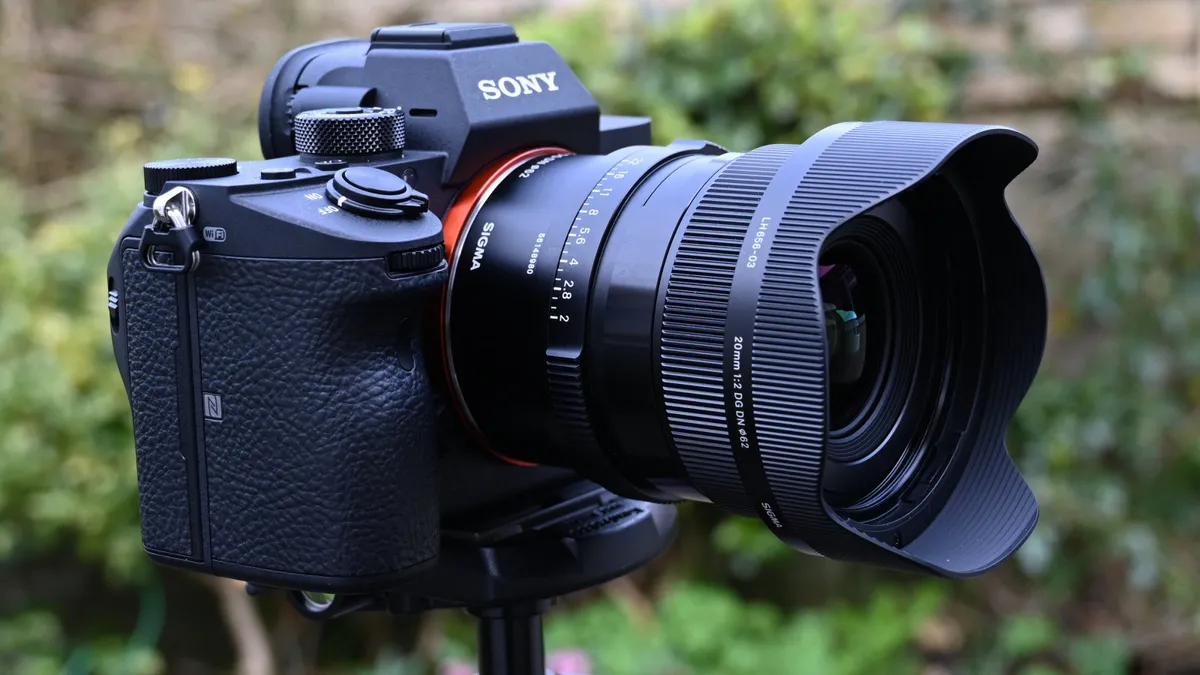


If you shoot landscape, architecture, or interiors, or just prefer to take a wider perspective, the Sigma 20mm f/2 DG DN | C is an ideal lens to pair with your Sony A7R camera. It's a small, metal-bodied, and robust lens with loads of sublime handling features, not least of which is the aperture ring. A small point perhaps, but I always appreciate it when a lens-maker sees fit to add one.
With a high-quality optical path, the Sigma 20mm f/2 DG DN | C produces images of impressive sharpness and detail – in our lab tests, we found that sharpness was retained even when the lens was used wide-open at f/2, and that's what I found in my real-world testing as well. There is noticeable distortion, though it's correctable via software, and color fringing is pleasingly negligible even in the corners of the frame.
Read more: Sigma 20mm f/2 DG DN | C review
Features ★★★★☆ |
Features include a fast f/2 aperture plus an aperture control ring, although there’s no de-click facility. |
Design ★★★★★ |
The solid build is based on a metal barrel, mounting plate and hood. |
Performance ★★★★☆ |
Edge-to-edge sharpness is very impressive even wide-open, although it relies on corrections for vignetting and distortion. |
Value ★★★★☆ |
It’s pretty pricey to buy but well worth the money. |
Best street lens for the A7R V, A7R IV & A7R III


I’ve come to expect a lot from Viltrox lenses, and for comparatively little outlay compared with equivalent own-brand Sony lenses. Even so, the Viltrox AF 35mm f/1.8 Evo II really comes up trumps with excellent all-metal build quality despite its compact, lightweight construction, along with advanced handling features such as a click/de-click aperture ring and a customizable function button.
More importantly, as far as I’m concerned, the autofocus mechanism is fast, near-silent, and consistently accurate, while image quality is superb in terms of sharpness and clarity, smooth bokeh, and a minimum of unwanted aberrations. Everything’s packed into a compact and lightweight package that helps with remaining inconspicuous when you’re out and about, shooting on the streets.
Read more: Viltrox AF 35mm f/1.8 Evo II review
Features ★★★★★ |
There’s a fine feature set for such a budget-friendly lens, including a click/de-click aperture control ring and a customizable function button. |
Design ★★★★★ |
The all-metal casing and mounting plate feel robust and well-engineered, there are weather-seals and the design is nicely compact and lightweight. |
Performance ★★★★½ |
Autofocus is fast and reliably accurate, while image quality is highly impressive in all respects. |
Value ★★★★★ |
Like other Viltrox lenses, this one is standout value for money and you get a great deal for your outlay. |
Best 50mm lens for the A7R V, A7R IV & A7R III
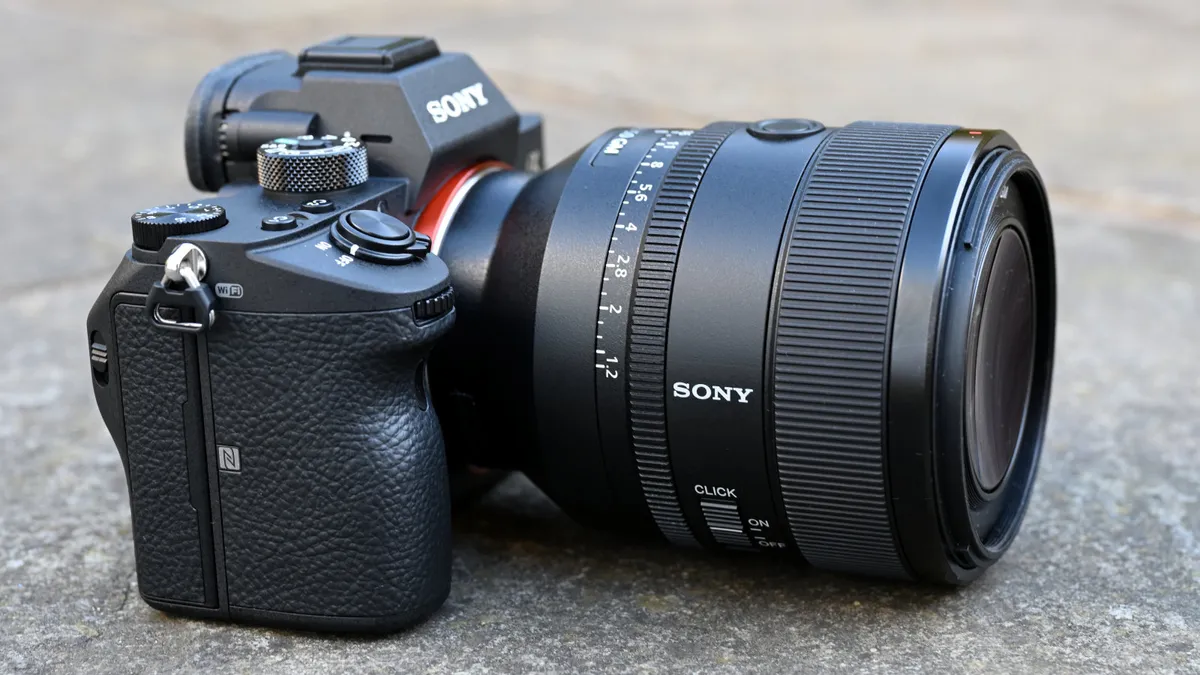


The Sony FE 50mm f/1.2 G Master is a spectacular nifty-fifty, boasting impressive sharpness right the way through its aperture range – yes, even at f/1.2. Sony has built this lens from the ground up with sharpness in mind, and its optical path includes three XA (extreme aspherical) elements; remarkably, these have been engineered to an accuracy of 0.01 microns (or one hundred-thousandth of a millimeter).
What this means, as I found in my testing, is that the lens performance is absolutely stellar – blowing away its rivals from the likes of Canon and Nikon. Our lab tests reported basically nothing in terms of imperfections, except for some pincushion distortion and a little vignetting at f/1.2.
The handling, too, is excellent. It's a heavy lens, as it needs to be with specs like these, but not exceptionally so in the pantheon of 50mm f/1.2 lenses. This is an all-around fantastic optic, and if its asking price isn't too dear for you, it'll deliver nothing short of spectacular performance.
Alternatively, the Sony FE 50mm f/1.4 GM is more affordable, captures very good center sharpness, and is both light and compact.
Read more: Sony FE 50mm f/1.2 G Master review
Features ★★★★★ |
The super-fast aperture is top of the features list but there's also fast autofocus. |
Design ★★★★★ |
The weather-sealed design is top-drawer and includes an aperture ring with click/de-click options. |
Performance ★★★★★ |
The lens combines scintillating sharpness with beautiful bokeh. |
Value ★★★★☆ |
Own-brand f/1.2 lenses don't come cheap and this one's no exception. |
Best portrait lens for the A7R V, A7R IV & A7R III




Like many portrait photographers, I swear by the 85mm short telephoto focal length, and if you're looking to shoot compelling images of people, the Sony FE 85mm f/1.4 GM II lens is one of the smartest buys you can make. Something that's critical in portrait photography is being able to produce images with smooth, attractive bokeh (the defocused areas of an image), and the G Master lens delivers that in spades thanks to its 11-bladed aperture.
Sharpness and image quality are exceptional, as I discovered when I tested the lens, and the high-grade construction means that handling is perfectly on point. If you need a cheaper alternative, the Sony FE 85mm f/1.8 still delivers a lot of the characteristics that portrait photographers are looking for.
Read more: Sony FE 85mm f/1.4 GM II review
Features ★★★★★ |
From its optical path to its fast autofocus and handling exotica, the lens is packed with features. |
Design ★★★★★ |
High-end design includes an aperture control ring with click/de-click options and dual function buttons. |
Performance ★★★★★ |
Performance is simply fabulous, from all aspects of image quality to quick, reliable autofocus. |
Value ★★★★☆ |
It’s a very expensive lens, costing about twice as much as the directly competing Sigma. |
Best telephoto lens for the A7R V, A7R IV & A7R III


My first impression of this Mark II Sony lens was how much lighter it is than the original, as well as beating most other ‘trinity’ telephoto zooms in this respect. Despite the lighter load, there’s no shortage of high-end handling extras, including switches for auto/manual focus, full-time DMF on/off, autofocus limiter, stabilization on/off switch, and stabilization mode. On the opposite side of the lens, there’s a switch to turn the aperture ring on and off.
Performance is everything I’d expect from a next-generation Sony G Master lens, combining excellent image quality with fast autofocus and effective stabilization. The only real sticking point is the price; then again, most camera manufacturers’ 70-200mm f/2.8 lenses command the big bucks, so the Sony isn’t unusual in this respect.
Read more: Sony FE 70-200mm f/2.8 GM OSS II full review
Features ★★★★★ |
A rank of function buttons, an autofocus range limiter and dual-mode optical stabilization are just some of the high-end features. |
Design ★★★★★ |
It’s designed and built as a fully pro-grade telephoto lens with a white finish and a rock-solid construction. |
Performance ★★★★★ |
Performance is excellent, from the speed and accuracy of autofocus, through reliable stabilization to superb image quality. |
Value ★★★★☆ |
There’s no denying it’s an expensive G Master lens but I reckon it’s still pretty good value at the price. |
Best super-telephoto lens for the A7R V, A7R IV & A7R III


I was hugely excited to see the coveted G Master line-up of lenses getting a 100-400mm optic, and the Sony FE 100-400mm f/4.5-5.6 G Master OSS did not disappoint. Blending superb sharpness with well-pitched handling that supports hand-held shooting, this is an ideal lens for long days capturing sports or wildlife on an A7R camera.
Indeed, in my review, we couldn't say enough good things about this lens. Its impressively complex optical path gives it excellent image quality across the board, while the handling is nothing short of impeccable. The focus operates smoothly, the three customizable buttons give you real customizability, and the ‘zoom smoothness’ ring lets you adjust the torque required to move the zoom in accordance with your preferences.
Read more: Sony FE 100-400mm f/4.5-5.6 G Master OSS review
Features ★★★★★ |
There’s a high-end feature set that includes dual-mode optical stabilization, an autofocus range limiter and function buttons. |
Design ★★★★★ |
The design is pro-grade through and through, complete with a comprehensive set of weather-seals. |
Performance ★★★★★ |
Autofocus speed, sharpness and other areas of image quality and handling are all top-ranking. |
Value ★★★★☆ |
You won’t find a cheap Sony G Master lens but this one is pretty reasonable value for money. |
Best ultra-telephoto zoom for the A7R V, A7R IV & A7R III


A complete redesign of the already excellent DSLR lens, the Sigma 150-600mm f/5-6.3 DG DN OS Sports is a great lens for bird photography, airshows, and all manner of different sporting occasions.
The autofocus is excellent, able to take advantage of the latest AF subject-detection and tracking facilities of Sony cameras. The build quality of the lens is also impressive – while no one is going to pretend this is a lightweight lens, it handles well, with tactile zoom and focus rings and a series of on-body controls for functions like AF speed, stabilization intensity, and, as an addition for the mirrorless version, Zoom Torque control to adjust the resistance of the zoom ring.
Read more: Sigma 150-600mm f/5-6.3 DG DN OS Sports review
Features ★★★★★ |
The lens inherits the high-end features and handling of the older version for DSLRs, in a smaller, lighter package. |
Design ★★★★★ |
The design is very refined, while build quality is excellent and includes extensive weather-seals. |
Performance ★★★★★ |
Excellent inherent sharpness is further boosted in real terms by highly effective optical stabilization. |
Value ★★★★★ |
It’s a pro-grade super-telephoto zoom with a ‘consumer’ price tag, making it standout value. |
Best wedding/event zoom for the A7R V, A7R IV & A7R III


For my money, this intriguing ‘not-so-standard’ zoom from Tamron works brilliantly well for shooting weddings and events. The wide-angle coverage is relatively limited, but it goes the extra mile (or at least a fair few extra millimeters) in telephoto reach, complete with a constant f/2.8 aperture. The net result is that it’s easily wide enough for group shots of people at the short end of its zoom range, while also enabling a natural shooting distance and a flattering perspective for solo portraiture at the long end.
I’ve found the lens to be impressively sharp with excellent clarity throughout its entire zoom range, even when shooting wide-open at f/2.8. Another bonus, especially at longer focal lengths, is that the f/2.8 aperture delivers a tight depth of field for isolating the main subject by blurring the background, coupled with smooth and dreamy bokeh. Yet another upside is a close minimum object distance, ideal for close-ups of wedding rings, table decorations, and the like.
Best of all, the Tamron is sufficiently versatile that you can cover most or all of your wedding and event photography needs with just this one lens. It definitely avoids the worry of missing vital, unrepeatable shots because you were busy swapping between different lenses on your camera body at a crucial moment. It’s also refreshingly lightweight for shooting all day long (and into the night) for wedding and event photography.
See our full Tamron 35-100mm f/2.8 Di III VXD review
Features ★★★★½ |
High-end features include a customizable function button and 3-way custom settings switch, but there’s no optical image stabilization nor a dedicated aperture control ring. |
Design ★★★★★ |
The design does a brilliant job of shoehorning such a big zoom range and constant f/2.8 aperture into such a compact and lightweight construction, complete with strong, weather-sealed build quality. |
Performance ★★★★★ |
Sharpness and clarity are excellent, throughout the entire zoom range and even when shooting wide-open at f/2.8. Color fringing, distortions, ghosting and flare are all well controlled and autofocus is super-speedy. |
Value ★★★★★ |
For a constant-aperture zoom lens with such a useful 35-100mm range, the Tamron is absolutely excellent value for money. |
Best macro lens for the A7R V, A7R IV & A7R III
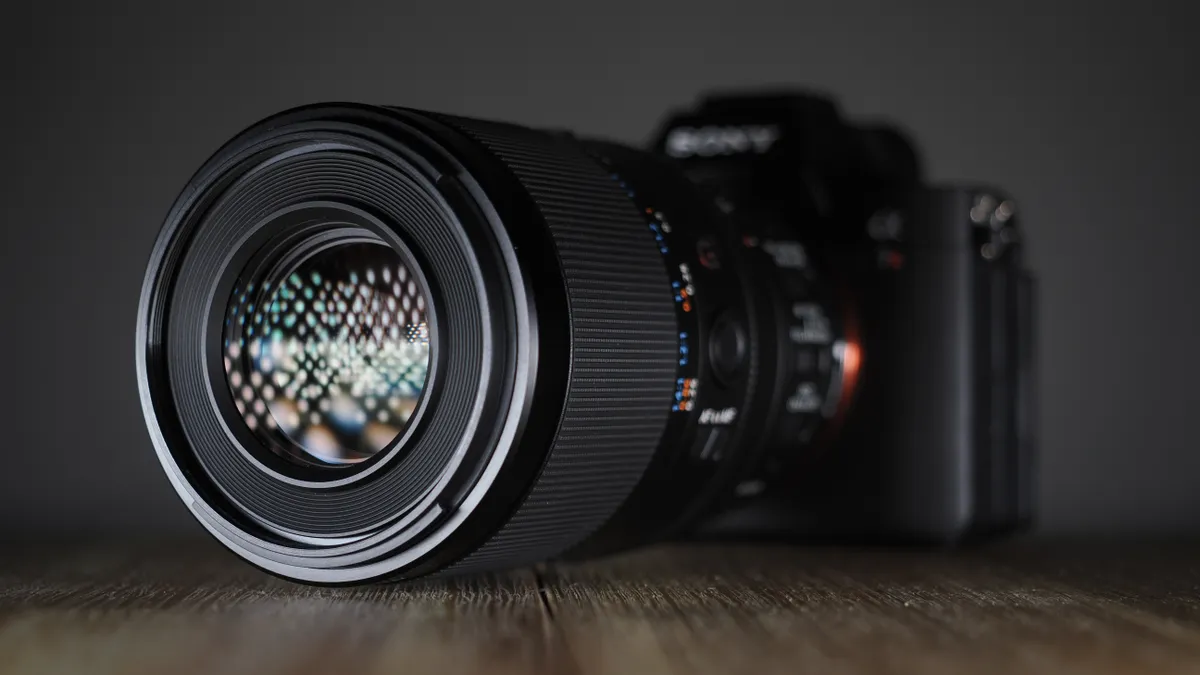


Sony’s time-honored FE 90mm macro lens has been looking a bit old and tired for some time now. Enter the new FE 100mm, which is everything I’d hope for (and more) in a top-end macro lens. For starters, it goes extra-large on maximum magnification, boasting 1.4x magnification at its minimum focus distance, instead of the more usual 1.0x. And if that’s still not enough, you can boost it to as much as 2.8x for revealing near-microscopic levels of detail if you add a 2x teleconverter.
While the maximum magnification is highly impressive, there’s a lot more to this lens than just acting as a magnifying glass for your Sony A7 V. There’s a smorgasbord of handling exotica, including a calibrated manual focus scale (I typically prefer manual focusing for macro shooting), an AF/MF switch, focus range limiter, stabilizer on/off and an iris lock switch to go with the aperture control ring.
High-performance glass includes two ED (Extra-low Dispersion) elements and two XA (eXtreme Aspherical) elements, along with a particularly well-rounded 11-blade aperture diaphragm. Nano AR Coating II and fluorine coatings are also applied. The lens isn’t a one-trick pony either. Great for portraiture or just as a short telephoto prime, it has no less than four XD (eXtreme Drive) linear motors to power its fast and virtually silent autofocus system.
Read more: Sony FE 100mm f/2.8 Macro GM OSS review
Features ★★★★★ |
Advanced features include four XD autofocus motors, an aperture ring with a de-click switch, refined manual focusing and Optical SteadyShot. |
Design ★★★★★ |
The design is something of a masterstroke, packing 1.4x macro magnification into a reasonably compact lens with top-end handling characteristics and weather-seals. |
Performance ★★★★★ |
The lens is super-sharp and delivers fabulously detailed macro images, along with fast autofocus and great quality in general shooting. |
Value ★★★★☆ |
It’s undeniably expensive for a macro lens but this Sony really is something rather special, making it good value at the price. |
How we test lenses and lab test comparisons
The lens experts in our testing lab run a range of tests under controlled conditions. We take photos of Imatest SFR (spatial frequency response) charts, then use the Imatest Master testing suite to analyze sharpness, distortion, and chromatic aberrations at the centre of the image frame, corners, and mid-point distances across the range of aperture settings (up to f/22).
The graphs below show the comparative performance of the lenses in this guide, based on our in-house lab tests. For zoom lenses, we repeat our test at the widest and longest ends of the zoom range, plus intermediate 'mid-wide' and 'mid-telephoto' settings. Use the dropdown menus to select between them (for primes, the same data appears on all graphs for ease of comparison). Only full f-stops are labelled on the X-axis for sharpness, so, for example, an f/1.2 or f/6.3 lens would correlate to f/1 and f/5.6, respectively.
The prime lenses in the group generally outperform the zooms for sharpness, although the Sony FE 24-70mm f/2.8 GM II has outstanding sharpness for a zoom lens (we haven't been able to get its stablemate FE 70-200mm f/2.8 GM OSS II into our labs yet, but real-world testing suggests similar levels of razor-sharpness). The Sony, Sigma, and Tamron zooms look less impressive, but they're still very sharp in practice. Color fringing is mostly very minimal, although it creeps up a bit in the Sony FE 100-400mm at its longest zoom setting. The Sigma 20mm prime relies most heavily on automatic in-camera distortion correction.
For more detailed graphs of each lens's performance, which give the full picture, check out the graphs in our full standalone lens reviews.
Center sharpness
Use the dropdown menu to select between wide-angle, mid-wide, mid-tele, and telephoto zoom settings (prime lens data is replicated across all charts for ease of comparison)
| Timestamp (f-stop) | Sony FE 24-70mm f/2.8 GM II () | Sigma 20mm f/2 DG DN | C () | Viltrox AF 35mm f/1.8 Evo II () | Sony FE 50mm f/1.2 GM () | Sony FE 85mm f/1.4 GM II () | Sony FE 100-400mm f/4.5-5.6 GM OSS () | Sigma 150-600mm f/5-6.3 DG DN OS | S () | Tamron 35-100mm f/2.8 Di III VXD () | Sony FE 100mm f/2.8 Macro GM OSS () |
|---|---|---|---|---|---|---|---|---|---|
| 0 | N/A | N/A | N/A | 2691 | N/A | N/A | N/A | N/A | N/A |
| 1 | N/A | N/A | 2655 | 2758 | 2678 | N/A | N/A | N/A | N/A |
| 2 | N/A | 2634 | 2759 | 2981 | 3161 | N/A | N/A | N/A | N/A |
| 3 | 2500 | 3015 | 3226 | 3014 | 3086 | N/A | N/A | 2186 | 2759 |
| 4 | 2726 | 2940 | 2883 | 3018 | 2893 | N/A | 2065 | 2183 | 2982 |
| 5 | 2562 | 2832 | 2765 | 2766 | 2942 | 1810 | 2146 | 2093 | 2993 |
| 6 | 2465 | 2577 | 2624 | 2517 | 2481 | 1792 | 2142 | 1981 | 2668 |
| 7 | 2133 | 2182 | 2358 | 2203 | 2046 | 1655 | 1946 | 1811 | 2207 |
| 8 | 1790 | 1768 | 1828 | 1735 | 1612 | 1461 | 1660 | 1557 | 1763 |
| 9 | 1430 | 1373 | N/A | N/A | N/A | 1178 | 1329 | 1275 | 1365 |

Fringing @ f/8
Use the dropdown menu to select between wide-angle, mid-wide, mid-tele, and telephoto zoom settings (prime lens data is replicated across all charts for ease of comparison)
| Product | Value |
|---|---|
| Sony FE 24-70mm f/2.8 GM II | 0.2 |
| Sigma 20mm f/2 DG DN | C | 0.13 |
| Viltrox AF 35mm f/1.8 Evo II | 0.32 |
| Sony FE 50mm f/1.2 GM | 0.48 |
| Sony FE 85mm f/1.4 GM II | 0.14 |
| Sony FE 100-400mm f/4.5-5.6 GM OSS | 0.15 |
| Sigma 150-600mm f/5-6.3 DG DN OS | S | 0.08 |
| Tamron 35-100mm f/2.8 Di III VXD | 0.23 |
| Sony FE 100mm f/2.8 Macro GM OSS | 0.12 |
Distortion
Use the dropdown menu to select between wide-angle, mid-wide, mid-tele, and telephoto zoom settings (prime lens data is replicated across all charts for ease of comparison)
| Product | Value |
|---|---|
| Sony FE 24-70mm f/2.8 GM II | -1.92 |
| Sigma 20mm f/2 DG DN | C | -4.7 |
| Viltrox AF 35mm f/1.8 Evo II | -0.35 |
| Sony FE 50mm f/1.2 GM | 1.41 |
| Sony FE 85mm f/1.4 GM II | 0.56 |
| Sony FE 100-400mm f/4.5-5.6 GM OSS | 0.53 |
| Sigma 150-600mm f/5-6.3 DG DN OS | S | 1.4 |
| Tamron 35-100mm f/2.8 Di III VXD | -1.13 |
| Sony FE 100mm f/2.8 Macro GM OSS | 0.28 |
There's more to it than just the technical side, though! Beyond the lab, our reviewers test lenses in real-world environments. We work with lenses both indoors and outdoors, in studio conditions and in natural light, with as many different subjects as possible (or appropriate – there's no point testing a landscape lens's ability to shoot a portrait!).
We take into account everything from handling and ease of use to autofocus speed and the overall quality of the images produced.
Find out more about how we test and review on Digital Camera World
How to choose the best lens for the A7R V, A7R IV & A7R III
The A7R III, A7R IV, and A7R V, like all Alpha 7 cameras, use the Sony E lens mount. Sony’s own E-mount lenses have either FE or E in their model names; all work on the A7R III, A7R IV, and A7R V. FE lenses are designed for use with full-frame Sony cameras, including the A7R series, so these should be your first choice. If you are buying a third-party E-mount lens, check that the lens is designed for use with the full-frame Sony E-Mount.
Sony lenses with an E (rather than FE) prefix are designed for APS-C format cameras such as the A6000 series. On the A7R series, they produce a cropped image that doesn't fully fill the frame, so they’re not an ideal choice.
Check out our guide to the best Sony lenses to learn more
Today's best prices compared
