
The best flashgun for your camera will put the built-in pop-up unit to shame, if it even has one. An external flashgun, Speedlite, Speedlight, or strobe (to name but a few catchwords) gives you massively more power and control.
So what features do you need? Automatic TTL (Through The Lens) flash metering enables easy use in all sorts of conditions. Bounce and swivel heads give you the option of reflecting light off ceilings and walls for a softer effect. Motorized zooms automatically track the focal length of your lens to extend your flash's reach when shooting at longer focal lengths. To varying extents, most flashguns also offer wireless connectivity, simplifying off-camera flash.
Pricier flashguns generally offer additional operating modes, such as high-speed sync, rear-curtain flash, and a programmable stroboscopic mode to capture motion at different steps throughout a long exposure.
Bear in mind, flashguns are not the only way to shine a light on your subject. You might like to consider the best LED panels, too. These certainly don't match the raw power of a flashgun, especially when you’re competing with outdoor sunlight, but they do provide continuous ‘what you see is what you get’ lighting. At the other end of the scale, you may need more flash power than any of these flashguns can provide, so you’d need to look at some of the best lighting kits for professional studio or location photography.
All the flashguns in this guide are compatible with multiple camera systems; however, you will need to buy the specific variant for your make of camera. The exceptions are 'universal' flashguns, which will work with any camera equipped with a hotshoe, but these are fully manual devices.
We also have guides to the best Canon flashguns, best Nikon flashguns, and best Sony flashguns, which focus on the manufacturers' own-brand devices, as well as the best third-party options specific to each make of camera.

Matthew Richards is a photographer and journalist who has spent years using and reviewing all manner of photo gear. He is Digital Camera World's principal tester of camera kit and your guide to the best flashguns available right now.
The best flashgun or strobe
Why you can trust Digital Camera World Our expert reviewers spend hours testing and comparing products and services so you can choose the best for you. Find out how we test.
Best flashgun overall

Better, faster, more! This is currently my favorite flashgun in dedicated TTL options to suit Canon, Nikon, Sony, Fujifilm, Olympus, Panasonic, and Pentax cameras. It runs on a Li-ion battery pack, which can power you through around 500 full-power flashes on a single charge, with super-fast recycling speeds between flashes. And full-power flashes are mighty too, rated at Gn 60 (ISO 100, meters) at the long end of the zoom range. I love that its built-in RF transceiver offers wireless master/slave operation over as much as 100m/330ft, while it’s inexpensive enough to make multiple flashgun setups truly affordable. It works great with the Godox XPro RF trigger, sold separately, and I also like that the full range of flash modes includes programmable strobe (multi-flash) output.
I find that the secondary LED lamp, with its 10-step power range, is great for close-up stills and video, as well as offering modeling and AF-assist functions, the latter working for mirrorless cameras instead of the red AF-assist beam for DSLRs. The motorized zoom and bounce ranges are generous, at 20-200mm and -7 to 120 degrees respectively. I think the only room for improvement is that the control panel feels a little dated and it lacks any weather-seals. Even so, you can’t buy better at the price. Also consider the Godox V1, which is essentially the same flashgun but with a larger, circular head.
Read our full Godox VING V860III review
Best alternative overall flashgun

I’ve long been impressed by the Hahnel Modus 600RT Mk II. It matches or beats the features of camera manufacturers’ own-brand flagship models, but at a fraction of the price. Even so, it’s a fair bit more expensive than the Godox VING V860III. On the other hand, I like the flexibility of being able to buy it in different kit options, either as the flashgun on its own, or as a wireless kit that includes a hotshoe mounting Viper RF (Radio Frequency) transmitter, as a ‘pro’ kit that comprises two flashguns and a Viper trigger, enabling the versatility of dual-flash lighting setups. Advanced flash modes include high-speed sync and programmable repeat (stroboscopic) options, and wireless RF master/slave operation has a long range of up to 100m/330ft.
I like that the flashgun is powered by a rechargeable Li-ion battery pack, instead of the usual four AA batteries (and this can be charged in the unit via USB). This gives far greater stamina, of up to 550 full-power flashes between recharging, along with very fast recycling speeds of 1.5 seconds after a full-power flash and just 0.7 seconds after a half-power flash. The only catch is that additional batteries (should you want any) cost around $60/£50.
Read our full Hahnel Modus 600RT Mk II review
Best compact Li-ion flashgun

For slimline, lightweight mirrorless cameras and small DSLRs, I find this compact flashgun a better fit than the full-blown Hahnel Modus 600RT Mk II. It certainly gives a less top-heavy camera and lens combo. Even so, the 360RT certainly isn’t lacking in features. Just like with its bigger sibling, I love the built-in RF transceiver for reliable off-camera triggering over a long range, its albeit downsized Li-ion battery pack, and its full range of flash modes, including programmable stroboscopic output. It even has a secondary LED lamp (missing in the 600RT Mk II), which you can use for AF-assist, modeling and close-range stills and video shooting, complete with adjustable power levels.
One area of downsizing that I'm not so keen on is that the maximum power output of the flash is relatively limited, and I struggled a bit with bounce and swivel flash with really high ceilings and relatively distant walls. And although you get a full 180-degree swivel to the right, there’s only 90 degrees to the left. Even so, it’s a very capable flashgun that’s very keenly priced, and recycling speed is fast even after a full-power flash, at 1.6 seconds.
Read our full Hahnel Modus 360RT review
Best universal flashgun for pros

The Godox V1Pro is an upgrade to the successful Godox V1 flashgun, and introduces some interesting new features. However, these come with a higher price tag, and whether the additional cost is justified largely depends on your photography style.
My favorite feature is the new USB-C battery charging feature, which I appreciate is not the most exciting of innovations, but it is a big quality-of-life improvement and frees me from carrying another charging block. The much-touted clip-on fill light, however, seemed more gimmicky than practical to my own work. I don't like direct flash, and the clip-on unit gave my photos a cheap ‘flash photography’ look, which I wasn’t fond of, although other photographers may wholly disagree. The other major feature, the ability to take 100 continuous shots at full power, is impressive but not something I would frequently use as that adds up to more flashes than I can conceive needing. However professionals with a higher rate of shooting might find this more beneficial.
Despite these points, it’s undeniable that this is an exceptional flash. The consistency of the flash is top-notch, the power is more than sufficient for portrait, event, and wedding photography, and Godox’s wireless system is superb. But then again, the standard V1 also possesses all these features and meets my needs perfectly, and I don’t find enough compelling features in the Pro version to justify paying about a third more than the regular V1, so I would recommend checking that out as well before you buy the V1Pro.
Read our full Godox V1Pro review
Best universal budget flashgun

The Godox iA32 flashgun is a compact, lightweight, and exceptionally versatile lighting solution. Its design cleverly merges a retro aesthetic with modern functionality, while its universal compatibility ensures it can be seamlessly used with a vast array of cameras, from classic models to contemporary digital bodies.
Despite its compact size, the flashgun is packed with smart features that enhance its usability and performance. It offers an effective, if slightly 'cheaty', auto flash exposure that relies on a light-sensitive cell rather than TTL metering, but nevertheless simplifies the process of achieving well-exposed images. A bounce head softens and diffuses light by directing it off ceilings, thereby creating more natural and flattering illumination (though there's no swivel for side walls). A vibrant color information screen, located on the rear of the unit, provides clear and intuitive access to settings and feedback.
Best of all, it offers excellent value for money. Its blend of compact dimensions, lightweight build, comprehensive features, and broad camera compatibility makes the Godox iA32 a terrific choice for both casual and more serious photographers looking to enhance their lighting capabilities.
Read our full Godox iA32 review
Best universal basic flashgun
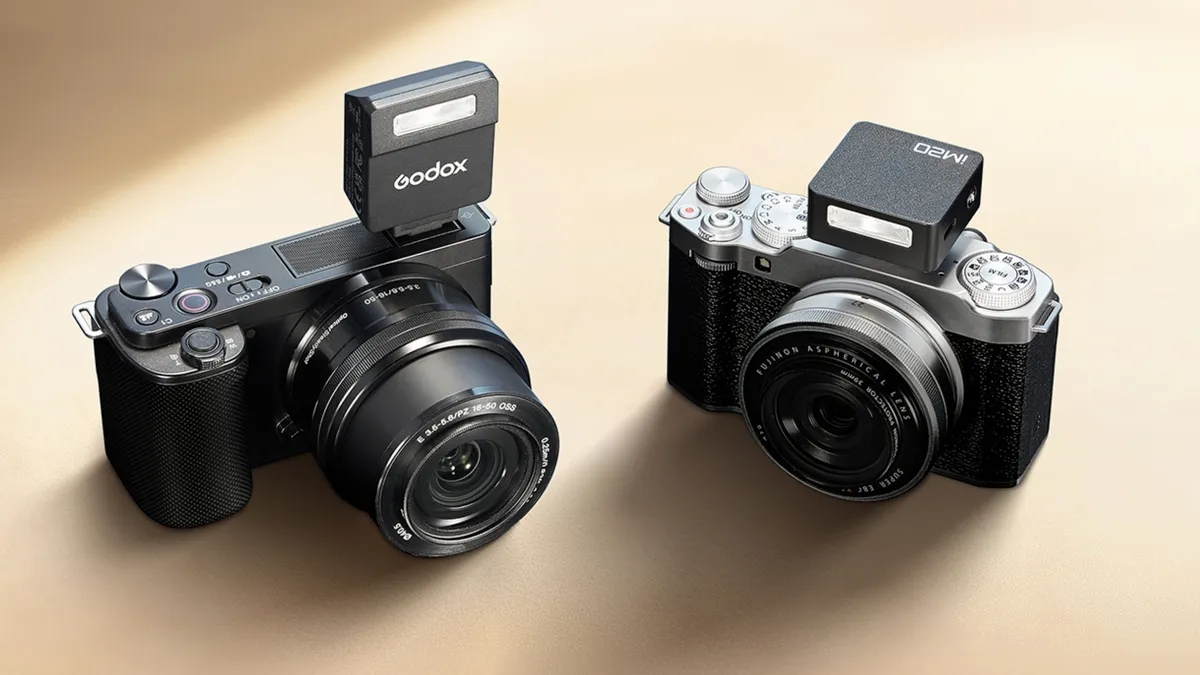
The Godox iM20 and iM22 are essentially the same mini hotshoe flashes, but the iM20 is shorter and flatter, while the iM22 is taller and thinner, and both act in a similar way to a pop-up flash. Their output is comparatively weedy against bigger ’guns, but they offer a highly convenient and useful mini-flash in situations where a modest amount of additional light is required.
With a universal fitting, they are compatible with a wide array of cameras, and they share an incredibly compact and lightweight design. They operate entirely in manual mode, lacking any form of automatic flash exposure, unlike bigger units with TTL or other auto-metering capabilities. The flash tube itself is similar in size to a camera’s built-in pop-up flash, and as such, its light output is only suitable for close-up illumination.
Powering the units is an internal, rechargeable Li-ion battery. This integrated battery takes approximately 70 minutes to achieve a full charge, after which it is capable of delivering around 440 full-power flashes, offering respectable endurance for its size. The iM20 and iM22 are cheap as chips, and offer no-frills lighting for quick, supplementary illumination, but for serious flash photogrpahy you'll need to look elsewhere.
Read our full Godox iM20 and Godox iM22 reviews
Best multi-system flashgun

The Godox iT32 and X5 kit is an innovative flash system that separates the flash head (iT32) from its hot-shoe mounting foot (X5). The iT32 flash itself has no mounting foot; instead, it connects to the X5 module via a secure magnetic push-fit interface. This design allows photographers to switch between camera brands (Canon, Nikon, Sony, Fujifilm, and OM System) simply by swapping the $20 X5 mount rather than purchasing an entirely new flash.
Furthermore, the X5 doubles as an RF wireless trigger, enabling an instant transition from on-camera lighting to off-camera creative work: you simply pull the flash off the camera, and it immediately functions as a remote unit while the X5 remains in the hotshoe to trigger it.
Despite its compact, pocket-sized build, the iT32 includes high-end features like a color touchscreen, TTL metering, High-Speed Sync (HSS) up to 1/8,000s, and a built-in LED modeling lamp. It also supports front- and rear-curtain sync and strobe modes. Its power is modest, with a GN 18, making it significantly more powerful than a pop-up flash but less potent than full-sized speedlights. The internal battery provides approximately 515 full-power flashes and charges via USB-C.
While it lacks a zoom head and has a slightly limited bounce range (-7 to 90 degrees), its ingenious modularity and reasonable price point (less than $100 for the kit) make it a game-changer for photographers who value portability and work across multiple camera systems.
Read our full Godox iT32 & X5 review
Best round-headed flashgun

The Neewer Z3 100Ws Flash is a powerful and very well-rounded tool that bridges the gap between traditional speedlights and compact studio strobes. A large 2.75-inch color touchscreen is highly intuitive and responsive, allowing photographers to navigate settings with simple taps and swipes like a smartphone. For those who prefer tactile feedback, physical controls are also included, such as a dedicated M/TTL switch and a robust test-fire button that respects current power settings.
With a 100Ws power rating, the Z3 offers significantly more oomph than standard speedlights, making it effective for overpowering ambient light or shooting outdoors. The round-head design, paired with a frontal lens, produces a softer light with a more natural, gradual fall-off compared to rectangular 'letterbox' flash heads. The unit also features an impressive bounce range, tilting from -7 to 120 degrees and swiveling a full 180 degrees in both directions.
The Z3 includes a built-in RF transceiver for seamless master/slave operation within Neewer’s Q system, and it is also compatible with Godox triggers. Performance highlights include high-speed sync of up to 1/8,000 sec for fast-action photography; a 3000mAh Li-ion battery that delivers over 500 full-power flashes and features an integrated USB-C port for direct charging; and a fast 1.7-second recycle time at full power.
While it is physically larger and heavier than entry-level flashes, its combination of raw power, professional-grade build quality, and a class-leading touchscreen makes it a compelling choice for both on-camera and off-camera work, and it offers standout value for Canon, Nikon, Sony, and Fujifilm shooters.
Read our full Neewer Z3 100Ws Flash review
Best retro-look flashgun

The Viltrox Vintage Z1 is a compact, retro-inspired flash designed to offer old-school style and simple functionality, serving as a stylish, portable alternative to the now-rare pop-up flash. Its primary appeal lies in its aesthetics. It features a matte silver finish with a black 'litchi-grain' leatherette wrap, making it a perfect visual match for retro-styled cameras like the Fujifilm X-series or Nikon Z fc. It is exceptionally portable, weighing only 116g and measuring roughly 7cm in its largest dimension, allowing it to easily slip into a pocket.
The Z1 is a strictly manual flash. It lacks TTL (automatic) metering and brand-specific pins, instead using a universal single-contact hotshoe, allowing it to work with almost any camera. A large mechanical dial on the back adjusts power across seven levels, from 1/1 (full) down to 1/64. The flash has a modest Guide Number of 12 (ISO 100), making it slightly more powerful than a typical pop-up flash but far less potent than a full-sized speedlight. It is powered by a built-in 1100mAh battery that provides about 400 full-power flashes per charge. Recycle times range from a snappy 0.2 seconds at low power to 3.5 seconds at full power.
The Viltrox Z1 is for those who prioritize portability and style over professional power. It lacks a zoom or tilt/swivel head, meaning bounce flash is not possible. However, it comes with a snap-on diffusion dome to help soften its 28mm-equivalent beam. While the lack of automation and bounce capability limits its versatility, its $50 price point and charming design make it a fun, pocket-friendly option for street photography, close-up fill light, or those looking to achieve a direct flash retro look.
Read our full Viltrox Vintage Z1 review
Best basic TTL flashgun

The Viltrox Spark Z3 is a compact, stylish flashgun that offers a significant step up in functionality from the company's Vintage Z1, due to its brand-specific TTL support. It also has cyber-inspired design cues, rather than the vintage retro look of the Z1. Its mech-inspired design features a matte metallic body that comes in gunmetal gray or tundra green, but its most striking design detail is a translucent top panel that reveals the internal circuitry and a 'photon core'. It looks more like a sci-fi film prop than a traditional camera accessory!
Unlike Viltrox’s manual-only flashes, the Spark Z3 is dedicated to specific systems (Canon, Fujifilm, Nikon, Sony), which allows for Auto TTL metering to ensure the flash automatically calculates the correct exposure for each shot. Optical slave modes enable wireless triggering via other flashes.
Eschewing digital screens, the Z3 uses two large tactile mechanical knobs on the rear – one for switching between Auto, Manual, and Off, and an oversized dial for selecting power (1/1 to 1/64) in full EV steps. With a Guide Number of 16 (ISO100), the Z3 provides enough pop for fill-in light and close-range subjects. Its internal 1800mAh battery delivers up to 650 full-power flashes per charge with a fast one-second recycle time. Charging is handled via a built-in USB-C port.
While it lacks a bounce or swivel head – meaning it is strictly a direct-illumination tool – and has no LCD, its combination of reliable TTL performance, portability (weighing just 144g), good value (around $55), and cyberpunk styling makes it an excellent travel or street photography flash.
Read our full Viltrox Spark Z3 review
How we test flashguns
We test all available features for each flashgun that goes through our labs. To test power output, we used a Sekonic flash meter placed at a distance of one meter from each flashgun. We check the complete range of manual power settings, in one-stop increments. Based on a sensitivity of ISO 100, the figures correlate directly with the Gn (Guide number). The results are double-checked by taking shots of a gray card with the appropriate lens apertures and using the camera’s histogram display in playback mode. This is done for flash zoom settings of 24mm, 50mm, and 105mm (in full-frame terms), where available.
We also check the accuracy and consistency of electronic/intelligent TTL (Through The Lens) flash metering, and the speed with which each flashgun can recycle to a state of readiness after a full-power flash, using both Ni-MH and alkaline cells, or a Li-ion power pack where supplied.
For more information on how we test photographic equipment, click here.
Flashguns: Jargon Buster
There’s a lot of jargon associated with flashguns, some of which can be daunting for the uninitiated. Here’s an explanation of the various terms and acronyms, to make light of the situation, so to speak...
AF-assist
You might well use a flashgun in very dull or dark lighting conditions. Traditionally, a red AF-assist beam will give the camera’s autofocus system something to lock on to. However, this doesn’t work with mirrorless cameras, which often feature a built-in AF-assist lamp.
Battery type
Most conventional flashguns run on either two or four AA batteries. Rechargeable AA batteries using NiMH (nickel metal hydride) cells tend to enable more flashes and faster recycling times, especially after high-power flashes, compared with alkaline batteries. Some of the latest flashguns run on rechargeable Li-ion battery packs, enabling a greater number of flashes and even faster recycling speeds.
Bounce and swivel
A bounce and swivel head lets you bounce the light off ceilings and walls, for a softer and more natural-looking lighting effect. Typically, you’ll get 0-90 degrees of vertical bounce and up to 180 degrees of lateral swivel in both directions, to the left and right. Some flashguns offer more generous vertical bounce, from slightly downward for extreme close-ups to slightly rear-facing. For the latter, you can also swivel the head through 180 degrees and then apply vertical bounce.
Catchlight card
This is a small white card that pulls out from the front of the main flash tube, where featured. It enables some forward-facing light when using the flashgun in bounce mode, to fill in shadows and give catchlights in the eyes when taking portraits.
Color filters
Some flashguns are supplied with clip-on color filter panels. Where featured, two are usually included, for balancing the color temperature of the flash with either tungsten or fluorescent ambient lighting. When fitted, the flashgun often conveys information to the host camera so that the appropriate white balance setting can be selected automatically.
Dedication
A dedicated flashgun is designed to work with a specific make of camera, typically enabling TTL (Through The Lens) automatic flash exposure settings for varying lighting conditions and different subject distances. It also allows various flashgun settings to be applied directly from the camera.
Diffusion dome
This is a translucent white plastic dome that fits over the front of the flashgun’s light tube. It gives a softer lighting effect and enables some forward-facing direct flash in addition to flash bounced off walls and ceilings. You’ll typically use it with around a 45-degree vertical bounce angle.
Diffusion panel
Many flashguns feature a diffusion panel that pulls out from the front of the flash tube and swings down with a spring-loaded action. It gives a wider beam angle, to cover the field of view when using a wide-angle lens.
e-TTL
Canon’s e-TTL system for ‘evaluative Through The Lens’ flash metering uses a pre-flash to automatically work out the correct flash intensity for any given subject distance and ambient lighting conditions. It’s since been replaced by e-TTL II, an updated version featured in Canon’s current flashguns.
Gn (Guide number)
The maximum power output (light intensity) of a flashgun is usually quoted as a Gn (Guide number). It’s generally quoted at the maximum zoom setting of the flashgun, where power output is at its greatest due to the relatively narrow beam angle, and tends to be given in meters and/or feet using a camera sensitivity of ISO 100.
i-TTL
Nikon uses i-TTL (intelligent Through The Lens) flash metering to work out the required flash power for shooting at any given subject distance and lighting conditions, to gain a ‘correct’ exposure. The flashgun fires a number of pre-flash pulses to make the calculation.
i-TTL BL
This is the default flash metering mode for current and recent Nikon flashguns. It stands for i-TTL Balance Light, and takes ambient lighting more into account than regular i-TTL mode, for a more natural overall look.
Illumination pattern
Some Nikon flashguns offer different illumination patterns, either giving wide and even-looking coverage, a more regular angle, or a tighter angle to concentrate the light in the central region of the image frame.
HSS (Auto FP)
The HSS (High-Speed Sync) mode offered by many flashguns enables you to use the flash at a faster shutter speed than the regular sync speed, which usually tops out at around 1/200 sec. Also called ‘Auto FP’ mode by Nikon, this enables you to use flash at super-fast shutter speeds, albeit with a reduction in maximum flash power.
LED lamp
Some flashguns include a secondary LED lamp. It usually comes with an adjustable output brightness. It’s useful for close-ups stills and video, as well as for use as a modeling lamp (to preview the effect of flash). You can also use it as an AF-assist lamp, useful with mirrorless cameras that can’t use a flashgun’s red AF-assist beam.
Red-eye reduction
This is a flash mode that fires a number of pre-flash pulses to narrow the pupils of the eyes when taking portraits. It reduces the effect of people appearing to have red pupils caused by the flash bouncing off the insides of their eyes.
Rear-curtain sync
With rear-curtain sync, the flash is fired at the end of the exposure rather than at the beginning. It can be useful when capturing light trails from vehicles with long exposures, as the light trails will appear to stretch out behind the vehicle in a natural manner, rather than in front of the vehicle.
Slow sync
Slow sync is a mode for combining flash with long exposures. It’s good for scenarios like night-time portraits, where you might want to photograph somebody set against the lights of a cityscape.
Stroboscopic mode
A programmable stroboscopic mode enables you to automatically fire a number of flashes at a preset interval, throughout a long exposure. This gives you the chance to freeze an object in motion at various stages through its path of movement.
Wireless modes
For using a flashgun off-camera, or in setups with multiple flashguns, one flashgun is configured as the master or commander, the others are set to slave or receiver mode. The most basic wireless linkage is the ‘optical’ mode, which senses the light from the main flash (pre-flash pulses in TTL mode can often be ignored). Infrared linking is more advanced, enabling TTL and other options, but works over a fairly limited distance. Wireless RF (Radio Frequency) linking is best, as it’s more reliable, especially in daylight conditions, doesn’t require a ‘line of sight’ so you don’t have to worry about obstacles, and often works over a range of up to 100 meters.
Zoom
Most flashguns feature a zoom head. It’s generally motorized in dedicated flashguns, so the zoom setting of the flashgun can be automatically matched to the focal length or zoom setting of the lens mounted on the camera. A zoom range of 24-105mm (in full-frame terms) is common, whereas some flashguns offer a more generous zoom range of up to 20-200mm, giving greater wide-angle and telephoto potential.
