




Digital Camera World Verdict
I’m properly impressed with the Neewer Z3 100Ws Flash. This round-headed gun gives a relatively soft lighting effect with a nice roll-off around the circumference, but with plenty of power on tap. It’s absolutely crammed full of high-end features and functions, packed into a clever design with great build quality and an intuitive color touchscreen interface. What’s not to love?
Reasons to buy
- +
Powerful 100Ws power rating
- +
Color touchscreen interface
- +
Li-ion for speed and stamina
- +
Built-in RF transceiver
Reasons to avoid
- -
Limited wide-angle coverage
- -
Touchscreen is a magnet for fingermarks
Why you can trust Digital Camera World Our expert reviewers spend hours testing and comparing products and services so you can choose the best for you. Find out how we test.
I’ve been a big Godox fan for a couple of years, but the Neewer Z3 is enough to make me think about jumping ship. The Neewer company has been going since 2011 and has built up a big fan base across the world. The name has become synonymous with high-performance photographic kit at very competitive prices. That’s a heady mix. Headline acts include a variety of flashguns and studio/location flash heads, LED panels, ring lights, video lights, and related add-ons such as soft boxes, brollies, reflectors, and triggers, to name but a few.
I’ve recently been impressed with the Neewer RF1 Macro Ring Flash, but the new Z3 looks and feels more like the Godox V100 flashgun that I reviewed a while ago. Like its Godox competitor, the Z3 is a 100Ws flashgun that features a built-in RF wireless transceiver for master/slave operation with multi-flashgun setups, or remote off-camera use with the similarly color touchscreen-based Neewer QZ hot-shoe trigger. The Neewer Z3 definitely has its eyes on the prize, aiming to be one of the best flashguns on the market, available in Canon, Nikon, Sony, and Fujifilm-dedicated options.

Neewer Z3 100Ws Flash: Specifications
Sync |
Regular, HSS, RC, Strobe |
Max output |
100Ws |
Bounce |
-7 to 120 degrees |
Manual Power Settings |
1/1 to 1/256 |
Auto flash exposure |
Yes |
Batteries |
Li-ion |
Full power flashes |
530 |
Wireless master/slave |
Yes |
Dimensions |
73 x 211 x 78mm / 2.9 x 8.3 x 3.1in |
Weight (inc battery) |
1.37lb / 629g |
Neewer Z3 100Ws Flash: Price
Everybody loves a bargain, right? The Neewer Z3 100Ws flashgun costs around $280 / £236 / AU$430. That’s a sizeable chunk off the similarly specced Godox V100, which sells for $349 / £339 / AU$610. It’s also a whole heap of money less expensive than own-brand flashguns from various camera manufacturers, which have relatively slim pickings in their feature lists. Potentially, this Neewer gun is standout value for money. Let’s see how the design, handling and performance stack up.
Neewer Z3 100Ws Flash: Design & Handling
The whole design and handling characteristics of the Neewer Z3 revolve around its comfortably large 2.75-inch color touchscreen, so it had better be a good one. And it is. Fitting seamlessly into the range of gadgets for the smartphone generation, you can go anywhere you want to go and do anything you want to do with the minimum of taps and swipes on this intuitive, responsive touchscreen display. And as you’d expect, you’re rewarded with instant feedback in the way of information displayed about flash settings and adjustments.
I’ve picked out four of the main screens from the interface for the gallery below, which show how the illuminated touchscreen looks in auto TTL (Through The Lens) flash metering mode, the underlying menu that’s revealed if you swipe upwards, and then manual flash mode and programmable repeat / stroboscopic mode. I’m sold on the intuitive convenience, but take a look for yourself and see what you think.


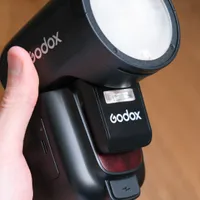
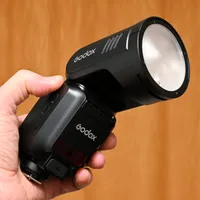
Not just a pretty interface, this Neewer flashgun has a clever head. With an octagonal profile, it’s more rounded than the letterbox shape of most flashgun heads and includes a frontal lens for evenly distributing the light. Compared with regular flashguns, the rounded head of this one delivers a softer quality of light that has a nicer fall-off towards the circumference.
And that’s not all. Bounce and swivel functions are taken care of, with an extravagant range in both respects, comprising -7-degree downward to 120-degree rear-facing bounce, and full 180-degree swivel rotation to both the left and the right. In a nutshell, you can bounce the flash off any nearby wall or ceiling, with a full range of movement.

Fancy taking a shot in the dark? No, I thought not. It’s nice being able to preview the effect of flash and, to this end, the Neewer features not one but two powerful modelling LEDs. You can switch them on and off and adjust their intensity. Not just for a preview of flash effect, they also work well as autofocus assist lamps when using mirrorless cameras. For legacy DSLRs (dare I say it), there’s also a red AF-assist beam that you can enable or disable in the menu system.

I’ll confess to having a love/hate relationship with TTL flash metering. When I’m in a big hurry and need to best-guess a flash power setting for a defining moment with no time to compose a shot, I’ll take TTL any time. But if time is on my side, I prefer to test the waters and tailor the strength of the flash in manual mode.
The Neewer makes it quick and easy to swap between both modes, not just through the touchscreen interface but also with a straightforward M/TTL switch on the left-hand side of the flashgun. Sometimes a physical, dedicated switch is hard to beat. Just below this is a test-fire button and, unlike the piffling equivalents in most flashguns, this one fires the flash at the strength you’ve preset. Lovely. And below that, there’s another physical pushbutton for quickly reverting to the previous menu level. All is good.

Let’s flip the flashgun over and take a peek at the right-hand side. Top of the tree is a power on/off button. Simply use a long-press to switch the flashgun on or off, with no need for supplemental touchscreen taps or swipes to confirm. Just below this is a dedicated button for turning the modelling lamps on or off. There’s also a 2.5mm sync socket for retro cable-linked rather than RF wireless sync. At least cable connectivity is catered for, although it’s not the favored option in this RF-linked day and age.
Next up are not one but two USB-C ports. The first one is colored black and is a data port for applying firmware updates if and when needed. The second is an integral part of the Li-ion battery that powers the flashgun, and is power color-coded in red. This one is for recharging the 3000 mAh battery, which takes around 90 minutes, if the battery is completely drained.

Some of the smaller Li-ion-powered flashguns I’ve seen of late have a built-in battery that’s fixed in place. I’m happy that the battery of this more powerful flashgun is an interchangeable unit. As such, you can buy a spare for backup if you tend to take on prolonged sessions. You can also charge up your spare battery while using the other one slotted into the flashgun. It’s a good way of keeping pace with the busiest workloads.

The collection can sometimes be more than the sum of the parts, and the Neewer comes on strong in this respect. I was pleased to find many and varied components in the box, including the flashgun itself, the Li-ion battery, a carrying case, a cold-shoe stand with a metal threaded 1/4-inch socket, a USB charging cable (but no mains charger), a clip-on diffusion dome, and even a rubber weather-seal shroud for the hot-shoe foot. All in all, it’s a very complete kit.

Back in days gone by, I used to religiously use a Sto-Fen Omni-Bounce diffusion dome with most of the flash-lit shots that I took. I’ve since moved on to using bounce flash more often, but a diffusion dome is still a great tactical weapon to have in your arsenal of winning flash accessories. A clip-on diffusion dome for the Z3 is supplied as part of the kit, giving you the opportunity of softening the quality of light without paying for optional extras.
Neewer Z3 100Ws Flash: Performance
There’s plenty of power on tap. In my lab tests using a Sekonic flash meter, the Neewer outgunned the Godox V100 round-headed flashgun for maximum power at longer zoom settings, the Godox also being rated at 100Ws. In old money, the Neewer equates to a Guide number of Gn 45 (meters, ISO 100) at the longest 105mm zoom setting.
The overall zoom range is actually the same as in the Godox, at 28-105mm. That’s fine as far as it goes, but wide-angle coverage is a little limited compared with most conventional flashguns that have a rectangular flash tube. On the plus side, the Neewer is supplied with a neat clip-on diffusion dome that spreads the beam to wider angles. It also softens the quality of light, reduces specular highlights, and makes shadows less harsh.

One slight niggle, as far as I’m concerned, is that I couldn’t find a menu option for changing the very fine 0.1EV adjustment steps to coarser 0.3EV steps. I often prefer to use larger step changes, and the option is available in the companion Neewer QZ touchscreen wireless flash trigger, but not in the Z3 touchscreen menu. I sometimes found it a bit tricky, for example, to increase or decrease the manual flash power by exactly a single EV step. I’d end up using the main touchscreen scale to make roughly the right change, then use the virtual + and - virtual buttons to home in on the correct value in 0.1EV steps.
As I’d expect from a flashgun that runs on a chunky Li-ion battery, recycling speeds are very quick. In my tests, recycling proved virtually instantaneous all the way up to 1/4 of full power, 0.5 seconds and half power and 1.5 seconds after a full-power flash.

There’s plenty of stamina as well, with the battery being rated at 530 full-power flashes and many more at lower power settings. It takes about 90 minutes to fully charge a flat battery, which again is pretty quick. In another element of stamina, resistance to overheating is also good, and you should be able to shoot a burst of up to 100 full-power flashes before things start to slow down and you need to give the Neewer a break. You’ll probably be ready for a break as well, after all that.
Neewer Z3 100Ws Flash: Sample images
The following gallery of example images was taken of a model car measuring about 20cm / 8 inches in length. I set the white balance of my Nikon Z 6II to Flash and used the Neewer in direct flash mode, then at a 60-degree upward angle with the diffusion dome fitted, then without the dome, but bouncing the flash at a rearward 120-degree angle off the ceiling. Finally, for creative effect, I fired the flash with the diffusion dome fitted again but remotely off-camera, using a Neewer QZ trigger. The last option gives the most creative freedom over lighting effects. See what you think.


Neewer Z3 100Ws Flash: Lab Results
We test all available features for each flashgun that goes through out labs. To test power output, we use a Sekonic flash meter placed at a distance of one meter from each flashgun. We check the complete range of manual power settings, in one-stop increments. Based on a sensitivity of ISO 100, the figures correlate directly with the Gn (Guide number) in meters. The results are double-checked by taking shots of a gray card with the appropriate lens apertures and using the camera’s histogram display in playback mode. We also use the gray card to test the accuracy and consistency of Auto and Auto TTL flash metering, where featured.
We check the speed with which each flashgun can recycle to a state of readiness, throughout its range of power settings, culminating in a full-power flash. We use freshly charged Ni-MH rechargeable batteries for this, or the supplied rechargeable Li-ion battery pack where featured in some flashguns. The graph below shows the power output (Gn, ISO 100, meters) at each full EV step through the complete power range, from minimum to maximum output. The recycle speed in seconds is shown at 1/8, 1/4, 1/2 and full power settings.
Power output:

As I’d expect, maximum power output rises at longer zoom settings but I’m impressed how the strength of the flash stays the same throughout the entire range in the shorter 28-50mm zoom range. At its maximum output setting and longest 105mm zoom setting, the Neewer edged ahead of the competing Godox V100 in my tests, returning a value of Gn 45 compared with Gn 38 (ISO 100, meters).
Recycle speed:

Recycling speeds are virtually instantaneous, from the minimum power setting of 1/256 all the way up to 1/4 power. Half a second is still very quick after a half-power flash, as is 1.5 seconds after a full-power flash. Unlike using alkaline batteries in a flashgun, there’s no slowdown as the Li-ion battery starts to discharge.
Neewer Z3 100Ws Flash: Verdict
I feel that the Neewer Z3 100Ws Flash is powerful and sophisticated, yet intuitive and easy to use. The color touchscreen interface makes everything I need very accessible and simple to adjust, and I like that the high-end features include a wealth of flash modes, along with a built-in RF transceiver, so it can be used as both an RF wireless master or slave in multi-flashgun setups.
There’s a nice range of extras included in the box, with a clip-on diffusion dome and rubber shroud that you can fit to the hot-shoe mounting foot. All in all, the Neewer is a great gun that delivers a lovely quality of light with excellent consistency. It’s also great value at the price. I’m hooked!
Features ★★★★★ |
Useful features include dedicated TTL flash metering, high-speed sync, programmable stroboscopic mode, modelling LED lamps and a clip-on diffusion dome. |
Design ★★★★★ |
The round-head design gives a lovely quality of light, while the color touchscreen interface is intuitive and highly effective. |
Performance ★★★★★ |
Maximum power output is impressive but very subtle output is also available, all with fast recycle speeds and great stamina from the Li-ion battery. |
Value ★★★★★ |
Considering the feature set, touchscreen design and overall performance, this flashgun is standout value for money. |

Alternatives