







Early Verdict
I feel like I just got back from time-traveling through camera history. The Fujifilm Instax Mini Evo Cinema is a unique retro camera with a decade dial that applies an era-themed preset to both stills and videos. It's hands down the strangest camera that I've ever used, but that's what makes it so highly entertaining. I'm holding off on my final verdict, however, as I came across a few annoying bugs.
Reasons to buy
- +
Decade dial
- +
Decades are adjustable
- +
Retro design
- +
Built-in video light
- +
Includes viewfinder, grip accessories
Reasons to avoid
- -
Expensive
- -
Smaller 5MP sensor
- -
Battery life feels limited
- -
Early model has some bugs
Why you can trust Digital Camera World Our expert reviewers spend hours testing and comparing products and services so you can choose the best for you. Find out how we test.
Science hasn’t yet taken time travel out of science fiction, but Fujifilm’s newest Instax camera can travel through nearly 100 years of camera history. The Fujifilm Instax Mini Evo Cinema is the first Instax with video, but it’s the decade dial that has captured the internet’s attention – and my heart.
The Fujifilm decade camera feels a bit like a combination of the hybrid Instax Mini Evo, the 1965 Fujica Single-8 cine camera, and a time machine. The camera itself is a digital-film hybrid that spits out instant film, but unlike the original Mini Evo, the Cinema also takes video, is styled like a vintage Super 8, and has ten decade-themed filters built in.
I “time-traveled” with the Fujifilm decade camera – and I’m predicting this little camera will be a hit among retro camera fans, but potentially loathed by pixel peepers.
Instax Mini Evo Cinema: Specifications
Sensor |
5MP, 1/5-inch |
Resolution |
1920x2560 stills, 600x800 pixel videos, 1080x1440 pixels in 2020 high quality mode |
Lens |
28mm (35mm equivalent) f/2.0 |
Autofocus |
Single AF, face recognition |
Focus distance |
10 cm to infinity |
Exposure compensation |
-2 EV to +2 EV |
Flash |
Auto, on, off |
Video format |
MP4 MPEG-4 AVC / H.264, AAC |
Video frame rate |
24p |
Prints |
1600x600 dots Instax Mini film (800x600 dots from a smartphone) |
LCD |
1.54-inch, 170,000 dot |
Dimensions |
39.4 mm x 132.5 mm x 100.1 mm / 1.55 inches x 5.22 inches x 3.94 inches |
Weight |
270g / 9.5oz |
Instax Mini Evo Cinema: Price
The Instax Mini Evo Cinema retails for $409.95 / £329 / AU$599 / CA$479. Pre-orders have already opened, including B&H in the US, London Camera Exchange in the UK, JB Hi Fi in Australia, and Amazon Canada.
The price point puts the little Instax Cinema at a steep jump from the original Instax Mini Evo, but a closer match for the Instax Wide Evo.
The camera was originally only announced in Japan, but Fujifilm announced its availability in additional regions on January 13. The camera is expected to begin shipping in the US and Canada in early February 2026, and at the end of January in the UK and Australia.
Instax Mini Evo Cinema: Design & Handling

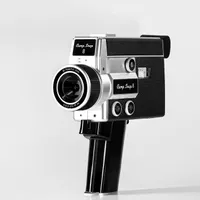
The Instax Mini Evo Cinema design is inspired by the 1965 Fujica Single-8 series of cine cameras, and like the inspiration, the Evo Cinema takes on the form factor of a small Super 8. The camera is held vertically, with a trigger-style record button.
Hold down the trigger, and the camera will record a video for as long as the button is pressed, or 15 seconds, whichever comes first. That does present a challenge when trying to use the Evo Cinema for selfie videos – but thankfully, the smartphone app has a remote that works around that issue. A perk of this design, though, is that you can shoot right or left-handed.

Above that trigger is the camera’s lens. A dial around the camera lens controls the intensity of the different decade filters. Topping the lens, there’s a flash which, surprisingly, also works as a constant light for video. A red light indicates when the camera is recording. Sandwiched between the recording indicator and flash, there’s a small mirror to aid in those selfies.

But let’s be real – the most unusual features on the Evo Cinema are housed on the side of the camera. A Gen Dial allows creators to select a decade-themed preset spanning every decade from 1930 to 2020. Below that, a small toggle controls the digital zoom. There’s a switch to go from video to stills.

A second switch, indicated by a frame icon, offers another unusual feature, but one that I’m really glad exists – it allows you to turn the decade frame effects on and off. For example, if you don’t want the time and date stamp on for the 1980s or the YouTube-esque overlay for the 2010s, this simple switch turns them on and off.

The final control on the side is for printing. But, in keeping with the retro style, this isn’t a button but a tab that pulls out and turns. This is a little finicky; I had to make sure I turned it all the way and held it for a second before I heard the printer begin to whir to life.

On the opposite side from that time machine – I mean Gen Dial – there’s nothing but a door to load the Instax film cartridge. Like with other Instax cameras, there’s a yellow mark to help you know which way to put the film in. Line up the yellow mark on the film and the camera, and you’re golden.

At the back of the camera, there’s a small non-touch screen. But, Fujifilm actually includes an accessory here that converts the screen into an electronic viewfinder, if you want the full retro experience. The viewfinder adapter isn’t quite as sharp and is a bit harder to see the edges, but it’s an unusual way of fitting in both a screen and an EVF.
Underneath the screen, there’s an assortment of buttons for the menu along with a control wheel. The Gen Dial is also placed at the edge so you can use your thumb to twist it from the back, and the decade will also pop up in the viewfinder. That means you can adjust the decade without turning the camera to the side to read the labels.

The bottom grip part of the camera is relatively small, but I didn’t find it too uncomfortable, with my index finger on the trigger, two fingers around the grip, and my pinky underneath. But, I’m a petite person, and those with larger hands may find the grip too small. Fujifilm includes an add-on grip in the box, which screws into the tripod mount and gives the grip more height as well as a rest for the fingers at the bottom. I preferred shooting without it, but those with larger hands will likely find it a welcome accessory.

Along with the viewfinder accessory and add-on grip, the Evo Cinema also ships with a wrist strap, plus a second, smaller strap to connect to the viewfinder accessory.
Instax Mini Evo Cinema: Performance

The Instax Mini Evo Cinema puts fun before specifications – and it shows. The decade dial had me grinning the way few cheap cameras can, at the same time, sparking some ideas using those retro presets.
Most cameras today are all about the tech, but Fujifilm’s decade camera is unabashedly about having fun. As entertaining as the decade dial is, I loved that there are ways to customize those looks. The ability to turn off the overlays or leave them on is well thought out, plus there’s a dial to control the intensity of the retro look. There’s even exposure compensation and white balance adjustments inside the menu.

1930
Image credit: Future

1940
Image credit: Future

1950
Image credit: Future

1960
Image credit: Future

1970
Image credit: Future

1980
Image credit: Future

1990
Image credit: Future

2000
Image credit: Future

2010
Image credit: Future

2020
Image credit: Future
But like the Fujifilm X Half, cameras that prioritize experience over tech have some limitations, and the Evo Cinema has a long list. The 1/5-inch 5MP sensor is plenty for credit-card-sized instant film prints and social media shares, but not for much else.
Videos are similarly low resolution and measure just 600 x 800 pixels. But, as strange as this is going to sound, I didn’t really notice the lack of resolution between the years of 1930 and 2000. These film effects are all intentionally sprinkled with noise, grain, and glitches, so it’s hard to notice any pixelation.
The more modern decades past the millennium have fewer of those intentional imperfections, which makes the camera’s low resolution and soft plastic lens a bit more obvious. The 2020 mode does bump up the resolution to 1080 x 1440, but this high-quality mode is only available when recording to a microSD card, not the internal memory. It’s also off by default, so dig into the camera’s menu to switch it on if you want the higher resolution.
The camera does have zoom, but it’s a digital, not optical type, and cropping an 800-pixel video even further isn’t going to be super useful. (It does, however, exaggerate the historic but terrible picture quality of some of the earlier decades.) The zoom also stops and starts, so it’s jittery if you zoom while recording.


Another key limitation for Fujifilm’s decade camera is that the videos are limited to a maximum of 15 seconds. The camera is designed for more quick clips that almost feel like Live Photos, just with sound and fantastic time-traveling presets.
The Evo Cinema also seemed a bit on the slow side, with a spinning wheel that pops up for a few seconds when you swap modes. It’s nothing major and almost feels like a reminder that old tech also had some pretty significant annoyances.
The battery on the Evo Cinema also felt a little short-lived – Fujifilm indicates a 100-print battery life, but doesn't hint at how many photos and videos you can take on one charge. Regardless, I had to charge it a few times during my review, which was surprising considering it can't take more than 15 seconds of video at a time.
I tried the Evo Cinema ahead of the launch, and the performance was a bit buggy. Initially, the camera froze on me repeatedly, and I had to resort to pushing the tiny reset button with a pin, but this only happened when using one specific memory card that hadn’t been formatted inside the camera. Once I swapped cards, that bug didn’t happen again.
A few times, the screen would go to strange colors and only take up a quarter of the LED. Hitting the record button seemed to clear the odd screen glitch after a slight delay. Then later, the camera stopped recording sound. I updated the camera’s firmware in the app, but I still have not gotten my sound back.
The Evo Cinema isn’t made for long videos. It’s not made for pixel peeping. But it is made for time traveling, and at that, the camera does fantastic. There are a few early bugs to contend with, though, hopefully those will have a quick firmware fix.
Instax Mini Evo Cinema: The App
The Instax Evo app adds a few notable capabilities to the Instax Mini Evo Cinema.
First, the app connection is required in order to “print” videos. A printed video works with a QR code that, when scanned, will play the video on the device’s screen, complete with an Instax white border. You’ll need to connect to the app for the feature to work, as the app needs to upload the video online for that QR code to have something to link to.
The other key component of the app is for taking selfies. With that trigger-style record button, the Evo Cinema can’t really record selfie videos from a tripod because once the button is released, the recording stops. Thankfully, the app has a workaround, and there’s a remote record button that works without holding down the trigger on the camera.
The app also allows you to print photos taken on a different camera, along with housing tools for firmware upgrades and editing images before you print.
Instax Mini Evo Cinema: Verdict


As a vintage camera collector, I immediately fell deeply in love with the Instax Mini Evo Cinema and its time-traveling decade dial. The effects are not only highly entertaining but also creatively sparking. This camera brought me joy.
But, don’t let the Cinema in the name fool you. The Evo Cinema isn’t a high-tech video camera with its 800-pixel videos. At just 15 seconds long, the videos feel more like moving pictures than videos.
I also ran into a few early bugs – hopefully those will have a quick firmware fix, but those initial glitches may warrant waiting a bit until a firmware update eases those oddities. Then again, this is a Fujifilm, and there’s the chance the uniqueness will have it selling out. Still, I’m going to hold off on giving this camera a star rating until I can get the bugs fixed.
That brings me to the price. The list price is a bit disappointing, though not exactly unexpected. I wish I could turn back time on camera prices, too, but, alas, the Evo Cinema doesn’t have a dial for that. The list price is in line with the Instax Evo Wide, but significantly steeper than the photo-focused original Instax Mini Evo. Like with the X Half, I think trends (and in the US, tariffs) are playing a role in a higher price point for a camera with limited specs.
The Fujifilm Instax Mini Evo Cinema is the strangest camera that I’ve ever used, but its inherent weirdness is 100 percent why the decades camera is so entertaining. As a camera, the specs are a bit ‘meh,’ but as a time travel machine, well, there’s really nothing like it.
Alternatives
You may also like
Browse the best retro cameras or the best instant film cameras.

