Digital Camera World Verdict
I feel that the Viltrox Vintage Z2 gives you the opportunity to ‘let your little light shine’. And it really is a little light, only being about 2.5 inches tall and weighing just a couple of ounces. Even so, it has plenty of stamina, thanks to its internal Li-ion battery pack. However, while it’s designed for simplicity and great value, the meagre maximum power rating and lack of bounce, swivel and zoom can be limiting factors.
Pros
- +
Compact and lightweight
- +
4 dedicated versions
- +
Internal Li-ion battery
Cons
- -
Meagre maximum power
- -
No bounce, swivel nor zoom
- -
Lacks optical slave modes
Why you can trust Digital Camera World Our expert reviewers spend hours testing and comparing products and services so you can choose the best for you. Find out how we test.
There has been a flurry or ‘retro’ mini flashes recently, from the likes of Godox and other manufacturers, as well as the Viltrox Vintage Z1. The Z1 marked the company’s first foray into the on-camera flash market, followed by the uber-modern ‘mech-inspired’ Viltrox Spark Z3. The latest Z2 reverts to retro styling but like the Z3 and unlike the Z1, it’s a dedicated rather than manual-only flash, again available in Canon, Fujifilm, Nikon and Sony options.
Designed to be compact, lightweight and easy to use, the Z2 aims to be one of the best flashguns on the market, at least if you’re after a low-budget retro TTL option and don’t mind a modest maximum power rating and a relatively basic set of features.

Viltrox Vintage Z2: Specifications
Dedicated versions |
Canon, Fujifilm, Nikon, Sony |
Max output (Gn, ISO 100, m / ft) |
6 / 20 |
Bounce |
None |
Manual Power Settings |
1/1 to 1/16 |
Auto flash exposure |
TTL |
Batteries |
Internal Li-ion |
Full power flashes |
700 per charge |
Wireless master/slave |
None |
Dimensions |
39x65x33mm / 1.5x2.6x1.3in |
Weight (inc battery) |
52g / 2oz |
Viltrox Vintage Z2: Price
Own-brand dedicated flashguns from camera manufacturers can be notoriously expensive. By stark contrast, the Viltrox Vintage Z2 is incredibly inexpensive, with a list price of just $36.99 / £31.99 / AU$ TBA. Sure, it’s ‘only’ a mini-flash with a fairly basic set of features but even so, it’s great value for money. For comparison, the Viltrox Spark Z3 which is available in the same range of dedicated options, sells for more than twice the price at $79 / £66 / AU$119.
Viltrox Vintage Z2: Design & Handling
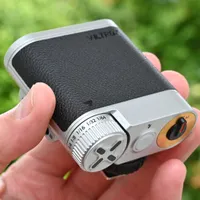
Adhering to the ‘KISS’ principle (Keep It Simple, Stupid), the Viltrox Z2 looks disarmingly straightforward. There’s a small flash tube up top, somewhat reminiscent of the pop-up flash built into a number of cameras. That said, the number of recent cameras that actually feature a pop-up flash is somewhat diminished, making the addition of a separate mini-flash all the more desirable.

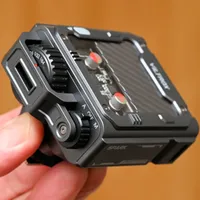
Flip the flash around in your hand, from front to back, and you’ll see a similarly simplistic rear panel. There’s no LCD info screen, let alone a color touchscreen as featured in a growing range of larger flashguns. Instead, you get a basic rank of status lamps, the first indicating that the flash is in Auto (TTL, Through The Lens) flash metering mode, where the output power is adjusted automatically depending on the shot conditions and the distance to the subject.

The rest of the status lamps in the line-up indicate manual power settings. There are only five in total, ranging from 1/16th to full 1/1 power settings, with no interim one-third or one-half EV steps. Most full-sized flashguns go right down to a minimum power setting of between 1/128th and 1/512th but the Z2 has a relatively modest maximum output, so the minimum value of 1/16th is a fair shout. Similarly, the lack of a bounce and swivel head is entirely reasonable, as there’s not really enough power on tap to effectively bounce the flash off walls or ceilings to soften the lighting effect.

Flashguns that run on AA or AAA sets of batteries are a dying breed. Like most recent releases, the Z2 relies on Li-ion power and in this case, it has a built-in, internal battery rather than an interchangeable battery. The only real downside with that is that you can’t buy a separate, spare battery, which can come in useful if you’re on a long shoot and need to pop in a replacement battery rather than waiting around for the internal one to recharge. On the plus side, the internal battery has enough juice for around 700 full-power flashes, so there’s plenty of stamina.
Recharging is courtesy of a USB-C port and takes around 70 minutes. That’s if you’re using a basic USB charger with a conventional 5V / 0.5A output. As is often the case nowadays, you’ll have to supply your own charger as there isn’t one supplied with the flash.

The flash has a nominal daylight color temperature of 6500K +/-200K. Another vital statistic is the flash duration, which ranges from 1/16,500s to 1/50,000s, depending on power setting. As usual, the flash nods off to sleep mode after a period of inactivity, which equates to 15 minutes. After that, you need to press the power button to wake it up again. As I’ve mentioned, the Z2 is very small but not all versions are exactly the same size. The Canon, Fujifilm and Nikon dedicated options all measure 38x65x33mm (WxHxD) whereas the Sony version is 2mm or just under a tenth of an inch taller.

Viltrox Vintage Z2: Performance
For the most part, performance comes down to power and speed. I wouldn’t expect a mini-flash to boast much in the way of maximum power and sure enough, the Z2 has a meagre 10Ws power rating, resulting in a Guide number of Gn 6 / 20 (ISO 100, meters / feet). For the sake of comparison, that’s slightly less than the rating of the built-in pop-up flash of the Nikon Z50 II, and marginally more than the tiny Godox iM20 and Godox iM22 manual mini-flashes. It’s also less than only half that of the Viltrox Vintage Z1 manual flash, at Gn 12 / 40.

In practical terms, the maximum flash power is sufficient for close-ups and to supplement ambient lighting in dull, indoor shooting conditions, as well as to add a little fill-in flash for sunny-day portraiture. However, if you’re relying on the flash to illuminate larger spaces, you’re likely to need to bump up your camera’s ISO setting somewhat.

The spread of illumination covers the same width as using a 28mm lens on a full-frame camera (about 18mm for APS-C), which is pretty reasonable. A push-fit diffusion dome is supplied with the flash, which spreads the beam angle and softens the light, at the expense of reducing the maximum available power (by 1.33 EV in my tests).

It bears repeating that the modest maximum output power is insufficient for effective bounce and swivel flash, off ceilings and walls. Unsurprisingly, the Z2 therefore lacks a bounce and swivel head. There are also no RF (Radio Frequency) nor infrared slave modes, so wireless remote off-camera flash isn’t within the Z2’s remit. Again, the emphasis is on straightforward simplicity, the idea being that you simply pop it into your camera’s hot-shoe and fire at will. That’s fine as far as it goes, but the lack of bounce, swivel and off-camera flash means that the ‘direct’ lighting effect is bound to be relatively harsh and two-dimensional.
As I've mentioned, the supplied diffusion dome softens the quality of light a little. The pair of example shots in the following gallery are lit from the Z2 flash, first without and then with the diffusion dome fitted. TTL flash metering proved consistently accurate during my testing and manual power adjustments are easy to apply in full EV steps.


Some flashguns can be prone to sluggish recycling speeds, towards the high end of their output range. There’s no such problem here, the Z2 recycling almost instantaneously through much of its power range, and being ready for action just 2 seconds after a full-power flash. If you’d rather go Auto TTL rather than setting the flash power manually, I found that TTL metering was consistently accurate when testing the Nikon dedicated version of the Z2 with my Nikon Z6 III and Nikon Z fc cameras.
Viltrox Vintage Z2: Lab Results
We test all available features for each flashgun that goes through out labs. To test power output, we use a Sekonic flash meter placed at a distance of one meter from each flashgun. We check the complete range of manual power settings, in one-stop increments. Based on a sensitivity of ISO 100, the figures correlate directly with the Gn (Guide number) in meters. The results are double-checked by taking shots of a gray card with the appropriate lens apertures and using the camera’s histogram display in playback mode. We also use the gray card to test the accuracy and consistency of Auto and Auto TTL flash metering, where featured.
We check the speed with which each flashgun can recycle to a state of readiness, throughout its range of power settings, culminating in a full-power flash. We use freshly charged Ni-MH rechargeable batteries for this, or the supplied rechargeable Li-ion battery pack where featured in some flashguns.
The table below shows both the power output (Gn, ISO 100, meters) at each full EV step through the complete power range, from minimum to maximum output. The recycle speed in seconds is shown for the same settings.
Power setting |
Output, Gn (ISO 100, meters) |
Recycle speed, seconds |
1/16 (min) |
Gn 1.4 |
0.1s |
1/8 |
Gn 2.2 |
0.1s |
1/4 |
Gn 3.2 |
0.5s |
1/2 |
Gn 4.5 |
1.0s |
1/1 (max) |
Gn 6.3 |
2.0s |
The maximum output power is fairly muted, in keeping with the very compact size of the flash. Fitting the supplied diffusion dome reduces the intensity of light at each power setting by 1.33EV. Recycling speeds are good, being almost instantaneous at the lowest two power settings and rising to just two seconds after a full-power flash.
Viltrox Vintage Z2: Verdict
The Viltrox Vintage V2 makes me feel like repurposing the ‘KISS’ principle as ‘Keep It Small & Simple’. I love that it’s sufficiently compact to be eminently pocketable, and that it’s a real featherweight. The combination makes it easy to pack and carry, and the load is also pretty much unnoticeable when it’s mounted in your camera’s hot-shoe, for portrait as well as landscape orientation shooting. For portrait orientation shooting latter, I find that big, hefty flashguns can feel a bit unwieldy, especially on smaller cameras.
Naturally, the small, lightweight build comes with compromises. The maximum available power is somewhat limited and there are no fancy frills like bounce, swivel and zoom, nor any advanced flash modes like high-speed sync or programmable repeat. Even so, I feel the Z2 accomplishes its aim in being a simple yet effective and inexpensive mini-flash in Canon, Fujifilm, Nikon and Sony dedicated options, ideal for adding a little light when and where you need it most. And for the budget-conscious, it's definitely one of the most inexpensive dedicated flashes on the market.
Features ★★★☆☆ |
The feature set is very basic but includes auto TTL flash metering for Canon, Fujifilm, Nikon and Sony cameras, in the various dedicated options. |
Design ★★★★☆ |
The design is centered on being compact, lightweight and simple, and stretches to the inclusion of an internal Li-ion battery. |
Performance ★★★★☆ |
So long as you can live with the modest maximum power, performance is good with accurate TTL metering and fast recycling between flashes. |
Value ★★★★★ |
Typical of Viltrox flashes, lenses and other accessories, the Z2 is very keenly priced and great value for money. |

Alternatives