
When Nikon created the Z-mount for its Z-series mirrorless camera range it opened up a whole new world of possibilities for its lens designers. The Z mount boasts a significantly larger lens flange than the F-mount used by the best Nikon DSLRs, while the absence of a mirror assembly in Z cameras allows the lens to be positioned much closer to the sensor than a DSLR. This design enables the creation of smaller, lighter, faster, and optically superior lenses. In fact, one of the key reasons Nikon Z mirrorless models are the best Nikon cameras is their exceptional and continually improving lens range.
Nikon had to start building its Z lens range from scratch when it launched the Z-series system in 2018, but now it has a comprehensive range that covers most of the bases, whatever you might shoot. The selection of the Nikon Z lenses continues to expand, covering every focal length that photographers and videographers might need.
As each new Nikon Z-fit lens has come into our labs for review, it has become apparent that Nikon's pushing of the virtues of the Z-mount's capabilities is no marketing hyperbole. There's not been a dud among them, and even the cheapest kit lens boasts optical quality that's off the charts compared to its F-mount forebears. There's also a growing range of independent Z-mount lenses from companies like Tamron and Viltrox, which aim to deliver similar performance but with greater value for money.
With such a variety available, choosing the right Nikon Z lens can be daunting. This gave me a bit of a headache too, when deciding on the best Nikon lenses for inclusion in this guide, because they all have a fair shout at being in the running. So I've zeroed in on what I reckon are the best buys that hit the quality and value sweet spot. They are the lenses that I would personally buy, and are not always the budget option: sometimes it's worth spending the extra.
But of course, different photographers will have different needs, and a Z8 or Z9 user will undoubtedly be prepared to spend more on a lens than an owner of an entry-level camera, such as the Z50 II or Z5 II, so I have provided links to our Nikon Z-series camera-specific guides at the end of this one!

Adam is Guides Editor at Digital Camera World, and has several years of experience as a photography journalist, most notably as editor of Nikon bible N-Photo magazine. An undisputed Nikon know-all, he has put his unrivaled knowledge into practice, testing and reviewing Nikon lenses for this guide.
Best Nikon Z lenses
Why you can trust Digital Camera World Our expert reviewers spend hours testing and comparing products and services so you can choose the best for you. Find out how we test.
Best everyday zoom

Nikon liked the original version of this lens so much that it made its own version with a Nikon badge on it: the Nikon Z 28-75mm f/2.8. However, the original Tamron lens was never made in Nikon Z-mount, only in Sony E-mount. The ‘Generation 2’ Tamron comes in both flavors and is a significant upgrade.
A new optical layout increases resolution and all-around image quality; the autofocus system is twice as fast, there’s more tactile feedback from the zoom and focus rings, and a customizable function button has been added.
That’s all great news, but what made the original Tamron (and Nikon) lens such a hit remains just as attractive in the G2 edition. The fast and constant f/2.8 aperture rating makes this a viable alternative to a ‘trinity’ standard zoom, and while it doesn’t go quite as wide-angle as a 24-70mm lens, you gain marginally more telephoto reach.
And the best bit is that it’s comparatively compact, lightweight, and affordable, compared with typical trinity standard zooms. All in all, it's my top choice as an 'everyday' lens for full-frame Z system cameras.
See our full Tamron 28-75mm f/2.8 Di III RXD G2 review


Features ★★★★★ |
This alternative ‘trinity’ f/2.8 standard zoom features voice coil motor autofocus and a Fn button. |
Row 0 - Cell 2 |
Design ★★★★★ |
Although compact and lightweight, the lens is extensively weather-sealed. |
Row 1 - Cell 2 |
Performance ★★★★★ |
It's sharper than the original Tamron 28-75mm, and Nikon's version of that lens. |
Row 2 - Cell 2 |
Value ★★★★★ |
Much less expensive than a typical ‘trinity’ 24-70mm f/2.8 standard zoom and top value. |
Row 3 - Cell 2 |
Best wide-angle zoom

Pro and enthusiast photographers aspire to owning zooms with fast, constant f/2.8 maximum apertures – but these come at a price and with bulk. The Nikon Z 17-28mm is a beautiful compromise for creating a fast wide-angle zoom. By providing a lens with a narrower wide-angle range than the more traditional 14-24mm f/2.8, Nikon has created a lens that is easier to carry and more affordable for users. As such, it follows on from – and becomes the perfect partner to – the Nikon Z 28-75mm f/2.8 standard zoom.
The autofocus system is very snappy for stills, while also delivering smooth transitions for video capture, along with negligible focus breathing and virtually silent operation. There’s no optical VR (Vibration Reduction), but the lens takes full advantage of in-body stabilization, featured in all of Nikon’s full-frame Z system cameras.
It doesn't go as wide as Nikon's other wide-angle zooms, and if that's more important to you than outright maximum aperture, the Nikon Z 14-30mm f/4 S has a similar price tag but is a stop slower. But overall, the Nikon Z 17-28mm f/2.8 delivers excellent image quality and all-round performance – at a bargain price!
See our full Nikon Z 17-28mm f/2.8 review


Features ★★★★1/2 |
It's not as wide as Nikon's other wide zooms, but has a fast f/2.8 aperture. |
Row 0 - Cell 2 |
Design ★★★★1/2 |
Build quality feels solid despite the relatively lightweight construction. |
Row 1 - Cell 2 |
Performance ★★★★★ |
Sharpness levels are spectacular, but drops off a little zoomed in to 28mm. |
Row 2 - Cell 2 |
Value ★★★★★ |
Top value for a fast wide-angle zoom, as long as you can live without an extreme 14mm at the wide end. |
Row 3 - Cell 2 |
Best workhorse telephoto zoom

70-200mm f/2.8 lenses are incredibly versatile, often favored for everything from action sports and wildlife to portraiture, weddings, and event photography. But they're not all created equal. When DCW reviewed the original version of this lens, we said it was probably the best 70-200mm lens in the world, and the replacement Mark II edition is even better. Nikon has managed to make it 26% lighter, increase the autofocus speed by 3.5x, as well as make it even more silent, and enhance the VR performance to 6-stop effectiveness.
Top-end glass includes two dual-sided aspherical elements, both ED (Extra-low Dispersion) and Super ED elements, a fluorite element, and an SR (Short-wave Refractive) element. High-tech ARNEO and Meso Amorphic Coat are added for good measure. There's also a new, more well-rounded 11-blade aperture diaphragm for enhanced bokeh when stopping down a little.
Handling benefits from a removable tripod mounting ring and two customizable L.Fn (Lens Function) buttons. Everything’s wrapped up in a sturdy pro-grade, weather-sealed build, complete with a fluorine coating on the front element. It was hard to see how Nikon could have improved on the original, but this second-generation lens really is even better.
That said, while the original Nikon Z 70-200mm f/2.8 VR S has already been discontinued, you may be able to pick it up at a knock-down price while retailers clear their old stock. And for a brilliant budget alternative, albeit with a slightly shorter zoom range and no VR, the Nikon Z 70-180mm f/2.8 is under half the price.
See our full Nikon Z 70-200mm f/2.8 VR S II review


Features ★★★★★ |
Internal zoom, Nikon’s blistering SSVCM, top-of-the-range lens coatings, dual function buttons and a clickable/de-clickable control ring. |
Design ★★★★★ |
Incredibly lightweight. Moving the control ring forward was a great ergonomic tweak. The Arca-Swiss compatible foot and removable collar are the icing on the cake. |
Performance ★★★★★ |
Betters its predecessor where it counts, despite having a simplified lens arrangement. Prime-like center sharpness. |
Value ★★★★☆ |
A top-tier lens at a top-tier price. You get what you pay for, but this isn’t a bargain. |
Best super-telephoto zoom
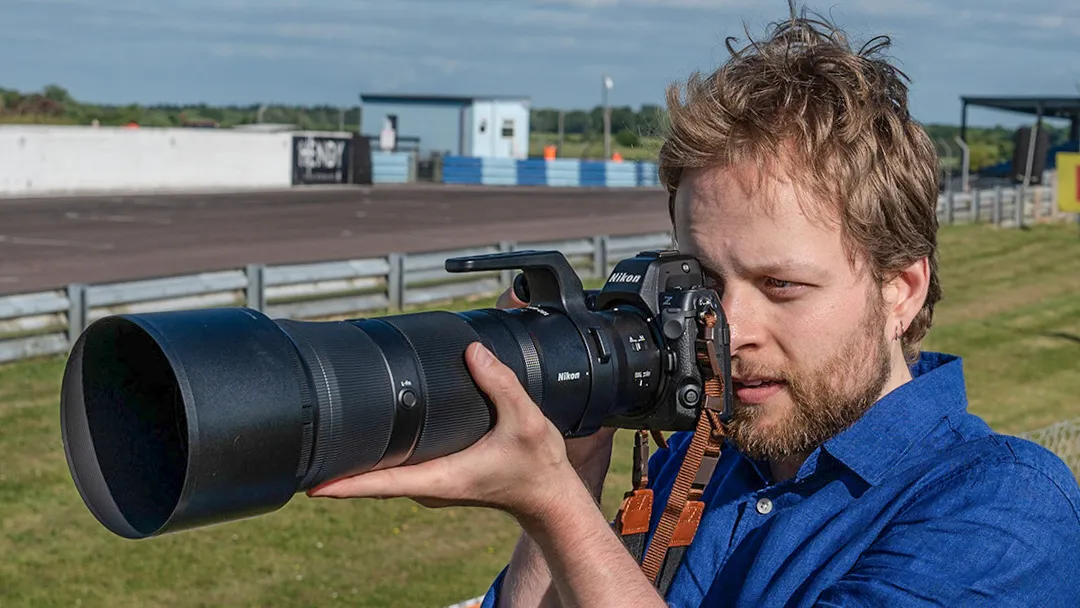
With a monster zoom range stretching from 180mm all the way to 600mm, the Nikon Z 180-600mm f/5.6-6.3 VR is a real treat for anyone who loves to shoot wildlife and action photography. I was expecting a lens with this kind of reach to be a beast, but it’s surprising how manageable it is for handheld shooting. It's reasonably lightweight, and the optical VR (Vibration Reduction) is very effective, providing impressively sharp shots even at slower shutter speeds, which is fantastic for those less-than-ideal lighting conditions you often encounter with wildlife.
With internal zoom and focus, the lens doesn’t extend or change balance, which helps with handling. Autofocus performance is another area where this lens shines; it's super fast and locks onto subjects with impressive accuracy, and gave me a really high hit rate, even with fast-moving birds or athletes. The customizable L-Fn buttons are a nice touch, allowing quick access to your preferred functions. The weather sealing and fluorine coating on the front element also give me confidence.
Image quality-wise, shots are razor-sharp across the entire zoom range, with great contrast and color rendition. I’ve noticed minimal color fringing, and any slight pincushion distortion is easily corrected in-camera or in post. If I’m looking for downsides, well, it’s an f/5.6-6.3 lens, so it’s not the fastest super-telephoto out there, but for the price and the incredible reach, it’s a trade-off I’m more than willing to make.
If you need a faster super-tele zoom and demand full S-line quality, the Nikon Z 100-400mm f/4.5-5.6 VR S could be a better option. Nikon also has a fairly extensive roster of Z-series super-tele primes, though the hefty prices put them in the reserve of the most deep-pocketed pros. But for any Nikon Z shooter looking for a powerful, sharp, and versatile telephoto zoom without completely emptying their bank account, this lens is an absolutely fantastic option.
See our full Nikon Z 180-600mm f/5.6-6.3 VR review


Features ★★★★★ |
A gargantuan 180-600mm zoom range is the standout feature, backed by zippy autofocus and 5.5-stop optical VR. |
Design ★★★★★ |
Zoom and focus is fully internal, and it's easy to locate subjects zoomed out then fully zoom in with a 90-degree twist of the zoom ring. |
Performance ★★★★★ |
The lens proved highly impressive in real-world tests, with superb sharpness, clarity, contrast and color rendition. |
Value ★★★★1/2 |
It's Nikon's most 'affordable' ultra-telephoto zoom – although admittedly that's a relative term! |
Best zoom for weddings and events

For my money, this intriguing ‘not-so-standard’ zoom from Tamron works brilliantly well for shooting weddings and events. The wide-angle coverage is relatively limited, but it goes the extra mile (or at least a fair few extra millimeters) in telephoto reach, complete with a constant f/2.8 aperture. The net result is that it’s easily wide enough for group shots of people at the short end of its zoom range, while also enabling a natural shooting distance and a flattering perspective for solo portraiture at the long end.
I’ve found the lens to be impressively sharp with excellent clarity throughout its entire zoom range, even when shooting wide-open at f/2.8. Another bonus, especially at longer focal lengths, is that the f/2.8 aperture delivers a tight depth of field for isolating the main subject by blurring the background, coupled with smooth and dreamy bokeh. Yet another upside is a close minimum object distance, ideal for close-ups of wedding rings, table decorations, and the like.
Best of all, the Tamron is sufficiently versatile that you can cover most or all of your wedding and event photography needs with just this one lens. It definitely avoids the worry of missing vital, unrepeatable shots because you were busy swapping between different lenses on your camera body at a crucial moment. It’s also refreshingly lightweight for shooting all day long (and into the night) for wedding and event photography.
See our full Tamron 35-100mm f/2.8 Di III VXD review


Features ★★★★½ |
High-end features include a customizable function button and 3-way custom settings switch, but there’s no optical image stabilization nor a dedicated aperture control ring. |
Design ★★★★★ |
The design does a brilliant job of shoehorning such a big zoom range and constant f/2.8 aperture into such a compact and lightweight construction, complete with strong, weather-sealed build quality. |
Performance ★★★★★ |
Sharpness and clarity are excellent, throughout the entire zoom range and even when shooting wide-open at f/2.8. Color fringing, distortions, ghosting and flare are all well controlled and autofocus is super-speedy. |
Value ★★★★★ |
For a constant-aperture zoom lens with such a useful 35-100mm range, the Tamron is absolutely excellent value for money. |
Best standard 'nifty fifty' prime

A 50mm prime is a classic focal length that offers a similar angle of view to human eyesight, but what's curious about the Z 50mm f/1.4 is that it's not only cheaper than Nikon's 50mm f/1.8 S-line lens but also 2/3-stop faster while being virtually the same size and weight. Having that f/1.4 capability is invaluable when the light isn't ideal, or you really want to make subjects pop with a shallow depth of field. Use it on an APS-C Nikon Z camera rather than a full-frame one, and it becomes a rather nice short telephoto that is ideal for portraits.
Autofocus is respectably quick and impressively quiet. It has dual control rings that can be customized; typically, I’ll set one for focus and the other for aperture control. It’s fairly compact and lightweight, which makes it easy to carry around. The 9-bladed aperture helps create some pleasing bokeh in out-of-focus areas. Image quality-wise, sharpness is good in the center, even when shooting wide open at f/1.4. It handles distortion well, and chromatic aberrations are kept to a minimum. The minimum focusing distance of around 0.37 meters is also handy for getting in a bit closer to subjects.
While it's not an S-line lens and can't quite match the Nikon Z 50mm f/1.8 S for outright image quality, for the price and the performance it delivers, particularly that fast aperture and good autofocus, this is the best choice nifty fifty for the majority of Z-mount shooters.
See our full Nikon Z 50mm f/1.4 review


Features ★★★★ |
Top of the feature list is the fast f/1.4 aperture and the lens has dual customizable control rings. |
Design ★★★★ |
It looks and feels a little basic, with no A/M focus mode switch, but the build includes weather-seals. |
Performance ★★★★ |
It’s not one of Nikon’s up-market S-line lenses, but performance combines good sharpness and nice bokeh. |
Value ★★★★★ |
The lens is excellent value for a 50mm f/1.4, undercutting the list price of the Z f/1.8 version. |
Best portrait prime (FX)

The Nikon Z 85mm f/1.8 S is unquestionably a great lens, but it has fairly basic handling and 'only' an f/1.8 aperture rating. This Viltrox lens is better in many respects, really living up to its ‘pro’ credentials. Build quality feels rock-solid and features extensive weather seals, and handling is a dream. It comes complete with an aperture control ring that has an accompanying click/de-click switch, and there’s a customizable function button that I tend to use for AF-hold. And there’s also an AF/MF focus mode switch to save the effort of fumbling around in camera menus.
High-grade optics comprise 15 elements arranged in 11 groups, featuring three ED (Extra-low Dispersion) elements, no less than nine HRI (High Refractive Index) elements, and one aspherical element. HD Nano multi-layer coatings are applied to minimize ghosting and flare, and a keep-clean fluorine coating is applied to the front element.
Autofocus comes courtesy of a VCM (Voice Coil Motor), which is both very rapid and virtually silent in operation, as well as ensuring super-smooth autofocus transitions if your portraiture turns to video capture. Image quality is simply gorgeous, with ultra-crisp sharpness and clarity coupled with beautifully smooth bokeh.
See our full Viltrox AF 85mm f/1.4 Pro review


Features |
There are plenty of features on tap, including a click/de-click aperture control ring and function button. |
★★★★★ |
Design |
The design works really well, from the robust metal weather-sealed build to the controls and VCM autofocus system. |
★★★★★ |
Performance |
The lens does well to combine excellent sharpness with soft and dreamy bokeh, ideal for portraiture. |
★★★★★ |
Value |
At less than a third of the price of some own-brand 85mm f/1.4 lenses, the Viltrox is outstanding value. |
★★★★★ |
Best portrait prime (DX)

Compared with full-frame cameras, Nikon's APS-C format 'DX' bodies can struggle to deliver a tight depth of field. That’s because DOF is more dependent on the ‘actual’ focal length rather than the ‘effective’ focal length after the 1.5x crop factor is applied. To compensate, I love that this lens has an ultra-fast f/1.2 aperture, which is capable of delivering a really tight depth of field at typical shooting distances for portraiture.
Making the most of the tight depth of field, the Viltrox combines superb sharpness with beautifully smooth bokeh in defocused areas, with a natural-looking roll-off between the two. It’s a great portrait lens that enables you to really isolate the main subject within a scene by blurring fussy-looking backgrounds.
Handling is excellent, and although the lens is necessarily a bit chunky due to the super-fast aperture rating, it’s well stocked in features. These include an aperture control ring with a click/de-click switch, a handy AF/MF focus switch, and a customizable function button.
See our full Viltrox AF 56mm f/1.2 Pro review


Features ★★★★★ |
Top-ranking features include great glass, a click/de-click aperture ring, AF/MF switch and AF-hold button). |
Design ★★★★★ |
Up-market build quality includes a full metal casing and metal mounting plate, complete with extensive weather-seals and great handling. |
Performance ★★★★★ |
Fulfills all the aspects of image quality that you want from this kind of lens, including excellent sharpness, beautiful bokeh and minimal aberrations. |
Value ★★★★★ |
It’s twice the price of some of the most inexpensive Viltrox lenses but worth every cent and much more, being a top-class optic. |
Best macro lens

The sharpness the Nikon Z MC 105mm f/2.8 VR S delivers is simply breathtaking, right across the frame, from infinity down to its 1.0x macro magnification at the closest focusing distance of 0.29m. Whether capturing the intricate details of an insect's wing or shooting a portrait, the clarity and resolution are consistently outstanding. Chromatic aberrations and distortion are practically non-issues, which speaks volumes about its optical design.
Autofocus is impressively fast and accurate, even at very close distances, which can be tricky for many macro lenses. The uprated optical VR system is a significant benefit, especially when shooting handheld in less-than-ideal light or trying to maintain critical sharpness at macro magnifications. Beyond its macro capabilities, it's a wonderfully versatile prime. It’s fantastic for portraiture, offering beautiful subject separation and that lovely compression you get from a 105mm focal length.
The handling is top-notch S-line quality, with a robust, weather-sealed build. It also features a multi-function OLED display, which is useful for checking focus distance or aperture, along with a customizable L-Fn button and control ring. The autofocus range limiter is also handy for speeding up focus acquisition when I know my subject will be within a certain range.
While it's a premium lens with a corresponding price, the performance and versatility it offers are well worth the investment. It’s not just a macro lens; it’s a high-performance prime that delivers sensational results across a variety of shooting scenarios. It’s definitely a jewel in Nikon’s Z-mount lineup. For those on a tighter budget, the alternative Nikon Z MC 50mm f/2.8 is worth considering, especially if you shoot with a DX-format Z-series Nikon.
See our full Nikon Z MC 105mm f/2.8 VR S review


Features ★★★★★ |
Top-notch features include a customizable function button and multi-mode OLED info display panel. |
Design ★★★★★ |
Build quality and handling are fully pro-grade, with plentiful weather-seals and an additional customizable control ring. |
Performance ★★★★★ |
Image quality is flawless for extreme close-ups at up to 1.0x magnification, as well as for portraiture and still life photography. |
Value ★★★★★ |
It’s certainly not a cheap lens but it’s nevertheless excellent value for an own-brand Nikon lens of this quality and performance. |
Best superzoom

The biggest draw of the Nikon Z 24-200mm f/4-6.3 VR is undoubtedly that huge zoom range. Being able to go from a wide 24mm for landscapes or cityscapes all the way to 200mm for picking out distant details, without ever needing to swap lenses, is incredibly freeing. Despite this range, it’s relatively compact and lightweight, which is a massive bonus when traveling. The built-in 4.5-stop optical stabilizer (VR) works really well, helping achieve sharp shots even when shooting handheld at the longer end of the zoom or in dim lighting.
For a superzoom, its sharpness holds up remarkably well, delivering results that I’ve found comparable to carrying separate standard and telephoto zooms. The autofocus is generally fast and accurate, which is crucial when you’re trying to capture fleeting moments. Weather seals and the fluorine coating on the front element are a bonus when shooting in less-than-perfect conditions. The customizable control ring is a nice touch too, which I usually set for manual focus override.
Of course, it's an f/4-6.3 lens, so it’s not the fastest glass out there, especially at the telephoto end. This means it's not my first choice for very low light or for achieving extreme background blur. However, for its intended purpose as a travel and all-round lens, the convenience and reach it offers, combined with its solid image quality and effective VR, make it a really compelling option.
When used on a DX-format Nikon, you gain telephoto reach but lose some wide-angle ability, with the ‘effective’ zoom range equating to 36-300mm, so DX users might find the Nikon Z DX 18-140mm f/3.5-6.3 VR a better bet, which has a similar 24-210mm equivalent focal length.
See our full Nikon Z 24-200mm f/4-6.3 VR review


Features ★★★★1/2 |
Sharpness is very good for a superzoom, and 5-stop IBIS helps beat the shakes. |
Design ★★★★★ |
Compact and lightweight considering its epic zoom range, making it an ideal travel companion. |
Performance ★★★★★ |
While it can't match Nikon's 28-400mm superzoom for outright reach, it wins out for image quality. |
Value ★★★★1/2 |
It's like getting a full-frame standard and telephoto zoom in one, albeit with a sluggish max aperture at the long end. |
Lab test data and comparisons
The lens experts in our testing lab run a range of tests under controlled conditions. We take photos of Imatest SFR (spatial frequency response) charts, then use the Imatest Master testing suite to analyze sharpness, distortion, and chromatic aberrations at the centre of the image frame, corners, and mid-point distances across the range of aperture settings (up to f/22).
The graphs below show the comparative performance of the lenses in this guide, based on our in-house lab tests. For zoom lenses, we repeat our test at the widest and longest ends of the zoom range, plus intermediate 'mid-wide' and 'mid-telephoto' settings. Use the dropdown menus to select between them (for primes, the same data appears on all graphs for ease of comparison). Only full f-stops are labelled on the X-axis for sharpness, so, for example, an f/1.2 or f/6.3 lens would correlate to f/1 and f/5.6, respectively.
Unsurprisingly, the prime lenses lead the way for sharpness in this group, although the f/2.8 zooms also do very well on the whole. The superzoom and kit lens are at the back of the pack, but still perform admirably for these classes of lenses. Color fringing and distortion are well controlled on the whole, and automatic in-camera correction is available for these aberrations anyway, which often can’t be disabled.
For more detailed graphs of each lens's performance that give the full picture, check out the graphs in our standalone lens reviews.
Center sharpness
Use the dropdown menu to select between wide-angle, mid-wide, mid-tele, and telephoto settings on zoom lenses
| Timestamp (f-stop) | Tamron 28-75mm f/2.8 Di III VXD G2 [Nikon Z] () | Nikon Z 17-28mm f/2.8 () | Nikon Z 70-200mm f/2.8 VR S II () | Nikon Z 180-600mm f/5.6-6.3 VR () | Tamron 35-100mm f/2.8 Di III VXD () | Nikon Z 50mm f/1.4 () | Viltrox AF 85mm f/1.4 Pro () | Viltrox AF 56mm f/1.2 Pro () | Nikon Z MC 105mm f/2.8 VR S () | Nikon Z 24-200mm f/4-6.3 VR () |
|---|---|---|---|---|---|---|---|---|---|---|
| 0 | N/A | N/A | N/A | N/A | N/A | N/A | N/A | 2086 | N/A | N/A |
| 1 | N/A | N/A | N/A | N/A | N/A | 2163 | 2230 | 2041 | N/A | N/A |
| 2 | N/A | N/A | N/A | N/A | N/A | 2749 | 2359 | 2277 | N/A | N/A |
| 3 | 2047 | 2997 | 2185 | N/A | 2186 | 3082 | 2884 | 2566 | 2218 | N/A |
| 4 | 2631 | 3374 | 3111 | N/A | 2183 | 3225 | 2847 | 2550 | 2520 | 2173 |
| 5 | 2465 | 3049 | 3064 | 2351 | 2093 | 2958 | 2429 | 2330 | 2472 | 2184 |
| 6 | 2514 | 2816 | 2644 | 2534 | 1981 | 2700 | 2310 | 2048 | 2329 | 2082 |
| 7 | 2299 | 2213 | 2241 | 2336 | 1811 | 2027 | 1859 | 1720 | 2034 | 1930 |
| 8 | 1872 | 1918 | 1822 | 1898 | 1557 | 1848 | 1542 | 1364 | 1728 | 1663 |
| 9 | 1391 | 1398 | 1363 | 1453 | 1275 | N/A | N/A | N/A | 1379 | 1333 |

Fringing @ f/8
Use the dropdown menu to select between wide-angle, mid-wide, mid-tele, and telephoto settings on zoom lenses
| Product | Value |
|---|---|
| Tamron 28-75mm f/2.8 Di III VXD G2 [Nikon Z] | 0.1 |
| Nikon Z 17-28mm f/2.8 | 0.13 |
| Nikon Z 70-200mm f/2.8 VR S II | 0.14 |
| Nikon Z 180-600mm f/5.6-6.3 VR | 0.05 |
| Tamron 35-100mm f/2.8 Di III VXD | 0.23 |
| Nikon Z 50mm f/1.4 | 0.07 |
| Viltrox AF 85mm f/1.4 Pro | 0.32 |
| Viltrox AF 56mm f/1.2 Pro | 0.15 |
| Nikon Z MC 105mm f/2.8 VR S | 0.12 |
| Nikon Z 24-200mm f/4-6.3 VR | 0.07 |
Distortion
Use the dropdown menu to select between wide-angle, mid-wide, mid-tele, and telephoto settings on zoom lenses
| Product | Value |
|---|---|
| Tamron 28-75mm f/2.8 Di III VXD G2 [Nikon Z] | -2.18 |
| Nikon Z 17-28mm f/2.8 | -1.05 |
| Nikon Z 70-200mm f/2.8 VR S II | -1.86 |
| Nikon Z 180-600mm f/5.6-6.3 VR | 0.96 |
| Tamron 35-100mm f/2.8 Di III VXD | -1.13 |
| Nikon Z 50mm f/1.4 | -0.39 |
| Viltrox AF 85mm f/1.4 Pro | 0.58 |
| Viltrox AF 56mm f/1.2 Pro | 0.78 |
| Nikon Z MC 105mm f/2.8 VR S | -0.6 |
| Nikon Z 24-200mm f/4-6.3 VR | -0.18 |
There's more to it than just the technical side, though! Beyond the lab, our reviewers test lenses in real-world environments. We work with lenses both indoors and outdoors, in studio conditions and in natural light, with as many different subjects as possible (or appropriate – there's no point testing a landscape lens' ability to shoot a portrait!).
We take into account everything from handling and ease of use to autofocus speed and the overall quality of the images produced.
Find out more about how we test and review on Digital Camera World
How to choose the best Nikon Z lenses
While there are many reasons to choose one lens over another, and some lenses are always going to be better than others, ultimately, the choice of lens you make is going to be guided by what you plan to shoot. Whether you want a wide-angle, standard, or telephoto lens, whether you pick a prime or a zoom – it should all be determined by what you want to use the lens for. You likely wouldn't use the same lens to photograph a sweeping landscape, wildlife, and a portrait.
Think about what you're planning to shoot and how you're planning to shoot it. Want to capture big vistas of landscapes and cities? A wide-angle lens will be perfect for filling the frame. Want to get naturalistic street shots and portraits? A standard lens (i.e. with a focal length around 24-70mm) will fit the bill. Looking to shoot sports or capture images of elusive wildlife? A long-range telephoto will be a must.
You'll also need to weigh up your budget. Lenses with wide maximum apertures, high-speed autofocus motors, and built-in optical stabilization systems are great to have – but they also cost more.
Nikon Z lenses: frequently asked questions
What are Nikon S-Line lenses?
This term denotes Nikon's top-end range of optically superior lenses. If you see an 'S' in a Nikon lens' name, that means it's part of the S-Line, and is designed to offer pin-sharp resolution, with (according to Nikon) 'superb point-image reproduction, even at the widest apertures'. They're designed to reproduce point light sources more accurately, and provide aesthetically pleasing bokeh characteristics. As such, they tend to be the more expensive members of the line-up.
Can you use Nikon Z lenses on DSLRS?
No. While it is possible to mount Nikon F-mount lenses to Z-mount mirrorless cameras, via the FTZ and FTZ II adapters, there is no way to do the reverse, due to the wider opening and reduced flange distance of the Z-mount system.
Are there third-party Nikon Z lenses?
Yes! There's an increasing range of excellent, independent lenses on the market, many of which offer top-spec build quality, handling and performance, at extremely competitive prices. Tamron and Viltrox are some of my favorites, as featured in this guide, while others include Sigma, 7artisans, TTartisans and Venus Optics (Laowa), to name but a few.
Best lenses for your Z-series camera
While I reckon this guide highlights the best lenses for most people, owners of different Z-series bodies will have varying priorities, so don't miss these camera-specific lens guides…
- Best lenses for Nikon Z30
- Best lenses for Nikon Z fc
- Best lenses for Nikon Z50/Z50 II
- Best lenses for Nikon Z5/Z5 II
- Best lenses for Nikon Z6 II/Z6 III
- Best lenses for Nikon Zf
- Best lenses for Nikon Z7 II
- Best lenses for Nikon Z8/Z9

