Digital Camera World Verdict
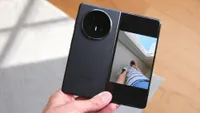
The Oppo Find N6 is my new favorite foldable. It is incredibly thin, light enough to forget you are carrying a book-style foldable, and its crease is among the best I have seen to date. Performance is excellent, battery life is strong, and the ColorOS software remains one of my favorite Android experiences. It's not perfect. The camera module still causes wobble on a desk, the square-ish inner display is not ideal for many apps, and while the cameras are very good for a foldable, they still do not beat the best bar-style photography flagships. The biggest issue for most DCW readers, though, is availability. Oppo is not officially selling the Find N6 in the UK, Europe, or the US, which is a huge disappointment considering just how good this thing is.
Pros
- +
Exceptionally thin and light
- +
One of the best foldable creases yet
- +
Excellent software and fast performance
- +
Very capable cameras for a foldable
Cons
- -
Not officially sold in the UK, Europe, or the US
- -
Camera bump wobbles on a desk
- -
Inner screen aspect ratio is awkward for some apps
- -
The best camera phones still do more
Why you can trust Digital Camera World Our expert reviewers spend hours testing and comparing products and services so you can choose the best for you. Find out how we test.
Oppo has spent the last few generations steadily refining its book-style foldables, focused on making foldables thinner and lighter. The Oppo Find N6 is the latest model in the company’s Find N line, and Oppo’s big pitch here is a new “Zero-Feel Crease”, which promises to make the inner screen crease – a long-held criticism of folding phones – a thing of the past.
There are also the usual new phone expectations. Oppo is upping performance, adding new productivity features, and enhancing the Hasselblad-branded camera system that borrows from the company’s recent camera-focused flagships.
From my perspective, the Find N6 sits in an interesting place. It is clearly competing with other premium foldables such as the Honor Magic V-series and Samsung Galaxy Z Fold for productivity, but foldables have always been behind the best bar-style camera phones when it comes to photography. Oppo might be edging ever closer to the perfect design for its foldables, but can it also produce a foldable camera phone that is not a compromise?

Specifications
Processor |
Qualcomm Snapdragon 8 Elite Gen 5 (custom 7-core CPU) |
RAM + Storage |
16GB + 512GB |
Display |
Cover: 6.62-inch OLED LTPO, 2616 x 1140, 1-120Hz, 431ppi Inner: 8.12-inch OLED LTPO, 2480 x 2248, 1-120Hz, 412ppi |
Main Camera |
200MP, 21mm equivalent, 1/1.56-inch, f/1.8, OIS |
Ultrawide Camera |
50MP, 15mm equivalent, 1/2.75-inch, f/2.0, AF |
Telephoto Camera |
50MP, 70mm equivalent, 1/2.75-inch, f/2.7, OIS |
Front Camera |
Dual 20MP selfie cameras, 21mm equivalent, f/2.4 |
Video |
Up to 4K 120fps on main camera; 4K 60fps Dolby Vision on all rear cameras; Log supported |
Battery & Charging |
6000mAh, 80W wired, 50W wireless, up to 55W via PD chargers |
Operating System |
ColorOS 16.0 (based on Android 16) |
Size |
Folded: 159.87 x 74.12 x 8.93mm / 6.29 x 2.92 x 0.35in Unfolded: 159.87 x 145.58 x 4.21mm / 6.29 x 5.73 x 0.17in |
Weight |
225g / 0.50lb |
Price & Availability
Another year, another huge disappointment for international Oppo/foldable fans. The N series is again not officially available in Europe, the UK, or the US. You can import the phone thanks to its global ROM, and you will have full access to everything Google, but as ever, you likely forfeit any warranty, and overseas imports may not work with your network carrier.
In China, the phone will cost ¥10,099 for the 16GB+512GB version. Direct conversions from Chinese prices are never quite accurate, but that works out as around $1,500 / £1,200 / €1,300. Although I'd expect it to be more expensive if launched on Western shores and comparable to the Honor Magic V6 (which will at least launch in Europe).
Design
Oppo really nailed the design with last year's Find N5, with one of the thinnest and lightest foldables yet, and honestly, I don't know how they even improve on that. So perhaps unsurprisingly, the Find N6 doesn't really rock the boat. At just 8.93mm folded and 225g, it's still incredibly slim and light for a book-style foldable, to the point that, in my hand, it feels only barely different from a normal flagship bar phone. I have said this before about the recent Oppo and Honor foldables, but it is worth repeating: we are now at the point where folding phones just feel like normal phones, and I would be perfectly happy carrying this as my daily driver even if I only opened the inner screen occasionally.
Oppo’s headline design feature is the so-called Zero-Feel Crease, and while that name oversells things slightly, there is a marked improvement on the last model. The crease is remarkably shallow, genuinely on par with the best I have seen from rivals, and I do not really know how much shallower foldables can get from here. This could genuinely be close to peak crease.

Still, it is not magic. You can see it when the screen is off and light catches it the right way, and you can still feel it under your finger. I found it especially noticeable when using the stylus, where the slight unevenness over the crease interrupts the smoothness of writing just enough to remind you that this is still a folding display. I don't want to downplay it; it is much better than the previous model, even if not as transformationally so as marketing might have you believe.
Visually, Oppo has stayed close to the previous generation. The camera sits in the familiar centered “Cosmos Ring” rather than moving to the squarer island look of the Find X9 Pro. Despite Oppo claiming the centered layout keeps the phone stable on a table, when open and laid flat, there is still a decent amount of wobble, which especially makes stylus use a little more uneven than ideal.


There is a side-mounted fingerprint reader in the power button, which is fast and accurate, even if it does require a little relearning if, like me, you have muscle memory for in-display scanners. Face unlock is present too, but like most single-camera solutions (except the Pixel’s), it's not secure enough for sensitive apps like banking and locked folders.
The biggest difference is the replacement of the old Alert Slider with the Snap Key, Oppo’s take on the action button. This doesn't really come as a surprise, as Oppo has been steadily removing it from all its recent models, but I do miss the tactile charm of a proper alert slider. However, I will concede that the Snap Key is objectively far more useful; it can launch the camera, toggle alerts, turn on the torch, translate text, capture content to Oppo’s AI-driven Mind Space, and more.

Both screens are strong too, although similar, if not the same, as those found on last year's model. The 6.62-inch cover display and 8.12-inch inner panel are sharp, bright, and colorful. Both displays have a good white balance out of the box, but you can also tweak this to your liking in the settings.
However, I said this before, and it's a general complaint with the current slate of foldables, the almost square ratio of the inner screen just isn't quite right. For multitasking two apps side by side, that shape works fine. However, for video, you end up with a viewing area that is not dramatically bigger than the outer screen once black bars are factored in. Similarly, with apps like Lightroom, menus can end up on top of images rather than alongside them.
Similar small but wider displays like the iPad Mini just handle layouts better. Oppo has done some work here with more flexible floating windows, which are very useful, but do make the content smaller, and it’s not the big screen app experience I want from an inner screen. I'd love to see a Fold N7 with a shorter but wider inner display, and it is exactly this kind of idea that makes tri-fold phones seem increasingly sensible.

Finally, durability is still a key concern for folding phones. Oppo says the Find N6 uses a second-generation titanium hinge that has been tested by TÜV Rhineland for a million folds, which is definitely way more than you'll do in the lifetime of the device. The frame is reinforced 7000-series aluminum, with an aircraft-grade fiber rear panel, and nanocrystal cover glass. The Find N6 gets an IP56, IP58, and IP59 certification, which is impressive for a foldable, though it still trails the latest Honor Magic V6's IP68/69 rating.
Camera Performance
For me personally, the Find N6 has big expectations to live up to, because Oppo’s recent camera phones have been excellent, and the Find X9 Pro was my phone of the year in 2025.
On paper, the setup on the Find N6 is a slight improvement on the N5. There is a new 200MP 21mm main camera – up from 50MP on the N6 – a 50MP 70mm telephoto, and the 8MP ultrawide is replaced by a 50MP 15mm sensor. The N6 also benefits for the first time in the series from Oppo’s True Color Camera, a multispectral sensor designed to improve white balance accuracy.
Sensor sizes are broadly similar to the previous model, with the main upgrade being the jump in resolution on the primary and ultrawide cameras, which should improve both the quality of the in-sensor zoom between 1x and 3x, but also handle low light better with more room to combine pixels and do computational wizardry.

I'm going to caveat this with: for a foldable phone. But for a foldable phone, the Find N6 cameras are excellent. They can't quite compete with the best camera phones, but this phone isn't a 1-inch sensor beast or packing multiple complex periscopes, but for day-to-day snapshots, they are fantastic.
The look of Oppo images remains one of the brand’s biggest strengths. I am a big fan of the color science from the Oppo Lumo Engine and Hasselblad collaboration; colors are balanced and natural, but with just enough saturation to make scenes lively without tipping into gaudy. The added True Color Camera seems to help here too, delivering usually quite dependable white balance, although I did see some noticeable color shifts on occasion between the three lenses.
HDR is another plus. It does not crush highlights or over-lift shadows, which makes images feel a lot more natural, rather than other brands that aggressively process images.
There is not a huge amount of fall-off in the background, so images can look slightly flatter and more two-dimensional than those from phones with larger sensors and wider apertures. That doesn't make the results bad, but it does stop them from having an almost camera-like rendering shown by models like the Xiaomi 17 Ultra.


Low-light performance squeezes a lot out of relatively modest sensor sizes. Night shots retain a lot of detail, with a strong balance between the highlights and shadows. Again, like daytime HDR, Oppo does a good job here of flattening images while keeping them natural and without overprocessing them. Although I saw a little more light blooming in some shots than is ideal.
The N6 also relies more heavily on long-exposure night processing than rivals with bigger sensors and faster apertures. Not a bad thing, just something to be aware of if you have unsteady hands or like to capture fast-moving subjects in low light.


When it comes to zoom, the telephoto camera is the only sensor that remains the same as last time out. That said, the 3x (70mm equivalent) telephoto is excellent, and Oppo’s in-sensor crop gives very good results out to around 6x (effectively 139mm), and even 10x remains genuinely usable if your subject is still and doesn't have too much intricate detail.


Up to about 30x, the superzoom still holds together surprisingly well, especially on buildings, where Oppo strikes a good balance between detail enhancement and realism, and crucially, it does not seem to descend into obviously fabricated generative AI.
The limitations arrive with more complex subjects and at the far end of the zoom range. Animals, birds and people are less consistent, and 120x is well, unusable. That sounds harsh, but it is fair; max zoom figures on phones are still mostly marketing.

230mm
Image credit: Future

689mm
Image credit: Future

460mm
Image credit: Future

689mm
Image credit: Future
Finally, macro performance is excellent. Oppo uses the 3x camera for macro, which gives a more flattering, more natural working perspective than the ultrawide macro systems found on some rivals.
Detail is strong, especially in the center of the frame, though the depth of field can become a little too narrow and there is some minor oversharpening. Even so, this is the kind of macro mode I actually want to use.


Phone Performance
The Oppo Find N6 is powered by Qualcomm’s Snapdragon 8 Elite Gen 5, though in this case Oppo is using a custom 7-core version tailored to the thermal limits of an ultra-thin foldable. On paper, that might sound like a compromise, but in actual use, I never really found it one.
Day-to-day performance was excellent, and creative tasks in Lightroom and CapCut ran quickly, exports were fast, and there was no annoying lag or stutter when scrubbing through a video timeline. With the inner screen being incredibly useful for photo and video work, the performance more than keeps up if you want to do some light editing on the move.
| Row 0 - Cell 0 | Oppo Find N6 (Qualcomm Snapdragon 8 Elite Gen 5 (7-Core)) |
Oppo Find N5 (Qualcomm Snapdragon 8 Elite (7-Core)) |
OnePlus 15 (Qualcomm Snapdragon 8 Elite Gen 5 (8-core)) |
GeekBench 6 CPU (Single Core) |
3470 |
2810 |
3527 |
GeekBench 6 CPU (Multi Core) |
9449 |
7932 |
10848 |
3DMark (Wildlife Extreme) High |
Row 3 - Cell 1 | 5972 |
5354 |
3DMark (Wildlife Extreme) Low |
Row 4 - Cell 1 | 3266 |
5328 |
Battery life is a small but welcome step up. The N6 sports a 6000mAh silicon-carbon battery, which is 400mAh up on the previous generation. It might not sound huge, but in my lab conditions battery test, the Find N6 got a result of 16 hours 20 minutes, a healthy two-hour improvement on the previous model. Although it does pale in comparison to bar-phones, with the 19 hours 43 minutes of the reigning champ Oppo Find X9 Pro.
But in practical terms, the phone lasted me around a day to a day and a half of mid to heavy use. It easily survived a twelve-hour flight from London to Hong Kong while watching video, messaging, and typing up this very review with around 20% battery remaining when I got to my hotel.
If you do run low, charging is incredibly quick, while Oppo rates it at 80W wired and 50W wireless with its SuperVOOC chargers, the N6 also supports up to 55W over PD. In my testing, PD charging got it from empty to 29% in 15 minutes and 59% in 30 minutes, which is quick enough that a top-up while I shower is enough before I leave the house in the morning.
ColorOS remains my favorite Android skin. It's clean, fast, and visually slick. Settings are easy to navigate, customization is present but not exhausting, and Oppo’s overall design language feels polished. The only minor downside is that there is still some pre-installed bloat, and Oppo duplicates most system apps with its own. Those apps are actually very good, but if you are deeply committed to Google’s ecosystem, you may find yourself uninstalling quite a few of them.
It's 2026, so of course, AI features are front and centre here. Oppo’s Photos app also remains a genuinely good alternative to Google Photos, and Oppo has one of the best mobile suites of AI image tools around, including face enhancement, object removal, reflection removal, portrait glow, unblur, and more.
These tools are generally very effective, even if they are not always fully convincing. You can definitely get away with some AI tweaks for social media, but if you can zoom in or really study an image, it's not that hard to spot the AI at work.
Below, top to bottom: AI 4K Detail Enhance, AI Eraser, and AI Reflection Removal

Before AI Detail Enhance
Image credit: Future

After AI Detail Enhance
Image credit: Future

Before AI Eraser
Image credit: Future

After AI Eraser
Image credit: Future

Before AI Reflection Remover
Image credit: Future

After AI Reflection Remover
Image credit: Future
Oppo also has an AI repository called Mind Space for collecting screenshots, which the AI then aims to pull useful information from. Mind Space itself sounds clever, though it's just not the way I personally interact with AI, and I find simply throwing information into Gemini or ChatGPT still feels like a more natural way to get what I want out of AI helpers.
Finally, there is an optional stylus. This isn't the first Find N phone with a stylus, but this is the slickest implementation yet. The stylus slots into a case on the rear of the phone that diverts the phone's wireless reverse charging to automatically keep the pen topped up. It’s nowhere near as discreet as Samsung’s S-Pen in the Ultra, but good luck finding a spare millimeter of internal space in the N6 for a pen.

The stylus features a click-button shortcut for screenshots, notes, and text capture. The stylus is a little short for longer writing or drawing sessions, but it works well for quick note-taking. The most entertaining feature is its ability to turn doodles into finished AI artwork; hardly essential, but definitely fun. There are also productivity tricks like turning circled notes into charts, though workplace AI tools such as Gemini or Copilot will usually do a better job.


Final Verdict
The Oppo Find N6 is my new favourite foldable. Last year’s model felt like Oppo’s first foldable flagship that was slim and light enough to actually replace my bar phone, and the N6 doubles down on that, as well as improves on a few of last year's weaknesses with enhanced cameras and a nearly invisible (in most lights) crease.
Phone performance is excellent, powering through creative tasks, with a battery that lasts all day, and often a little more. I also continue to think Oppo makes some of the nicest smartphone software around. The cameras are also impressive enough that I never felt regret that I was just carrying a foldable. Oppo’s continued Hasselblad partnership and Lumo image engine produce really nice colors with balanced HDR and a good amount of detail, especially from the new 200MP sensor.
Still, the Find N6 does not quite rewrite the rules. The crease may be shallow, but it is not gone. The inner display is great for multitasking, but not ideal for every app. And while the cameras are very good, the best camera-focused bar phones still offer better results. Then there is the biggest practical issue of all: if you live in the UK, Europe, or the US, this is not officially on sale for you anyway.
Design ★★★★½ |
Incredibly thin, light, and refined, with one of the best foldable creases yet, though I’m still not convinced the square inner screen is the best ratio. |
Camera Performance ★★★★½ |
Excellent for a foldable, with lovely color, strong zoom and good low-light results, but the very best bar phones still deliver more natural depth and better video. |
Phone Performance ★★★★★ |
Fast, polished, and dependable in real-world use, with great battery life, quick charging, and one of my favorite Android software experiences. |
Value ☆☆☆☆☆ |
Hard to judge fairly because unofficial availability makes it a niche import for most readers, however cool the hardware may be. |
Overall |
★★★★½ |

Alternatives