Digital Camera World Verdict
The Leica Leitzphone is, without a doubt, one of the best camera phones I’ve ever used. Mainly because it shares the Xiaomi 17 Ultra’s outstanding camera hardware: a 1-inch main camera, large 200MP telephoto with a true 75-100mm mechanical zoom, producing image quality that can look genuinely photographic. But here Leica’s design touches do help it feel more distinctly premium. The black fibreglass finish, knurled frame, new rotating camera ring, and Leica UI tweaks do make this feel more like a Leica product than just a rebadged Xiaomi. But the Leitzphone also inherits my frustrations with the Xiaomi’s inconsistencies between lenses, and clever but limited mechanical zoom. Add in the higher Leica price, and this becomes a phone for only the most dedicated camera phone enthusiasts, but that said, it's hard to find a better camera phone right now.
Pros
- +
Big 1-inch main sensor makes for stunning quality
- +
Excellent quality 75-100mm mechanical zoom
- +
Stylish Leica Looks and UI
- +
Premium Leica design
Cons
- -
More expensive versus Xiaomi equivalent
- -
Main and telephoto don’t always match
- -
Mechanical zoom range is modest
- -
Battery life is good but not exceptional
Why you can trust Digital Camera World Our expert reviewers spend hours testing and comparing products and services so you can choose the best for you. Find out how we test.
While Leica has been co-branding Xiaomi phones for some time, its own Leitzphone line has historically been a niche Japan-only curiosity. However, this latest model changes that, becoming the first globally available Leitzphone, or to give it its full title: Leica Leitzphone powered by Xiaomi. Coming from Xiaomi and Leica's longstanding partnership, it pairs Xiaomi’s latest flagship hardware from the Xiaomi 17 Ultra with a more overtly Leica design and user experience.
So what exactly is different from the Xiaomi 17 Ultra I previously reviewed? While the Xiaomi is a Xiaomi flagship with Leica-tuned cameras, the Leitzphone is positioned much more as a Leica-designed phone, with Leica cameras, that runs on Xiaomi hardware. It's a little confusing, but in practical terms, that means the same core internals, screen, battery, and camera hardware, but the Leitzphone has a redesigned exterior, a new rotatable camera control ring, Leica-specific software touches, and a far more obvious Leica identity.
The Xiaomi 17 Ultra was already one of the closest things I’ve used to a genuine compact camera replacement. So the real question with the Leitzphone is not whether the camera hardware is good; I already know it is. The question is whether Leica’s changes make this feel more enjoyable or more desirable to justify the steeper price.

Specifications
Processor |
Snapdragon 8 Elite Gen 5 |
RAM/Storage |
16GB+1TB |
Screen |
6.9-in OLED, 2608 x 1200, 1–120Hz LTPO, 3500 nits peak |
Main Camera |
50MP, 23mm, ƒ/1.67, 1-inch Light Fusion 1050L, OIS |
Ultrawide Camera |
50MP, 14mm, ƒ/2.2, 1/2.75", 115° FOV |
Telephoto Camera |
200MP, 75–100mm mechanical zoom, ƒ/2.39–2.96, 1/1.4", OIS, 30cm macro |
Front Camera |
50MP, 21mm, ƒ/2.2 |
Video |
Up to 8K 30p; 4K 120p Dolby Vision; 4K 120p Log |
Battery & Charging |
6000mAh; 90W wired; 50W wireless |
Operating System |
Xiaomi HyperOS 3 (based on Android 16) |
Size |
162.9 x 77.6 x 8.29mm |
Weight |
223.4g |
Price & Availability
This is where the Leica Leitzphone most clearly separates itself from the Xiaomi 17 Ultra. Leica is selling it globally in a single 16GB/1TB configuration for £1,700 / €1,999 / AU$2,299, which is a fair jump over the Xiaomi’s pricing (£1,299/€1,499 for 16GB+512GB, or £1,499/€1,699 for 16GB+1TB).
Leica is effectively asking you to pay a premium not for radically different hardware, but for design, branding, software, and a some Leica-inspired camera filters. The Xiaomi 17 Ultra already felt premium at its asking price, and the Leitzphone goes beyond that. If you are choosing with your head, the Xiaomi remains the sensible buy, but if you are swayed by the Leica design or that red dot, then the Leitzphone is the only choice.
Design
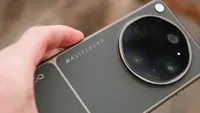
The main differences between the Leica Leitzphone and the Xiaomi 17 Ultra are concentrated in the exterior design. Leica has given the phone a black fibreglass rear, a knurled metal frame, and its own pared-back Leica styling. The phone also adds a rotatable camera control ring and a more Leica-specific user interface with bespoke looks, sounds, and filters. Beyond that, much of the underlying experience, including the screen, dimensions, and weight, remains very similar.
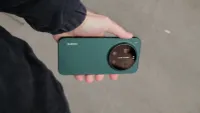
The Leica Leitzphone is a very handsome device. Leica has leaned into its usual design language of restraint, and the result is a phone that feels very Leica – much more so than the sparkly green Xiaomi I've been sporting for the last few months. The black finish is understated, the textures are premium, and the overall aesthetic feels much closer to a Leica camera than a typical phone. And, perhaps most importantly, the Leitzphone gains the iconic red dot.

The fibreglass rear panel gives the Leitzphone a slightly softer feel in the hand, although the downside is it's an absolute fingerprint magnet. While the knurled metal rail around the outside feels really nice in the hand, it adds a level of grip that I now miss with other phones. Combined, there is a real attempt here to make the phone feel camera-adjacent, not just visually but physically too, and it pays off.
That camera-like idea is reinforced by the rotating camera ring, which Leica has used to bring a little more mechanical interaction into the shooting experience, letting you adjust zoom, exposure settings, and Leica Looks. But, while I appreciate the ambition here, in practice, I found the ring to be more irritating than useful.
The ring just turns far too easily. I would knock it when shooting and zoom in or out, sometimes far enough to jump between cameras. The camera ring can also open the camera with a twist, followed by a quick reverse twist, but with how easily the ring turns, I just kept accidentally opening the camera app while just handling the phone.
Even when I was intentionally trying to use the ring, it felt too unwieldy to do it with one hand, and like I might drop the phone. But too awkward having to use the phone with two hands. Ten out of ten for invention, but the execution needs more work.

The camera bump is also pretty substantial. The Leitzphone is built around some serious camera hardware, and that means it comes with the kind of size you would expect from a device with a huge 1-inch main sensor and a mechanical zoom module. But if you want one of the best camera phones available, some physical bulk comes with the territory. However, the phone still manages to stay relatively lightweight at 223g, which is in line with a lot of other flagships with far less ambitious camera hardware inside.
The display is the same 6.9-inch OLED screen used on the Xiaomi 17 Ultra, which is just about as large as I can manage with one hand. It's a really nice panel. It's bright, sharp, colorful, and exactly what I would want on a flagship phone aimed at photographers and video creators. Images look punchy and detailed, the high refresh rate keeps everything feeling smooth, and there is plenty of brightness for outdoor shooting and playback.


Camera Performance
Like the Xiaomi 17 Ultra, the 50MP 1-inch Light Fusion 1050L main camera remains the hero, and it is still one of the best phone cameras I have used for producing images that feel photographic rather than overly processed, with a depth here that most phone cameras still struggle to match. Sharpness is outstanding, and even using in-sensor cropping for a 2x (46mm equivalent) image, I can’t spot any visible loss of detail.
The Leitzphone is also debuting new LOFIC tech, which expands dynamic range by storing greater charge directly at the pixel level, which essentially means the camera can capture more detail in the high and lows as well as at night – and it really works.


The dynamic range on the main camera is fantastic; skies that could easily be blown out kept their color and definition, and there was a lot of detail held in the shadows. I am continually impressed by the way Leica/Xiaomi has managed the HDR. It's not extreme, and there is also no tacky HDR effect where it looks like the software has just dragged the highlights and shadows sliders; the results look natural and like you might get from a larger sensor digital camera.
The downside? The main camera has noticeably better control over highlights and colors than the other two sensors. Introducing LOFIC on just the main camera has proved to be a bit of a double-edged sword, as on one hand it shows what a powerful development LOFIC actually is, but on the other hand introduces some less-than-ideal inconsistencies between cameras, as the other two cameras just can't match the impressive results, as you can see below. But it makes me very excited to see this technology employed on more of the sensors in future models.

Taken with the main camera, look at the depth in color in the sky and water
Image credit: Future

The telephoto camera can't match the same detail and richness
Image credit: Future
However, with all that said, in isolation, the 200MP 75-100mm periscope telephoto is actually incredibly good. At 75-100mm, the optical zoom is a very useful length for portraits, and the large 1/1.4-inch sensor, along with Leica’s processing, gives it a level of subject isolation that looks, again, like a larger camera and lens. Image quality is superb, and even in low light, the large sensor captures a lot of detail. But as mentioned, if you want the absolute best dynamic range or night shots possible, I'd try to stick to the main lens if possible.


The Leitzphone also introduces a mechanical zoom that physically moves between 75mm and 100mm, the same as a camera lens. However, as clever and technically impressive as this I didn't really find it revolutionary.
The idea of physically moving through 75mm to 100mm in a phone is very cool, and it is technically a better solution than in-sensor cropping, as you use the entire 200MP sensor throughout the whole zoom range. But in practice, it is still a relatively modest zoom range, and I struggled to really notice day-to-day that 25mm made any difference in how I could shoot.
It is nice to have, but it is not a reason to buy the phone on its own. But I admire the ambition, and I do hope Leica and Xiaomi stick with the idea and can extend the range next time around.
The mechanical lens also makes close-up shooting more impaired than the previous model, as it can't focus nearly as close. The Leitzphone can capture very attractive closeish-focus images when you work within the telephoto’s sweet spot, where you can get striking shots with plenty of depth and character, but it's not quite a macro specialist. The ultrawide lens can also shoot macro images, although the perspective is far from ideal for flattering shots.


Superzoom is very impressive, largely because Leica has such a strong base to work from, with the large 200MP telephoto sensor, which means cropped zoom shots hold together well until around 400mm-equivalent.
After that, AI steps in to clean up the images. The AI is decent up until around 60x, although once you push further, the usual smartphone issues do appear, with fine detail starting to look overprocessed and the image losing some natural texture, and the phone inventing some minor details like getting the numbers on the clock all wrong on the example below. But for fun rather than photography, the AI superzoom is incredibly useful.

14mm on the ultrawide camera
Image credit: Future

All the way to 2760mm!
Image credit: Future
But what really makes the Leitzphone’s cameras stand out is their photographic character. A lot of that comes from the Leica color profiles, which give JPEGs a more photographic feel straight out of the camera rather than the flat, overly clean look so many phones default to.
You can choose between Leica Vibrant and Leica Authentic. Vibrant is the more conventional option, with punchier color and a brighter, more immediate rendering of the scene. However, Authentic is the one I keep coming back to. Color is a little more restrained, with a more muted saturation, and it adds a subtle vignette and a slightly moodier contrast that gives images a more cinematic feel.

The Leica M3 profile does a great job of replicating a classic camera
Image credit: Future

There are also numerous different filters to choose from
Image credit: Future
The Leitzphone also adds two more with profiles made to match the classic Leica M9 and M3 cameras – both of which produce really beautiful photos, almost enough to convince you that these photos weren’t taken on a phone.


Alongside those profiles, there are a lot of filters, with Leica’s black-and-white and film-inspired looks genuinely some of the best I have used on a phone. I have used plenty of filters and color modes on phone cameras over the years, but Leica’s still feel among the most convincing.
If all you want is a neutral point-and-shoot result, an iPhone or Pixel may still be the more obvious choice. But for photographers who care about mood, tone, and a stronger visual identity in their images, the Leitzphone offers something more distinctive than almost anything else on the market.
Phone Performance
Because the Leitzphone shares its core platform with the Xiaomi 17 Ultra, which I rated so highly, performance is predictably excellent. The flagship Snapdragon 8 Elite Gen 5, paired here with 16GB of RAM and 1TB of storage, has more than enough power for any photography-centric workflow you are likely to throw at it, from shooting and editing images to handling demanding video capture and rendering.
| Row 0 - Cell 0 | Leica Leitzphone (Snapdragon 8 Elite Gen 5) |
OnePlus 15 (Snapdragon 8 Elite Gen 5) |
Oppo X9 Pro (Mediatek Dimensity 9500) |
GeekBench 6 CPU (Single Core) |
3560 |
3527 |
3077 |
GeekBench 6 CPU (Multi Core) |
10512 |
10848 |
8929 |
3DMark Wildlife Extreme (Avg) |
5131 |
5333 |
4491 |
The battery is also unchanged with a 6,000mAh cell. In use, though, I still wouldn’t call battery life class-leading. It is good and comfortably usable for a day away from a charger, but I wasn't getting nearly enough life out of it as I do from many rivals like the Oppo Find X9 Pro or the OnePlus 15, with their colossal batteries.
Thankfully, the Leitzphone charges incredibly quickly. There is 90W wired plus 50W wireless charging – if you have a Xiaomi Hypercharge compatible charger – although PD charging is also surprisingly quick. I went from empty to around 40% in 15 minutes, and around 70% in half an hour.
Support for Content Credentials is interesting, with so many AI photo-editing tools built into the phone. It's not unexpected, as Leica is a major proponent of the Content Authenticity Initiative and has pioneered Content Credentials in camera, like the Leica M11-P.
However, Leica says the phone can embed cryptographically secured metadata via a dedicated security chip in line with C2PA standards, echoing what it has already done with the Leica M11-P. That will not matter to everyone, but for editorial, documentary, and authenticity-conscious users its essential for proving your images are accurate and untouched by AI.

The general Android experience is still underpinned by Xiaomi's operating system, but Leica has skinned parts of the experience with new fonts, app icons, and widgets. On the surface, it feels distinct enough from Xiaomi's OS, but under the hood, it is not entirely separate from it.
If you look beyond the Leica polish, then this is the same experience as any Xiaomi phone. That said, HyperOS is very good, although it still has limiting frustrations with things like UI scaling and app management compared to slicker OS like Oppo's ColorOS or Google's Pixel OS.
Final Verdict
Strip away the Leica design and, yes, this is still the Xiaomi 17 Ultra I already rated so highly. But Leica has done enough here to change the feel of the device. The fibreglass body, knurled frame, rotating camera ring, Leica-inspired interface, and excellent Leica Looks give it a stronger sense of Leica identity and make it feel more like a photographic tool than just another camera-centric Android flagship.
The 1-inch main camera is superb, and still clearly the star of the show, especially thanks to the way LOFIC helps it handle highlights and color in difficult lighting. The telephoto is ambitious and very good, but it has a few inconsistencies with the main camera, and the 75-100mm mechanical zoom remains impressive as an engineering feat, but 25mm is limited in practice.
The real sticking point is price. Leica has taken the brilliant Xiaomi phone and definitely made it look more desirable, but also more expensive. For most people, the Xiaomi 17 Ultra will be the more rational buy. But rationality has never been the whole point of Leica.
Design ★★★★½ |
Leica’s redesign gives the familiar Xiaomi hardware a far more distinctive, camera-like identity, with premium materials and a genuinely useful rotating control ring. |
Camera Performance ★★★★½ |
The main camera is exceptional and the Leica Looks are excellent, though the telephoto still cannot quite match the main lens for consistency. |
Performance ★★★★½ |
Flagship-fast with a big battery and strong charging, but battery life still feels good rather than truly standout. |
Value ★★★★☆ |
A beautiful luxury spin on the Xiaomi 17 Ultra, but the Leica premium makes this a heart-over-head purchase. |
Overall |
★★★★½ |
Alternatives