Digital Camera World Verdict
The Sony A7R VI is an extraordinary high-resolution mirrorless camera that takes the A7R line from slow studio-focused detail machine to a fast hybrid flagship. Its 66.8MP stacked sensor, 30fps shooting, excellent stabilization, superb autofocus, and improved video features make it one of the most capable full-frame cameras I’ve used. But at around $4,500, it is also very expensive, if you need resolution and blazing speed, then the investment might be worth it, but if resolution alone is your main priority, I’m not convinced it does enough over the A7R V to justify such a steep jump.
Pros
- +
66.8MP image quality is superb
- +
30fps 14-bit RAW shooting
- +
Excellent autofocus and IBIS
- +
Strong video features
Cons
- -
Expensive
- -
Dynamic Active stabilization jitters
- -
No open gate video
Why you can trust Digital Camera World Our expert reviewers spend hours testing and comparing products and services so you can choose the best for you. Find out how we test.
Sony’s A7R series has always been about resolution first, and the A7R VI is still very much the high-resolution star in Sony’s full-frame Alpha lineup, but this time, Sony has cranked up the speed too.
The headline is the new 66.8MP stacked full-frame sensor, paired with Sony’s BIONZ XR2 processor with built-in AI processing.
That combination gives the A7R VI more resolution than the A7R V, but also much more speed with 30fps blackout-free shooting with autofocus and auto exposure measured around 60 times per second.
There is also 8K or 4K120 video, with reduced rolling shutter, and stronger subject tracking than the last generation.
This makes the A7R VI less of a specialist landscape, commercial, or studio camera, and more of a camera that can plausibly do almost everything.
That does, however, put the A7R VI in an interesting position. It is not just competing with quick high-resolution cameras from the likes of Canon EOS R5 Mark II, Nikon Z8, and Lumix S1 II, but also with Sony’s own A1 II, where the lines between the two have become increasingly hard to decipher.

Specifications
Sony model number |
ILCE-7RM6 |
Lens mount |
Sony E |
Sensor |
66.8MP Full-frame stacked |
Processor |
BIONZ XR2 with built-in AI |
ISO |
100–32,000 (50–102,400 expanded) |
IBIS |
8.5 stops center, 7.0 stops periphery, five-axis |
Continuous shooting |
10fps mechanical shutter, 30fps electronic shutter with AE/AF |
Video |
8K30p, 8K25p, 8K24p (1.2x crop); 4K60p (no crop); 4K120p (1.1x crop or no crop in View Priority mode) |
Viewfinder |
9.44-million-dot EVF |
Screen |
3.2-inch, 3:2, 2.1-million-dot, four-axis LCD |
Storage |
1x CFExpress Type A., 1x SD UHS-II |
Battery |
NP-SA100, 2,670mAh, 600 shots LCD, 710 shots EVF |
Connectivity |
6GHz Wi-Fi, dual USB-C, top port USB 3.2 Gen 2 10Gbps |
Dimensions |
5.2 x 3.8 x 3.3 inches (132.7 x 96.9 x 82.9 mm) |
Weight |
1.6 lbs (713 g) with the battery and memory cards |
Price
At around $4,500 / £4,399 / AU$6,999, the Sony A7R VI is more expensive than any previous A7R camera. The A7R VI certainly has the specs to try and justify its price – a stacked 66.8MP sensor, a faster processor, 30fps 14-bit RAW shooting, 8K video, much stronger autofocus, better stabilization, a brighter EVF, dual USB-C ports, and a new higher-capacity battery.
However, the question of value comes down to if you will actually use all those features? For many working professionals shooting sports and wildlife who need the combination of detail and speed, the answer might well be yes.
But, if resolution is your top priority, and you don’t need top speeds, the A7R V already offers enormous resolution, excellent handling, and strong image quality – and can now be found for much less money.
Design & Handling
The Sony A7R VI will feel instantly familiar if you have used recent Sony Alpha cameras. Sony has not reinvented the body here, and I don’t think it needed to. I really like the way Sony’s cameras look – clean and serious. And with the exception of Fujifilm’s chic retro bodies, I think Sony makes the nicest camera bodies on the market.
Not just all about the looks, the A7R VI also feels very well built. There is a proper sense of solidity to it, with some reassuring heft in the hand without it becoming heavy or tiring to carry, and it has weather sealing to protect from the elements.
The camera follows Sony’s “next-generation design”, and while the overall shape is roughly the same as the last gen, a few key details have improved. First up, the grip has been updated to the same as that found on the recent A7 V. It is a little deeper, with a bit more of a lip for your top finger, and it’s comfortable, and secure, even with larger lenses. Sony’s camera bodies just keep growing, and the A7 VI has also become larger, so a bigger grip is partly a necessity, but the handling is all the better for it. With the 20-70mm lens mounted I spent most of my time testing with, the A7R VI felt very natural, even in just one hand.

I have praised Sony’s button and dial layout before, and with no sweeping changes this time around, the control scheme continues to be excellent. Sony gives you controls for basically everything, and there are several custom buttons for assigning your own functions.
The one major change you’ll find is Sony has now illuminated several of the key buttons on the back, which makes the A7R VI easier to use at night. It’s triggered by a little lightbulb-icon button on the top of the camera that sits between the shutter and exposure dial. Its sits very naturally under an index finger, and is really not difficult to find without looking at the camera, which is kind of essential in pitch black scenarios. It is a small addition, but I am sure on especially appreciated by event or wedding photographers, and, of course, astrophotographers.

The EVF has got a nice upgrade. It is now a 9.44-million-dot viewfinder that Sony says is three times brighter than the A7R V’s, with a wider color gamut and high dynamic range. In practice, it is clear, very easy to frame through, and has a good refresh rate.
The rear screen, in term of quality is unchanged, although I'm not overly fussed as the old screen was very good, and I'm not personally clamouring for anything more as I’d prefer not to take the hit to battery life for a larger or higher res screen.
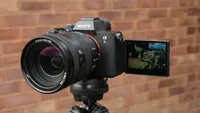
It is still a 3.2-inch, 3:2, 2.1-million-dot monitor, but the screen does see a functional upgrade, joining recent Sony models in the 4-axis club. The screen now both folds out and rotates, so you can tilt the screen for waist-level shooting, or fully articulate it for video. The screen will also now automatically switch to a vertical display mode when shooting vertically – which will please social media creators.

For connectivity, the A7R VI now has two USB-C ports, one for charging and one for power or data transfer, with the top port offering USB 3.2 Gen 2 with 10Gbps transfer speeds for pro workflows. There is also a full sized HDMI port, as well as headphone and mic jacks. My only minor annoyance is that the ports are unmarked on the flaps.
The camera also ships with a new battery, which is perhaps the most interesting design change, as Sony cameras have used the same battery for eons. The new NP-SA100 battery has a 2,670mAh capacity, which is 17% higher than the previous 2,280mAh NP-FZ100, and Sony claims 600 shots with the LCD and 710 shots with the EVF. Sony also says the battery should charge faster.
In use, I found battery life actually a little better than quoted for stills, and noticeably better than before. The battery also performed exceptionally well for video, I easily got a four-five hours of 4K30p.
However, the new battery has one minor downside – if you are like me, and have a bag full of Sony batteries, it is time to start re-buying all those spare cells!

Performance
The A7R VI’s image quality is incredible. The 66.8MP stacked sensor captures a huge amount of detail, and it's the kind of resolution that actually changed the way I shoot. I was mostly shooting with a 20-70mm lens, but because there is so much resolution to play with, I could shoot at the end of my focal range and crop in later still with outstanding quality. It kind of feels like having a lens with twice the focal length.
But while resolution though has always been the hallmark of the A7R, it's the stacked sensor that takes it to another level over previous high-resolution bodies and really pushes the R cameras away from being just for static subjects.


The A7R VI can shoot blackout-free at 30fps with autofocus and auto exposure using the electronic shutter, and that is in 14-bit RAW. That is a massive step up from the A7R V, which topped out at 7fps in 12-bit RAW electronically. Mechanical shutter shooting remains 10fps, but that is now also 14-bit rather than 12-bit.
For most people, 30fps is overkill. The storage demands alone are enough to make me ever think twice about utilizing the full speed of the A7R VI. Even Sony knows this, and it encourages you to limit the shooting speed using a custom button to only boost up to 30 fps only when needed. But if you are a professional where speed and resolution both matter, then it is there when you need it. The A7R VI also adds pre-capture from 0.03 to 1 second, so you can start shooting at 30 fps before you even fully depress the shutter.
The buffer is improved too, with Sony quoting 215 JPEGs and 60-150 RAW files at 30 fps, depending on you’re chosen method of RAW compression, or more than 1,000 JPEGs and 130-535 RAW files at 10fps using the mechanical shutter using Sony's CFExpress Type A cards.


I have heaped plenty of praise on Sony’s autofocus in the past – it is fantastic, and one of the best autofocus systems of any brand. It is extremely fast, and Sony’s subject recognition remains some of the best in the business. The A7R VI has 759 phase detection AF points covering 94% of the sensor, with sensitivity down to -6.0 EV, plus the AF tracking speed and sensitivity is now more adjustable.
Sony has also added the latest version of it’s human pose estimation tech which tracks human subjects entire bodies through movements, while Sony says tracking has also been improved when subjects move in and our of cover, and better recognition of smaller objects. But, despite Sony’s claims, I did find the AF could still be tripped up by branches, leaves, or other objects obscuring the subject – not often, but enough to be notable.
The A7R VI also gains Sony's auto subject recognition mode, which means you don’t have to constantly dive into menus or switch subject types manually – although Sony states dedicated subject modes do remain more accurate. And, true to that, in auto subject mode I did find the camera struggled a little recognising the eye with some birds I was shooting, despite them being clear and large in the frame, so I had to toggle the camera into bird mode where I had more reliable success.
I am massively nitpicking here, but it is worth saying, this is outstanding autofocus, not infallible autofocus.

When it comes to stablization, Sony claims up to 8.5 stops at the center and 7.0 stops at the periphery. In real-world stills shooting, I found I could get steady photos when walking in good light or quickly snapping street shots. In low light, I could comfortably get night shots down to around 1/5 second.
RAW dynamic range is excellent, Sony says the A7R VI can deliver 16 stops of dynamic range, and Sony’s dynamic range optimizer – basically a dynamic range boost for JPEGs/HEIFs – now goes up to level 8, three levels more than before. The new dynamic range boost levels do a really good job, they can look a bit unnatural, but if you are shooting sports or an event where getting the shot matters more than absolute tonal accuracy, they it could be essential.

Dynamic Range Optimizer – Level 0
Image credit: Future

Dynamic Range Optimizer – Level 8
Image credit: Future
The auto white balance now powered by "AI " – its good, and it seemed pretty accurate most of the time, but I am not convinced it is significantly better than before. I had a few miscalculations during my time with the camera, where exactly the same scene and framing would have different white balance in consecutive images. It was never disastrous, but it's still a frustration.
Sony has simplified the RAW options, down from five to three, and added a new compressed HQ option. Close up, the new RAW HQ looks pretty clean to me with a similar level of dynamic range to the uncompressed version.
The camera also adds 270MP pixel shift shooting, which can be combined in Sony's Imaging Edge desktop software, where you can also find composite RAW shooting, and Sony’s AI tools for noise reduction or resolution enhancement – neat features, although Canon does give you a way to do some of this in-camera.
Sony also now includes a total of 12 Creative Looks, including the new Film Look 2 and Film Look 3, which look a little like film – but not really. However, they add some welcome in-camera flexibility for anyone who wants a more finished file straight out of camera, but they don’t compete with Fujifilm’s film simulations/recipes or Lumix's photo LUTs for breadth or control.

Video
Video quality is excellent. The A7R VI can shoot 8K30p, 25p and 24p, oversampled from 8.2K, though all 8K modes come with a 1.2x crop. In 8K the files are monstrous, but the footage is incredibly detailed and has huge cropping potential.
More practical for most people is 4K where you get 4K60p (oversampled from 5K) with no crop, and 4K120p (also oversampled from 5K) with a 1.1x crop. There is also a View Priority mode that removes the 4K120p crop but at the expense of noise reduction, but if you are shooting a well lit scene – then you can go a little wider.
There is still no open gate. I am not sure with a 66.8MP sensor, this should be the first Sony camera to get open gate, but still, after the disappointment of it’s absence in the A7 V – Sony do need to get with the times.
You can also shoot in Super 35 for extra reach, with 4K60p and 4K30p oversampled from 4.6K at a 1.5x crop from the full sensor, or 4K120p with further 1.4x crop from Super 35.
Sony has also added dual gain for video, but this is more a feature for serious videographers in specific scenarios rather than something a lot of people will actually use. There are a few caveats – it is only available in 4K up to 30fps, and turning it on slows readout speed, increases power consumption, and limits ISO to 400 (or 200-3200 in S-Log). That makes it less suitable for moving subjects, but it is very useful for controlled high-dynamic-range work.
The A7R VI adds LUT import, LUT monitoring, S-Log2, S-Log3, S-Cinetone, Auto Framing, a front tally lamp, improved internal microphones to reduce steady background noise, and better heat dissipation using graphite materials.
When it comes to video, Sony has improved Active Stabilization to move a little more smoothly side-to-side without fighting your movement. It does feels a little less erratic during panning shots, although there are still some micro-jitters as the sensor jumps to catch up.
The A7R VI also adds Dynamic Active stabilization, which is Sony’s most powerful digital image stablization. Is its very effective, especially for very heavy movement, but the crop is significant, and it still suffers from some of the same jittery issues where sometimes it feels like the sensor is playing catchup to my movements with a little too obvious little jumps.
If you want a stabilized result quickly, it is incredibly useful, but I would still choose to utilise the gyro data Sony’s handily provides with video files and stabilize later in Gyroflow or Sony’s own Catalyst Browse. It gives more control over the final crop while getting a similar result.
Sample Gallery


Lab results
We've pitched the A7R VI against its main rivals from Canon, Nikon and Sony for our lab data comparison: the EOS R5 Mark II, Z8, and S1R II. All are full-frame cameras with an emphasis on outright resolving power, and they boast professional video capabilities.
Resolution (line widths/picture height):

Though all four cameras prioritise stills resolution, the 66.8MP A7R VI prioritises it a little more: the result is it captures noticeably more fine detail than the ~45MP cameras can resolve.
Dynamic range (EV):

Dynamic range is a measure of a camera's ability to record extreme brightness ranges and still retain detail in the brightest and darkest parts of the scene. It's measured in EV (exposure values, or 'stops').
Dynamic range is excellent for such a pixel-packed sensor, narrowly beating the competition at lower sensitivities. Push past ISO 1600 and the S1R II starts to eke out a 0.5EV advantage, but the A7R VI still outperforms the Canon and Nikon cameras, capturing around 1EV more dynamic range.
Signal to noise ratio (decibels):

This test compares the amount of random noise generated by the camera at different ISO settings as a proportion of the actual image information (the 'signal'). Higher values are better and we expect to see the signal to ratio fall as the ISO is increased.
Only now do we see a small chink in the A7R VI's armor. Sony has crammed more pixels onto the A7R VI's full-frame sensor than Canon, Nikon and Panasonic have with their sensors. This means each pixel has to be smaller, which in turn compromises its sensitivity to incoming light. The end result is increased noise, and hence we see the A7R VI producing marginally noisier images than the Canon and Panasonic cameras. However, the difference is mostly minor, and the A7R VI manages to equal the Z8’s noise levels, despite its extra resolution theoretically putting it at a disadvantage here.
Verdict
The Sony A7R VI is a very impressive camera. It takes everything I expect from the A7R series, mainly huge resolution and excellent image quality, and adds the kind of speed, autofocus, and video capability that makes it feel much closer to the tippy-top all-round flagship.
The detail from the 66.8MP sensor is fantastic, and the flexibility it gives for cropping. Image stabilization, is excellent, autofocus is fast and reliable, and video options are much-improved. The handling is also very strong, with a comfortable grip, excellent controls, a superb EVF, a more flexible screen, and practical touches like illuminated buttons and dual USB-C. I am not sure what else I could really want from this camera.
But the price is hard to ignore. At around $4,500, the A7R VI is expensive. If you need high resolution and speed in one body, then it makes a very strong case for itself. However, if you mostly want resolution, I think the A7R V still offers better value. The A7R VI is a brilliant camera, but it is not an automatic upgrade for everyone.
Design ★★★★★ |
The A7R VI is superbly built with a deeper grip, excellent EVF, flexible four-axis screen, illuminated controls, and useful dual USB-C ports. |
Photos ★★★★★ |
The 66.8MP stacked sensor delivers outstanding detail, excellent dynamic range, strong RAW files, fast 30fps 14-bit shooting, and superb autofocus. |
Video ★★★★½ |
With 8K30p, oversampled 4K, 4K120p, Super 35 options, LUT support, improved stabilization, and dual gain, the A7R VI is a great hybrid camera, though serious still no open gate. |
Value ★★★★☆ |
There is no question that the A7R VI is tricked out, but at $4,500, it is a very expensive upgrade, and photographers who mainly want resolution may find the A7R V still offers the better deal. |
Overall |
★★★★½ |
Alternatives