



Digital Camera World Verdict
The Ricoh GR IV refines a proven design with meaningful updates to image quality, handling, autofocus, and storage, while keeping its trademark compactness. Despite compromises – including lacklustre video and fiddly controls – its imaging performance and pocketability make it the best GR yet.
Reasons to buy
- +
Exceptional image quality for a compact APS-C camera
- +
Faster autofocus and improved stabilisation
- +
Larger battery and internal storage
- +
Redesigned 28mm lens with enhanced corner sharpness
Reasons to avoid
- -
Video features remain extremely limited
- -
microSD card slot is fiddly
- -
Small controls can feel cramped
- -
No built-in flash
Why you can trust Digital Camera World Our expert reviewers spend hours testing and comparing products and services so you can choose the best for you. Find out how we test.
For over 30 years, Ricoh’s compact cameras have built an unexpected cult following, starting with the 35mm R1 and later the premium GR1 series – famed for their ultra-slim bodies and sharp wide-angle lenses.
Since 2013, the digital APS-C GR line has carried that legacy forward, evolving steadily through the GR, GR II, and GR III. The Ricoh GR IV continues this lineage, keeping the familiar metal body and 28mm-equivalent prime lens that define the series while introducing its most substantial set of upgrades yet.
Ricoh maintains the minimalist, photography-focused philosophy that has always made the GR a favourite among street photographers: a “real camera” interface, prime lens, and pocketable design. But under the surface, almost everything has been tweaked – from a new backside-illuminated sensor to a redesigned lens and overhauled control layout.
These changes build on the strengths of the GR III while addressing long-standing complaints such as battery life and storage limitations – positioning the GR IV as the most refined entry so far in Ricoh’s iconic fixed-lens compact line.

Specifications
Lens |
18.3mm f/2.8 (28mm equivalent) |
Sensor |
25.74MP BSI CMOS |
Processor |
GR Engine 7 |
ISO |
100–204,800 |
IBIS |
5-axis, up to 6 stops |
Continuous shooting |
4.0 fps |
Video |
Full HD 1080p @ 60/30/24 fps |
Viewfinder |
None |
Screen |
3-inch TFT LCD, 1037K dot |
Storage |
microSD + 53GB internal memory |
Battery |
DB120 (approx 250 shots) |
Dimensions |
109.4×61.1×33.7 mm |
Weight |
262g |
Price
The Ricoh GR IV launches at $1,499 / £1,199 / AU$2,199, placing it at the premium end of fixed-lens compact cameras – though part of the appeal of the GR line is that it delivers APS-C image quality in the smallest possible package. Its price reflects both the cult reputation of the series and the significant upgrades added here: a BSI sensor, redesigned lens, stronger stabilisation, and a larger battery.
The GR IV has little direct competition, with the closest options being the compact APS-C Fujifilm X100VI, which is a larger and much more premium camera, but with an even more premium price point. However, Fujifilm's entry-level X-M5 might be worthy of consideration, as together with a pancake lens (such as the new XF 23mm f/2.8), it challenges the GR IV on size and price.
A special thanks to Park Cameras for loaning us a copy of the Ricoh GR IV for this review.
Design & Handling
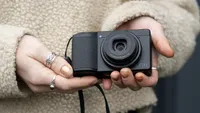
Ricoh has been slowly chiselling away at the GR formula for years, and with the GR IV, you can feel just how much the company has learned from the previous generations. In the hand, it’s still that unbelievably slim magnesium-alloy brick – somehow even a touch thinner than the GR III – and at 267 grams it all but disappears into a pocket. The handgrip is still small, of course, but it’s just enough to anchor the camera securely, and after a few minutes of shooting, I barely thought about it.

What I noticed immediately, though, was how much better the revised controls feel. Ricoh has brought back the plus/minus rocker from the older models, and honestly, I’ve missed it. It makes exposure tweaks so much faster when you’re working on instinct. The new rear e-dial is also a proper dial this time – not the odd pseudo-wheel from the GR III – and the press-to-ADJ action feels natural once you customise the five tiles. With 17 different options to choose from, you can pretty much tailor the camera to shoot exactly the way you want.
The move from a rear wheel to a navigator keypad also helps the camera feel more decisive. I liked having direct access to ISO, white balance, macro, and drive modes without diving into menus. There’s only one Fn button, but Ricoh lets you assign 37 different functions to it, so you’re hardly left wanting. The menus are still written in that slightly tiny Ricoh font – the brand stubbornly hanging on to this quirk, but the layout is at least clean and well structured across the five chapters. The touchscreen helps too, not just with AF point placement but also sliding through menus and reviewing images like you would on a smartphone.

As expected, there’s no built-in flash, and the optional GF-2 accessory flash remains a curious non-TTL unit. Personally, I think most GR users will skip it and use the hotshoe for one of Ricoh’s optical viewfinders instead, which genuinely suits this camera’s shooting style. Physical connectivity is minimal, just a USB-C port, but wireless options are more up to date now with dual-band Wi-Fi and Bluetooth 5.3 for the GR World app – handy for geotagging and remote control.

The fixed 7.62 cm LCD is the same panel as before, though the new Outdoor View Setting is a welcome addition when you're out in bright sun. You still get the option to display histograms, grids, highlight warnings and level indicators, and in playback, the 20- or 81-thumbnail view and dual histograms make reviewing images surprisingly deep for a compact. Ricoh has packed in a huge amount of useful editing tools too – Levels Compensation, White Balance Adjustment, Colour Moiré Correction, and even a proper post-capture parameter adjustment system that feels unusually powerful for such a tiny camera.
This all adds up to a camera that, once configured, feels very natural to shoot with. There are quirks, sure — it’s still a tiny camera with tiny buttons — but Ricoh has polished the experience enough that I stopped thinking about the compromises and just enjoyed shooting.
Performance

Performance is where the GR IV really starts to feel like a meaningful step forward. The updated hybrid AF system is simply quicker and more confident than before. It locks on faster, misses less, and even the tracking feels more secure – at least until you get major obstructions in the frame. The face and eye detection work well enough, and the various zone and pinpoint modes let you choose exactly how deliberate you want to be. And, of course, the GR’s secret weapon is still Snap Focus. Setting a distance and having the camera snap to it instantly with a full shutter press is as addictive and fast as ever.
Exposure is handled by a very capable 484-point metering system, and I found the highlight-weighted option particularly useful for keeping drama in bright outdoor scenes. The new Snap Distance Priority AE mode is clever too – letting you pick both a Snap distance and a depth-of-field profile and having the camera take care of the aperture. It’s a feature that feels like it was built for GR users specifically. With ±5 EV of compensation and three-shot bracketing, there’s plenty of control when you want it.


What surprised me most, though, was the impact of the upgraded five-axis stabilisation. Ricoh claims up to six stops of correction, and in practice it really does make the camera more resilient when shooting in low light. Paired with the new BSI sensor – which gives a more even brightness across the frame – the GR IV feels more capable at night than any previous GR.
Image quality is exactly what GR fans hope for: crisp detailing, smooth tonal transitions and plenty of dynamic range. Highlights in particular hold up beautifully. RAW files give you at least four stops of usable shadow recovery, which is impressive for such a small camera. The redesigned lens’s improved corner sharpness also pays off, giving the images a more polished look across the frame.
High-ISO performance is strong. According to the test shots, the GR IV looks almost unchanged from ISO 100 right up to ISO 6400, which is remarkable. You only start to see meaningful noise at ISO 12,800, and even ISO 51,200 keeps a surprising amount of detail intact. Sure, ISO 102,400 and 204,800 soften noticeably and colours start to fall apart, but they’re still usable when you absolutely need the shot. For an APS-C compact, this is impressive.


Continuous shooting remains modest at 4fps, and the camera captured 23 JPEGs in about 5.8 seconds in testing – perfectly fine for the kind of photography this camera is built for. Ricoh’s claim of a 25% faster start-up time seems believable, too; the camera jumps to life noticeably quicker, and the redesigned lens mechanism should also help reduce dust intake, which GR users will appreciate.
Video is still very much an afterthought – Full HD only, no AF tracking, no manual exposure, and limited mic control – but honestly, the GR has never been a video-first camera, and the GR IV doesn't pretend otherwise.
Overall, once I’d set the camera up the way I like to shoot, the GR IV felt fast, responsive, and instinctive. Ricoh has smoothed out many of the friction points from the Mark III, and the combination of the new stabilisation, BSI sensor, and autofocus improvements makes this the most capable GR yet when you’re moving quickly and reacting to the world around you.


Verdict
The Ricoh GR IV takes everything people love about the GR series – portability, sharp optics, discreet shooting – and improves almost every meaningful component. It isn’t perfect, and its video mode remains an afterthought, but for stills shooters the GR IV is a brilliant, pocket-sized photographic tool and the strongest GR model yet.
Features ★★★★☆ |
A significant upgrade with a new BSI sensor, redesigned lens and deeper storage while retaining the GR ethos. |
Design ★★★★☆ |
Compact, minimalist and refined, though still hampered by small controls and a fixed screen. |
Performance ★★★★☆ |
Superb image quality, stronger stabilisation and improved AF make it the best-performing GR yet. |
Value ★★★★☆ |
Premium pricing, but unmatched in size-to-performance ratio for APS-C street photography. |
Overall |
★★★★☆ |

Alternatives