Digital Camera World Verdict
I feel a bit like the LK Samyang / Rokinon AF 24-60mm f/2.8 FE gives with one hand and takes away with the other. I really like the generous wide-angle perspective at the short end of the zoom range, compared with most ‘alternative trinity’ standard zooms that only shrink to 28mm. I’m less happy about the meagre maximum telephoto reach. Even so, the zoom range makes this lens very versatile, especially as it’s backed up by a relatively fast and constant f/2.8 aperture. It does rely on automatic in-camera corrections but that’s nothing new among lenses that are designed for mirrorless cameras, with the aim of being compact and lightweight.
Pros
- +
Constant f/2.8 aperture
- +
Impressive performance
- +
Small, light and tough
- +
Refined handling
Cons
- -
Limited telephoto reach
- -
Lacks an aperture ring
- -
Relies on corrections
- -
Only Sony E (FE) mount
Why you can trust Digital Camera World Our expert reviewers spend hours testing and comparing products and services so you can choose the best for you. Find out how we test.
As they say, wait ages for a bus and then two come along at once. That’s not quite the case here but the wait hasn’t been overly long. I tested and reviewed the LK Samyang AF 14-24mm f/2.8 FE zoom lens (badged Rokinon in the USA) about six months ago. That was the first lens created as the result of a collaboration between the well-known South Korean LK Samyang company, and the legendary German optical pioneer Schneider-Kreuznach.
I was very impressed with the 14-24mm ultra-wide-angle zoom lens, not least because it’s conveniently compact and lightweight, yet punches well above its weight in terms of image quality and all-round performance. But I was left wanting more. That ‘more’ has now been served up by a second helping of Korean / German fusion, in the similarly diminutive shape of this 24-60mm f/2.8 zoom. It neatly picks up the baton in the handover from 14-24mm and 24-60mm zoom ranges, making it the ideal companion to the previously launched lens. All things considered, the new LK Samyang / Rokinon lens aims to be one of the best standard zooms on the market, as well as one of the best lenses for Sony full-frame E-mount cameras.

LK Samyang / Rokinon AF 24-60mm f/2.8 FE: Specifications
Mount options |
Sony E (FE) |
Lens construction |
14 elements in 11 groups |
Angle of view |
84.1 to 39.6 degrees |
Diaphragm blades |
9 |
Minimum aperture |
f/22 |
Minimum focus distance |
0.18m / 0.59ft (W) 0.32m / 1.05ft (T) |
Maximum magnification |
0.27x (W) 0.25x (T) |
Filter size |
72mm |
Dimensions |
78x102mm / 3.1x5in |
Weight |
494g / 17.4oz |
LK Samyang / Rokinon AF 24-60mm f/2.8 FE: Price
Think constant-aperture f/2.8 ‘trinity’ zoom lenses, and you’re probably thinking big bucks. That’s not always the case, though, and there have been cut-price options from a variety of camera manufacturers and third-party lens developers, with slightly alternative zoom ranges to the usual ’24-70mm’.
A very good example is the Tamron 28-75mm f/2.8 Di III VXD G2 for Nikon Z and Sony E (FE) cameras, which retails for around $849 / £649 / AU$1,249 . This LK Samyang / Rokinon lens has a similar launch price of around $899 / £635 / AU$1,209 . That’s potentially very good value as far as I’m concerned, following on from the LK Samyang AF 14-24mm f/2.8 FE which launched at a rather pricier $1,199 / £1,050 / AU$1,999.
LK Samyang / Rokinon AF 24-60mm f/2.8 FE: Design & Handling
Some say the best things come in small packages. I’m inclined to agree, especially if it means I don’t have to lug around a big, heavy and clunky lens hanging off the front of my slimline mirrorless camera. And let’s face it, standard zoom lenses excel for everyday photography, where you’re likely to rack up a fair few miles pounding city streets, trekking into the wilds or even flying to the ends of the earth.

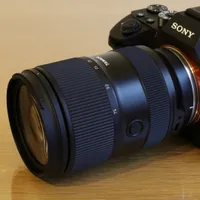
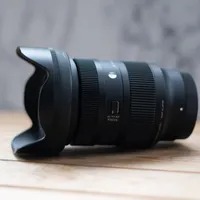
My simple equation for walkabout and travel photography is that smaller + lighter = better. And for an f/2.8 standard zoom, this one is definitely small and light, measuring a mere 78x102mm / 3.1x5in and weighing just 494g / 17.4oz. A telltale sign of the compact build (for a constant f/2.8 zoom) is that the lens has a 72mm thread. The companion 14-24mm f/2.8 ultra-wide-angle zoom has a 77mm thread. Sure, the lens physically extends by just under an inch at the long end of the zoom range but that doesn’t bother me at all. Check out the product shots above and below to see how the extension looks in practice.

To put its diminutive size into context, the Nikon Z 24-70mm f/4 S is an f/stop slower but the same width, pretty much the same weight and only half an inch longer – and that’s with the Nikon in its retracted rather than operational state. Although small, the LK Samyang packs no less than 14 elements, arranged in 11 groups. Specialist glass includes three aspherical elements, two ED (Extra-low Dispersion) elements and three HR (High Refractive index) elements. The aspherical elements help to cut down the overall size and weight as well as enhancing image quality, while the ED and HR elements aim to boost sharpness and clarity while reducing color fringing.

I have to say, the lens looks pretty splendid before you even get it out of the box. The retail carton really looks the business and is impeccably turned out, creating the impression that you’ve landed a high-quality item right from the get-go. Unpacking the lens is certainly no disappointment, as it has the same richly textured zoom and focus control rings that I enjoyed on the 12-24mm sibling lens. The manual focus ring is electronically coupled and works with smooth precision, with a nice tactile feel.

The zoom ring is situated towards the rear of the lens and falls neatly under the fingers and thumb. Again, it has a very tactile feel and pleasantly smooth action. As I’d expect, it’s calibrated with markings at various focal lengths, correlating to 24mm, 35mm, 50mm and 60mm focal lengths. I’m not put off by the reduction in maximum telephoto reach, compared with most alternative trinity standard zooms, which are typically around 28-70mm or 28-75mm. With these lenses, I really miss the extra wide-angle potential of a 24mm focal length, so I’m very pleased that the LK Samyang’s zoom range ‘comes up short’ in a good way.

I’ve seen plenty of lenses for mirrorless cameras recently that cut handling extras to the bone, in the pursuit of downsizing. Indeed, many prime lens examples have no switches or other moving parts at all, apart from the focus ring. I feel that the LK Samyang strikes a good balance. Yes, it’s small and light, but it does feature and AF/MF switch and a customizable function button. The switch saves the time and effort of resorting to in-camera menus when you need to make the change in a hurry, and the function button can come in really useful for the likes of AF-hold.

The designers have also managed to squeeze in a USB-C port on the side of the barrel. You can use this for applying firmware updates, as and when they become available. It’s a neat and tidy way of making sure that the lens keeps abreast of the latest features and any bug-fixes. One thing that’s lacking however, is an aperture control ring. Many photographers and most videographers find this useful, the latter also preferring a click/de-click that enables silent and stepless aperture control when shooting video. As with many lenses though, there’s no aperture control ring featured.

As I’ve mentioned, the lens stretches in physical length by just under an inch, as you zoom to its most telephoto setting. That’s certainly not uncommon, although it does raise a question mark over weather-proofing. A plus point is that the lens features a comprehensive set of weather-seals around all of its joints, focus mode switch, function button and mounting plate, and sports an IP5-level dust protection rating. Build quality is further enhanced by the lens being based on a strong aluminum frame and featuring an oil/moisture-repellant coating on its front element.

One thing to be award of when zooming is that the minimum focus distances stretches from 0.18m / 0.59ft (wide-angle) to 0.32m / 1.05ft (telephoto), so you need to be attentive when shooting extreme close-ups. The maximum magnification ratio remains pretty similar throughout the zoom range, from 0.27x (W) to 0.25x (T). The upshot is that close-up photography is certainly within the remit of this lens, along with a tight depth of field enabled by the f/2.8 aperture.

Little extras include a proper, printed instruction manual with text that’s actually big enough to read (and not to be taken for granted nowadays). The lens also comes with nicely engineered front and rear caps, and a petal-shaped hood. The hood has the usual bayonet-fitment and can be reversed for compact stowage. Similarly, the front cap has the typical pinch-action release mechanism, so you can fit or remove it with the hood in its front-facing orientation.

LK Samyang / Rokinon AF 24-60mm f/2.8 FE: Performance
The image quality of modern lenses for mirrorless cameras has become a game of two halves. In the pursuit of downsizing and weight-saving, the native optical prowess is certainly still a crucial factor, but it’s certainly not the whole story. Increasingly, lenses rely on automatic in-camera corrections for the likes of distortion and vignetting, or ‘Shading compensation’. It’s a trick that’s certainly not lost on this LK Samyang lens, and the automatic correction for distortion can’t be switched off in the camera menu.
Indeed, not only does the lens rely on in-camera corrections, but LK Samyang was quick to launch a free-to-download profile. The profile applies automatic corrections to RAW files when using Adobe Photoshop and Lightroom, taking care of distortion and vignetting.


The pair of shots above demonstrate the relative angles of view at the short and long end of the zoom range. As you’ll see, wide-angle coverage is generous. There’s not a massive difference in maximum reach, compared with a regular trinity 24-70mm f/2.8 lens.

Naturally, you can also flatter the performance of lenses in terms of sharpness and color fringing, with in-camera or software-based enhancements, the latter at the editing stage. Straight ‘out of the box’ performance in these areas is more of a crucial concern in my books, and I’m happy that the lens is crisp and sharp with minimal chromatic aberrations throughout its complete zoom and aperture ranges.

Another plus point is that the widest f/2.8 enables a tighter depth of field than when shooting with slower, variable-aperture lenses. As such, there’s more scope for throwing the background out of focus and isolating the main subject within scenes. The lens does well in this respect, and the quality of bokeh is pretty nice and smooth.

LK Samyang / Rokinon AF 24-60mm f/2.8 FE: Sample Images
The following gallery of example shots were taken in and around the ‘Underfall Yard’, a historic boat yard in the English city of Bristol. The weather was sunny and rainy at the same time – look out for rainbows!


LK Samyang / Rokinon AF 24-60mm f/2.8 FE: Lab Results
We run a range of lab tests under controlled conditions, using the Imatest Master testing suite. Photos of test charts are taken across the range of apertures and zooms (where available), then analyzed for sharpness, distortion and chromatic aberrations.
We use Imatest SFR (spatial frequency response) charts and analysis software to plot lens resolution at the center of the image frame, corners and mid-point distances, across the range of aperture settings and, with zoom lenses, at four different focal lengths. The tests also measure distortion and color fringing (chromatic aberration).
Sharpness:


Center sharpness is very good, even wide open at f/2.8, and stays consistently so through to f/11, throughout the focal range. Corner sharpness is a little disappointing, especially when you zoom in at f/2.8 - you'll need to stop down to f/5.6 to get the best corner-to-corner sharpness.
Fringing:

Chromatic aberration is fairly well controlled, just straying into visible territory at 35mm.
Distortion:

With automatic correction for distortion disabled when processing RAW files (it can't be disabled in-camera) extensive barrel distortion is revealed at 24mm, and it remains distracting at 35mm. Only at 50mm and longer zoom settings does distortion become mostly unnoticeable.
LK Samyang / Rokinon AF 24-60mm f/2.8 FE: Verdict
For everyday shooting and travel photography, I like lenses to be compact and lightweight. But I also like the relatively fast and constant f/2.8 aperture ratings of ‘trinity’ zoom lenses, which tend to be bigger, heavier and more expensive. This LK Samyang standard zoom puts ticks in a whole bunch of boxes, winning me over along the way. It has very good build quality and handling, delivers impressive image quality (albeit with automatic in-camera corrections) and is very good value at the price. I’m really happy using it on my Sony Alpha camera but I just wish it was also available in other mount options.
Features ★★★★★ |
The fast and constant f/2.8 aperture rating is a key feature, but there are also some nice handling extras including an AF/MF focus mode switch and customizable function button. |
Design ★★★★☆ |
The design lacks an aperture control ring that many hybrid photographers (especially) favor these days, but the lens is compact, lightweight and strongly built. |
Performance ★★★★☆ |
Image quality is very impressive although that’s thanks in no small part to automatic in-camera corrections for aberrations. |
Value ★★★★★ |
The lens is massively more affordable than regular ‘trinity’ lenses, and a better fit for slimline mirrorless cameras in terms of size and weight as well. |

Alternatives