Digital Camera World Verdict
I’m a sucker for a bargain, and the Meike 35mm f/1.8 Pro AF lures me in with its highly competitive selling price. Even so, it features an aperture control ring, fast and virtually silent autofocus, weather seals, and comes complete with a petal-shaped hood. Image quality is mostly very good, but edge/corner-sharpness could be better at wide apertures.
Pros
- +
Aperture control ring
- +
Fast, virtually silent AF
- +
Weather-seals
- +
Budget price tag
Cons
- -
No iris lock switch
- -
No click/de-click switch
- -
Mediocre edge-sharpness at wide apertures
Why you can trust Digital Camera World Our expert reviewers spend hours testing and comparing products and services so you can choose the best for you. Find out how we test.
Everybody loves a 35mm prime, right? It’s certainly one of my favorite types of lenses for walkabout, travel, and street photography, delivering a natural but moderately wide perspective with a full-frame camera. I feel that this Meike strikes a good balance between a fairly fast but not overly rapid f/1.8 aperture rating, enabling a pretty compact size and light weight. On the face of it, the lens also looks excellent value for money.
So who is Meike anyway? The company is based in Hong Kong, currently comprising 30 technicians and 200 production personnel, running multiple production lines, a dust-free workshop, and a test lab for lens manufacture, headed with the slogan ‘realize your vision’. Like other Chinese lens manufacturers, the overall aim is to deliver quality goods at bargain prices. As such, the full-frame compatible Meike 35mm f/1.8 Pro AF lens that I’m reviewing here aims to be one of the best lenses for Nikon Z cameras and one of the best lenses for Sony E-mount cameras. Well, if not the outright best, then at least one of the best-value options.

Meike 35mm f/1.8 Pro AF: Specifications
Mount options |
Nikon Z (FX), Sony E (FE) |
Lens construction |
12 elements in 10 groups |
Angle of view |
64.8 degrees |
Diaphragm blades |
9 |
Minimum aperture |
f/16 |
Minimum focus distance |
0.35m |
Maximum magnification |
0.13x |
Filter size |
58mm |
Dimensions |
74x93mm / 2.9x3.7" |
Weight |
400g / 14oz |
Meike 35mm f/1.8 Pro AF: Price
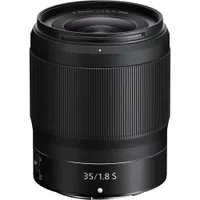
The price tag hanging off this fairly feature-rich 35mm prime lens is $379 / £319 / AU$573. That compares very favorably with own-brand options like the Nikon Z 35mm f/1.8 S at $897 / £799 / AU$1,399 and the Sony FE 35mm f/1.8 at $848 / £539 / AU$989. The Meike certainly looks like a bargain at the price, considering that it comes complete with a dedicated aperture control ring, weather seals, and other finery, although naturally it all comes down to image quality and all-around performance.
Meike 35mm f/1.8 Pro AF: Design & Handling
What do you really expect from a ‘pro’ lens nowadays? The badge seems to be bandied about very liberally and is generally best taken with a pinch of salt. Even so, this Meike prime looks the part, to some extent at least. Sure, it ‘only’ has an aperture rating of f/1.8 rather than f/1.4 or even f/1.2, but that’s generally fast enough as I’m concerned, and I prefer a compact and lightweight build for a 35mm lens, especially for the likes of street photography and walkabout shooting. The Meike certainly obliges in this respect, measuring a dinky 74x93mm / 2.9x3.7" and weighing in at a mere 400g / 14oz. That makes the lens very easy to live with.

Sneak in behind the front element of the lens, shown above, and you’ll discover a fairly complex optical path comprising 12 elements arranged in 10 groups. These include two aspherical elements, which are claimed to minimize aberrations and improve image quality, along with three ED (Extra-low Dispersion) elements with the aim of enhancing clarity and reducing chromatic aberrations. Nano-structure multi-layer coatings are also on hand to minimize ghosting and flare.

Naturally, sharpness in practice boils down to the performance of the autofocus system just as much as the quality of the glass. The Meike scores highly here, with a fast and virtually silent system that’s based on the combination of NanoDrive and a linear stepping motor. As well as being designed to keep up with fast-paced action in stills photography, the lens also boasts minimal focus breathing when shooting video, and is advertised as having sufficient resolving power for capturing 8K footage.

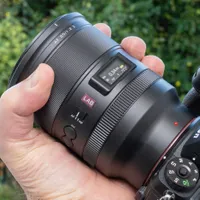
Towards the rear of the lens barrel is an aperture ring with calibrated markings at one-third f/stop increments from f/1.8 down to the narrowest aperture of f/16. Beyond this is the Auto position, for controlling the aperture from the host camera body. The aperture ring is good news up to a point, but it lacks a switch for locking the ring in its Auto position, and there’s also no switch to enable a click/de-click facility, the latter of which would be more ideal for video capture. The aperture itself is based on a 9-blade diaphragm, which is pretty well-rounded.

Unlike many own-brand ‘budget’ lenses from camera manufacturers, the Meike is supplied complete with a hood. It’s an efficient, petal-shaped hood at that, with the typical bayonet fitting that’s reversible for compact stowage.

As usual, the hood is actually dual-purpose. It helps to reduce stray light entering the lens from oblique angles, thus reducing the danger of ghosting and flare. And it also provides physical protection to the front element of the lens, lessening the risk of it picking up scrapes and knocks.

As I’d fully expect in a ‘pro’ lens, the Meike features a metal rather than plastic mounting plate. Not only that, but it has a rubber weather-seal gasket around its circumference, to minimize the ingress of moisture and dust. There’s also a USB-C socket, which you can use to apply firmware updates if and when they become available.
Meike 35mm f/1.8 Pro AF: Performance
How sharp do you like it? I tested the Meike with a high-res 45.7MP Nikon Z8, which puts a spotlight on the resolving powers of any lens. I found that the Meike was super-sharp in the central region of the image frame, even when shooting wide-open at f/1.8. That’s reinforced by the consistent accuracy of the autofocus system. In the region between the middle and edges of the frame, sharpness is still very good wide-open and excellent at apertures between f/2.8 and f/8. However, extreme edge/corner-sharpness is relatively disappointing at wide apertures between f/1.8 and f/2.8, and it pays to stop down to between f/5.6 and f/11 for best results in this respect.

Color fringing can also be a little noticeable away from the center of the frame at f/1.8, and becomes a little worse as you stop down through the aperture range. That said, the actual amounts of color fringing certainly aren’t severe, and are easily within the remit of automatic in-camera corrections featured in both Nikon and Sony bodies. The same goes for vignetting at wide apertures and barrel distortion throughout the range, the latter of which I’ll come to in ‘lab results’ below.

As with any fast lens, the quality of bokeh is often considered to be equally important as sharpness and other attributes of image quality. The widest aperture of f/1.8 enables a fairly tight depth of field, despite the moderately wide-angle focal length of 35mm, especially when shooting close-ups. Bokeh is nice and smooth, with a natural roll-off between focused and defocused areas within images.
Meike 35mm f/1.8 Pro AF: Sample Images
The gallery below comprises sample images taken in and around Isambard Kingdom Brunel’s SS Great Britain, ‘the ship that changed the world’. A revolutionary vessel that was iron-hulled, steam-powered, and propeller-driven, she was launched in 1843, eventually scuttled on the Falkland Islands in 1936, then towed some 8,000 miles back to her birthplace in Bristol in 1970, where she has undergone meticulous restoration and is currently a major tourist attraction, floating on a ‘glass sea’ in dry dock.


Meike 35mm f/1.8 Pro AF: Lab Results
We run a range of lab tests under controlled conditions, using the Imatest Master testing suite. Photos of test charts are taken across the range of apertures and zooms (where available), then analyzed for sharpness, distortion and chromatic aberrations.
We use Imatest SFR (spatial frequency response) charts and analysis software to plot lens resolution at the center of the image frame, corners and mid-point distances, across the range of aperture settings and, with zoom lenses, at four different focal lengths. The tests also measure distortion and color fringing (chromatic aberration).
Sharpness:

Center-sharpness is very good even wide-open at f/1.8, and is excellent in the f/2.8 to f/5.6 sector of the aperture range. In the mid-region between center and edge, sharpness comes on strong at f/2.8. However, edge/corner-sharpness is relatively lackluster at wide apertures and you need to stop down to f/5.6 for images to be really crisp around the edges.
Fringing:

There’s slight color fringing away from the central region of the frame at f/1.8 and it gets gradually worse at the edges as you stop down throughout the aperture range. On the plus side, it’s not particularly bad and the automatic in-camera correction of Nikon and Sony bodies fixes the issue completely.
Distortion: -2.88
Barrel distortion can be noticeable but, as with color fringing, automatic in-camera correction can take it out of the equation. Unlike many modern lenses designed for mirrorless cameras, in-camera correction for distortion isn’t ‘forced on’ and the Meike is perfectly usable with the correction disabled.
Meike 35mm f/1.8 Pro AF: Verdict
I like that the Meike 35mm f/1.8 Pro AF is reasonably compact and lightweight, yet robustly built with the inclusion of weather seals. Center-sharpness is impressive throughout the aperture range, even when shooting wide-open, although edge-sharpness leaves something to be desired at apertures wider than f/5.6. All in all, image quality is very pleasing, backed up by fast and consistently accurate autofocus. It’s a stretch to call it a ‘pro’ lens, but the Meike is certainly an appealing prime at a very attractive price.
Features ★★★★½ |
Leading features include a fairly fast f/1.8 aperture, fast NanoDrive/STM autofocus and a dedicated aperture control ring. |
Design ★★★★☆ |
The design strikes a good balance between compactness and lightness of weight, with a robust and weather-resistant construction. |
Performance ★★★★☆ |
Autofocus is quick, virtually silent and consistently accurate. Center-sharpness is impressive but wide-aperture edge-sharpness is lackluster. |
Value ★★★★★ |
All things considered, the Meike is great value at the price. I wouldn’t call it a truly ‘pro’ lens but you get a lot of bang for your buck. |

Alternatives