Digital Camera World Verdict
The Sony 70-200mm f/2.8 GM OSS II puts the workhorse in a lighter body, creating a highly versatile lens that doesn't feel like an arm workout. I'm impressed by the lens' design, sharpness, and autofocus performance. I was delighted to be able to catch a bit of golden hour flare, but lens flare is less attractive coming from a mid-day sun. My biggest complaint? There's a steep price difference in the Gen II over the original.
Pros
- +
Sharp subjects mixed with lovely bokeh
- +
Highly versatile zoom range
- +
Autofocus keeps up with action
- +
Much lighter than predecessor
Cons
- -
Pricey
- -
Issues with strong flare
Why you can trust Digital Camera World Our expert reviewers spend hours testing and comparing products and services so you can choose the best for you. Find out how we test.
The f/2.8 workhorses are widely loved, but putting an ultra-bright aperture inside a pro-grade zoom tends to create a heavy optic. When Sony reimagined its popular GM Series 70-200mm, however, it shaved off nearly a third of the weight. The Sony 70-200mm f/2.8 GM OSS II continues the GM series’ legacy of sharpness and speed, but in a form factor that feels less like a workout.
I spent some time photographing portraits and action with the Sony 70-200mm f/2.8 GM OSS II – and found a few surprises.
Sony 70-200mm f/2.8 GM OSS II: Price
Sony’s GM series optics are high-end pro lenses – and they tend to have a price to match. The Sony FE 70-200mm f/2.8 GM OSS II is no exception.
In the US, the lens lists for $3,148 – which is $1,000 more than the price of the first-generation lens, which remains available.
In the UK, the lens retails for £2,600, while the older model can be found for around £1,939. In Australia, the lens lists for AU$3,499. Canadian retailers sell the lens for around CA$3,499.
Sony 70-200mm f/2.8 GM OSS II: Specs
Aperture |
Maximum f/2.8, minimum f/22 |
Mount |
Sony E |
Coverage |
Full frame |
Angle of view |
34° to 12° 30' |
Minimum focus distance |
15.7" / 40 cm |
Design |
17 elements, 14 groups |
Aperture blades |
11, rounded |
Stabilization |
Yes |
Autofocus |
Yes |
Tripod collar |
Removable, rotating |
Filter size |
77mm |
Dimensions |
3.46 x 7.87" / 88 x 200 mm |
Weight |
2.3 lb / 1045 g |
Sony 70-200mm f/2.8 GM OSS II: Build

When I first pulled the Sony 70-200mm f/2.8 GM OSS II out of the box, my first thought was how light the lens is. Zoom lenses with bright f/2.8 apertures tend to be on the heavy side. The 70-200mm won’t be mistaken for a prime, but it’s lighter and smaller than I expected for a telephoto workhorse. The lens is 2.3 lbs / 1045g, which is around 30 percent lighter than the first-generation optic.
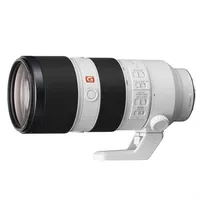
Despite being lighter than I expected, the lens takes on a classic telephoto look, including an off-white finish. The lens's design is a classic take that Sony fans will be able to jump into quickly. The lens is an internal zoom, which means the length of the lens doesn’t change as you zoom.

Let’s take a tour of the lens, starting from the mount. There’s a tripod collar with a removable foot.
Next, there’s a bank of control switches. The line of switches includes controls for manual to auto focus, full-time DMF on/off, a focus limiter, a stabilization on off switch, and a stabilization mode switch. On the opposite side of the lens, there’s a switch to turn the aperture ring on and off. The only feature I was slightly disappointed by on those switches is that there’s no close-up option on the focus limiter, just full and 3m to infinity.

Next is the labeled aperture ring, followed by a grippy zoom ring. A set of shortcut buttons sits on the stretch between the zoom and focus rings.
Sony includes a lens hood – and it does have a door for accessing adjustable screw-in filters such as circular polarizers and variable NDs.

As part of the GM series, the lens is weather-sealed. I took the lens out in some pretty steady snowfall – twice. I dried everything off when I came in and didn’t experience any issues from being out in the snow.
Sony 70-200mm f/2.8 GM OSS II: Performance

To test the 70-200mm f/2.8 OSS GM II’s autofocus, I enlisted the help of the fastest athlete in my family: my dog. To make the test even more challenging, considering this is most certainly a pro-level lens, I also did this test as snow was falling.
The lens, mounted on the A7R V, impressively managed to get even shots of the dog leaping in mid-air in focus. The focus continued to perform well even as he ran towards the camera. While there were a handful of softer shots in the mix, I had a good number of sharp shots to choose from until the focus dropped off as the dog got too close to the lens.


The 70-200mm lens can focus as close as 15.7 inches / 40 cm from the front of the lens. Mixed with the length of glass, that creates some nice close-ups, though of course the 0.3x magnification ratio doesn’t encroach on macro capabilities. I appreciated the full-time Direct Manual Focus, which let me quickly pull the focus ring if the autofocus didn’t lock on to the correct object – though I did wish the focus limiter switch had one more setting for close shots.
The Sony 70-200mm f/2.8 GM OSS II is sharp enough that I can make out the individual details of snowflakes landing on a portrait subject. In this shot here at f/2.8, the autofocus is on the eye, not the snowflake, so it’s just out of focus but still impressively detailed.

Similarly, I found even the corners and off-center subjects have a nice level of sharpness.
On the flip side, the mix of a maximum 200mm focal length and f/2.8 aperture combines for some lovely soft bokeh. Bokeh balls are typically rendered round with soft edges, but the brightest points of light can take on a harder edge and more texture.

Pincushion and barrel distortion are mild. At 200mm, there’s a very slight bend to straight lines that I wouldn’t have been able to spot without a test chart. This distortion is slightly better at 70mm.
Chromatic aberration is well controlled. I didn’t spot any annoying colored fringing in my tests.
Many Sony lenses that I’ve used in the past have heavily suppressed flare, so I was a bit surprised to find that I could actually create some lens flares with this lens. Flare is rather subjective, but I tend to be a pro-flare photographer. At golden hour, the lens creates a nice streaky warm glow.

But, directed towards a much harsher sun, the flare becomes purple and green rather than gold, and there are some occasional ghosting spots.


The ability to create flare and the long focal length can present issues if directing the lens directly towards the brightest light sources, like midday sunlight, however. At 100 percent, the harsh flares created lines running through the image. This isn’t necessarily an issue with the lens, but something that happens on cameras with PDAF autofocus sensors when bright light reflects off of the pixels reserved for autofocus.
The reflected light off those lines of autofocus sensors creates lines running through the brightest flares. I only spotted this with the brightest light sources and not at golden hour, but photographers working with a midday sun will want to take care not to direct the lens straight at the sun.
Sony 70-200mm f/2.8 GM OSS II: Image Samples


Sony 70-200mm f/2.8 GM OSS II: Verdict
In some ways, the Sony 70-200mm f.2.8 GM OSS II lived up to everything that I’ve come to expect from Sony’s GM lenses, but, in others, I found a few surprises.
The good? The lens feels much lighter than a typical 70-200mm. Sharpness is solid, even towards the corners. Distortion and chromatic aberration are kept to a minimum. The lens seemed to keep pace with the autofocus quite well, with only a handful of misses with the fastest action.
The bad? The high-end lens comes with a high price tag to match. The lens lets in some flare – which I love at golden hour, but can create some occasional issues shooting at midday, including PDAF artifacts and flares that take on a more green and purple coloring. The use of a two-position autofocus limiter switch instead of three is also mildly disappointing.
Alternatives