



Digital Camera World Verdict
A new film compact that performs the basics well enough, the Kodak Snapic A1 adds a few quality-of-life features to justify a higher price tag than standard point-and-shoots, like automatic film winding and a top LCD screen. However, the fundamental photographic experience is unchanged, with no manual settings control, which means that you are paying a somewhat significant premium for benefits that are mostly cosmetic.
Reasons to buy
- +
Very slim and easy to carry
- +
Affordable price tag
- +
Auto film wind and rewind
- +
3-element glass lens is decent
Reasons to avoid
- -
Fixed exposure settings
- -
Doesn’t function at all without battery
Why you can trust Digital Camera World Our expert reviewers spend hours testing and comparing products and services so you can choose the best for you. Find out how we test.
Arriving at the tail-end of 2025, the Kodak Snapic is a cheap and unfussy analog camera, clearly pitched towards tempting newbies to the fun of film photography. With fixed exposure settings, it is the definition of point-and-shoot, but manages to find room for some fancy extra features, like automatic film winding and two-zone focusing.
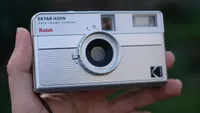
Comparisons are easy to draw with another cheap point-and-shoot member of the Kodak family, also made by Reto Project – the popular Kodak Ektar H35N. However, the Snapic A1 is twice the price in more ways than one. It comes with an initial price tag of $99 to the Ektar H35N’s $52, and it’s full-frame, rather than the Ektar H35N’s economical half-frame. This means you get the usual 36 full-size shots out of a roll of 36, rather than 72 half-size ones.
So, to be worth the buy over the Ektar H35N, the Snapic A1 really needs to be twice as good. Or, indeed, four times as good. Is it? I took it for a walk to find out…

Kodak Snapic A1: Specifications
Type |
Point and shoot analog camera |
Film format |
35mm |
Lens |
25mm, 3-element glass |
Aperture |
f/9.5 |
Shutter speed |
1/100sec |
Viewfinder |
Optical |
Flash |
Yes |
Dimensions |
118 x 62 x 35mm |
Weight |
117g |
Battery |
2x AAA (not included) |
Price & Availability
As mentioned, the Kodak Snapic A1 is available for a flat starting price of $99 / £99. You’ll need to spring a little extra for a couple of AAA batteries, as these don’t come included – as well as, of course, some film. Though you do at least get a nice little rope-style strap and a carrying pouch to keep the camera safe, which is handy, as there’s no lens cap. It’s available in two colors: Rhino Gray and Ivory White (the model pictured here is the latter).
Build & Handling
The box-like design of the Snapic A1 calls to mind – no doubt intentionally – its 1970s semi-namesake, the Kodak Pocket A1. There is a raised and textured ridge on the right-hand side, and the slim body is nicely pocketable – I found it slotted rather well into an inside jacket pocket, with the generously sized strap looped around my neck.
As you’d expect from a camera at this price, it’s cheap plastic through and through. This keeps it light, but means it doesn’t feel particularly robust. The camera is powered by a pair of AAA batteries, and unlike some point-and-shoots like the Ektar H35N, these are mandatory. Whereas the Ektar only uses the battery to power its flash, and can rattle through a roll of film just fine without one, the Snapic A1 needs to be powered up to do anything at all. If your batteries die, your day’s shooting is done.


So, what are these batteries actually powering? Well, not any kind of settings control, so put that thought away right now – the Snapic A1 shoots at 1/100sec and f/9.5, and that’s your lot. However, it does offer a number of neat extra features, including automated film winding and rewinding. Once you’ve hooked your film correctly into the take-up spool, the camera will nudge it along independently after each exposure, and wind it back into the canister when the roll’s done. I can’t honestly say that I’ve ever found winding and rewinding film to be a massive hardship, but still, nice to have.

There’s a top LCD that displays a shot counter, flash mode and focus setting. Focusing comes in two flavors – close-up and scenic – and can be changed with a flick of the switch under the lens. The shutter button is big, orange and unmissable on the top, and there’s also a mode switch on the left hand side. This is used for toggling flash settings and for activating the Snapic A1’s multiple-exposure mode, which lets you expose a single frame of film twice for creative effects.

Performance
I can admit I was a little disappointed when I realised the Snapic A1 was going to be a fixed-settings affair. It has the trappings, trimmings and price of a more premium compact point-and-shoot, but in practice it’s not really any different in use from a cheap disposable-style camera.
Still, it performs well enough. The three-element lens produces images with solid levels of clarity and detail. I can’t say it’s radically better than other point-and-shoots I’ve used, but it’s reliable enough that you’ll get a high percentage of keepers, and there’s also none of the pronounced vignette that can plague cheaper cameras.
Activating the multiple-exposure mode is a bit of a headache – I had to read the instructions a few times to get my head around it. First, you hold down the flash-mode button, which is labelled ‘M.E.’. Then you take your first exposure. Then, you slide the multiple-exposure lever, which is located in a different spot near the shutter button, and is also labelled ‘M.E.’. Then you take your second exposure. I’m not a product design guru, but I think when you’re giving two separate buttons the same label, something’s gone a bit wrong in your process.
Besides, once you’ve done all that, your multiple exposure will quite possibly come out as a blown-out mess anyway, since you can’t meter down to compensate for the fact that you’re exposing the same frame twice.
Sample images
The following images were taken using AgfaPhoto Color 400 film, using the Kodak Snapic A1, on a sunny day in early January. They were shot at the camera’s fixed settings, and developed as normal using the C41 process.


Verdict
The Kodak Snapic A1 is a perfectly fine point-and-shoot camera. But comparing it to other, cheaper point-and-shoots makes me feel like someone is trying to upsell me a fancy cake where all they’ve done is add extra icing and flowers, without changing the underlying sponge.
Tortured metaphor? Maybe (yes). But is an LCD-screen shot counter really so much better than an analog one? Is automatically winding film massively more convenient than simply nudging it along myself? These things are nice to have, sure. But they don’t change the fact that I could pick up something like a Yashica MF-1 or a Kodak M38 for less than half the price of this camera, and my experience would not be all that different. It’s also worth reiterating that all these fancy features mean the Snapic A1 becomes a brick when the batteries die – unlike many comparable point-and-shoots, which can capture images without power.
Overall, the Kodak Snapic A1 is a perfectly fine travel compact for analog shooters – but one that slightly struggles to justify its higher price than others on the market.
Should you buy the Kodak Snapic A1?
✅ Buy it if…
- You want a slim, pocketable compact
- You’re budgeting less than $100
- You want something easy to use
⛔️ Don't buy it if...
- You want manual settings control
- You want the cheapest compact around
Alternatives