



Digital Camera World Verdict
The newer model of Kodak's H35 has a noticeably improved lens that increases my hit rate. It's lightweight, affordable, and its ability to double shots from a roll feels like a real saving. The extra features, like the star filter, might be gimmicky, but I enjoyed them. This camera prioritizes fun over perfect image quality, and I'd love to see more features like this in the next Ektar.
Reasons to buy
- +
Very easy to use
- +
Doubles shot count of 35mm film
- +
Lightweight and pocketable
- +
Genuine improvement on Ektar H35
Reasons to avoid
- -
Annoyingly stiff flash ring
- -
Fixed exposure settings limit film choice
Why you can trust Digital Camera World Our expert reviewers spend hours testing and comparing products and services so you can choose the best for you. Find out how we test.
The original Kodak Ektar H35 was a bold attempt at making film photography at least somewhat affordable. Costing just $50 new, it allowed you to squeeze more value out of a roll of 35mm film by dividing its frames in half. So, instead of 36 shots measuring 24x36mm from a standard roll, you’d get 72 shots measuring 24x18mm. This was not a new concept, but it had fallen out of vogue, and the Kodak Ektar H35 proved a modest hit among cash-strapped analog enthusiasts.
An updated version swiftly followed: the Kodak Ektar H35N. At first glance essentially identical, the H35N nevertheless comes with a few extra features, probably the most interesting of which is the upgraded two-element lens, including a glass element and an aspherical acrylic element. Elsewhere, we get a tripod socket, a bulb mode for the shutter release, and a new ‘star’ filter for creating dramatic points from strong light sources.
I reviewed the original Kodak Ektar H35 in 2023, and have kept it in occasional rotation since then. My opinion hasn’t changed massively since (though I do think that 3.5-star rating was perhaps a little generous) – it’s a fun and easy camera to use, but the image quality is pretty average. So, I’m interested to see if the new lens means the Kodak Ektar H35N is a noticeably better performer.

Specifications
Type |
Point and shoot analog camera |
Film format |
35mm (half-frame) |
Lens |
22mm |
Aperture |
f/8 (with flash), f/11 (without flash) |
Shutter speed |
1/100sec |
Viewfinder |
Optical |
Flash |
Yes |
Size |
110 x 62 x 39 mm |
Weight |
110g |
Battery |
1x AAA (for flash only; not included) |
Price & availability
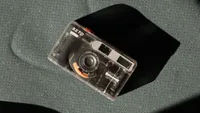
The Kodak Ektar H35N can currently be picked up for around $52 / £67, making it one of the cheapest 35mm film cameras around (of course, the film itself is an ongoing cost). This is a small increase from the original Ektar H35, which debuted at $49 / £50, though not enough to make a fuss about. It’s available in a wide range of colors, including: Striped Black, Striped Green, Striped Silver, Glazed Orange, Glazed Blue, Glazed Pink, and a pinky-blue ‘BT21 Edition’, which I believe is a KPop thing.
Build & handling

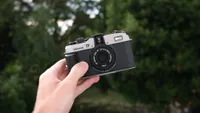
Were I a lazier sort, I could basically copy and paste my comments on build and handling from the original Ektar H35 review, since the two really do look and feel almost exactly the same. The Kodak Ektar H35N is a plastic box with rounded corners and very few controls. Film is loaded in the back, there’s a shutter button on top, and a twisting lens ring to activate the flash. It’s not what you’d call ergonomic, and doesn’t feel particularly robust, but it’s lightweight and pocketable.

When I used the original Ektar H35, the elastic on the protective pouch broke immediately and the flash stopped firing after a single shot. Neither of those things happened this time, so either my luck has improved, or Kodak brand licensee Reto Project (who manufactures this camera) has tightened up its quality control.
In terms of new features, the Ektar H35N now has a screw thread on the base for a tripod mount, and a socket on top for a cable release – both included to facilitate the use of the newly added bulb shutter mode for long-exposure shots. I’ll admit I’m not sure who exactly this is for – it’s hard to imagine a person who owns both a cable release and a tripod, but has no better options for long exposures than the Kodak Ektar H35N.

Nevertheless, new features are always welcome. The other new control is the switch for the star filter, located on the lens ring. Flick it up to create a ‘four-beam flare’ when photographing strong light sources.

The Kodak Ektar H35N is very easy to load and use, befitting its status as a beginner-friendly film camera. The only real annoyance I found was that the flash ring was bizarrely stiff, requiring a forceful, two-handed wrench to activate and deactivate.
Performance
Having reviewed my images from the Kodak Ektar H35N alongside some of my older shots from the original Kodak Ektar H35, there’s really no contest. The new glass element hasn’t radically transformed the camera into an ultra-sharp SLR-beater, but I definitely came away with a much higher rate of keepers.
As I mentioned in my review, the previous camera was essentially incapable of shooting into the light – you just ended up with a blown-out blurry mess. This time, I shot a couple of backlit images and they came out quite nicely. Indeed, I felt overall that the improvement in quality meant the camera better fulfilled the value-for-money promise of a half-frame camera. Getting 72 shots out of a 36-shot roll may sound cool, but it doesn't mean much if half of them are muddled, soupy clunkers.
It still has many of the same restrictions. The fixed exposure settings limit your choice of film – I wouldn’t go below ISO 400 unless you’re going to be exclusively shooting in very bright daylight. You have to key yourself into the idea of shooting in a vertical aspect ratio, and remain aware that the view through the viewfinder isn’t necessarily a very representative view.
Really, with this camera, you need to let go and have fun. It’s not one for pixel-peepers (or their analog equivalent), it’s not one for those who obsess over the corner sharpness of lenses – which is good, because this lens doesn't have any. Indeed, Reto Project has leant further into this with the addition of the star filter, which I actually found rather charming. Find a strong light source and the effect is indeed very pronounced.
Sample images
These images were all shot with the Kodak Ektar H35N, on Kodak Ultramax 400 film, on a sunny day in December. They were developed at box speed, and are unedited.


Verdict
In retrospect, I do think my 3.5-star rating for the original Ektar H35 was a little generous – I think I was just happy to see someone out there actually trying to make film photography more affordable. I’m more comfortable awarding the same rating to this newer camera (maybe let's retroactively downgrade the original to a 3).
It’s a fairly minor overhaul, but the upgraded lens did make a tangible difference to my hit-rate. It’s lightweight and easy to carry, with a low asking price, and its improved quality means that its ability to double the shots from a roll of film feels more like a genuine saving.
The extra features like the star filter may be a bit gimmicky, but sue me, I enjoyed it – and after all, this is a camera that firmly puts fun first, pristine image quality second. Frankly, I’d be happy to see more such gimmicks on the next Ektar camera.
Should you buy the Kodak Ektar H35
✅ Buy it if…
- You want a cheap film camera for travel and fun
- You want an easy camera to use
- You're on a budget
⛔️ Don't buy it if...
- You want super-sharp images
- You want to take manual control of settings
Alternatives