Digital Camera World Verdict
Not quite as new as it appears, Kodak Kodacolor 100 is a perfectly fine daylight-speed film that bears a marked resemblance to previous Kodak stocks – hence the firm’s bet-hedging of calling it a ‘sub-brand’. It’s nice and soft, with colors that are pleasant and naturalistic, but the reality isn’t quite as exciting as it first seemed.
Pros
- +
Produces pleasant, naturalistic, soft results
- +
Fairly affordable, especially in the US
- +
Grain is perceptible, but subtle
Cons
- -
Not a real new film
- -
Highlights can glare a little
Why you can trust Digital Camera World Our expert reviewers spend hours testing and comparing products and services so you can choose the best for you. Find out how we test.
Eastman Kodak is once again selling its own film! Or so said the surprise announcement on Instagram a couple of months ago. Following the firm’s bankruptcy procedures in 2013, the arrangement had been that Eastman Kodak produced the film, while a separate entity called Kodak Alaris held the rights to distribute and sell it. With this news, it seemed that Eastman Kodak had got some of its distribution rights back under control, and that perhaps we’d see film prices start to come down.
The news was heralded with the announcement of two new stocks – Kodak Kodacolor 100 and Kodacolor 200. Here, we’re focusing on Kodak Kodacolor 100, a daylight-speed film, once considered medium speed but by modern standards fairly slow at ISO 100. It’s reasonably affordable, and produces naturalistic colors with a medium to fine grain.
Are we at the beginning of a new era? Can this really be the first truly new Kodak film in decades? Well… sort of. We’ll get into it. For now, let’s load up Kodak Kodacolor 100 and take it for a spin to see how it performs.

Kodak Kodacolor 100: Specifications
Brand |
Kodak |
Introduced |
2025 |
Type |
Color negative |
Speed |
100 |
Process |
C41 |
Format |
35mm |
Price & Availability
Kodak Kodacolor 100 seems to vary quite a bit in price by region – in the US it’s priced at $8.99, while in the UK it’s around £15, and in Australia it’s about AU$18. Still, it seems to have arrived at UK shores first, as it’s available now at UK retailers, while in the US and Australia it’s listed as ‘Coming Soon’.
In the US, it’s a pretty cheap film. Elsewhere, it’s more mid-tier – Kodak Ultramax 400 and Colorplus 200 are routinely less expensive.
Performance
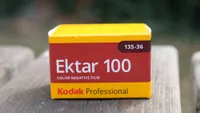
Kodak has been a little opaque on what exactly these new Kodacolor films are, describing them as ‘sub-brands’ (?) of ‘existing Kodak films’. Which films do they mean? They’ve declined to tell us, but given that Kodak only distributes a couple of ISO 100 color-negative films, the list of candidates is short. First, there’s Kodak Ektar 100, which this film is definitely not. And then there’s Kodak Pro Image 100. Pro Image is a cheap daylight film with saturated colors, which sounds a lot like Kodacolor 100. Accordingly, there’s been a lot of speculation in the film community as to whether Kodacolor 100 is a tweaked version of Pro Image 100 – or, indeed, is exactly the same as Pro Image 100.
Having reviewed my images alongside previous rolls I’ve shot of Pro Image 100, I don’t think the two are identical – and other online analysis seems to bear this out. Pro Image 100 appears a touch warmer, with stronger red tones, while Kodacolor 100 is a little cooler. With that said, they are certainly very similar, and if you’ve shot and not cared for Pro Image 100, I don’t think Kodacolor is necessarily going to rock your world.

Some have also speculated that Kodacolor 100 is a rebadged version of an older film called Kodak VR 100, and that it is therefore basically the same as Lomography 100, which is widely alleged to also be rebadged VR 100. I haven’t used either, so I can’t comment.
But enough time in the rumor mill – how was Kodacolor to shoot? Overall, I came away quite pleased with my results. I felt like I didn’t really get to shoot the film in its ideal environment; one gets the sense that Kodak Kodacolor 100 would prefer a warm, vibey evening to soak up the sunlight. The problem, dear reader, was that it was December in the United Kingdom, and a warm vibey evening was not an option. I had the single morning of the week when it was not forecast to rain. And besides, we can hardly judge a film solely on how it performs in ideal conditions.
The film is nice and soft. Colours are saturated without being over-bright, and it generally gives a fairly true-to-life representation without too much grain. I feel like I’m echoing past comments I’ve made on Pro Image 100 when I say that it’s basically just a solid film that does a decent job. It’s not the strongest vibe in the world, but it delivers clean, bright images, with grain that’s perceptible but not overbearing.
I will say I had quite a contrasty light situation to work with, as directional winter sunlight casted strong shadows, and Kodacolor did show a tendency to produce quite glaring highlights. If you’re in a similar situation, it might be worth getting in the habit of underexposing by maybe just a third or two-thirds of a stop to rein it in a bit.

Sample images
The following images were shot on the same day in December in London, with bright clear skies and morning sun, using a Canon EOS 300 and 35-80mm f/4.5-5.6 lens. They were shot and developed at box speed and are unedited.


Verdict
I think a lot of us analog shooters went through the same emotional process at the announcement of the Kodacolor films. Excitement that Kodak was producing something new, and then once we’d read the fine print, slight disappointment that it wasn’t quite as new as it seemed.
Kodak Kodacolor 100 is a pleasant film for shooting in daylight. Its colors pop quite well without being non-naturalistic, grain is present but not overbearing, and if you’ve got nice light, you’ll get nice images.
If I don’t sound too excited, it’s honestly because I’m not. I would have loved to have seen Kodak take a swing and produce something bold and new like Harman Phoenix. This is not that.

Should you buy Kodak Kodacolor 100?
✅ Buy it if…
- You want a dependable daylight film
- You’re on a budget (in the US, at least)
⛔️ Don't buy it if...
- You want something new and exciting
- You don’t like Kodak Pro Image 100
Alternatives