Digital Camera World Verdict
The Ricoh GR IV HDF packs everything that we loved about the original, but adds in a highlight diffusion filter for glowing light sources and subtle softness. The HDF gives the camera a more film-like feel without losing too much of the high resolution and flexibility of digital. It's an excellent pocketable camera for street and documentary photography, but it's too slow for action and too limited for video.
Pros
- +
Excellent image quality
- +
HDF for a more film-like look
- +
Improved autofocus and stabilization
- +
Tiny, pocketable design
Cons
- -
Not made for fast action
- -
Limited video features
- -
No viewfinder
- -
Fiddly microSD format
Why you can trust Digital Camera World Our expert reviewers spend hours testing and comparing products and services so you can choose the best for you. Find out how we test.
If there’s a filter that stays on the end of my favorite lens more often than not, it’s a warm diffusion filter. But compact cameras are a bit harder to outfit with filters, which is why the Ricoh GR IV HDF has one built right in.
The specs on the Ricoh GR IV HDF are a near-identical match for the camera without the HDF in the name. The key difference? Ricoh included a built-in HDF filter that can be turned on and off with a press of a button to create softer blooms of light and taper that modern camera sharpness.
I spent two weeks with the Ricoh GR IV HDF – a rental provided by LensRentals – and that built-in HDF makes this pocketable camera feel more film-like than the original.
Ricoh GR IV HDF: Specifications
Sensor |
25.74MP BSI CMOS |
Lens |
18.3mm f/2.8 (28mm equivalent) |
Processor |
GR Engine 7 |
ISO |
100–204,800 |
IBIS |
5-axis, up to 6 stops |
Continuous shooting |
4.0 fps |
Video |
Full HD 1080p @ 60/30/24 fps |
Viewfinder |
None |
Screen |
3-inch TFT LCD, 1037K dot |
Storage |
microSD + 53GB internal memory |
Battery |
DB120 (approx 250 shots) |
Dimensions |
4.3 x 2.4 x 1.3" / 109.4 x 61.1 x 32.7 mm |
Weight |
9.2 oz / 262 g (With Battery, card) |
Ricoh GR IV HDF: Price
The addition of a built-in diffusion filter doesn’t come without a cost, as the Ricoh GR IV HDF sits at a slightly higher price point than the original GR IV. In the US, it’s about $100 more, about £100 more in the UK, AU$200 in Australia, and CA$100 more in Canada.
That puts the Ricoh GR IV HDF at a price of about $1,599 / £1,299 / AU$2,399 / CA$1,999. Demand for the GR IV series has been high since launch, so be wary of third-party sellers asking for more than that list price.
Ricoh GR IV HDF: Design & Handling

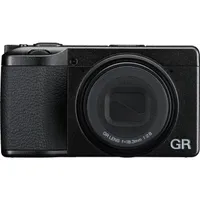
The variants of the Ricoh GR IV are near mirror images of each other – which means the GR IV HDF has the same iconic compact size of the original GR IV. The camera weighs just 9.2 oz / 262g with a battery and microSD card installed.
Despite housing an APS-C sensor that’s more often found in mirrorless cameras than compact cameras, the GR IV HDF is a pocketable camera; it is just 1.3 inches / 32.7mm deep – the only measurement that’s not smaller than the dimensions of my iPhone 15 Pro.

While the camera looks like a basic point-and-shoot, it still has a hot shoe slot, a dial housing manual and auto modes, and two wheels for adjusting exposure settings. The grip is fairly shallow, but it’s more comfortable to hold than my smartphone.
At the back of the camera, controls for exposure compensation sit right at my thumb. The HDF filter is turned on and off with a quick press of the Fn button, plus the menu arrows double as shortcuts for things like ISO and macro mode.

The reason I love the built-in HDF? The camera only supports filters with an adapter, which makes the camera less pocketable. With the GR IV HDF, a diffusion filter is there right with the press of a button.
Ricoh was able to cram a good amount of features into such a small camera. I did miss having a viewfinder at times, and I always find the microSD card format a bit of an annoyance. But I think those sacrifices are largely worthwhile to put such a big sensor (and bright lens) into something that looks more like a basic point-and-shoot than a mirrorless camera.

The GR IV HDF isn’t cheap, though, and the build isn’t that of a budget point-and-shoot. The camera’s body feels metallic, and there’s a subtle pebbled texture to the grip. One minor gripe? Weather-sealing was also left out for the sake of size, so while the camera is small enough to go anywhere, it’s not built to go out into rain, snow, or dusty/sandy conditions.
Ricoh GR IV HDF: Performance

The Ricoh GR IV HDF isn’t a jack-of-all-trades sort of camera. It’s built to be a compact camera with a big sensor for street photography, documentary photography, and travel. The GR IV HDF isn’t a sports camera or action camera – and neither were its predecessors. It snaps photos as fast as 4 fps, which feels a bit like the camera speeds of 15 years ago. That’s not news for fans of the Ricoh GR series, however, as the compact camera was never really built for speed.
But, I did find a noticeable improvement in the GR IV HDF’s autofocus performance compared to the GR III HDF. The camera seemed to lock on a bit faster than the earlier model and had fewer misses. In low light and in macro mode, the focus noticeably lags a bit more. Still, even at a walking pace, the camera tends to drop focus with subjects moving towards the camera.

Like the original GR IV, the Snap Focus is a helpful mode that simplifies the longstanding practice of zone focusing. Using this mode, you tap the screen to focus on a distance, and the focus is then locked in at that distance. On the side of the screen, a green marker will show the range of distances that are in focus, based on your focus point and aperture settings.
Upgraded stabilization also gives the camera a nice boost, both in low light and to create some motion blur without a tripod.

With the same lens and sensor as the original GR IV, image quality is identical between the two cameras, with one exception: The built-in HDF, or highlight diffusion filter. Diffusion filters are one of my favorite tools for getting a film-like look – it spreads the light out into softer “blooms” of light and softens the modern camera's sharpness just a bit. The original GR IV has a built-in ND filter instead, useful for darkening long exposures, which the GR IV HDF lacks.


The Ricoh GR IV doesn’t have traditional filter threads as a compact camera, so the ability to get the softer look at the press of a button is a fantastic tool to have. With the filter activated, images are a little less sharp and light sources spread out much further.
This creates a more film-like look – which I was particularly fond of when I swapped the camera’s color profile to “positive film” which offers warmer, richer colors than the more neutral standard profile. I really loved the colors in this setting; it’s a color profile that I feel didn’t really need to be adjusted much in post and was ready-to-go right as JPEGs.

Otherwise, image quality performance is on par with the original GR IV. With a built-in lens tailored specifically for that sensor, sharpness is excellent, even at the widest aperture and towards the corners. If that’s too sharp, the HDF filter is there for a softer look.
The wider lens is excellent for street photography and landscape captures, though I spotted some of that classic wide-angle distortion when trying the camera at more classic portraits. There’s still some background separation – not the kind that you’d find with a longer focal length, but an impressive bit of pop for a pocketable camera.

High ISO performance is solid, thanks to the APS-C sensor and conservative resolution. Shots at ISO 64000 are still plenty usable, and while noise is noticeable, I wouldn’t call the photos that I shot at ISO 12800 throwaways either. It’s worth noting that the GR IV Monochrome does outperform the HDF in noise at both low and high ISOs, with very fine grain ISO, but that’s at the cost of sacrificing all color.
DNG files are highly flexible. I was able to recover quite a bit of shadow detail in this shot that I exposed for the sky, but left the silos too dark.

Unedited JPEG
Image credit: Future

Edited DNG
Image credit: Future
The GR IV HDF isn’t really much of a video camera – it’s there at Full HD, but without autofocus tracking or manual controls, it’s not a highlight for the GR series in general.


Ricoh GR IV HDF: Verdict
The Ricoh GR IV HDF is the more film-like camera in the series, thanks to its built-in diffusion filter that creates soft blooms of light – paired with the positive film color profile, and I didn’t even want to retouch the images in post. The GR IV HDF continues everything that we loved about the GR IV, but adds that diffusion filter for a softer look and blooms of light.
Like the original, it’s important to understand what the GR IV HDF is and is not before considering a purchase. It’s not an action camera, nor is it a camera that can shoot every genre with ease.
But the compact design and capable sensor make it an excellent camera for documentary-style images, street photography, and travel. Images are sharp, noise is well-controlled, and there’s some lovely background separation considering this is a compact camera with a wide-angle lens.
The final question is whether or not to go with the original Ricoh GR IV or the HDF. If you’re a pixel peeper and crave super sharp images, you can save yourself a little cash by opting for the original. But if you love the softer, more film-like look, then the price difference is worth it – the cost difference is around the cost of a high-end diffusion filter, only you don’t need to remember to pack it.
Ricoh GR IV HDF: Alternatives